31 December, 2008

2005 Lincang "Gushu Chawang"

While investigating the garden of our new place (something I've not had much opportunity to do), I found the following, growing up against a greenhouse:


Frosty Ouseley


It's a little baby fig tree, trying to grow through the brutality of a cold winter. What a sweet little thing it is, and presumably doomed to failure until the warmer months.

Another of my fond discoveries is the Lincang Gucha [ancient tea] company - you may remember the 2005 "Gushu Zhenpin" [ancient-tea treasured-product] that I so enjoyed before (pictured below, with its sister).

Technically, I suppose that this is Nada's discovery (thanks again!), but who's counting...

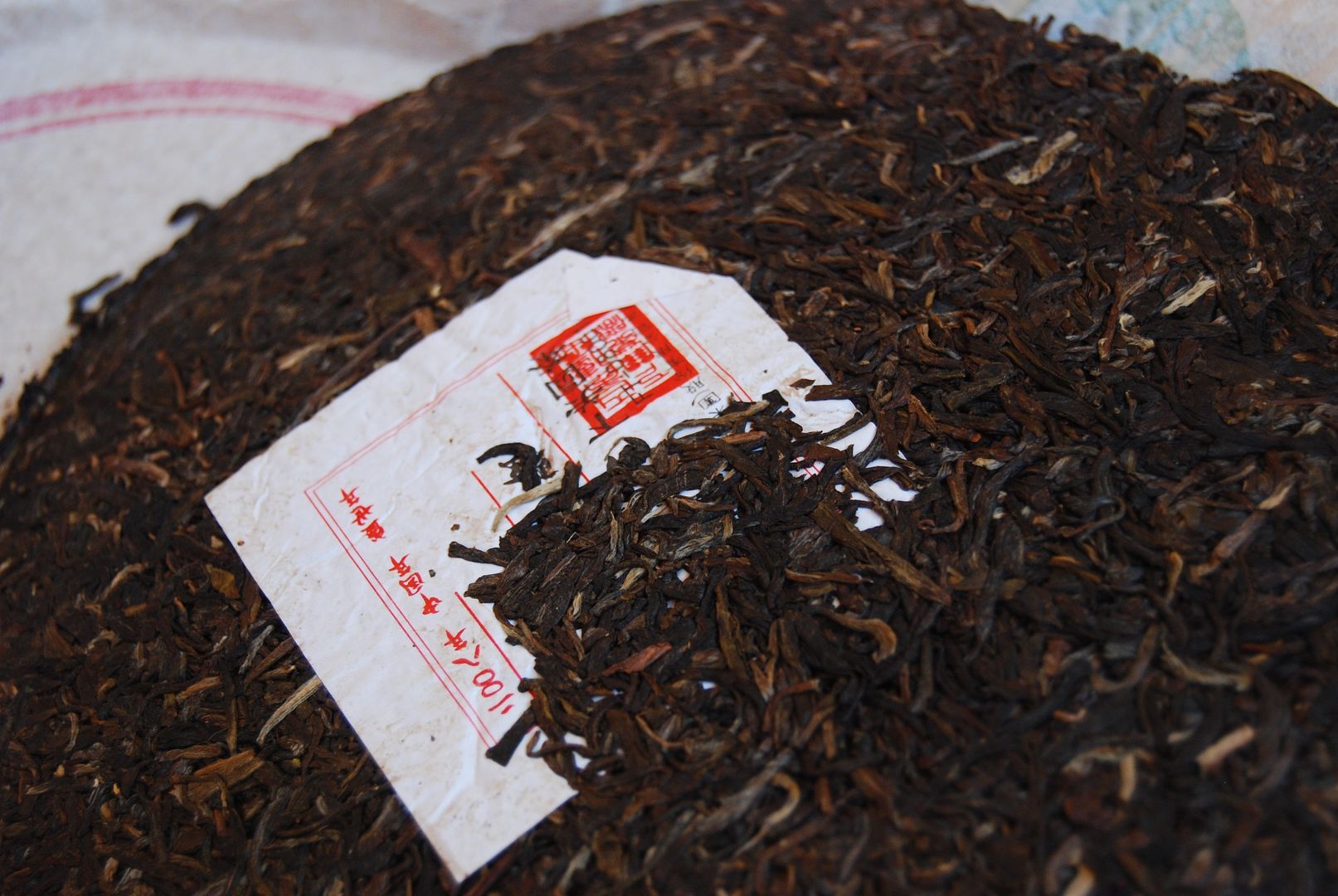
(It's nice to see, below, that I'm not the only person who has problems with pinyin: "Lin Chang".)


2005 Lincang "Gushu Chawang"


The leaves for this cake come from the rather amusingly-entitled "Bangdong Village" - amusing, that is, if your sense of humour hasn't changed much since primary school (of which I am wholeheartedly guilty). This cake came from Yunnan Sourcing, where the price is independently reporteded as being very close to the actual Kunming price - perhaps achieved by buying in bulk. Either way, that's fine by me...

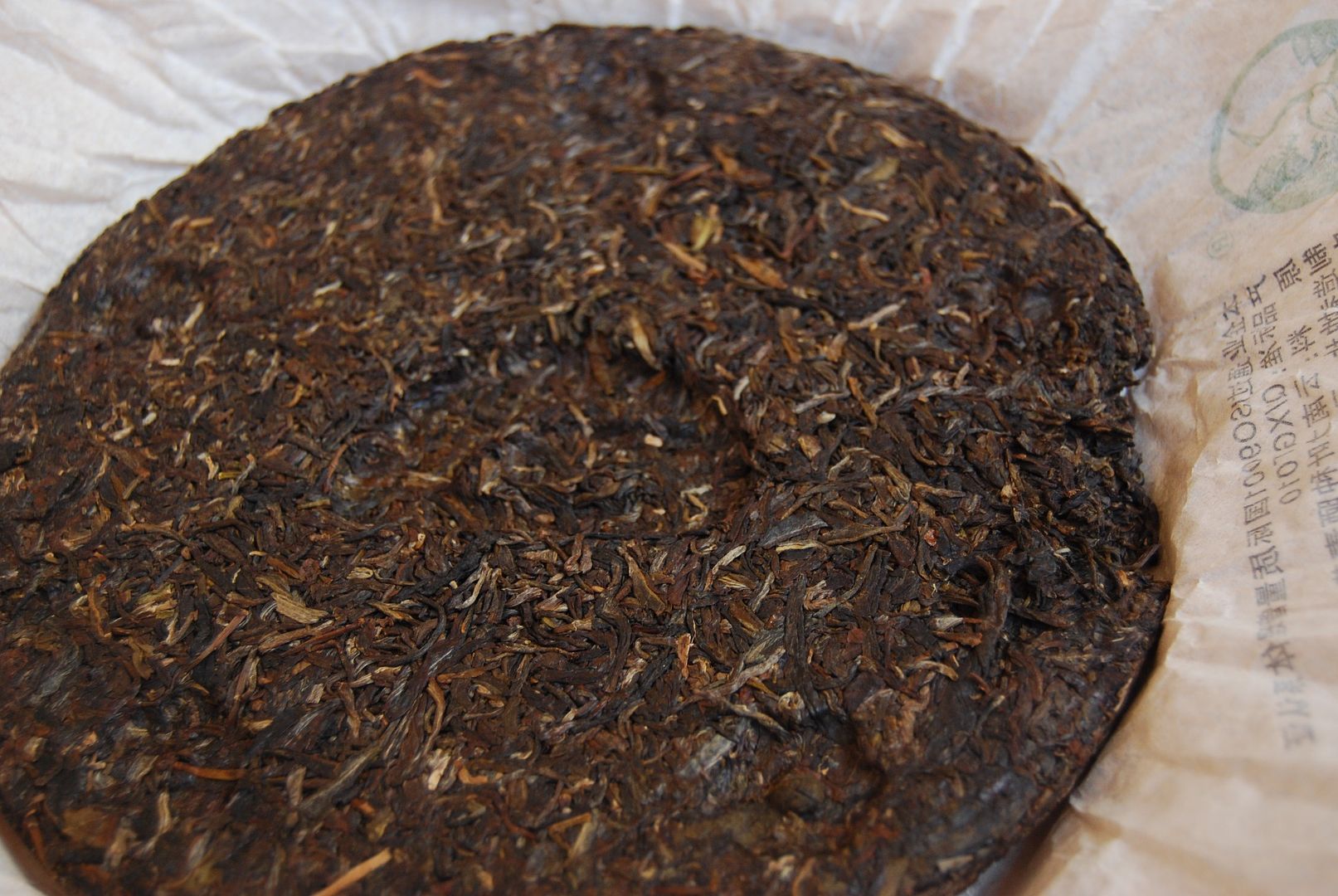
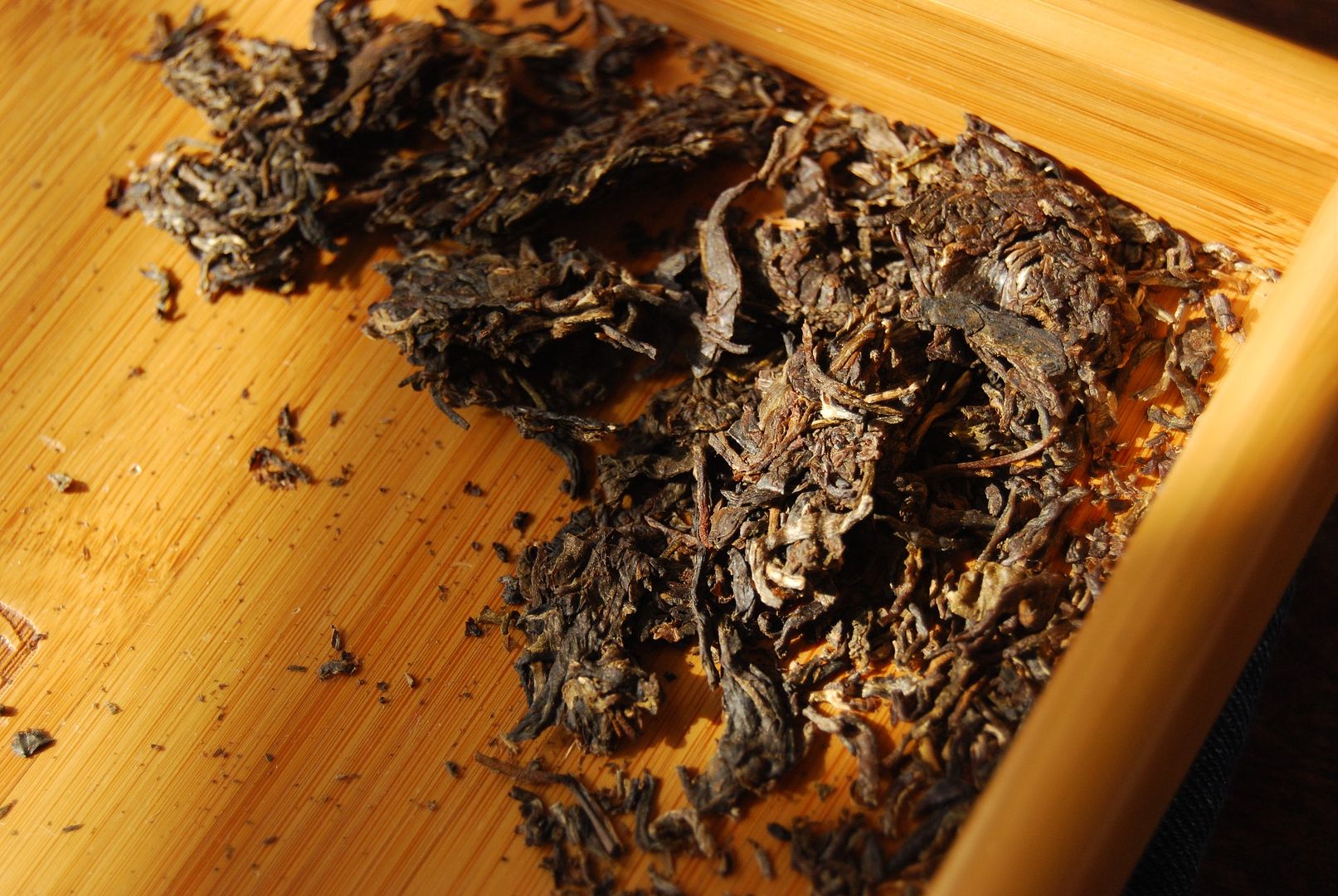
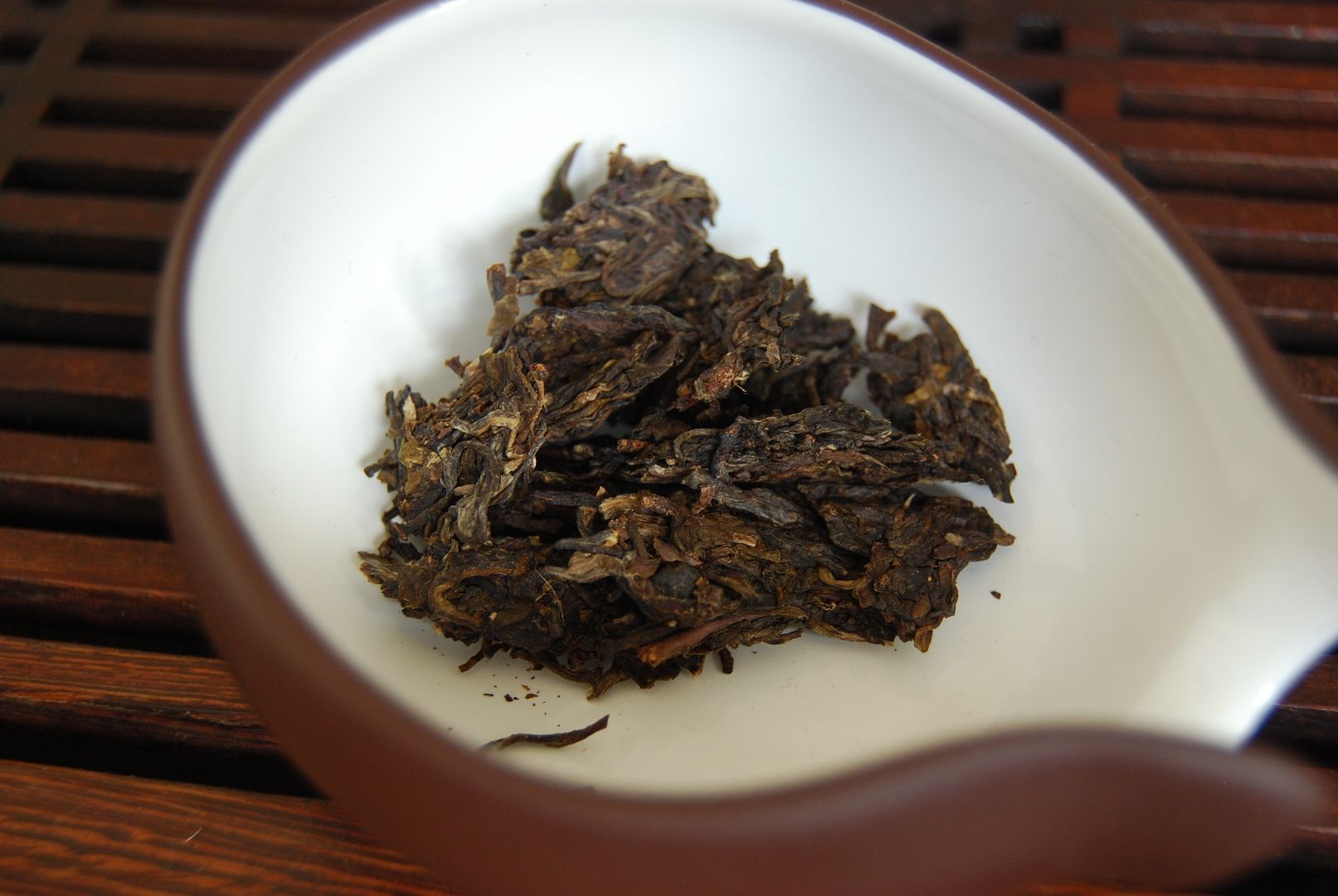
Shown below, the big and dark leaves, which are somewhat fragmented, but which carry a high and quite sharp aroma - there's something of sweet leather about it. Some of the leaves have a vague red tinge which raises eyebrows.


2005 Lincang "Gushu Chawang"


Garden-like candy in the wenxiangbei [aroma cup] makes me immediately pleased with this spritely offering, which has good endurance. The soup is shaded towards orange (pictured below), which I suspect is not entirely due to its three years of aging.

The flavour has the predicted tinge of hongcha maltiness to it, but it has plenty of sweetness atop, and plenty of tobacco below, and it all works rather well together.


2005 Lincang "Gushu Chawang"


What a vigourous little number this is, with plentiful chaqi and cooling sensations to be had.

To sum up this energetic cake, I would classify it as "candy and hongcha", which is a unexpectedly appealing combination.

In later infusions, the sweetness of the unprocessed leaves dims in comparison to the oxidised, processed leaves, and the "red" hongcha nature takes more of a role near the end. All in all, a good tea - if you're ready to tackle the processing.

And with that, a toast to 2008 - and many good teas in 2009! See you there.

28 December, 2008

2008 Shuangjiang Mengku "Bingdao"

Ah, festivals. I trust you've had a good one, if you celebrate Christmas. Vacations can be deferred during busy times, but there's nothing like the immediacy of a non-negotiable festival to tear you away from your daily concerns. Park the thesis, close up the log-books, power down the computers, and warm up the mulled wine...


Frosty Ouseley


Over Christmas at home, I was drinking a delicious Darjeeling, hand-picked and generously supplied by JC. I was surprised by the rich, dark fruitiness similar to Oriental Beauty (Dongfang Meiren, or Baihao). Relaxing back in the lounge of the house in which I grew up, drinking tea from a distant friend, sharing some with my mother - great stuff.

Now, a swift journey and we're back in our home city.


Balcony of Roses


What better way to get back into the swing of things than with a random tea, plucked from my wee collection of samples?

The vendor pages claim that this tea is made from Bingdao leaves, but at the $24 price, I suspect they're not going to be too far from the plantations. They do look decent enough, though, as you can see for yourself in the image below. Small, dark, and a touch fragmented, they have a cold, metallic, icy aroma - appropriately enough, given their name [ice island].


2008 Mengku "Bingdao"


This is quite orthodox: sweetness in the wenxiangbei [aroma cup], a fine yellow brew, and a little thickness of texture.

"Not bad, but simple", sayeth my dear wife, which rather sums it up. There is no obvious mintiness here (bingdao!).


2008 Mengku "Bingdao"


This excessive mediocrity of this tea is impressive: no matter how I brew it, how the water is changed, no matter which leaves are used, it remains irretrievably average. A refreshing session, but I was hoping for something just a little bit more interesting.

Too sour, too simple, too average.

May the good Lord deliver us from average tea in 2009, amen.

23 December, 2008

1980s Nanjian Tuocha

It's Christmas time for sure, but I wasn't expecting such generous gifts as were recently given by ST, including (pictured below) a Nanjian tuocha from the 1980s. What better way to get into the festive spirit than with some delightful tea given by a friend?


1980s Nanjian


Prior to 1998, Nanjian made tuocha since their founding in 1983, sited not a million miles away from that mightiest of tuocha manufacturers, Xiaguan.

ST notes that this tuocha is a mixture of shengpu and shupu. He has owned it for nearly ten years, which makes it real treasure among teas...


1980s Nanjian


Shown above and below, the copper-coloured tips mixed with fragments of small leaves remind me of shupu, and the aroma is a distant, gentle woodiness. ST has stored it well, and the compression is relaxing a little as it begins to breathe.


1980s Nanjian


Following ST's suggestion, I use fewer leaves than I would otherwise, and brew it gently.


1980s Nanjian


Greeted with a rich, red soup, the aroma is surprising: while it has the smooth cedarwood nature of well-matured shupu, there is an undercurrent of direct sweetness, which explodes in the lengxiang [cool-scent, the aroma in the aroma cup as the cup cools] giving a strong caramel character. This must be the shengpu speaking. That lengxiang endures, giving me confidence that the leaves have not been aged into nothingness (as so often occurs with some old maocha), but rather that they retain their vigour.


1980s Nanjian


The soup itself is a creamy, cedarwood affair, with the particulate nature I associate with shupu. As with some of those fine old shupu bing that we rescued from my wife's home-town, this is extraordinarily smooth, like thin silk.

The shengpu wraps itself around the consistent shupu core to provide some depth and challenge, swelling in the throat to a crescendo of sweetness and mouth-watering vanilla. It's quite a work-out.


1980s Nanjian


My eyes are opened, and the cold, wintery morning suddenly seems excessively bright. I drink this into mid-morning, then pack the weary leaves into a container to take to my office, where they undergo some hour-long infusions to coax out any remaining flavour and chaqi.

Well, then, time to depart for "The Other Place" (Cambridge) for a family Christmas. Special thanks to ST for such a charming gift, and my best wishes to all readers for the coming Christmas period. Make it a good one.

21 December, 2008

2008 Shuangjiang Mengku - Muyechun "Laoshu Qingbing"

One more for the Muyechun book, the first of their 2008 teas that I've tried. It's so cold, this had better not be one of those "cooling sensation" numbers...


Frosty Ouseley


This tea is highly inexpensive. I do wonder if Shuangjiang Mengku could do with putting out the odd "premium" cake, but this laoshu-style [old tree] cake is about all they do. You will remember the 001 and 002 from last year, and both ST and Yunnan Sourcing have referred to a mysterious "003" production that I have not yet seen.

Below, the now-familiar pretty branch that signifies the Muyechun output.


2008 Mengku Muyechun Laoshu


Leaves for this tea came from the first flush of 2008, from the Yongde region in which the Muyechun factory is situated, with a "high percentage" of laoshu leaves.


2008 Mengku Muyechun Laoshu


Curiously, the accompanying ticket invites us to steam it apart:

"Shell the tea biscuit first,
steam and knead it in a loose state ready for use."

I won't be doing that, but it's an interesting idea. Given the loose compression, it doesn't seem entirely necessary. Shown above, a chubby 400g bing with large leaves of all colours. The aroms is quiet, but is sweet and pleasant - green, candied, with a little spiciness. Reticent, you might say, if feeling kind. Underpowered, if feeling less charitable.


2008 Mengku Muyechun Laoshu


Zounds and gadzooks.

This is a sweet one. I shouldn't be surprised, given the ludicrously sweet 2007 teas from the same producer, but it is quite something. The aroma in the wenxiangbei is white sugar, then, instantaneously, sugary darkness - as if a switch had been thrown. It is a highly acrobatic aroma.

While "low" in the pitch of its flavour, it is reasonably smooth. The first infusions are understated in texture, flavour, and huigan, but this develops satisfactorily by the third brewing.

Creamy and sweet, in correspondence with its tippiness, I rather like it.


2008 Mengku Muyechun Laoshu


Unlike the vapidity of, for example, dancong, this is a conversation with an amiable sort with a good sense of humour. It keeps me entertained, and isn't something from which I'd require too much.

Perhaps, if I were looking for stable tea for immediate consumption, I might buy more of this. However, while pleasant, it doesn't thrill me with possibilities for the future, and I am fortunate to have more than enough tea for immediate drinking. One cake is definitely enough.

19 December, 2008

2008 Puerh Shop - Meiguohao "0801"

More winter chills settle on the garden. By the standards of some readers' environments, I'm sure the English winter is tame - but for us, it's brutal.


Frosty Ouseley


Let's get cosy with Puerh Shop's "Meiguohao". I am unashamedly biased: I love home-made (or hand-selected) cakes. I loved the 2007 Daxuashan from Maison des Trois Thes, I loved the 2008 Nadachayuan "Chachanyiwei". I even have a soft spot for those silly commemorative cakes, made as special-runs from the large producers. Home-made is great.

The vendor description reads, "These are our finest pu-erh teas, definitely the premium class reserved for collectors and true tea drinkers." I admire Puerh Shop's humility!


2008 Meiguohao


"What's in a name? That which we call a rose
By any other name would smell as sweet.
"

It's tempting to think so. However, the name "Meiguohao" [America Brand] sticks in the gullet like a painful fishbone.

There is something uniquely unpleasant to me about products named with some sort of phoney nationalism. I'm sure this is a character flaw on my part. I walk the aisles of Chinese shops and see product after product with the stars-and-stripes on, or sometimes the British flag, or even the German flag, and it makes me sad. For the English, the act of naming something after the nation, or even putting an image of our flag on a product is rather uncomfortable. It's approximately as bad as naming tea after a banking plaza, or calling it (you guessed it) "scholar tea". Gnnhhhggnnng.

That's all I'm saying.


2008 Meiguohao


However, 'tis the season to be jolly. Forgive and forget, that sort of thing. I wonder if that bias induced by the tea's name balances out my bias towards hand-made cakes?

The compression, shown further up, is very loose, and the leaves look sumptuous. Lots of silver fur is to be seen, and the Mansa leaves are well-handled, large, and mostly whole.

If the first bite is taken with the eye (see ranting above), the second bite is taken with the nose, and it is infinitely more palatable. Quiet, but sweet.


2008 Meiguohao


Into the mouth, and the magic is dispelled: the cloudy brew is thin, has the character of chunky mushrooms, and is devoid of any huigan.

By the third infusion, the single tone of mushroom has left me bored, and I am looking out through the window planning my day. This is good, fresh maocha, but that's really all it is: maocha, squished into a cake. For monochrome leaves such as this, with no complexity to be found, the tea has to be blended in order to give it some character. This experience is absolutely akin to drinking 1-dimensional maocha.

So, I started excited at the prospect of hand-made tea, became sad when looking at a packet that sports a badly-printed image of the stars-and-stripes, became happy again at the sight of the leaves, but, ultimately, became bored by a simple mushroom tea.

I read that there's a new version available at Puerh Shop, which I look forward to trying. Unfortunately, it's still called Meiguohao, but a man can't have his cake and eat it...


Gnnngnngh

17 December, 2008

2007 Shuangjiang Mengku - Muyechun "002"

Winter is here already, and it feels as if I didn't even get a proper opportunity to say goodbye to autumn. The seasons are whizzing past, mostly unmarked, as I have my head buried deeply in my work. I'm looking forward to the light at the end of the tunnel, in the New Year.


Frosty Ouseley


To see off these wintery mornings, I reach for a cheering, friendly tea: the 002 from Shuangjiang Mengku's Muyechun label, the exclusive output of their Yongde sub-department that was set up last year. Readers with good memories might recall my pleasure at encountering the simple, sweet joys of the 2007 Muyechun 001.

ST once wrote that these teas were "a hot favourite among the ladies in Singapore"! I always think of that phrase when I encounter Muyechun teas...


2007 Shuangjiang Mengku - Muyechun 002


As pictured below, this cake has fewer tips than its 001 sister, but consists of small, springtime growth. The aroma is reserved, but what there is to be found is gently sweet, and candy-like.

In the wenxiangbei [aroma cup], the candy note continues in a simple, but pleasant, sugary scent. The duration of the aroma is very decent, and I hope that this continues...


2007 Shuangjiang Mengku - Muyechun 002


(Colour balance agony, above.)

More simple, candy-sweet charms in the mouth, yet mixed with a lower, "brown" characteristic, that I associate with plantation leaves - that ever-so-slightly ragged roughness that sometimes accompanies young leaves. The lower flavours of larger leaves continue with some notes of root-crop flavours.

Oddly enough, this tea is noticeably cooling in its sensation - as if I had just eaten a mint. Fresh! I wasn't expecting such good leaves to have been used in a fun-while-it-lasts cake, and am pleasantly surprised.


2007 Shuangjiang Mengku - Muyechun 002


The chaqi of this cake is very good: it lifts me up and brightens me, but at the same time soothes and calms me. I can see why tea was a hit with Chan monks.


2007 Shuangjiang Mengku - Muyechun 002


Simple, sweet, with some broad, lower notes, this tea is lifted above the herd by its pronounced cooling sensation and excellent chaqi. The huigan is more of the candied sweetness. For not much investment (~£8), this is a friendly, amiable affair.

I often liken my tea sessions to conversations. This one is a young girl with some education - a pleasure to talk with, and enjoyably light.

15 December, 2008

2008 Xiaguan - FT "Duling Fengsao"

I wrote previously about a resurgent Xiaguan, and this is a good example from their now-excellent FT (Feitai) brand. I suspect FT now has less to do with making gangsters in Taiwan happy, and more to do with demonstrating the Xiaguan premier teas.


2008 Xiaguan FT Duling Fengsao


"Duling fengsao" is "alone-leading literary elegance", which does have overtones of the dreaded "scholar tea".

Gnngrnngh.


2008 Xiaguan FT Duling Fengsao


The bing is iron-compressed. This being Xiaguan, I was expecting the compression on their tiebing to be exceedingly brutal, but, while it is thin (see below), it is quite easily separated.


2008 Xiaguan FT Duling Fengsao


If you are, like me, a fan of Baoyan bricks, then this tea is The One For You. It is based on the Baoyan recipe, but uses good-quality leaves. If there is anything to be said against the charm of the lovely Baoyan brick, it is that they're a bit rough - though the ruggedness is undoubtedly part of their charm.

The leaves give the game away: dark and sweet, they have the precise aroma of Baoyan leaves. This makes me happy.


2008 Xiaguan FT Duling Fengsao


Since moving into our new house, a cat from the neighbourhood appears to have adopted Lei and I as new servants. He waits for me when I return in the evening, and watches me put away my bicycle, while mewing loudly, then sits by the door ahead of me with an expectant look on his face.

Pictured below, His Royal Fatness perched on a makeshift bed that we have set up for him, consisting of a pink rug on a chair. He likes to watch me drink tea, and purrs for hours on end. We have named him "Heidu" [black belly], or, on occasion, "fatman" or "your chunkiness". His rug/chair arrangement has been dubbed "The Palais de Fat".


2008 Xiaguan FT Duling Fengsao


The soup is, just like Baoyan, yellow-orange. Just like Baoyan, it is a dark and flavoursome brew - and yet, against all the odds, it appears quite well-named: it is elegant, being gradual and charming. With all the flavour and character of Baoyan, it delivers it slowly and gracefully - rather than the brusque rollercoaster of the Tibetan bricks.


2008 Xiaguan FT Duling Fengsao


I love it. The Baoyan darkness is balanced against a fine ku in the finish, and it has plenty to reveal. It pays to be restrained in the quantity of leaves used for brewing.

Top stuff - thumbs up, Xiaguan.

13 December, 2008

2006 Hailanghao "Lao Banzhang"

Oh, Hailanghao, how do I love thee.

Let me count the ways.


I've been drinking this sample generously provided by AL since May, and it has been making me repeatedly happy. I believe that it has long since disappeared from the vendors, so I have been enjoying it slowly.

Luxuriously long leaves, mixed with plump silver tips - the entire affair is furry. It looks like some kind of pet, rather than a beverage.


Banzhang aroma aplenty in the dry leaves, that familiar sweet leather that I love so much. The soup opens with an honest yellow, though it oxidises quickly, as pictured above. The aroma is thick and sweet, sweet, sweet, continuing for whole minutes. Marvellous stuff.


Mushroom and wild grass, just like clean, unprocessed maocha, but with some bite. That sweetness, eternal and strong, hangs in the finish. After just one small cup, I am awake, my mouth watering, my body warm.

There is acidity, but of the appealing variety that adds to the complexity in the throat, emphasising and augmenting the huigan. Just the thing for a cold, blue day.

What was I thinking to let this one slip past unnoticed?

(Detailed notes from AL on Chadao.)


Headington Hill

11 December, 2008

2003 Kunming Tailian "Jingmai"

Here's a fun one. I do so enjoy exploring the outer reaches of the pu'ersphere.


The wrapper, shown above, has "Yiban Xinxiang" [one segment, heart-scent], which Lei dismisses as "vulgar teenager-language". A vulgar, cloyingly-sentimental pu'er wrapper, who would have thought...


What else do we know about this mysterious tea? The Kunming Tailian factory literally means "Taiwan ally", which gives us some indication of the factory's purpose. This is fine by me, as I enjoy Taiwanese pu'er as much as any other. Just don't mention "scholar tea" around me and I'll be fine.

*Grinds teeth*.


The factory has since become part of the modern Yibang Chamasi company, that tea producer trading off the reputation of Dynastic pu'er administration centres, but nonetheless the creator of some fun little teas.

The leaves are long, and all manner of colour from silver tips, through green and brown basis leaves, to the inclusion of some yellow leaves (normally removed by producers, but always welcome in my cakes).

The low, sour aroma about the leaves is unusual, a touch of the Jingmai nuttiness about it.


In the wenxiangbei [aroma cup], the "honey" aroma lasts seemingly forever. "Honey" being my shorthand for rugged sweetness combined with a base of broad, lower notes providing the complex sweetness of wild honey.

While I consider the tea, it turns from its initial solid yellow to a deeper orange with surprising rapidity - it is active in contact with the air.


Crikey, it's a thick tea. Thick with copious viscosity. The complexity of the aroma is carried over into the mouth, and this is a chunky, good tea. Entwined with the honey is a challenging, throaty bitterness of the enjoyable variety. Beneath it all, a bedrock of hazelnut flavours that reveal its Jingmai origins.


This tea is as blended in its character as it is in its leaves: some candy, some bitterness, lots of low nuttiness. It all works together, though, and does not give the impression of patchwork. It is a good blend, which is hard to achieve. There's even some tobacco in there, to keep me happy.

A charming tea, I like it very much.

(Cf. Ancient Tea Horse Road.)


Headington Hill

09 December, 2008

1996 Menghai - Dayi

Changing gear on the Menghai front, this 1996 example produced for their Dayi brand comes from Skip4Tea.


This is a mid-to-late 90s cake, and so 1996 is believable. The silver tips (shown above and below) have turned a bright copper, while the basis leaves have become rusty. The compression is relaxing a little, especially around the edges, in line with its supposed age.


The aroma of the dry leaves is noticeable shicang [wet store-house], but in the distant manner that suggests it has been stored in drier conditions in more recent years. I love a bit of shicang, it has to be said, and I don't have very much of it to choose from on my shelves.


The soup moves from deep orange to rich red as the leaves open, with that welcoming aroma of almonds and shicang. It's quite a tea to behold.

Surprisingly energetic in the mouth, it causes instant effervescence on the lips and tongue, followed by a strong cooling sensation. These are striking - by comparison, the flavour takes a back seat. However, the flavour is pleasant: good, old honey.

From two small cups, I have flushed skin and bright eyes. Just recently, I read that historical health claims for pu'er included "improved eyesight", and it is interesting (though perhaps coincidental) that I observed a tangible, sharpening effect when drinking this.


Even from the first infusion, it is thick, and adheres to the roof of the mouth. "The coolness is obvious on my tongue, even if I do not draw air into my mouth!" notes Lei. The whole gamut of sensations ends up nicely in the throat, and dwells there for some time.

Menghai made good tea in 1996.

Is it worth over £200? You decide...


ABC Woods

Say goodbye to autumn...