05 May, 2007

2005 Dahongpao Zhengyan, 2005 Laocong Shuixian Zhengyan

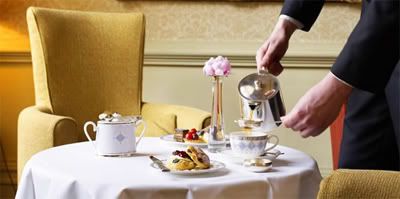
Today, afternoon tea at the Randolph Hotel. This city doesn't have a huge number of great hotels, but the Randolph is a decent place that doesn't shout about itself. That level of discretion (and extreme heating) makes it popular with its usual clientele of lecturers, chaplains, and postgrads. It's rather popular with American visitors, too - at least half of population of the tea lounge is North American in origin at any one time, almost without fail. They came for the architecture, they stayed for the scones.


While not likely to find anything more adventurous than a somewhat greener Darjeeling, they do serve a very pleasant Lapsang Souchong [Zhengshan Xiaozhong], which is a good grade of leaf, lightly smoked with pine. It makes a refreshing change to the smoke-stack lapsang tea that is usually on offer in England. Today, we found out that this rather enjoyable leaf comes from Twinings, of all places - who knew that they could actually produce decent tea?
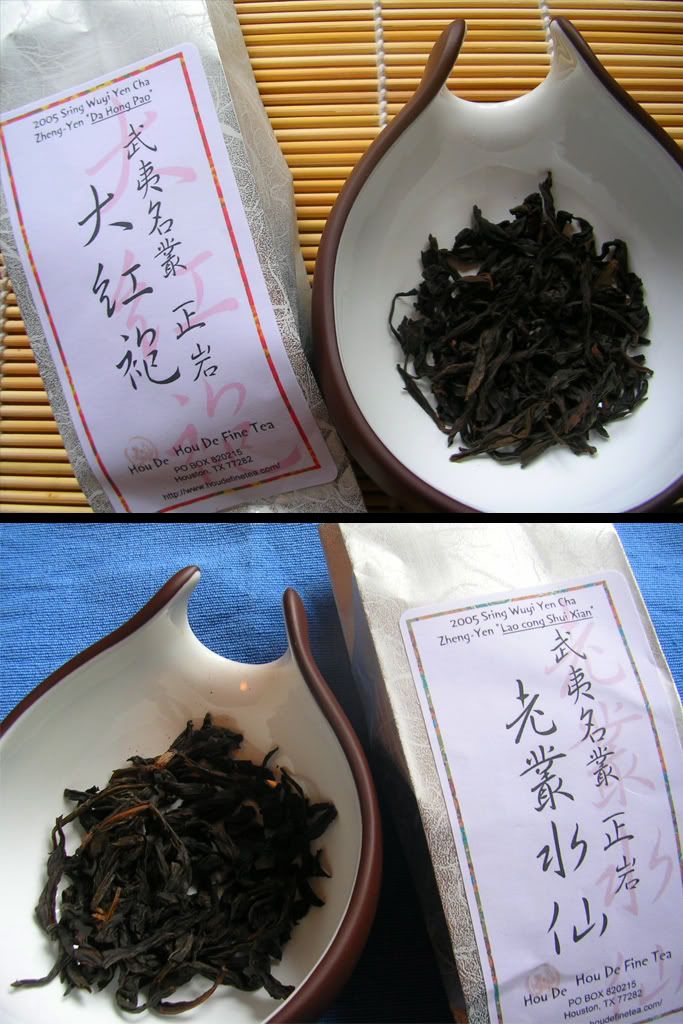
Moving swiftly on, we cover the remaining two of the Sidamingcong [Four Great Famous Bush] yancha from Houde: the Dahongpao [Big Red Robe], and Laocong Shuixian [Old-bush Water-Sprite/Narcissus-Flower]. As before, both are designated "zhengyan", claimed to be from the central Wuyi area. As always, we'll take this under advisement and let our tastebuds make the decisions. Note that these are 2005 teas, whereas the previous pair were 2004.

In the following, the Daohongpao and Shuixian will be A and B, respectively, and appear in upper and lower in photographs, respectively.

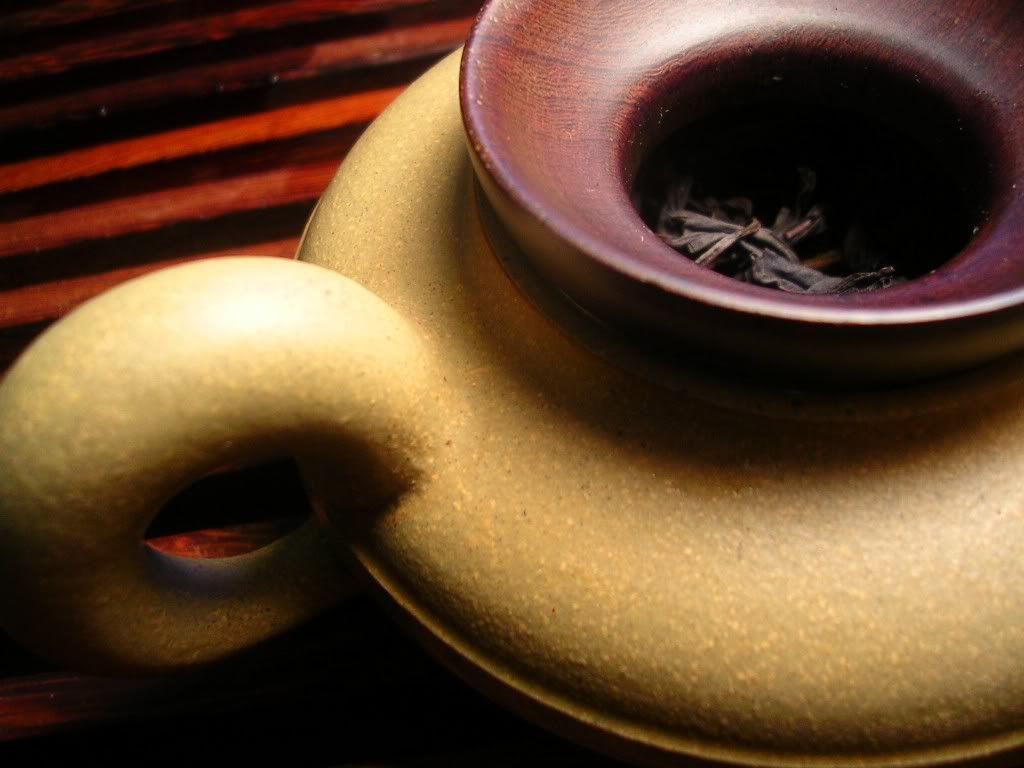
12cl nongxiang pot; Caledonian Springs @ 90C; 2 scoops; 1 rinse.

Dry leaves:
A:
Large 3-4cm twisted strips, all thoroughly roasted and suitably dark. "Very decent." A highly edible roast aroma!

B:
Similar to A, again with no small fragments - just plenty of long, twisted segments. A stable but rather quiet creamy, roast aroma.
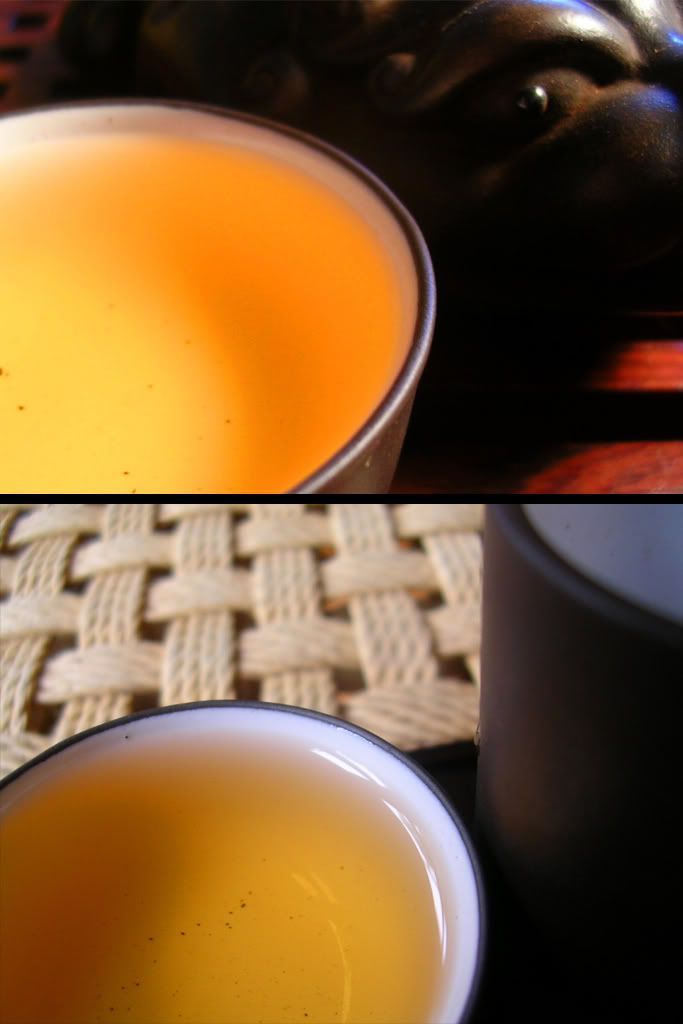
15s, 15s, 20s, 25s, 40s, 60s:
A:
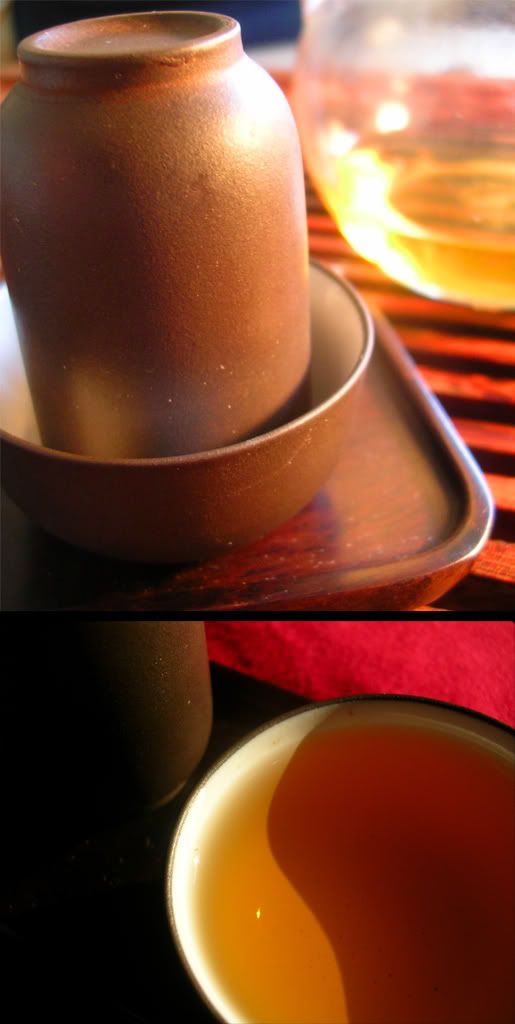
Orange soup with a green twist. A very sweet, constant aroma - very long in the wenxiangbei - that eventually becomes a muscavado sugar lengxiang. It really does hold on for a long time indeed, indicative of decent leaf endurance, we hope.

Very sour, but that's a good thing for this tea. The roast is pleasant, and wonderfully understated - as discreet as a Randolph tea-waiter. The chaqi is fine: my cold limbs are flushed with warmth.

Later infusions see separation into the sour and roast constituents, and it becomes a little "green" in the throat. The huigan is energetic, and enduring.

B:
The rich, dark scent of molasses, from beidixiang to lengxiang. Rich orange soup.

The flavours are chocolate-like, almost powdery, reminiscent of a malted bed-time beverage. "A clear and wide flavour", which I find to be broad and open. It is, again, understated in its roast, which can only be a good thing, showing the gentlest of tea-sourness. A very comforting tea - perfect for a cold day, with a Bach violin sonata.
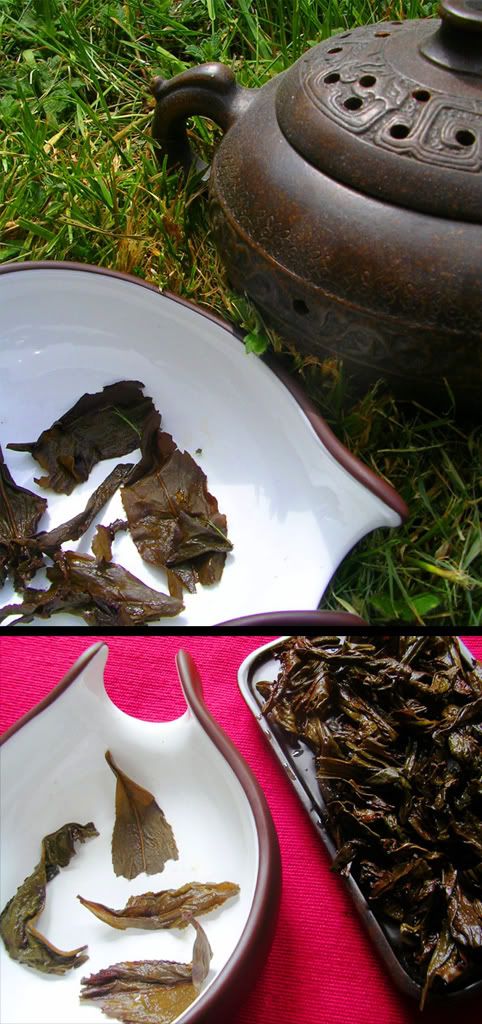
Used leaves:
A:
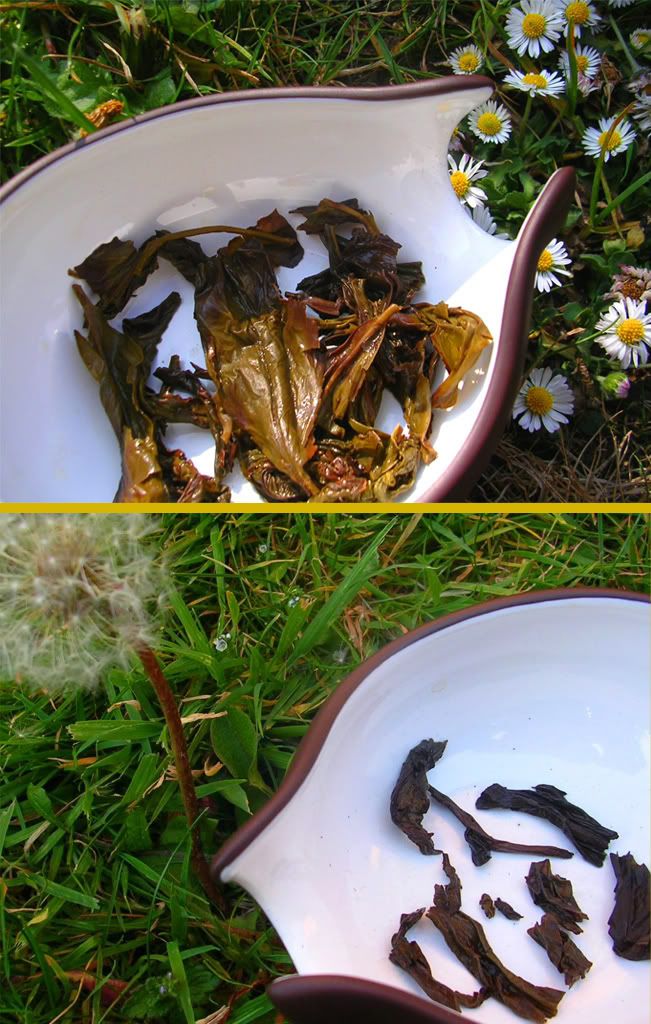
Surprisingly green. These are smaller leaves than the 2004 pair from yesterday, perhaps indicative of a better grade. The oxidation in the chahe gives a pronounced peach aroma that was not present in the tasting session.

B:
Edge-oxidised, but quite green - indicative of that restraint in the roasting. Pleasant, hand-picked leaves of a generally small size.

Overall:
A:
This dahongpao is refined and elegant. It is not complex, being a smooth and consistent combination of sweet-sour tea with a fine roast. Happily, these zhengyan teas seem to have plenty of innate flavour that does not require a pungent, overbearing roast - much like the Lapsang Souchong from the hotel, in fact. Downhill after the second infusion.

B:
Malty, granular, slow, and rich, with the long aroma of molasses. This is a dark and sticky shuixian, to pair with the dry and noble dahongpao. Like its 2005 stablemate, this tea begins to show signs of age after the second infusion. The 2004 teas from yesterday had greater endurance.

In all, the Sidamingcong offer something different in each. It was an interesting learning experience, made easier by decent leaf - from the sweet and lighter pleasures of the baijiguan, to the straight-faced nutty roast of the Tieluohan; from the noble and simple sour-roast of the dahongpao, to the sticky molasses of the shuixian. Quite the pleasure.
04 May, 2007

2004 Baijiguan Zhengyan, 2004 Tieluohan Zhengyan

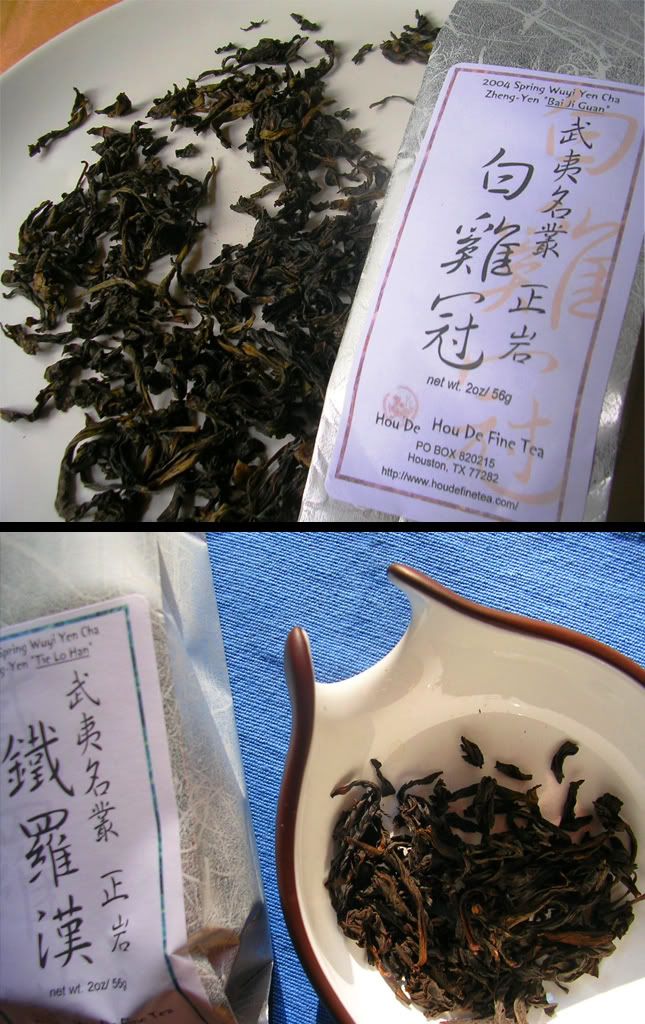
As the beautiful springtime sunshine recedes, what better time to spend huddled up indoors than with the "si da ming cong" [Four Great Famous Bushes] sample set from Hou De. I find it difficult to obtain good Wuyi yancha [rock tea], and so the prospect of tasting potentially decent examples from Hou De is an attractive one.


Today, we examine the first two of the set of four - and let's begin with the unusual two: Baijiguan [white cockscomb] and Tieluohan [iron monk]. These are particularly hard to obtain in any form, let alone of any decent quality.

All four samples in this sidamingcong set are labelled "zhengyan" [proper rock-tea], equivalent to the pu'er "zhengshan" [proper mountain], being indicative of provenance from the "true" Wuyi central district (elevation > 650m). I crave fine examples of these two unusual yancha, and look forward to the results.

In the following, Baijiguan and Tieluohan will be referred to as "A" and "B", respectively, and appear upper and lower in accompanying photographs, respectively. As always, more detail may be obtained by clicking on the images.

2 scoops in 12cl nongxiang pot; Caledonian Springs @ 90C; 1 rinse.

Dry leaves:
A:
Typical yancha twisted strips, these are loosely rolled. In the expected mass of dark browns, there are plenty of green shades to be seen. The roasting is far from homogenous - some tips are roasted at the edges only. Is this indicative of poor roasting, or an intentional part of making baijiguan?

The aroma of these leaves is captivating: wulong scents mix with a creamy butter. The roast-scent is gentle, and very smooth - it rewards attention, and a little time. Particularly with heavily-roasted leaf, I find it all-to-easy to dismiss the aroma with a cursory sniff, which would be a shame for a tea like this.

B:
Superbly dark. The only concession to the darkness is an occasional rich, chocolate colour. The leaves are 2-3cm twisted segments. The primary aroma is that of the roasting, but with an unusually potent scent of the tea itself. I find it unusual for such roasted teas to smell so heavily of tea, and I wonder if this may indicate a certain potency of leaf due to its "zhengyan" specification.

15s, 15s, 20s, 25s, 30s, 45s:
A:
Pure, golden soup - shining with the luster of gold. The entire room is filled with the sweetness of the butter-and-honey aroma. Drinking this tea is a privilege.

The beidixiang opens with spicy-green wulong, becoming that wonderful butter, which in turn cools to a caramel lengxiang. The flavour attests to its Mainland origins: a hearty wulong base, with a fine sourness around the outside. The butter and caramel from the aroma are present in the aftertaste.

"Very deep, round sweetness". Contrary to previous concerns about a potentially poor roasting, the flavour shows that it has been executed particularly well, giving a seamlessly-integrated roasted profile to the rich leaf flavours.

The huigan is the sweet-yet-spicy huigan that one might experience from cooked ginger: spicy and warm, but not discomfortingly so.

B:
The aroma is truly unique. It is... acrobatic, and will require a little careful description.

It opens with a roasted, dark-chocolate musk, which lasts for about five seconds. Then, as if the melody had suddenly shifted from the violins to a double bass, the aroma drastically and obviously changes: it becomes instantly bass, low, and nutty. I've never experienced such an exertion in the aroma, and it performs it repeatedly and consistently throughout the infusions.

This rich, low nut aroma lasts for around 30 seconds, before the lengxiang eventually arrives as a sweet-sourness. It is a highly accomplished aroma, and bears future examination.

The powerful bass aroma is also the basis of the flavour: this is broad, sincere - truly, an iron monk. "Luohan" refers to a somewhat senior rank of monk, who has gained position through commitment and sincerity (though not a high rank, such as abbot) - this tea is very well-named. It is a stocky, dark, robust tea.

Used leaves:
A:
Very green, interestingly enough for a yancha. They are quite large, and strong, with very few tips evident. I wonder if the grade of this tea is not quite the finest - though the quality of what is present is very fine, perhaps by virtue of being "zhengyan". The aroma is peach-like.

B:
Segments of large leaves, particularly dark. Similar grade to A.

Overall:
A:
Sweet, buttery, yet robust enough to be yancha. This is a fine tea, and a real treat to find. Certainly this is one for the yancha enthusiast, who will not be disappointed. Later infusions tend to polarise in flavour between the robust Mainland wulong taste and the rich roast. It does indeed feel like the grandfather of Taiwanese leaves.

B:
Zhengshan potency and refinement, with a highly skillful roasting. Quite the most acrobatic wulong aroma I have ever encountered, and fascinating it is too. The iron monk is well-named, for this is a solid and unaloof tea.

02 May, 2007

2001 Menghai "Yiwu Zhengshan"

This cake has been the darling of the tea community for a while, as initially advocated by Davelcorp Ministries and Our Man in Singapore. MarshalN recently encountered this in a cloak-and-dagger blind tasting. In fact, this tea literally arrived on my desk while I was replying to MarshalN's thread regarding the very same tea.

I liberated this from the Great Gold-Rush, a few weeks ago, from Hou De. It's a Menghai Factory "special purchase", apparently, and is designated both "Yiwu Zhengshan" [Yiwu proper-mountain] and "Yesheng" [wild]. Quite a pedigree to claim. It's time to don the proverbial gold-rimmed spectacles and cast a cynical eye over this tea: does it justify the good press?


2001 Menghai Yiwuzhengshan


Approx. 15cl Caledonian Springs @ 100C in a 35cl shengpu pot; approx. 2 scoops of leaf; 1 rinse.

Dry Leaf:
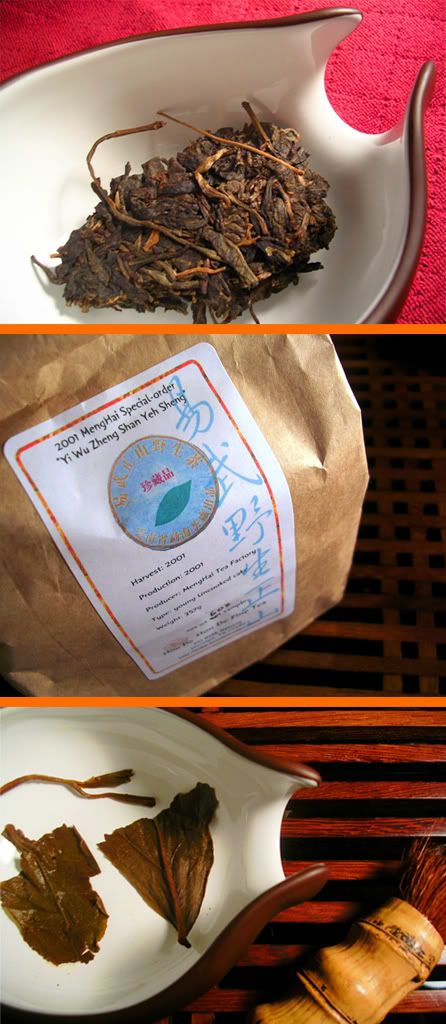
Dark-brown to mid-green, with plenty of tips that have turned golden. Decent grade of apparently whole leaves. The density of aroma is remarkable - the six years of aging have been kind to this tea. Rich fruits, tanned leather.

15s, 15s, 20s, 25s, 30s:
The first notable aspect of this tea is that it possesses both a beidixiang [initial scent] and a lengxiang [cold scent]. It opens in the wenxiangbei with tanned, sour scents which linger long, before gradually fading into a sweeter caramel lengxiang. The complexity of progression is rather unusual for a six-year tea.

The range of flavours are surprisingly broad, but consist of two main characteristics: there is a wide base of leathery, thick, uncut tobacco leaves, over which plays a sour-then-bitter Yiwu note. The latter remains in the throat, giving a decent huigan, and aftertaste.

As a young boy, my father used to take me to a traditional tobacconist in Cambridge, in which shelves filled with heavy jars of thick, uncut tobacco leaves would look down on me. Every opened jar filled the small shop with rich, earthy aromas, and this particular tea takes me back to those moments, at my father's side.

This isn't an excessively smooth tea: it has the texture of a robust 70% dark, chocolate, with that familiarly particulate, grainy sensation in the throat.

As infusions progress, the density of tobacco flavours hands over to the more enduring sweet-and-sour effect. Note that I detect no smokiness here, just the rich flavours of pure tobacco.

Used leaves:
Large half-leaf segments, with a fair amount of "filler" small segments. The majority are darker green, with no edge oxidation, perhaps indicative of careful handling, with some stem-and-tip systems indicating its hand-picked status.


2001 Menghai Yiwuzhengshan


Overall:
This is an invigorating tea, Lei likened it to the refreshing feeling after meditation. However, it's overall energy is calming - particularly so. A day of research, a train journey, a pint in a busy pub - all washed away by the feeling of this tea. I breathed more slowly, with a sense of well-being. Very positive, indeed.

The broad range of rich flavours testifies to its provenance, while the strength of the Yiwu sweet-and-sour note shows that this still has the touch of youth, despite its excellent aging. It reminded me of a precocious young man, aping his superior - his virtues make it seem likely that, one day, he will become a master himself. But not quite yet.


Addendum
11 October, 2008

Returning to this tea after a year and a half, I disagree with some of what I have written above.

The leaves are now dark, exceedingly so, and yet the potency of the tea has very much decreased. It contains a great deal of the calming chaqi noted above, but now the leather-and-tobacco flavours, while still present, are very quiet. I have to push this tea very hard, using long infusions, to get much oomph out of it. When I do so, there is no potency - it does not fight back, and seems muted, as if its volume can only be increased so much and then it saturates, flattens out.

It's good, but it's weak - and what I noted to be "careful handling" before is obviously cheeky Menghai processing, as indicated by its lack of potency and red flavours.

I love it, and all of its tobacco-like charm... but wouldn't it be nice if it were more potent? I am slightly less unhappy that I didn't manage to obtain more of this when it was on sale during the Great Houde Rush of 2007.