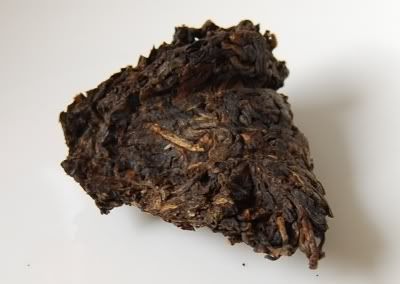
New (Chinese) Year, new hangover. We fire up the kettle and let pu'er work its restorative magic.

This is a tea from Houde, with many thanks to TA for kindly providing the sample. Ever the Pinyin pedant, I note that the packet labelled this as "Da Shui Shan" (Big Water Mountain).
It has become popular to criticise Xizihao. Though I am keen to treat each sample with an unbiased hand, I can understand why such criticism exists. Xizihao is turning into the Calvin Klein of tea. The public wants a quality brand in which they can trust, and, several years ago, Xizihao was satisfactory.
It is my opinion that the popularity of this brand has caused it to bow to market forces, resulting in teas like this Daxueshan [Big Snow Mountain] maocha. The price increases year by year, the product names become more exaggerated (we recently had a Tea Emperor, rather than a "Tea King", and a Desolate Forest, rather than a "Wild Tree"), product descriptions become more stretched and loaded with hyperbole, and the quality of tea inevitably decreases.

This is a pretty maocha, but dark for less than one year old. In its favour, this is clearly a leaf of good breeding: it has an effervescent energy on the tongue, a mouth-watering huigan, and a decently thick texture.
Unfortunately, that's where the fun ends: the flavour and aroma are simple, being light grass and little more. There is absolutely no aroma in the wenxiangbei.
I pushed this tea, using longer infusion times and large quantities of leaves, in order to coax some interest out of it. It responded by correspondingly increasing its huigan and astringency, but the character remained ethereally light and vapid.

I draw a fourth infusion simply because there is water remaining the kettle. I can agree with very few of the statements presented in the product description for this tea.
Xizihao/Sanhetang need to make fewer gimmicky teas per year, and return to their roots: proper tea. This tea is the nadir of Xizihao so far, to my palate.

This is a tea from Houde, with many thanks to TA for kindly providing the sample. Ever the Pinyin pedant, I note that the packet labelled this as "Da Shui Shan" (Big Water Mountain).
It has become popular to criticise Xizihao. Though I am keen to treat each sample with an unbiased hand, I can understand why such criticism exists. Xizihao is turning into the Calvin Klein of tea. The public wants a quality brand in which they can trust, and, several years ago, Xizihao was satisfactory.
It is my opinion that the popularity of this brand has caused it to bow to market forces, resulting in teas like this Daxueshan [Big Snow Mountain] maocha. The price increases year by year, the product names become more exaggerated (we recently had a Tea Emperor, rather than a "Tea King", and a Desolate Forest, rather than a "Wild Tree"), product descriptions become more stretched and loaded with hyperbole, and the quality of tea inevitably decreases.
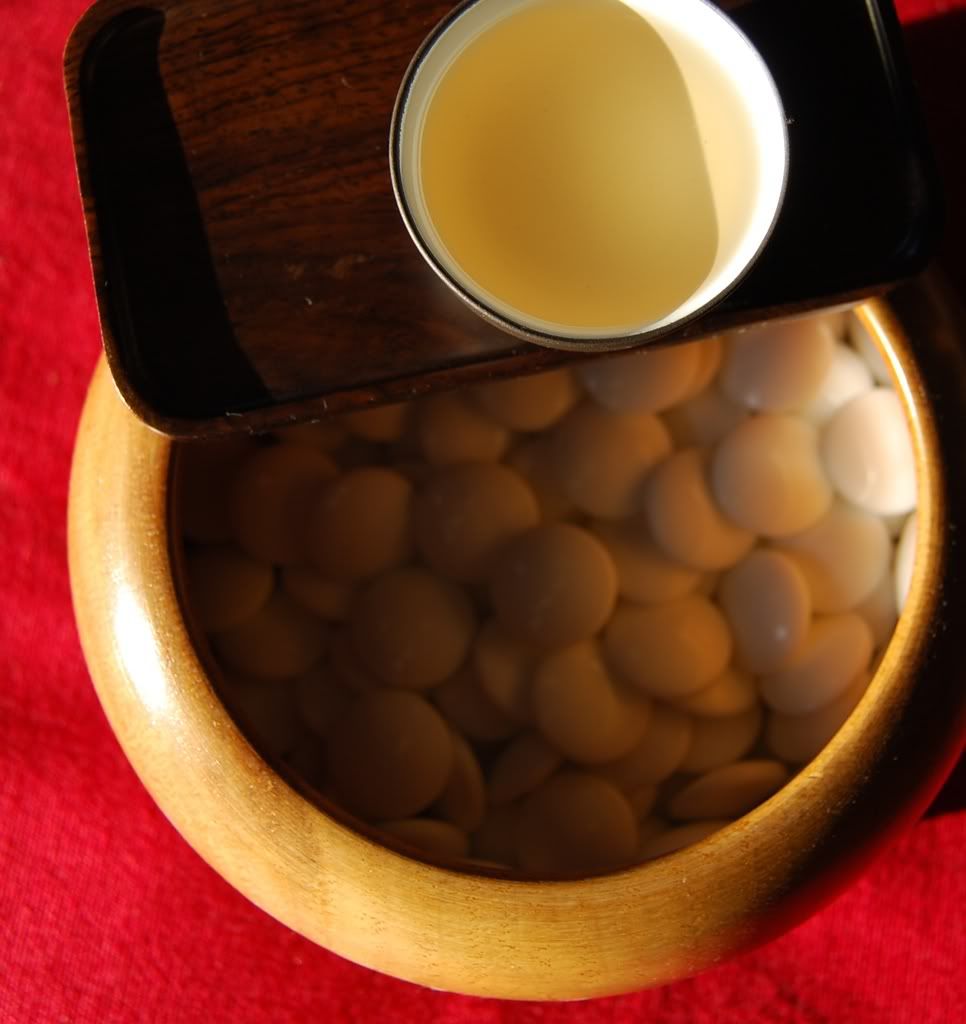
This is a pretty maocha, but dark for less than one year old. In its favour, this is clearly a leaf of good breeding: it has an effervescent energy on the tongue, a mouth-watering huigan, and a decently thick texture.
Unfortunately, that's where the fun ends: the flavour and aroma are simple, being light grass and little more. There is absolutely no aroma in the wenxiangbei.
I pushed this tea, using longer infusion times and large quantities of leaves, in order to coax some interest out of it. It responded by correspondingly increasing its huigan and astringency, but the character remained ethereally light and vapid.

I draw a fourth infusion simply because there is water remaining the kettle. I can agree with very few of the statements presented in the product description for this tea.
Xizihao/Sanhetang need to make fewer gimmicky teas per year, and return to their roots: proper tea. This tea is the nadir of Xizihao so far, to my palate.