05 July, 2008

A Friendlicious Cornucopia

I sat in my office with some students, watching them rapidly scribbling various graphs and equations on my whiteboard. Anarchy (or at least exuberance) prevailed. Eventually, they stopped. They sipped the tea I offered them. Peace descended. The peacemaker: a lovely tieguanyin, courtesy of Chabei's JMcM. (Great stuff, thanks again.)


Though absent from writing here, being beneath a burden of work (though a pleasant burden, it must be said), a post in thanks to the various tea-chums who have so kindly provided for me recently is due. I've been meaning to share for some weeks a lovely letter received from AL:


...all covered in tea-poetry, which he has written about previously in the Victorian splendour of Chadao.


Contained within, some sweet "tea moons", with which readers of Chadao will be familiar. More to be revealed of those during future posts...


Ok, cue the music...


Above, one of two parcels that arrived from Kunming on the same day - a fine day for tea. The highlight (well, more of a dazzling, exploding supernova than a highlight): some famed tea created by Nada himself...


This is his Nannuo cake, which I was delighted to find out he has named "Cha Chan Yi Wei" [Tea, Zen - Same Taste]. What a sterling name for a tea. The wrapper, shown below, is a thick, rustic, wabi-sabi affair that I truly admire.


So, let's unwrap it. I've only had time for gongfucha at the week-ends, lately, and each of the two sessions I've allowed myself have been with this tea. The cake (pictured below) is pretty indeed: a good level of compression, such that the whole leaves can easily be removed without breakage. The neifei reads "Nada Chayuan" [yuan as in yuanfen, fate/karma/destiny].


This is a fruity, punchy tea, which reminds me of two teas that I very much enjoy: it has the quality and character of the 2007 Xizihao "Pu Zhen" (which cost me a brutal $100), combined with the grape-like fruitiness of the 2005 Dehong "Purple Tips" brick.


It's fresh, delicious, and very thick. I would buy this in large amounts were it for sale. That it is unattainable and truly limited makes it even the more enjoyable; that it is created by a good friend makes it a singular event.


Hats off to Nada. See you soon!


Addendum

Nada has very generously offered (see Comments) to provide samples of this tea to those who would like to try it. Do please contact him via A Felicific Life.

26 June, 2008

"If By a Man's Works Shall We Know Him...

...then you, sir, are a colourful, nine-dimensional blob."

A quote from a colleague. I take it as a compliment. If you can't make pretty graphs, what's the point of science?


EVD


Apologies for my absence - recent days are mostly spent taking tea in a rough-and-ready way while writing up. With a new position starting for me next week (though happily in the same group), my thesis-writing time will be squeezed into evenings and week-ends alone, so I don't see much chance of improvement in the immediate future. Your patience is appreciated!


Toodlepip,

Hobbes

11 June, 2008

Models

Despite having my head buried in my thesis, I've been relaxing with one my hobbies - modelling.

A tiny boat on a Venetian canal:


Tiltshift


...and a painstaking version of the Summer Palace:


Tiltshift


Do please enlarge them by clicking on the photos before we go on...


Of course, these models were a wee bit unorthodox, being the product of tilt-shift. It's a very easy way of tricking the eye into thinking that an object is very small, because it has a blurred foreground and background. Combined with accentuated model-like colours and lighting, the results can be startling. For further reading, and much more accomplished examples than my crude first efforts, more can be found at Flickr.

The originals are below, for your reference.


Tiltshift

Tiltshift

09 June, 2008

Haiku

Thanks again for all of your haiku - it was a pleasure to read each and every one. Pictured below, the entries. Selecting a winner was impressively difficult - we used Basho's ancient "Seashell Game" method for selecting the eventual winning pair, in which every haiku is paired with similar haiku, in a contest of elimination, until only two remain.


Haiku
(Click to enlarge)


The runner-up prize goes to JC. Despite only learning Chinese for a single year, he bravely provided a haiku in Chinese pictograms. We found appealing the Zen-like sense of infinite potential, of which we usually only have an imperfect, restricted view. Here's our highly imperfect translation, paired with a humble photo of our own.


Cups

strong tea scent -
limitless ability,
limited by the drinker

JC


The first prize (inc. calligraphy) goes to RJ. His haiku is absolutely "my cup of tea", and a very accomplished haiku in its own right. The image is perfectly ambiguous - is it the fading light that wanders over this town with the clouds? The lack of resolution sticks in the mind like a thorn, trying to be resolved, with no resolution possible. It is that irresolution found in koans, that frustrates the mind's rational purpose.

Then, it has a level of wabi-sabi, a serene detachment, a wandering sense of natural purpose that sits very well in haiku, with a melancholy touch. The clouds feel like old Daoist mendicant priests, roaming our towns, treading with light footsteps. Really very good.


Park

fading light
over this town wanders
a shade of clouds

RJ


To all entrants, do please send me your addresses, and I'll post your samples and prizes as soon as possible. Other entries from the competition will follow in future articles. Many thanks once again to all for a decided treat.

05 June, 2008

HH the Dalai Lama

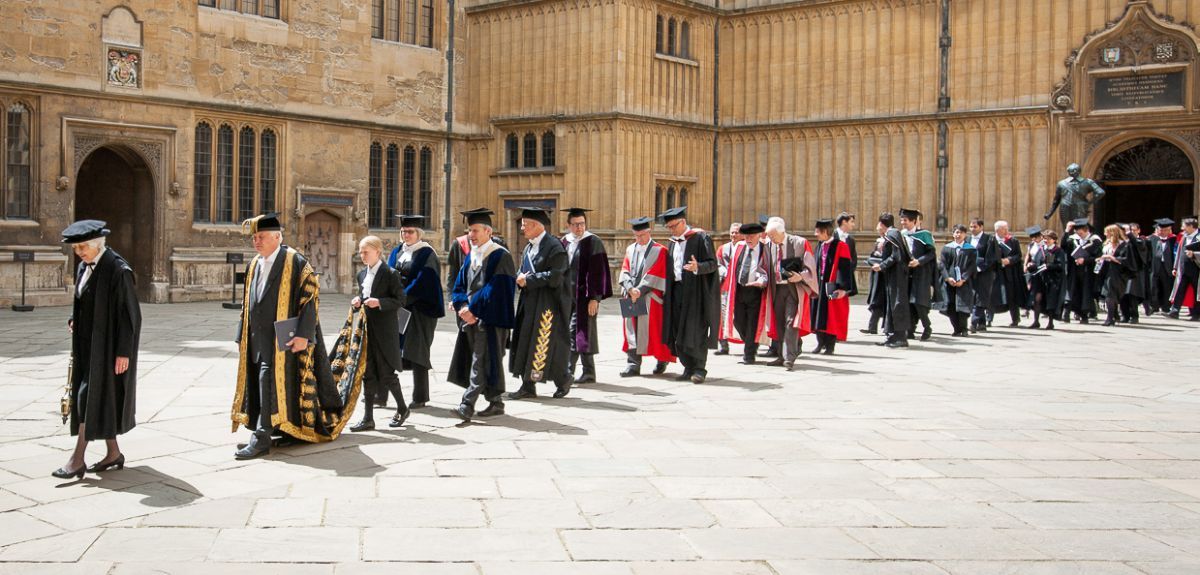
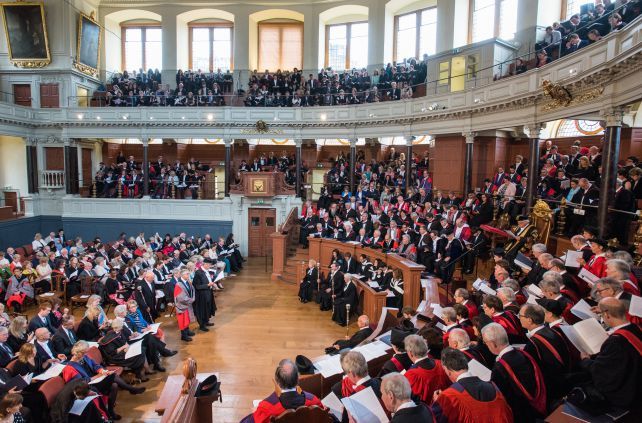
One of my favourite spots in town is the Sheldonian Theatre, built about 40 years after the Mayflower took the pilgrims overseas. It's quite dear to the university, being the place where we matriculate and graduate - but recently, it became just that bit more dear, as His Holiness the Dalai Lama honoured us with an address.


Sheldonian Theatre


Like many Westerners, the only real exposure I have had to His Holiness' teachings are through the books attributed to him. His autobiography, Freedom in Exile (Harper Collins, New York, 1990) is particularly powerful. To hear him speak on the troubles of current times was a true education - but perhaps just to witness his character when speaking on the troubles of current times was the real education.


HH Dalai Lama

It is undoubtedly not easy, being the 14th Dalai Lama. The Mainland Chinese accuse him of inciting atrocities; most well-educated Chinese scholars that I meet (and my college is about 30% Chinese) believe him to be a dissembling fox at best and an lying terrorist at worst; factions within the Tibetan Buddhist hierarchy address him with vitriol. It seems far from easy being the 14th Dalai Lama.

Yet, he speaks with a kindness towards all these attacks that is truly remarkable. His voice is filled with sincere warmth, he speaks with his whole person, as if describing with gentle humour the activities of a much-loved but errant child. His is not the position of aloof authority or condescension, but one of apparently great and honest compassion. I have seen nothing like it before, and I am sure that my clumsy words fall far short of being able to describe it properly.

His address was 30 minutes long, his admittedly broken English occasionally assisted by his translator (pictured above), followed by an hour of answering questions from the university's senior dons. Throughout, the distant chants of protestors outside nearby Hertford College could be heard. His Holiness' energetic but aged voice was often swallowed up by the sounds of protest.

Some weeks prior to the event, my college issued a warning that the university square should be avoided because of a "visiting dignitary" and the "expected protests". However, the scale of the protesting was surprising.

In the blue corner (pictured above-left), the pro-Tibetans, waving their made-in-China (amusing but true) Tibetan flags. In the red corner (pictured above-right), the Chinese and a faction of Tibetan Buddhists - the latter being very keen to distance themselves from the former.

My favourite placard was one held up by some Chinese undergraduates (wearing full sub-fusc), entitled "A Newlywed Tibetan Couple", picturing a happy Tibetan man and wife in Western wedding costume, against a background which was the PRC flag transposed onto a love-heart. You couldn't make it up.

Through it all, His Holiness seemed absolutely unperturbed, holding up his fingers over his head and chuckling that "they think I am a daemon". The sheer force of his endless humour seemed to have every member of the audience laughing alongside him - his giggling flowed naturally and ceaselessly.

After his address, His Holiness noticed that the Prof. Gombrich's DPhil robes were slipping down, and hoisted them back up around his shoulders with a mighty tug as he walked past. I don't suspect I will ever see the likes of that again...


Whisked away in a car alongside his security personnel, he waved energetically at the gathered crowds, smiling at supporters and protestors alike. The 14th Dalai Lama is a unique character indeed.

HH Dalai Lama

31 May, 2008

Interregnum

We're working on the haiku competition: they've been scribed onto little cards, and we're taking the eight finalists out with us on our afternoon picnic to determine the winner. The tension... is... unbearable!

Ahem. :)


silent dusk
in the abbey ruins
distant bells

29 May, 2008

1986 CNNP

In 1986, I was just leaving lower school. I remember a love of playing marbles, collecting Star Wars action figures with my friends, being terrified at the prospect of attending a school filled with Big People, and truly despising tea. I don't get quite so much time with the marbles or action figures these days, and that school now looks rather small and sweet, but my attitude to tea has changed somewhat. While that freckle-faced young boy was facing his new school, this tea was being picked, steamed, and pressed. The timescale of tea can be very sobering.

Very many thanks to ST for sending this excellent tea all the way from Singapore. (More pretty stamps for my wife, too!)


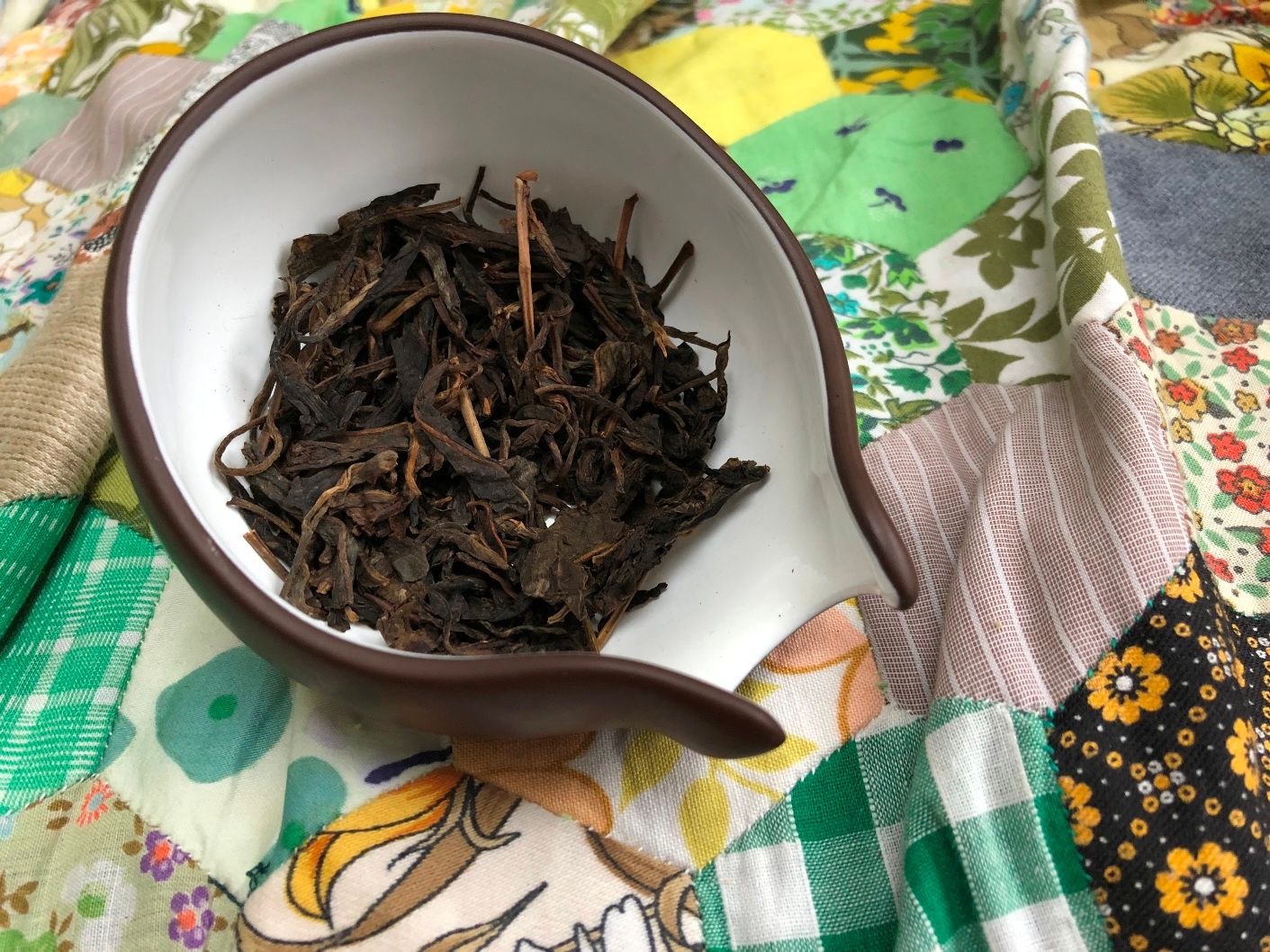
As is common with teas of the old school, the leaves are very small. They have already passed rusty orange, and are descending into the reassuring colour of dark chocolate (shown above, and below). They have a sharp shicang [wet storehouse] aroma, but nothing too recent - this one has been aired for some time. Comme ci, comme ca - I am neither greatly enamoured nor violently opposed to shicang characteristics.


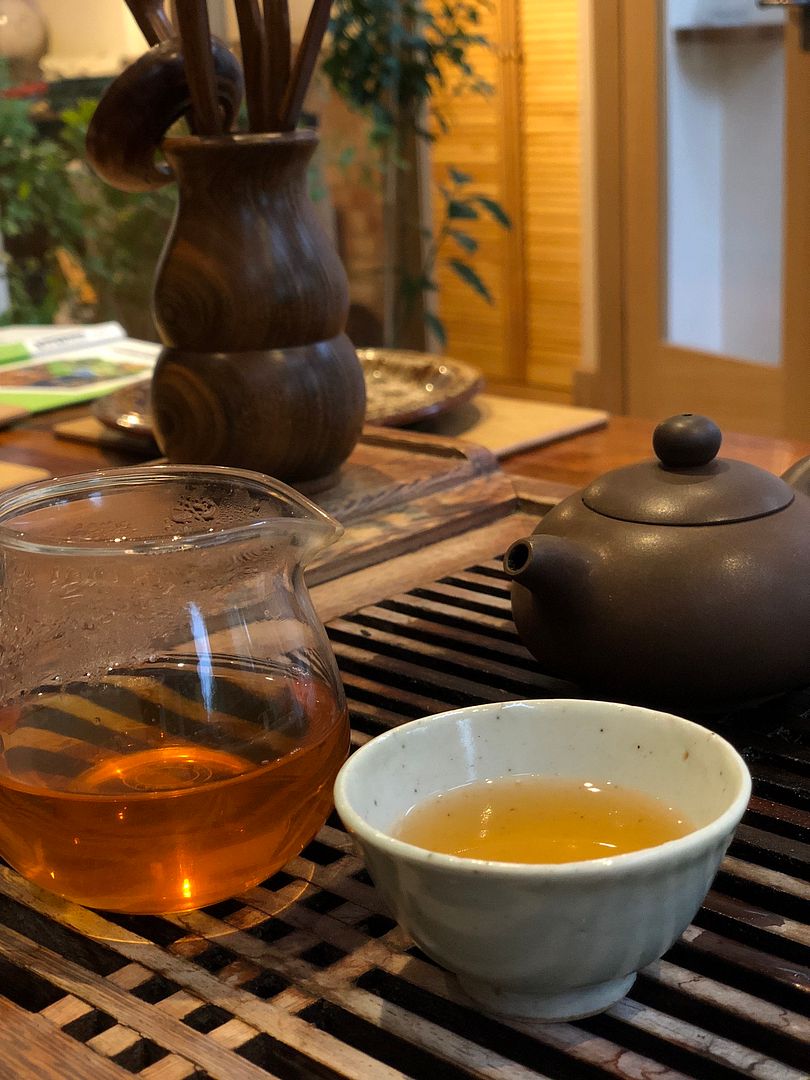
The wenxiangbei [aroma cup] is all sweetness, with great duration. While shicang, it is clean and distinct. The colour of the soup is a highly desirable orange-red.


The first sensation is its immediate flavour, a charming and unique character: sweet cedarwood, with a broad, root-vegetable base that reminds me of sweet potato. In the nose, a similarly vegetable-like aroma. What a curiousity this is.

The huigan pauses before making itself felt, but then resounds in the throat for many minutes. Drinking slowly, this tea is a long event.


I have used our hanwa [Han dynasty-style ceramic] little 7cl pot, which treats old leaves very well. Its small size requires repeated filling, but more than compensates for our efforts with the joy it brings.

Even creamy vanilla notes develop in later stages of this tea, while a gentle chaqi rumbles on regardless of time or potency.

Thanks again to ST for a fine experience. I have no doubt that the young boy mentioned at the start of this article would have found this tea utterly repugnant, but he turned out OK in the end...

28 May, 2008

To the Victor, the Spoils

This is a "good news", "bad news" post. First, the good news...

The haiku contest appears to have been a hit, a very palpable hit. It being a poetry contest, I was not anticipating a huge turn-out. I am delighted to see that I was wrong! I've sent e-mails to all the entrants that I have received - thanks again for the excellent submissions.

And so, to the bad news...

Given the surprisingly large number of submissions, and the fact that every entrant will be receiving at least a few samples of tea, I will close entry to the contest by midnight GMT, tonight (Wednesday). If you have some submissions teetering on the edge of being sent, do please send them.


Chadao


I can heartily recommend the holding of such a contest in order to introduce yourself to your readership! Of the 21 entries so far (representing 9% of the current daily readership, according to dear old Google Analytics), only 5 are from readers with whom I have had correspondence in the past. That's 16 new folk that I didn't previously know! I'm very grateful to have had the opportunity to do so, and always encourage e-mails from readers (hobbesoxon at gmail dot com), as blogging is very definitely a two-way process.

Hint hint. :)

It makes me wonder... who else is out there?!

25 May, 2008

A Contest of Sorts

One of my favourite parts of writing for this site are the community events, and I hadn't realised that it hasn't been since last year that I held one. So let's change that.

The proprietor of Skip4tea (Patrick) rather unexpectedly sent me a lovely piece of calligraphy, on the theme of tea, seemingly created by an artistic friend. He kindly consented to it being offered as a small prize here - thanks again, Patrick.


Skip4tea Calligraphy
(Click to enlarge, as with all photographs on this site.)


cha2 xiang2 pu1 bi2
ru4 kou3 chun2 gan1
hui2 wei4 wu2 qiong2
tea scent wafts nose
enter mouth mellow sweet
return-taste without end

(I favour the sparsity of pidgin English for translating the sense of oriental languages.
If you prefer more "complete" translations, you could have:
"The scent of the tea assails the nostrils/
entering the mouth, mellow and sweet/
the returning flavour is without end.")


So, then: two bijou prizes:

First prize:
This (rather quite large) piece of calligraphy, with a bunch of samples of teas that I've recently been drinking.

Second prize:
The above, without the calligraphy.

Your task:
e-mail me (hobbesoxon at gmail dot com) with a haiku of your own creation. The two that I subjectively enjoy the most will win the prizes. Please put the word "haiku" somewhere in the title, so that I can find it easily.

(I'm an easy man to please when it comes to haiku, by the way.)

Edit:
my wife is right - we can't take these lovely haiku without something in return. So, all entrants will receive at least one sample of something enjoyable from recent weeks (probably some 12 Gentlemen tea).


Guidelines:

1. The haiku can be either "fixed" format (5-7-5 syllables) or "freeform" format.
The fixed-format approach is taught in many schools, to correspond with the 5-7-5 syllables that appear in the original Japanese haiku. However, Japanese sound-syllables (onji) carry less semantic weight than Western equivalents, and so a similar poem might use a smaller number of syllables if written in English, which motivates the more terse "freeform" format. Most of the haiku that you may have seen scattered through this web-site are freeform.
2. You can be as formal or as informal as you wish.
There are a bunch of "rules" for creating haiku, which can get complicated (cutting words, seasonal words, etc.). Use these if you like, but you won't be penalised for not using them.
3. The subject can relate to tea, or not to tea, as you see fit.
Don't feel obliged to stick to the theme of tea.
4. You can make a haiga, senryu, tanka, or renga if you wish.
(If you're familiar with them.)
5. All entries could be used to adorn later tea articles on the Half-Dipper!
This way, we can all enjoy the fruits of your labour. I'll try and match them to a photograph of my own that suits them (example below). If you don't want your initials appearing next to a haiku in a later article, let me know.
6. The closing date will be in around one week's time.
...but I'm never very good at keeping to time.


Good luck! I close with a pseudo-haiga courtesy of the photographic genius of VL - please visit his site to enjoy the full range of his talents.


VL's Train

sunshine on green fields
it is the mind that moves
outside train windows

23 May, 2008

Timing Tea

So-called "Zen learning" is something that fascinates me, and it's something that we're all undertaking when we brew tea.


I've twice before mentioned Herrigel's Zen and the Art of Archery, which brought Zen to Europe after World War II. In this short classic, Prof. Herrigel described how he learned archery from one of Japan's masters in the art: day after day, month after month, he repeated the tedious exercise of holding the bow sideways, and then simply drawing and releasing the bow. With no arrows. Draw, release, draw, release. Day after day.

After some months, the master commented after one drawing-and-releasing, "There! You had it!" He had observed something transcendent in the manner in which Herrigel released the bow-string, at exactly the right moment, and with exactly the right quality. Herrigel duly tried to repeat the success, with excitement, but met with more familiar failures. His master told him to continue the exercise.

Fighting tedium and doubt, more months passed. Every now and again, the master would note a drawing-and-releasing in which he observed that certain quality. Over time, these incidences ("successes") became more frequent. Eventually, Prof. Herrigel became frustrated, "gave up", and yielded entirely to the bow, with the result of obtaining mostly continuous achievement of the right quality.


At this stage, his master allowed him to progress to using an arrow - but the arrow would just flop down onto the ground after every release of the bow. This new stage of repetitive exercise was to continue for months, each time the arrow flopping to the ground not far from Herrigel's feet.

Eventually, the landing of the arrow in a far-distant target happened as a consequence of continued practice - the successful hitting of the target occurred as a side-effect, with the main exercise being the achievement of the right quality - that fusion of archer and bow in some state far removed from the mind that he initially brought to his practice.

This is Zen learning, and it fascinates me very much, permeating many of the Oriental arts, from archery, to flower-arranging, to martial arts... and, of course, to tea.


2006 Huangzhixiang Dancong


We brew tea day after day, month after month, year after year - water in, water out, water in, water out. This is practice, of a sort. Throughout this practice, something fascinating can be observed: we are learning tea, and its brewing.

Up until quite recently, perhaps even as recently as a few months ago, I would count the passing seconds in my mind as the tea infused. I remember writing about this about a year ago. It helped me lengthen the infusion times with each successive brew.

Just recently, my dear wife pointed out something to me that I had not noticed: I was no longer counting. I just poured water in, and then poured the water out. Though some infusions came out too strong and some came out too weak, the number of infusions with the right quality were much higher than when I counted breaths. That is, the number of failures had drastically decreased - but they had decreased as a consequence of something having been learned, something that I could not adequately codify or communicate. The tea - just stopped being poorly infused (quite so often).

This is not a mystical process, and I am certain occurs in all our daily activities to some extent: the computer programs eventually stop having certain bugs in them; the paint eventually goes onto the canvas in just the right way; the flower arrangements somehow look "right".

This is learning the outer form, then the inner form.


Taijijian


This got me thinking about taijiquan.

In taijiquan [tai ch'i, the meditative/martial form that one sees being practised in parks at dawn], the beginner initially learns the "outer" form. He learns a sequence of stances, and movements to get from one stance to the next. He learns where to put his weight, where to put his hands, where to fold his hip.

Once the outer form is learned, and the outer shape of the sequence of moves becomes unconsciously remembered, he can work on the "inner" form. He can learn where to put his mind, where to place the focus of his attention, where to move the more subtle parts of what the Chinese believe constitutes our physiology.

Progress in learning the inner form is immediately obvious in a certain quality of the outer form. That is, the outer form takes on that quality as a consequence of learning the inner form.


Angel and Greyhound Meadow


(Many video clips of famous taijiquan masters (and other "inner arts" such as bagua) can be found through the magic of YouTube - even clips of Master Zheng Manqing [Chen Man Ch'ing], who was personal physician to Jiang Jieshi [Chiang Kai Shek], and who is ultimately responsible for taijiquan in the West, can be found in grainy, ancient black-and-white video. To watch the outer form of such masters is to witness that quality which is a manifestation of their mastery over the inner form.)

In tea, we learn the outer form first. I painstakingly learned the recommended "right" infusion lengths, the "right" vessels for each tea, the "right" amount of leaves to use, all from the words of others, just as if I was learning taijiquan again.

Then, we learn the inner form: brewing tight teas vs. loose teas, brewing dark green leaves vs. rusty orange leaves, brewing heavily aromatic pu'er vs. quietly-scented pu'er. We come to realise that there are no "right" parameters, only suggested outer forms, and we reorganise our own brewing according to our internal experience.

We brew, brew, brew, day after day, month after month. Eventually, something clicks, and the tea tastes good on occasion - the quality is good. Maybe this quality comes more often with time, and our intuitive feeling of what any particular tea needs becomes unconsciously more accurate. Eventually, the trappings of the outer form fall away as we no longer require them: the scales to weigh leaves, the timers to time infusions, the thermometers to measure water temperature, even (in my case) the counting of the passing seconds.


1990 CNNP Yesheng Brick


I'm no master, but it remains fascinating to see progression even in my humble and clumsy approach to tea. It's worth keeping an eye on.