Showing posts with label hongcha. Show all posts

27 April, 2015

Better Dead Than Red

Ave, Reader, full of tea,
blessed art thou among drinkers and blessed is the fruit of thy zishahu.

It has been one month to the very day, at the time of writing, that I have foisted my missives in your general direction, and I trust that this lunar cycle has been favourable to you and yours.  I have come to conclude lately that my tiny little world is so very tiny, and my mind likewise, that I have very little idea about life beyond my immediate Schwarzschild radius.  

This even goes for understanding that the weather is not the same the world over: as I sit here in Middle England, comfortably chilly, and wearing a cardigan, I am reminded of an academic visit to Paris last week.  The entire city was so very, very hot that I had to [sharp inhalation of breath] remove my cardigan.  Not even a waistcoat.  There was not a single necktie in the entire city.  And this was in May.  Baffling.  Happily, I was back in England within 24 hours for the purposes of seeing my little family, and so I was able to resume normality quite quickly.  However, the experience was traumatic.


I suspect that the root cause of the problem here is that I have trouble understanding that some people are not me.  That doesn't sit easily into my aforementioned tiny mind.  So, when I kick back and write about hongcha, I naturally assume that you are totally into hongcha in the same way.

Imagine my surprise when I tried some of these teas out on friends and colleagues only to discover that some of them did not like the tea.  Again, completely baffling.  This is hongcha, and it's good hongcha - what more is there to say?


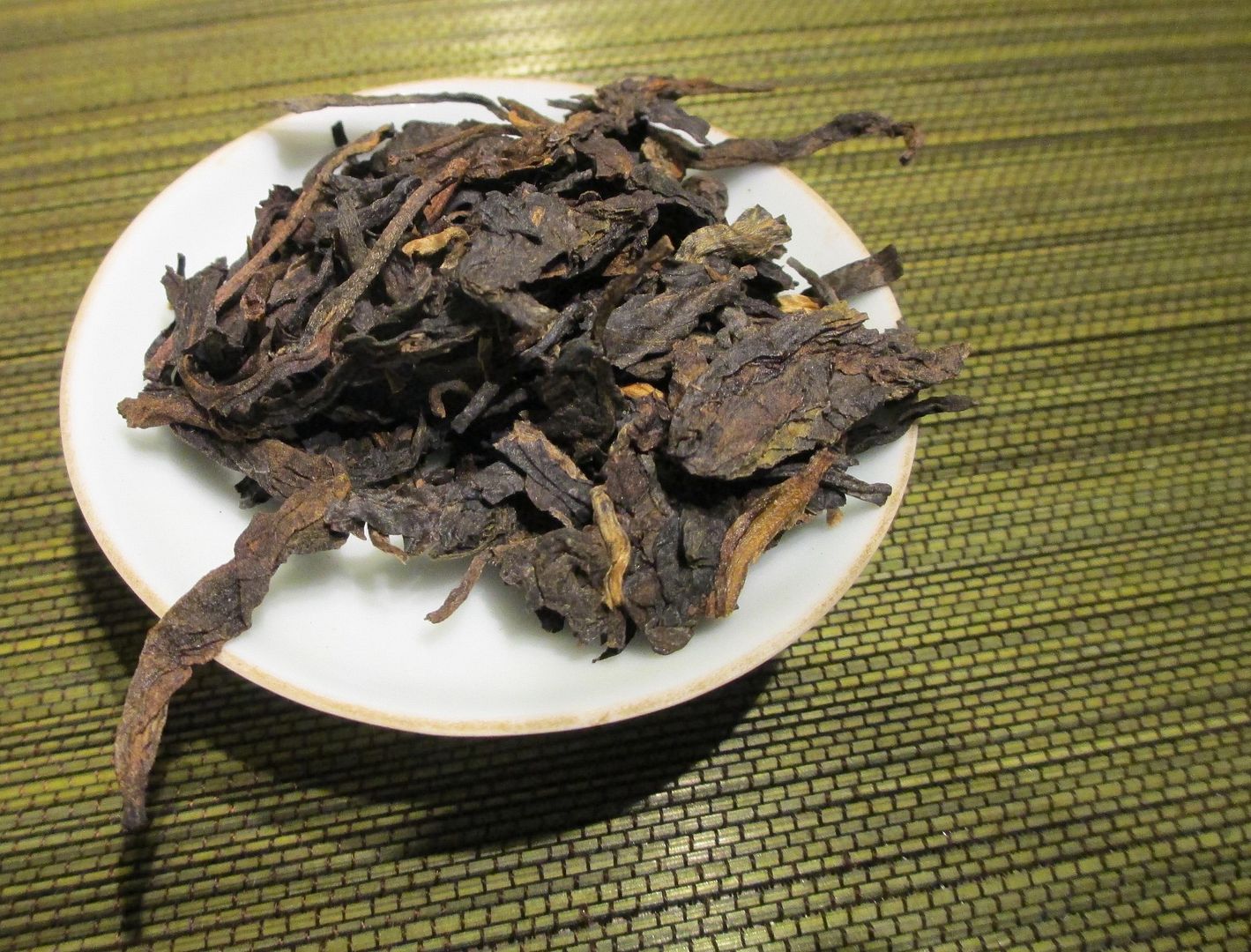
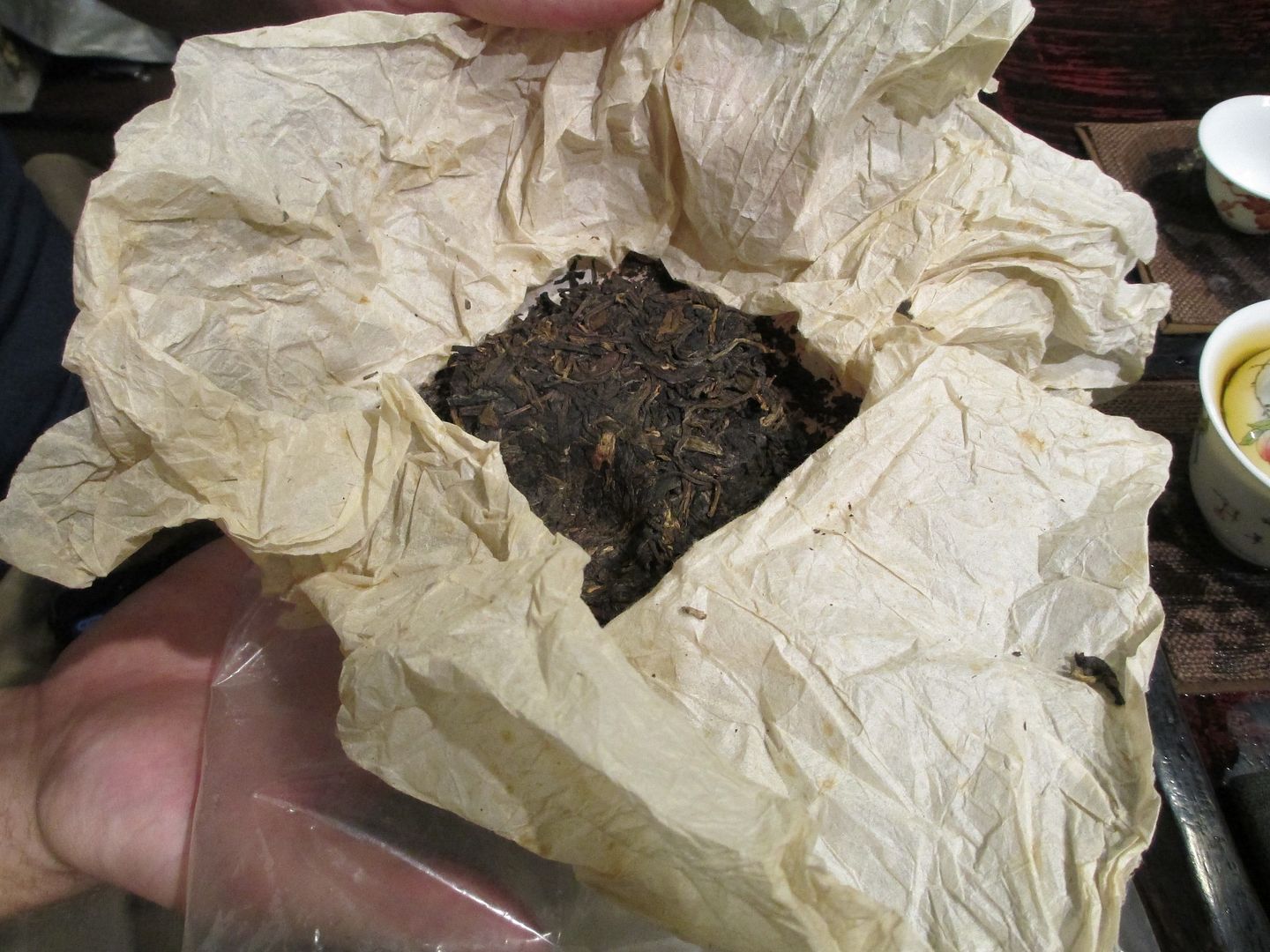
You might have guessed from the (pagan druidic?) wrapper that this little cake is from Ee-Oh-Tee.  Check out those leaves, with the rusty tips.  There's your hongcha right there.

It seems to be made from Mengsongshan leaves, and Ee-Oh-Tee notes that it comes from the same leaves as the 2014 "Yuanwei".  Commercial confidence surrounds the exact location of the village, so that comparison might not be entirely helpful, but you get the general idea.  It's pu'ercha gone red.


I admire a tea-maker with both the Jones and co-Jones to use good pu'ercha leaves for the purposes of making either (i) shupu, or (ii) hongcha.  You are, essentially, guaranteeing yourself some chunky, meaty, beefiness.  Never has beefiness been in such strong demand as when you sit down with a pot of the ol' hongcha, because you don't sit down with a pot of the ol' hongcha expecting a prissy, fussy, delicate experience.  No, you expect to be slapped upside the head, and then insulted.  You expect a bit of a fight.  Hongcha is not supposed to go quietly into the night.


At a cost of 28 Britishunits for a mass of 200 S.I. grams, this is not too terrifying in its price.  I think that's appropriate for something like hongcha.  Isn't it interesting that if you just leave the tea as it is, and make a shengpu cake, then the result sells for £54/200g, but if you turn those same leaves into hongcha, then the price approximately halves?  Mystifying.  Cue enraged letters in the "comments" section.

This cake is as precise and clean as one would expect from Ee-oh-tee, and I like the fact that it has been tested for pesticides in a credible manner.  I like even more the results of that test, which suggest that it is clean.  This fact alone rather recommends it to my shelves, for some daily drinkage in the lab.

Like the puer'cha that it once was, this little hongcha lasts forever.  Importantly, its carnivore-pleasing strength seems undiminished when brewed with lesser water-quality, during the working day. 


Some months after drinking the above, I bounced into BIG TREE RED, which sounds like a Menghai special production but is, in fact, hongcha.  I think that outcome pleased me.


As pictured above, this hongcha comes from Dubs.  The web-site suggests that this is priced at $35 for "0.050 kg", and I wonder if there was a problem with the placement of the decimal point there.  Thirty-five bux for 500g would be in line with my expectation for good ol' hongcha, while the same price for just 50g would be in danger of raising an eyebrow.

I suppose that it is at this stage I would be pointed in the direction of the text that describes how the leaves come from 100-200 year-old trees and that they have been massaged by the inner thighs of pretty, nubile teavixens.

Those teavixens really drive up the price.


I like Lincang.  Lincang is rough, unapologetic, and great fun - and that's where these leaves originate.  I can't say that I've ever had Lincang hongcha before, and so I'm attentive as the kettle kicks into gear.


To say that I brewed this tea hard is something of an understatement.  I brewed this tea like nuclear fusion.  I brewed this tea like Odysseus on an Ithacan goat after a decade at sea.  Pile those leaves high, and pack that little pot to the brim.  The result is solid, sharp, and potently cooling.  It soon drops the pretence of being candy-sweet "hongcha" and gets down to the serious business of being red pu'ercha.  It cuts through your life like a hot knife through churned lipid solution.

Drink this tea and conquer the world.  Teavixens and all.


French Windmills


French windmills
always remind me of
English windmills

05 January, 2015

Dorje Ling, The Thunderbolt Place

Greetings, Mighty-Thighed Traveller from Beyond the Stars.

Your rippling torso is, no doubt, straining to contain the thousand pleasures (calories) that accompany celebrating the birth of the Holy Infant.  Surely, massive consumption of alcohol and rich foodstuffs is in the spirit of the season.  Somehow.

What better way in which we might collectively work off our accumulated requirements for penance than in the confessional of the teatable?  Brothers and sisters, let us pray.


We are gathered here today to celebrate the nuptials of this tea (interestingly packaged, very Indian) with my hongcha teapot.  If anyone knows any reason why this delicious-looking subcontinental filly should not be married to my charming old red pot, let them speak now or forever hold their peas.


"Wouldst thou wish to imbibe the produce of our labours?" quoth an e-mail from GOLDEN TIPS, apparently writing from their warm and comfortable position somewhere around the middle of the 18th century.  "Hellz yah", responded your humble correspondent.

And thenceforth, the two fabric-wrapped missives did subsequently wend their way from the Indies all the way to this sceptred isle.  Against the envy of less happier lands!

Fat stacks from India, pictured above, in their plural and munificent beauty.


2014 Arya "Ruby"


Reader, there is much written about the throbbing undercarriage of tea that is pu'ercha, not some little of it upon these threadbare pages.  However, as those among you serving a particularly long sentence for violent crimes against humanity will know, Gentle Reader, much of my Actual Life is spent sucking down hongcha.

In all its myriad forms, from "ENGLISH BREAKFAST" (i.e., the tea equivalent of 100% proof potato vodka, feel the healing power of the capslock) through to "Lapsang", hongcha maintains a firm and constant nippletwist on my affections.

It is a common enough trait among my kind.  We are conceived in hongcha.  We float in it from the womb.  It is the amniotic fluid.  It is the silver sea.  It is the waters at their priest-like task, washing away guilt and purpose and responsibility.


2014 Arya "Ruby"


When I hit up the local taverna on my travels; when I am slumped facedown in my gruel at some overpriced St. Pancras venue; when I am sat quietly weeping into my scones at Cream Tea in some country cottage or slick city-hotel alike; my bibendi prima is The Hongcha.

If they have it, I will wrap my consonants around the word of power, DORJELING, while Anglicising it (and therefore anaesthetising it) into something that sounds a little like "Darjeeling".


2014 Castleton "Moonlight" (leftmost), 2014 Arya "Ruby" (rightmost)


I drink a lot of very mediocre DORJELING, Gentle Reader, and I am not afraid to admit it.  From time to time (read: when my homes from Chennai buy some for me), I tantalise my hongcha pot with Nilgiri.  This one time, in band camp, I drank Ceylon.

Strangely enough, though my father's family is from Kenya (like Obama!  Have we seen Hobbes' birth certificate?!), I only had my first Kenya single-estate tea last month, after getting a helpful new research programme funded over there.  The tea was OK.


2014 Castleton "Moonlight"


Imagine, then, the rapturous trance into which I slipped when the entire contents of this article were revealed unto me, like some warm, orange, sweet-smelling Apocalypse.


2014 Okayti "Silver Needles" (leftmost), 2014 Giddapah "Muscatel" (rightmost)


I actually enjoyed these teas between November and December of last year (2014).  The dudes over at GOLDEN TIPS keep sending me e-mails, slapping my figurative backside, and asking WHENOHWHENAREYOUGOINGTOWRITEABOUTOURGDTEAS.  Trying to get me to do anything (at all) is difficult; if you slap my figurative backside, Gentle Reader, I might add that you are not expediting the situation.  You are, if anything, causing me to pause and reflect upon the figurative stinging sensation in the posterior homoerectus.  And you do not want me reflecting upon the posterior homoerectus, rest assured.

Nothing good ever came of such reflections.


2014 Okayti "Silver Needles"


So, then, the teas.  Suffice to say that some of these teas are, like the cherry pie of Agent Dale Cooper in the 1990s, damned fine.

Names like CASTLETON and MARGARET'S HOPE are, to me, a little like reciting the names of the Thundercats, or the Masters of the Universe.  That is, they are words that are burned into my consciousness - they are concepts that are part of my hindbrain, the primitive id.  The package was like a "greatest hits" of Darjeeling.  It got my toes tapping.

Other names are previously unknown to me, but not, it seems, to Google.  Names such as ARYA and OKAYTI.  Names such as GIDDAPAH, which rather sounds like the start of James Brown's "Sex Machine".

However, all of these teas, without exception, were doubleplus good.  My favourites, perhaps expectedly, were the second-flush DJs.  Unlike pu'ercha, second-flush DJ is not lower-quality than the first-flush.  As Michael Caine would say, not a lot of people know that.  The first flush is nambypamby ladyboy tea (a little like the lace and frills of girly Jingmai), while the second flush brings the proverbial motherblanking ruckus in B minor (a little like the rusty juggernaut of nasty Bulang).  Needless to say, I like my battery acid, and so I loves me a pot of heavily overbrewed second-flush DJ.

Classics of the genre, such as Castleton "Moonlight", continued to thrill.  It was a little like Biluochun, actually, in that modern DJ way.  It pads the mouth with cotton wool.   Drinking the previously-unknown Arya "Ruby" was like listening to "Shame On A N*****" for the very first time.  That is some serious shi'itake.  ("BLAOW, HOW YOU LIKE ME NOW")

Plus, the caffeine from these DJs is like the aforementioned nasty Bulang: it slams into the consciousness like a the oft-lyricised vehicular homicide.  It will wake you up.

Other highlights of this assassin's backpack full of weaponry included the surprisingly hardcore "Avaata Supreme Nilgiri", which was a well-calibrated sniper rifle, in the Chinese lucha style.  I had no idea that my aforementioned homes in Chennai were drinking what tastes for all the world like real Chinese green, yet somehow given a badboy Tamil twist.

So then, to draw my conclusions, if you like your hongcha, then you will probably like GOLDEN TIPS.  Just let your mouse pointer wander - pretty much the only thing I didn't love was the Okayti "Silver Tips" and that's simply because I don't dig on white tea.

No-one really likes white tea, anyway, as everyone knows.

20 June, 2014

Pox Romana

My youngest son recently had a case of chicken pox.  He was generally, in himself, quite well, but he was covered in spots.  This meant that he and I had a good amount of time together during weekdays, as I took the time away from work to look after him.  We had a lot of fun, and spent some of it visiting cafes, in between his usual favourite places (parks, museums, etc.).  I came to appreciate that good tea is getting around, at least a little.  I don't usually get to visit cafes, and to do so was something of an education during my time with dear, spotty Xiaolong.


The first venue that we tried was the "Grand Cafe".  As its name suggests, it is a bit of a tourist trap.  It claims to be "the site of the first coffee house in England" but I can remember that just ten years ago, the Grand Cafe used to be a shop, selling something entirely different.  Specious claims aside, you can imagine the interior from the name: it is a "belle epoque" outfit, with marble columns, ornate mirrors, etc. etc.  I'd had a fantastic coffee (Kenya peaberry) in there a year before, and so thought it time to try the tea. Xiaolong was unimpressed by the decor, and slept through our visit.

The result, pictured above, was a very solid Darjeeling.  With Darjeeling, perhaps more than any other tea, a cafe has the chance to get it right, without risk, while still charging a sizeable price.  England has a long history of buying teas from that region, and so, if you run a cafe, it is not too hard to find a distributor able to sell you something reasonable from one of the good estates.  The quality was not at all bad, and I was pleased to see that Darjeeling is coming back into the popular consciousness, even in just at the periphery.


Next up: a real Oxford education.  We have a concept in English called the "greasy spoon", which is used to refer to a very low-cost cafe that sells basic breakfasts and the like.  I first came to Oxford in 1998, and St. Giles cafe, the greasy spoon's greasy spoon, had already been trading for some decades.  So endearingly bad (in a nice way) was the cafe, that it is commonly known in the university as "the Cafe San Giles", pronounced in the French way (soft "g") to give it some ironic elegance.

Imagine my horror to learn that the Cafe San Giles (soft g) had been taken over by new management in the middle of 2013.  The old greasy spoon looked approximately the same (thankfully), but had been pulled up by its bootlaces and was now distinctly "gastro".

We have another effect in England at the moment: the "gastro pub".  These are pubs that focus on high-quality, quite rustic food, served at medium-to-high prices.  Good ol' Cafe San Giles (soft g) had been gentrified.  Not too much, but enough.

The result was actually rather good.  I had sausages made in the shop (out of meat, no less), and a special blend of Assam and Darjeeling that the owners had bought in especially from a trader in London known to some of us.  It was really very good: heavy, with the malt of Assam, but floral and zesty in the manner of Darjeeling.  I am truly delighted to see that the "gastro" movement can sometimes include proper tea.


Xiaolong didn't sleep through all of our cafe trips - pictured above, in Cafe Coco on the Cowley Road (a rather "studenty" area), my spotty little fellow awaits his order while poking a rubbery ricecake.  Cafe Coco sells "detox tea", which I naturally wouldn't touch with a barge-pole, and so we drank coffee.  Xiaolong had juice, good times were had.

He's over his chicken pox, but we had a fine time together - and we were exposed to some decent tea, as well as to his virus.

17 February, 2014

Simian Delights

I love it when I get to my office and there's a parcel waiting.  Who's this one from?


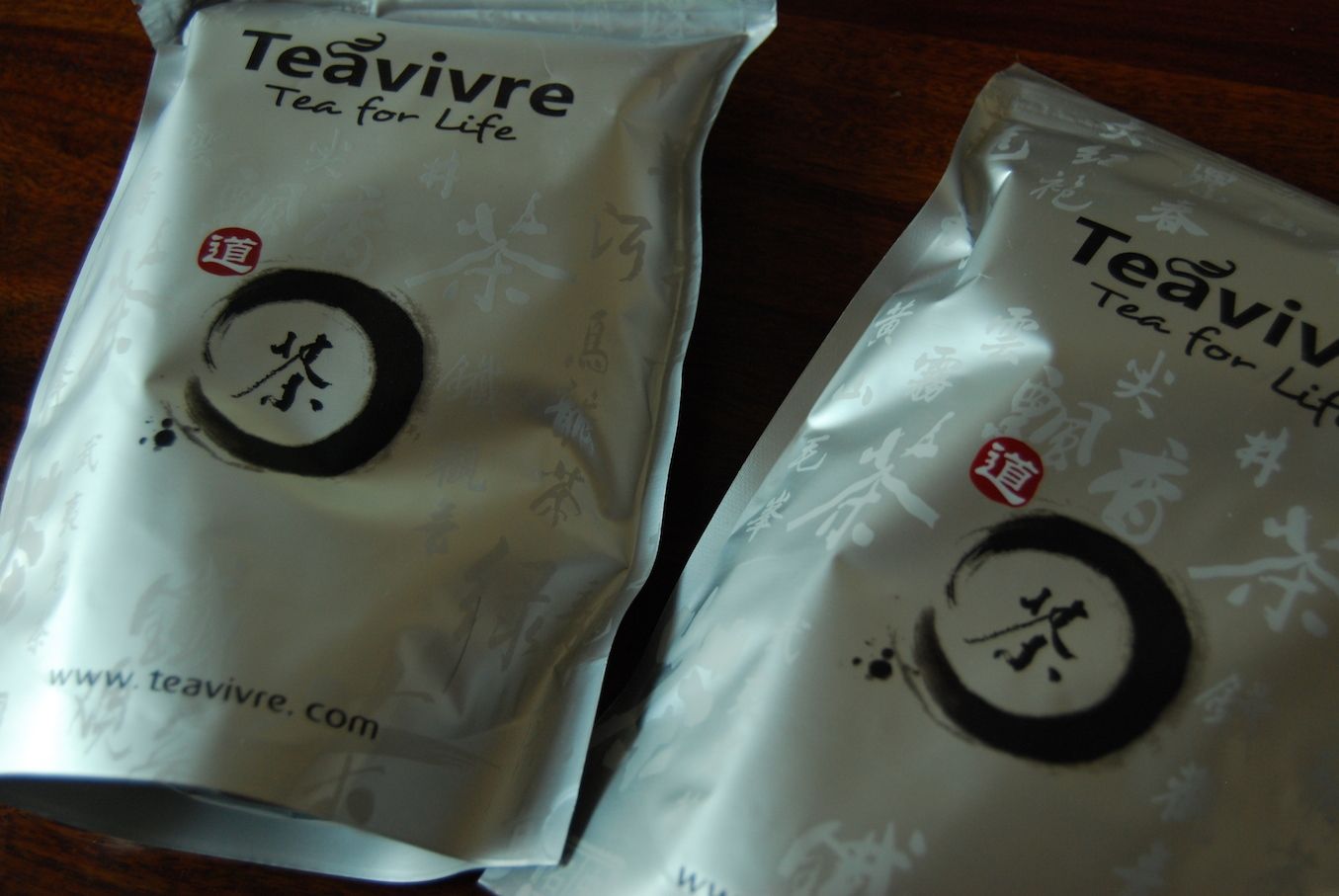
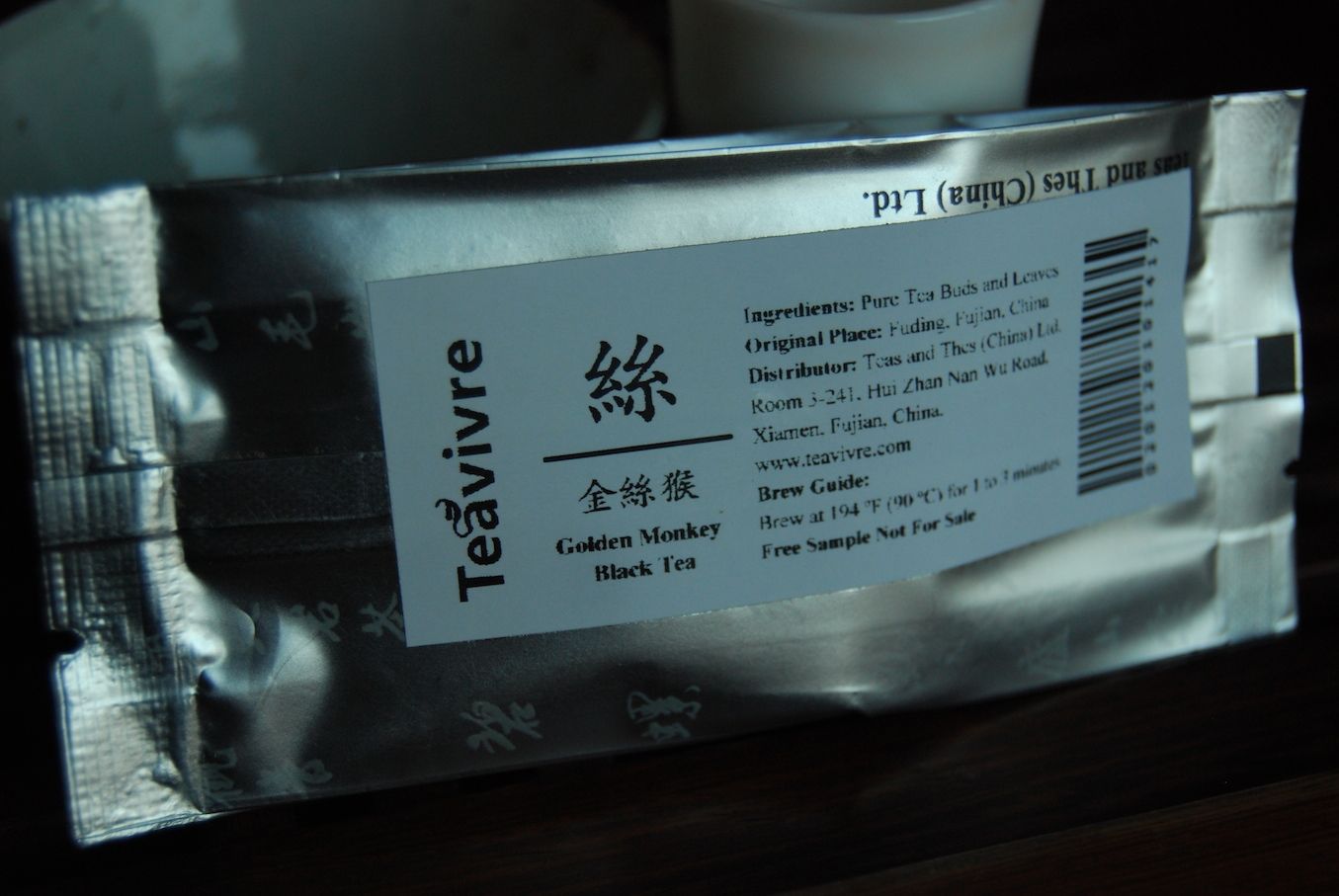
It's from TeaVivre, the folks from Xiamen with the pretty tea-packets...


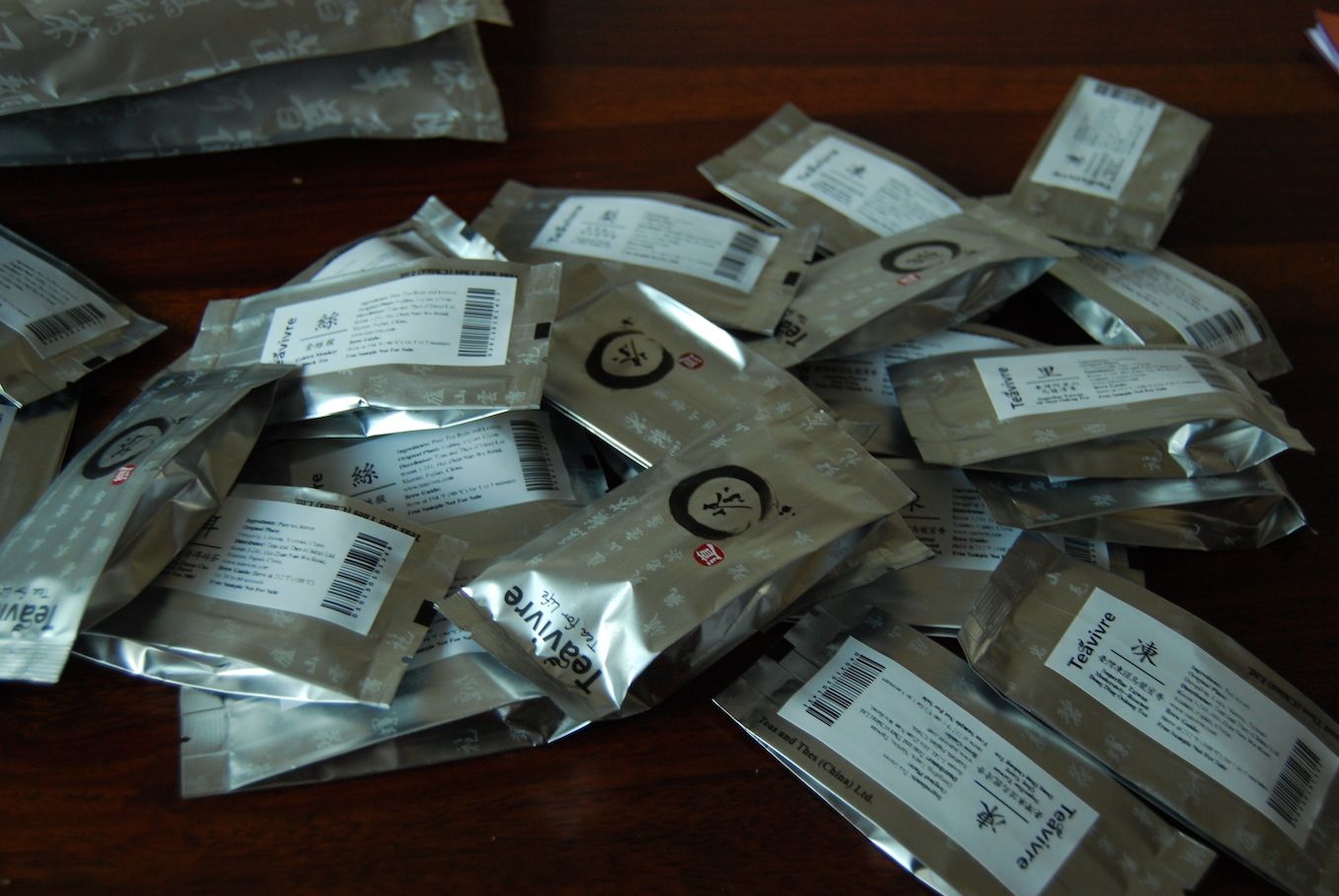
Opening the packets reveals a bonanza of sample-bags...


While it transpires that there are actually six different teas in this pile, it is perhaps a sign of the times that I reach past the pu'ercha, for this first selection, and instead go straight for the hongcha.  When it's cold outside, when it's been raining so much that the river has flooded, when it's daylight only for a small interval around noon, then you know that you need the warmth and comfort of solid hongcha.  At least, that's how it works for your correspondent.


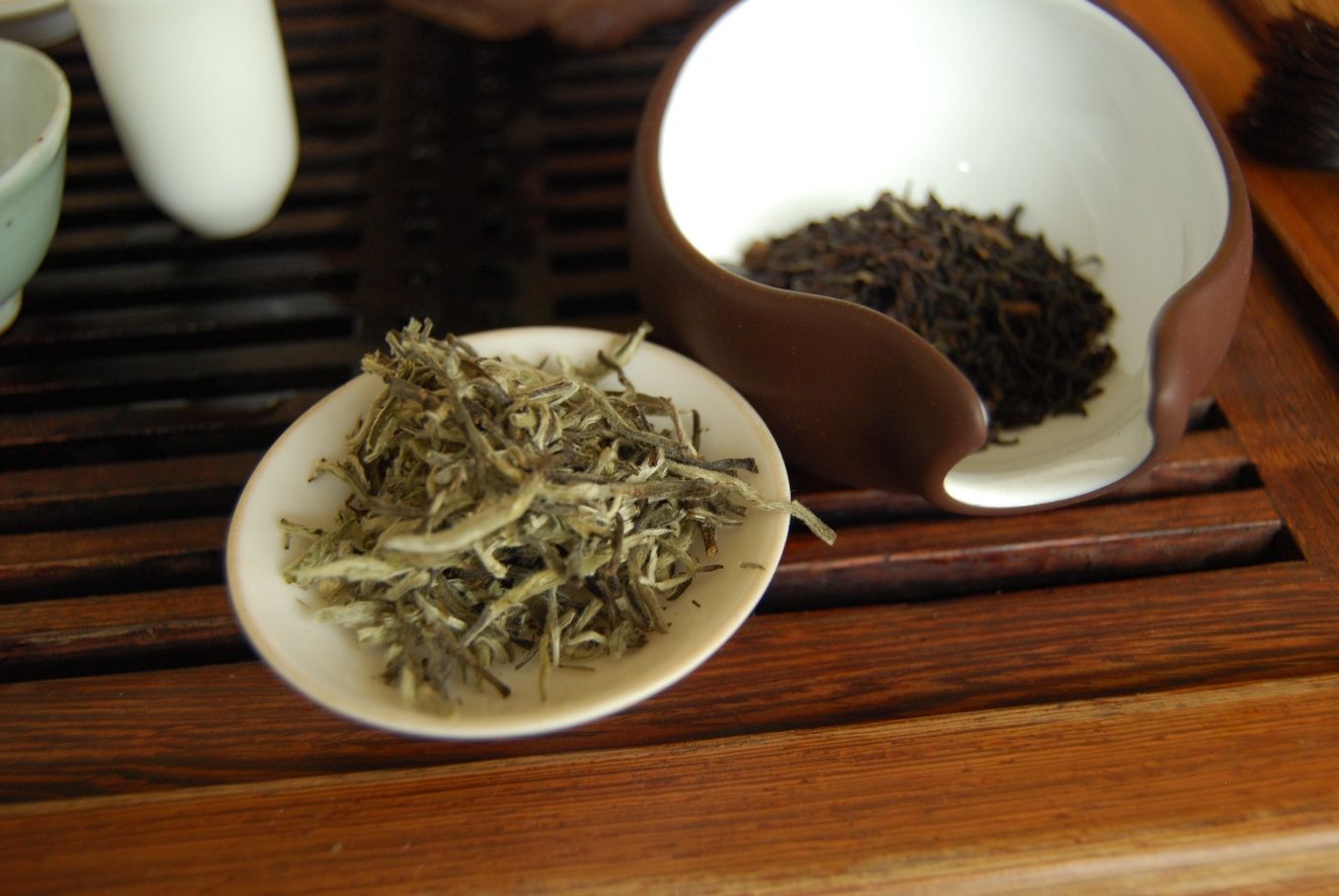
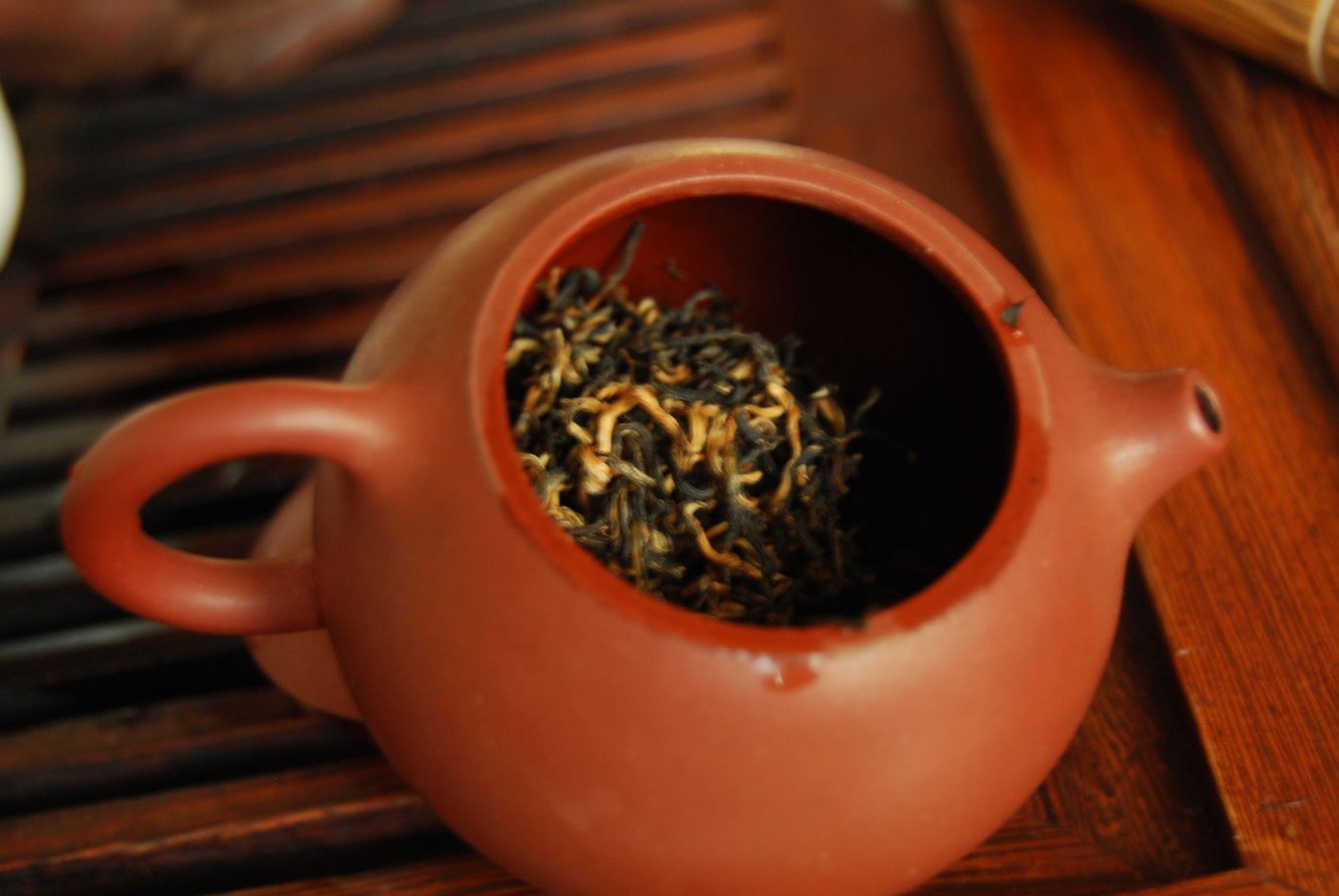
"Jinsihuo" [jin-ser-hwo] literally means "gold-fur monkey".  It isn't a type of tea that I have encountered before, although the mighty Babelcarp appears to have learned the phrase "Jinsiluo", referring to "gold-fur snail" (or "gold-thread snail") from the same area of Fuding in Fujian.  A quick glance at the photograph below will suggest why the "snail" name came to stick, perhaps because it is a hongcha version of Biluochun.  However, this tea is all about monkeys and not snails, and I respect that.


Many hongcha are simple.  Some are complex.  Some are porcelain elegances - I'm thinking of the canonical varieties sold by Essence of Tea, for example.  It must be said that my favourite kind of hongcha is strong, potent, and uncompromising.  I begin to wonder if the curly, fragile wisps of Jinsihuo can slice the Dijon.


Fears of underpowered leaves are quickly dismissed in the first infusion.  Due to the small size of the leaves, they rapidly give off their character, rather than the evolution that one might expect over several infusions from pu'ercha.  These little fellows manage to pack a significant punch into that first infusion, which lasts well.  It is a fine mixture of an excellent, traditionally-malted base, along with a tenacious sweetness, refusing to relinquish its hold on the tongue.


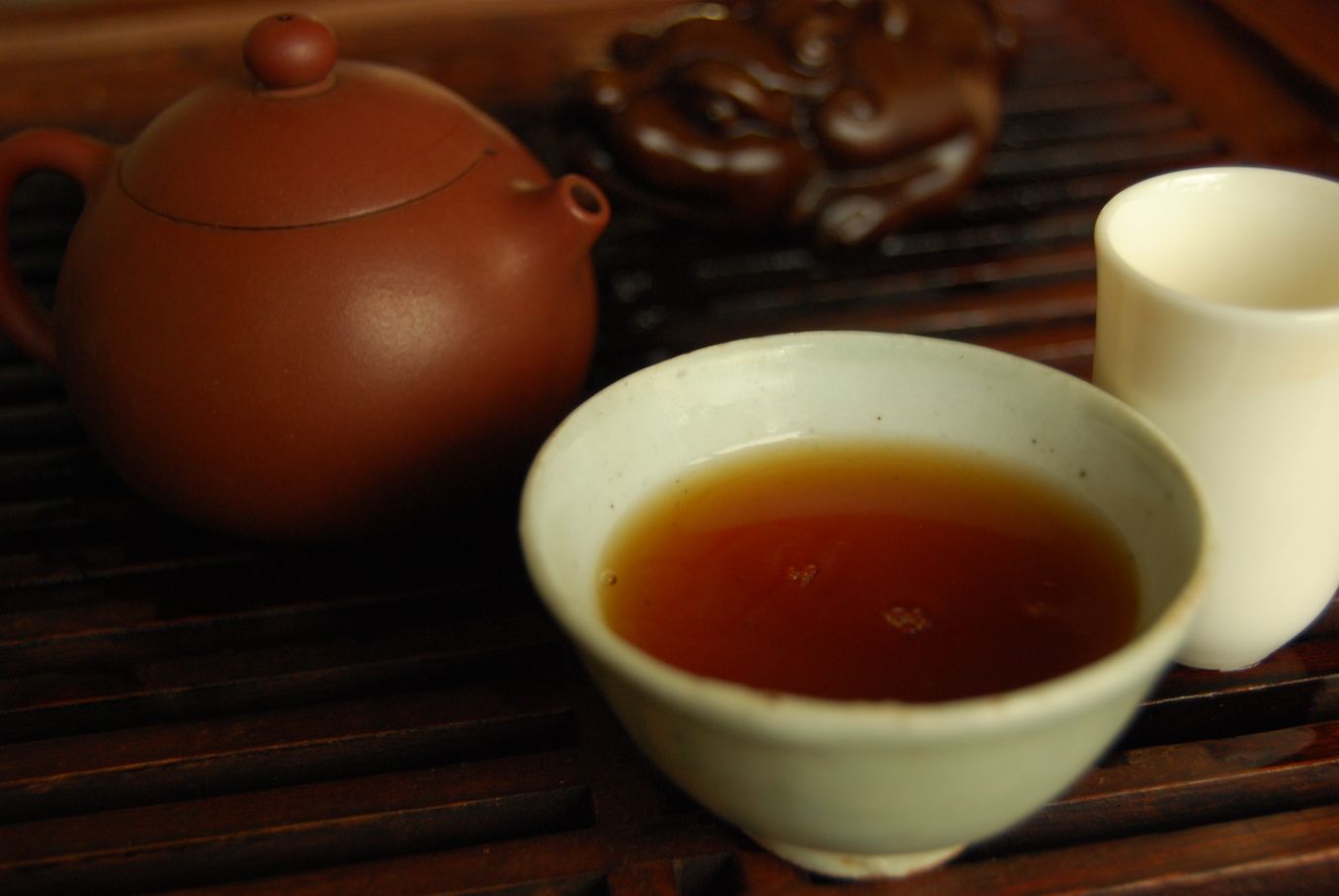
The colour, as shown above, is likewise solid - it has the golden meniscus that provides good contrast, and where its body is fat, chunky, and very pleasant.  This is a solid little hongcha, and I'm rather enjoying the session.  Perhaps next we should look at the price... $67 / 500g may seem, at first blush, quite a lot for hongcha, which is usually rock-bottom in price.  However, this tea comes with a chemical screening test from a reliable lab; if we accept that this tea is in fact similar to that which was used in the lab test, $67 for peace of mind is probably worthwhile.  With hongcha, in particular, sharp practice including the use of nasty agrochemicals is standard practice.

Thanks very much to TeaVivre for the session, which was a warming treat on a grim English day.

14 June, 2013

Tea with Mr. Twodog2

I landed in Beijing, checked into my hotel on Zhichunlu, and then called PM (a.k.a. twodog2), proprietor of white2tea.  Within twenty minutes, I was zooming through the (now entirely enormous) Beijing metro.  I visit Beijing about once per year, and each time that I visit more subway lines have been created.  When I first went to the city, almost a decade ago, there were just two simple lines (one straight line, one circular!), whereas now there are zillions.  Most of the maps available on the internet are comically out-of-date, such is the rate of tunneling.
 
What this means is that you can get almost anywhere within 45 minutes, and you can avoid sitting in the heavy road traffic.  Additionally, there is 100% mobile signal strength throughout the subway, meaning that you can even get some work done.  I chose to spend the time writing haiku, and so was busily scribbling into my diary while standing up, swaying around with the movements of the train, much to the amusement of the locals.
 
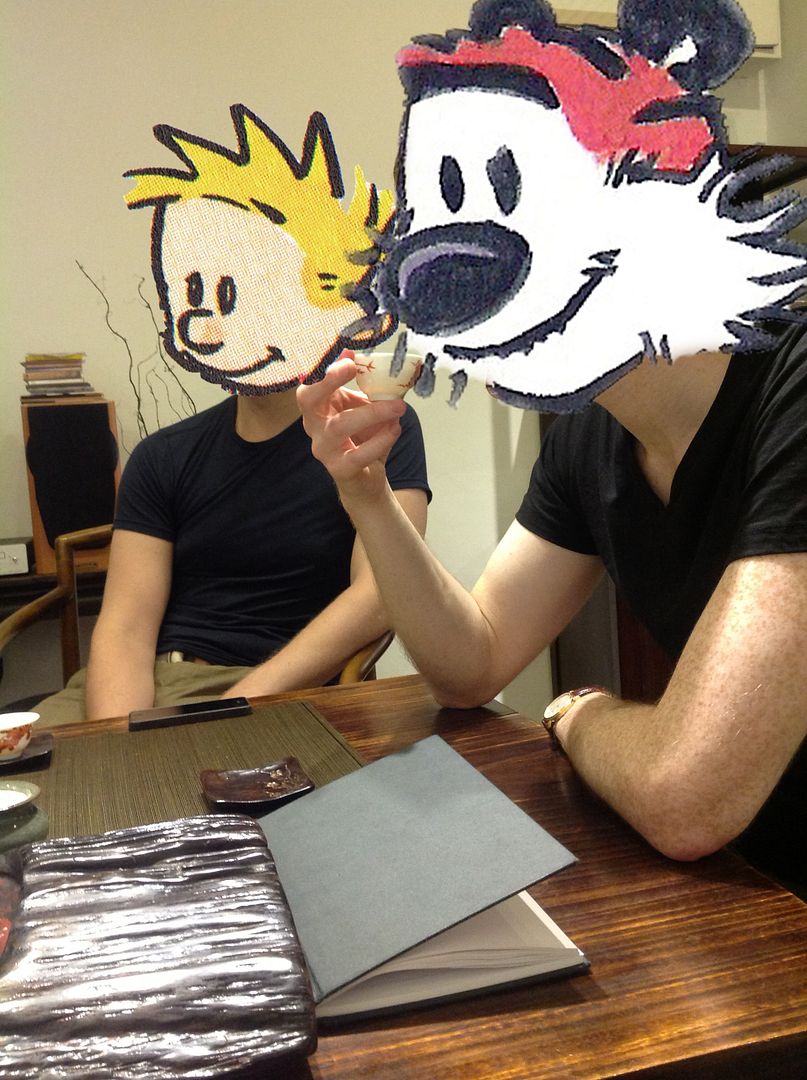
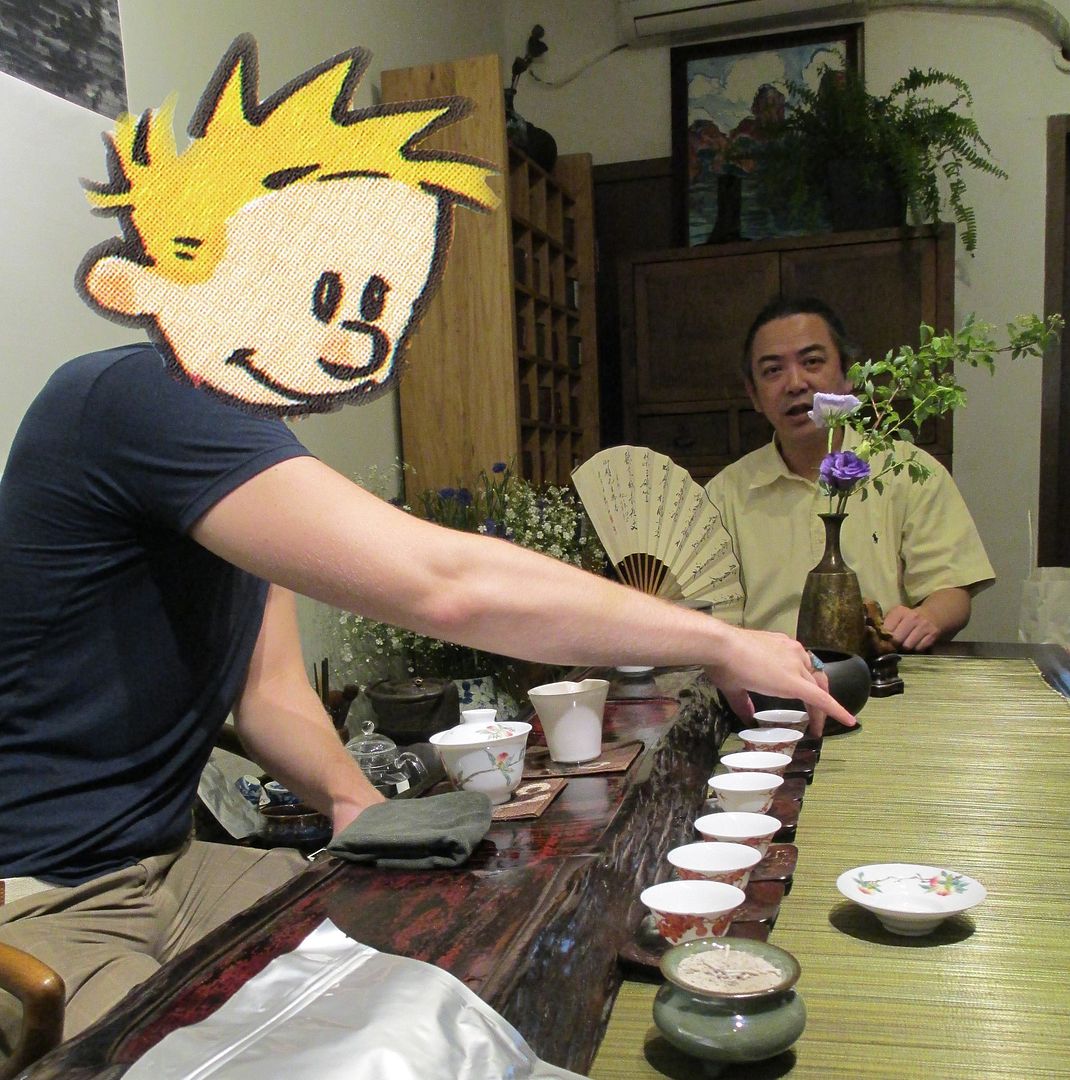
Within the hour, I was greeted at Guomao station by the blond maniac himself.  He looks almost exactly like Calvin; the photograph below is a very good likeness.


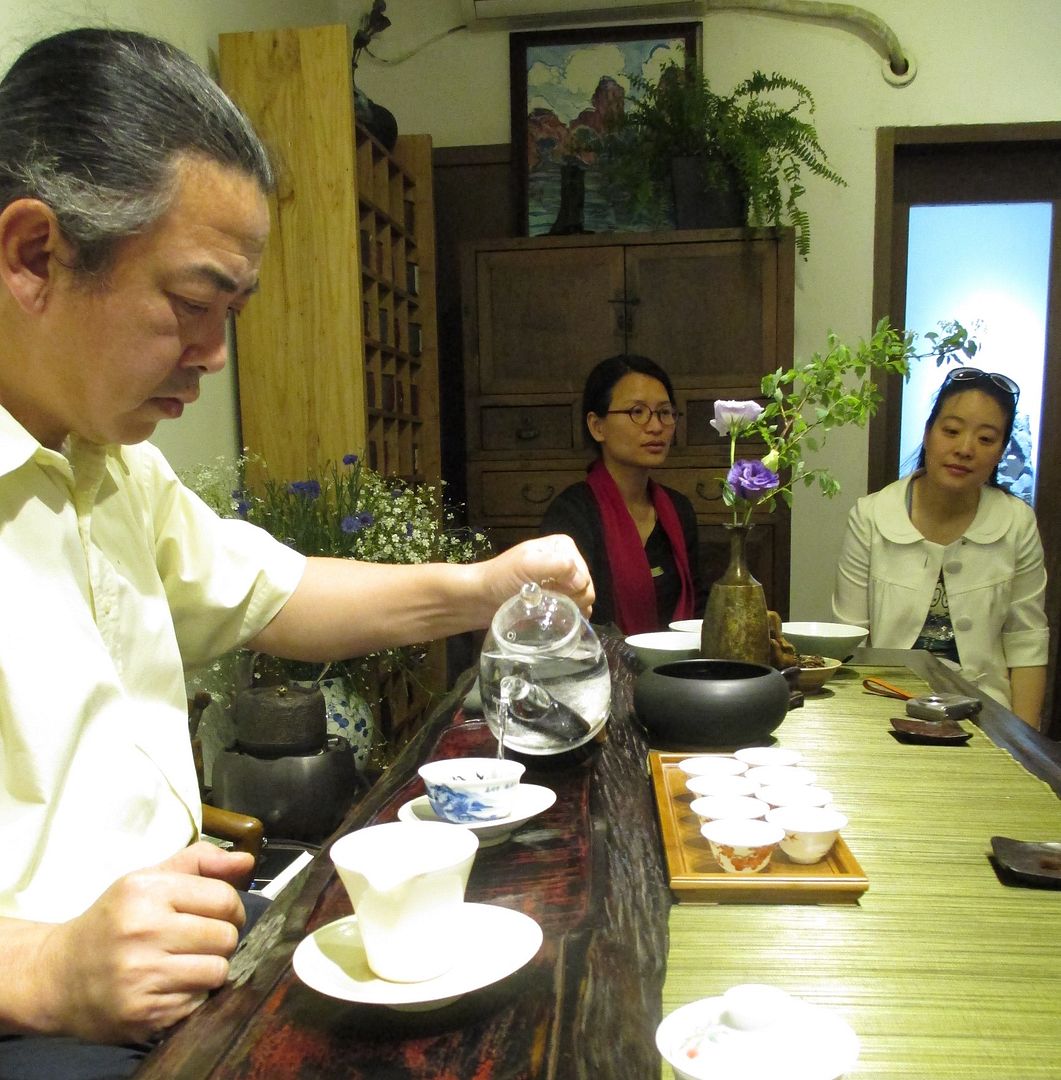
We headed to a nearby friend's teahouse, which was a very pretty little venue.  Pictured below, another visiting friend of PM's, from Taiwan, was just returned from a tea-producing expedition (I think).  My Mandarin is approximately 1% as good as PM's, who has been immersed in Beijing for several years.
 
PM stepped up to the teatable and began the brewing...


It must be something to do with the variety of people that one finds in teahouses, but this is the third time that I have visited such a place where there is a Zen  monk sitting at the table.  When I arrived, the monk came out of a little door which I assumed led to a small temple or meditation room.  I later found out that I was almost correct, and that the door led to the loo.  Spiritual insights abound in both locations.


It was a long session, and I had not eaten since the early-morning meal on the aeroplane, such was my haste to get to the tea-session!  This means that the subsequent four or so hours of drinking tea left me entirely ravenous, but I figured that this would be a good way to burn off some of my massive fat reserves before the Chinese lunches and dinners kicked in.

We started off with a 2002 Bulangshan, which I think is perhaps the cake pictured above.  Along with a 2005 Nakashan cake, PM had been generous in bringing some very good leaves with him.


Shown above, a 1995 Songpin (correct me if I'm wrong), allegedly from Yiwushan.  This was a Big Tea, and noticeably Yiwu-area, although a debate about precise regions then followed between PM and our Taiwanese colleague.  I think I'm right in calling him "Mr. Zhang".
 
18 years after its production, the 1995 cake tasted heavily of wildflowers - often a surprise to me, when I assume that floral characteristics dissipate with age.  Its constancy was a great pleasure, even after serious brewing.


Mr. Zhang then reclaimed his rightful seat at the tea-table.  Being rather English about it, I'm not particularly keen on calling tea-people "Master", but suspect that Mr. Zhang might go by that title in some circles.
 
(The very amusing owner of the tea-shop is shown above, wearing a red scarf and the 1920s spectacles.)
 
Hallelujah - his first tea was a really decent zhengshan xiaozhong from Tongmuguan (if I understood him correctly), and which reminded me of both Essence of Tea's version and Vicony's version from that canonical area for "lapsang".  I must have seemed impressed, because Mr. Zhang kindly packed me up a big bag of it.


We rolled through a Taiwanese qingxiang wulong, shown above, and followed it up with a nongxiang (yancha?) version that PM may already be selling via his web-store.


While PM stepped outside to Talk Business with Mr. Zhang, I got down to the serious business of drinking more wulong and eating snacks, my eleven-hour appetite threatening to cause me to eat my own leg.
 
At around 7 p.m., we said our goodbyes, and went our separate ways, bellies filled with great teas and heads filled with good conversation.  It was an excellent start to a busy week, and a very great pleasure to meet PM.

03 June, 2013

Tolkien Knew Best

It seems that I am always banging on about Tolkien's love of lapsang souchong, but it is about all that we have in common, aside from being at the same academic institution. We certainly do not share his literary or linguistic talents.  That said, Tolkien probably quite rubbish at calculus.  Heh.


2011 Tongmuguan Xiaozhong


Vicony Teas has kindly sent me a rather large pile of this most delicious of hongcha, for which I am most grateful.
 
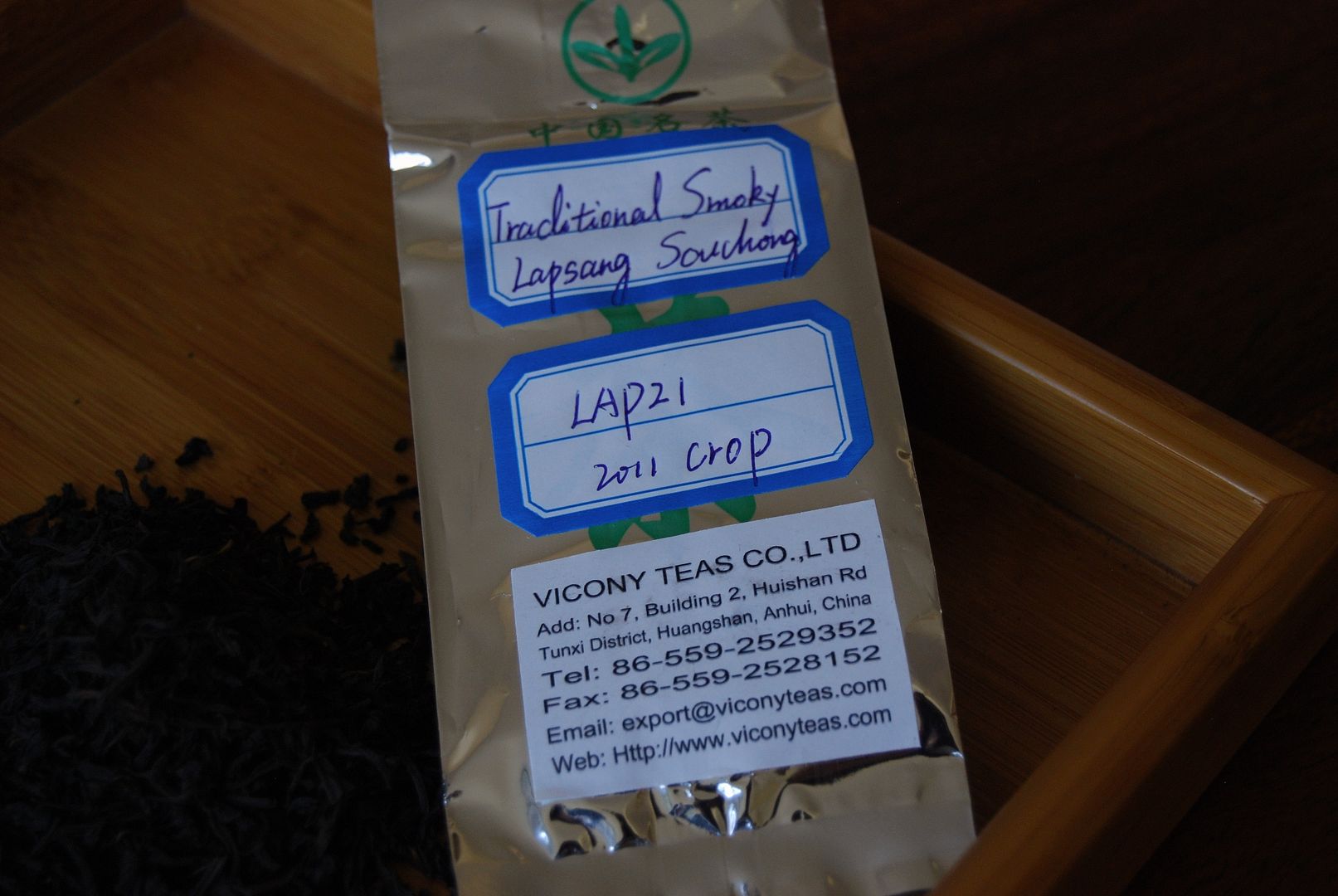
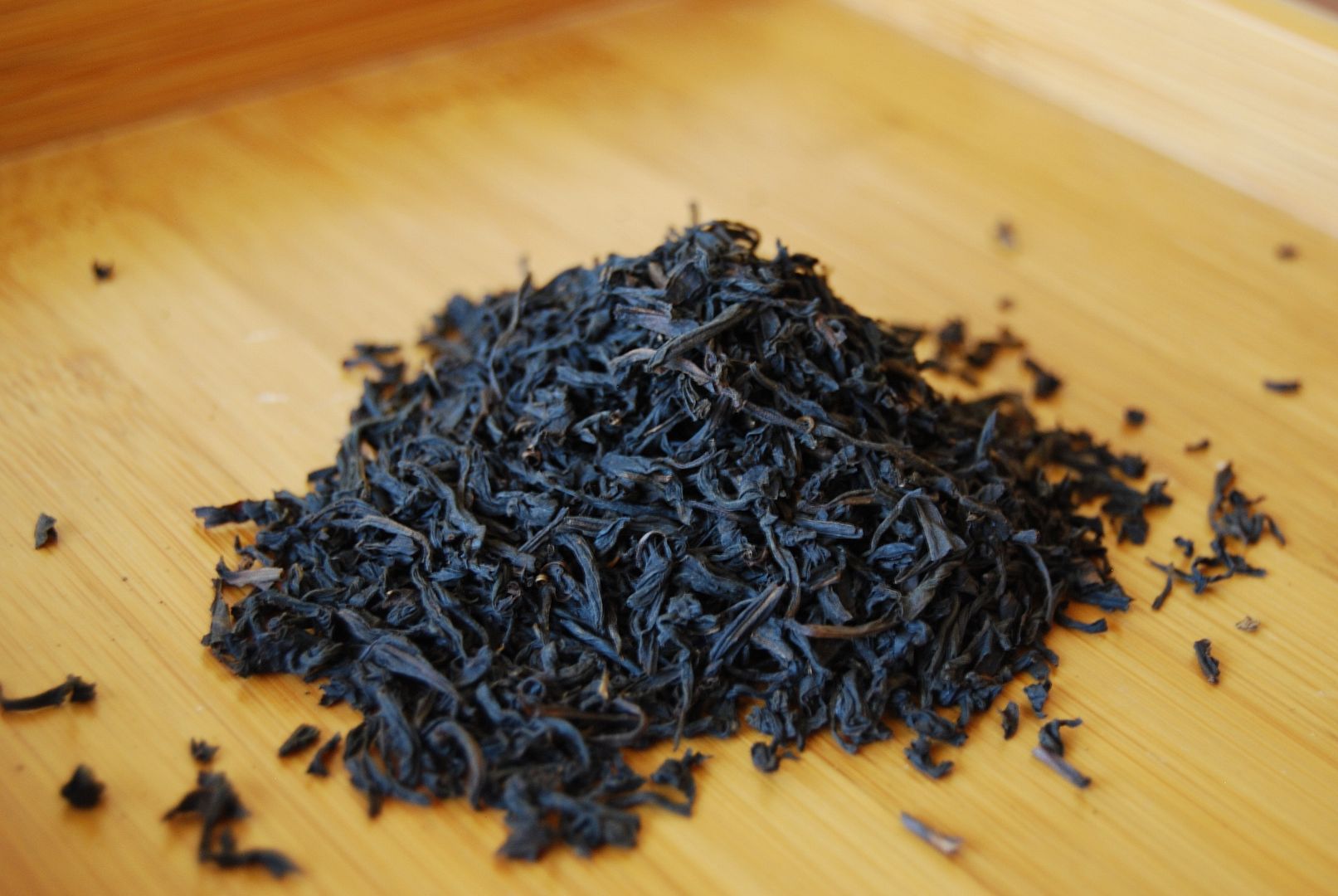
Tongmuguan [where "guan" refers to a mountain "pass] is in the Xingcun village area of Chongan county, within the Wuyishan area of Fujian.  This makes it Real Lapsang.  As you can see from the above, this 2011 Tongmuguan Xiaozhong is sold under the "LAP21" code at Vicony.


2011 Tongmuguan Xiaozhong


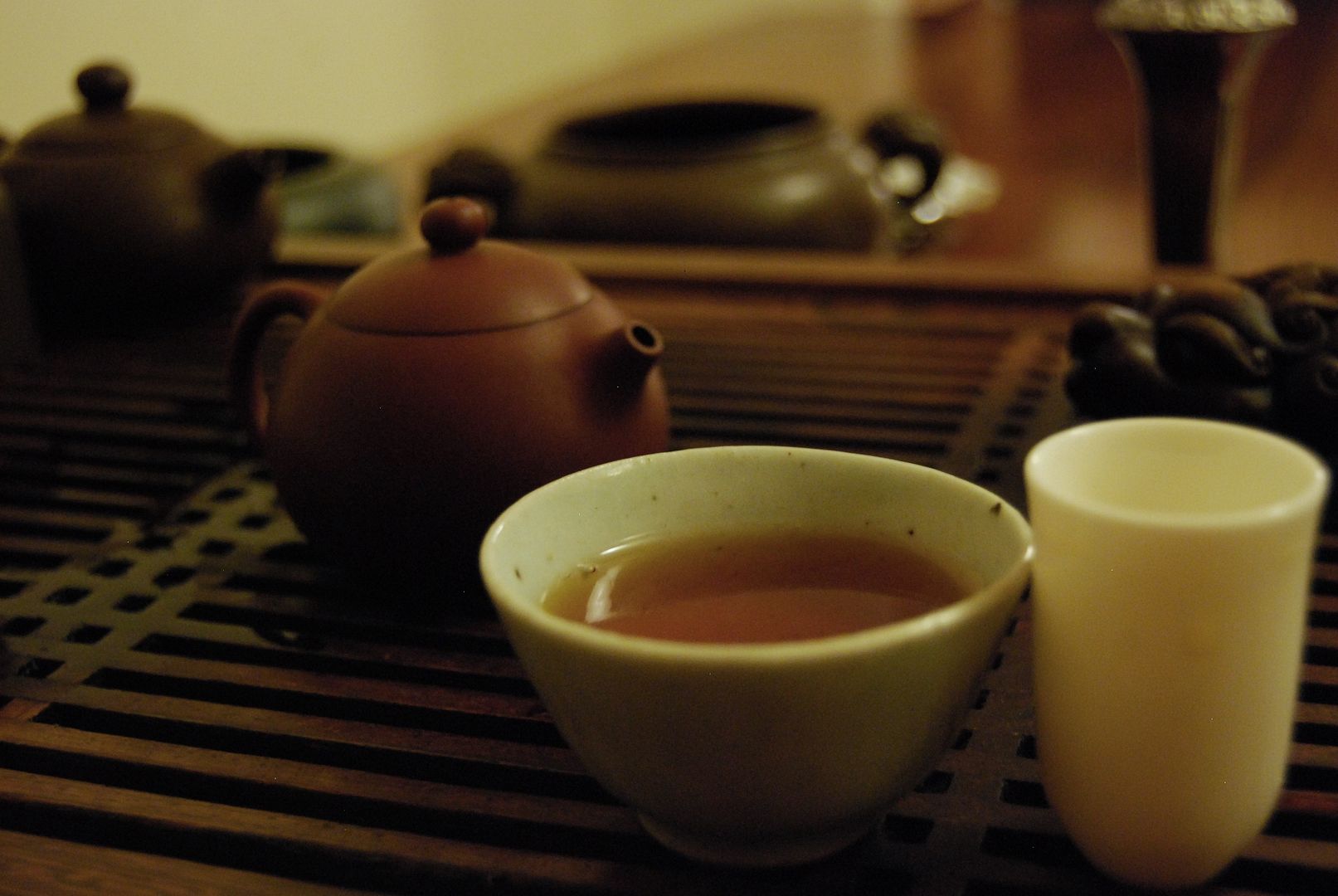
The soup, shown below, has a vibrant heaviness that is instantly appealing, and somewhat unusual in hongcha.  Along with its huigan [returning sweetness] and cooling sensations, we could be forgiven for thinking that this was hongcha at all.
 
This is a light tea - fresh, sweet, and clean, but very light.


2011 Tongmuguan Xiaozhong


You may be familiar with my own tastes in lapsang souchong, which require heavy robustness; this Tongmuguan is charming, but a little too elegant.  "Where's the beef?" sort of territory, perhaps.


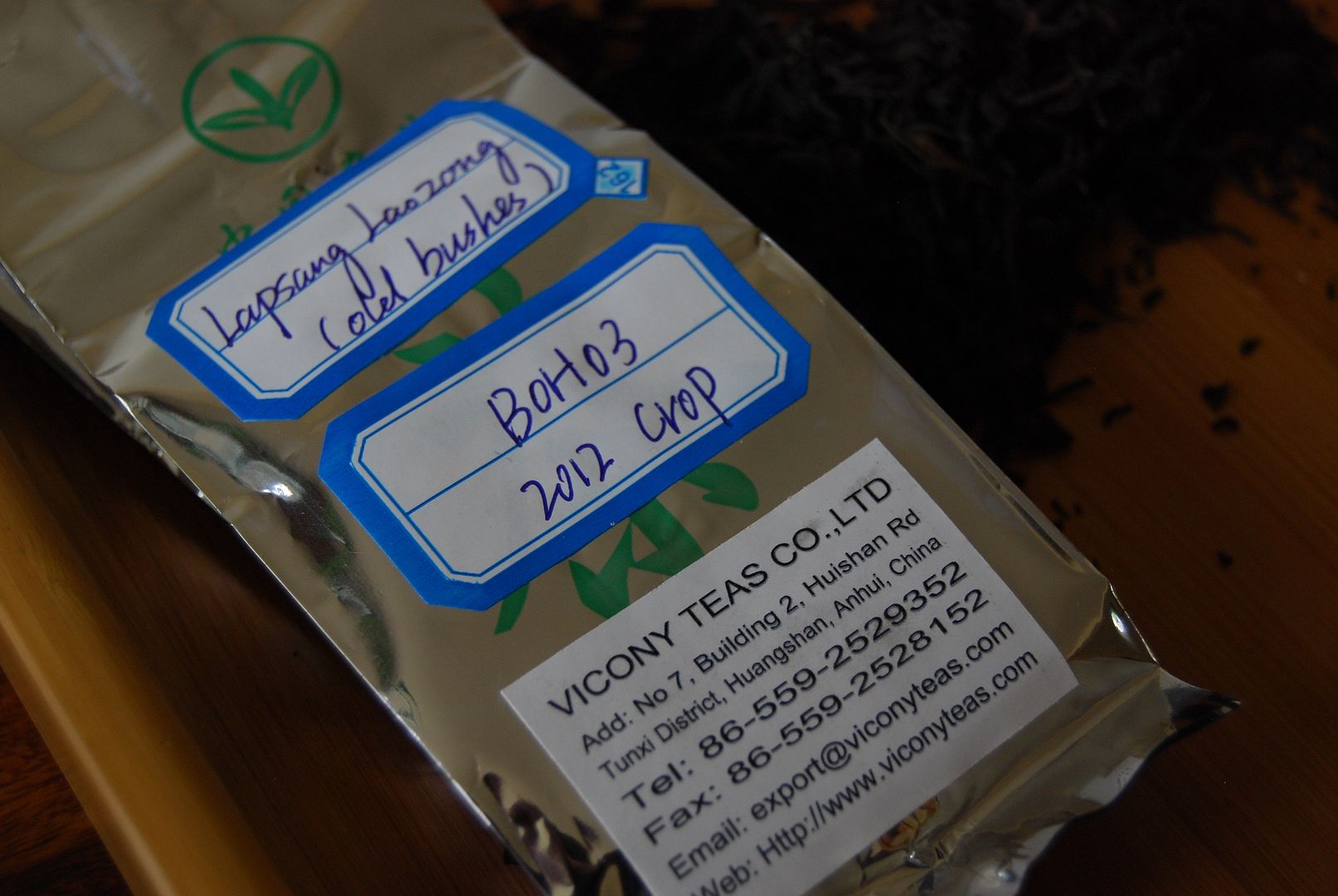
The "BOH03", pictured below, is a laocong [old bush] version.


2011 Tongmuguan Xiaozhong


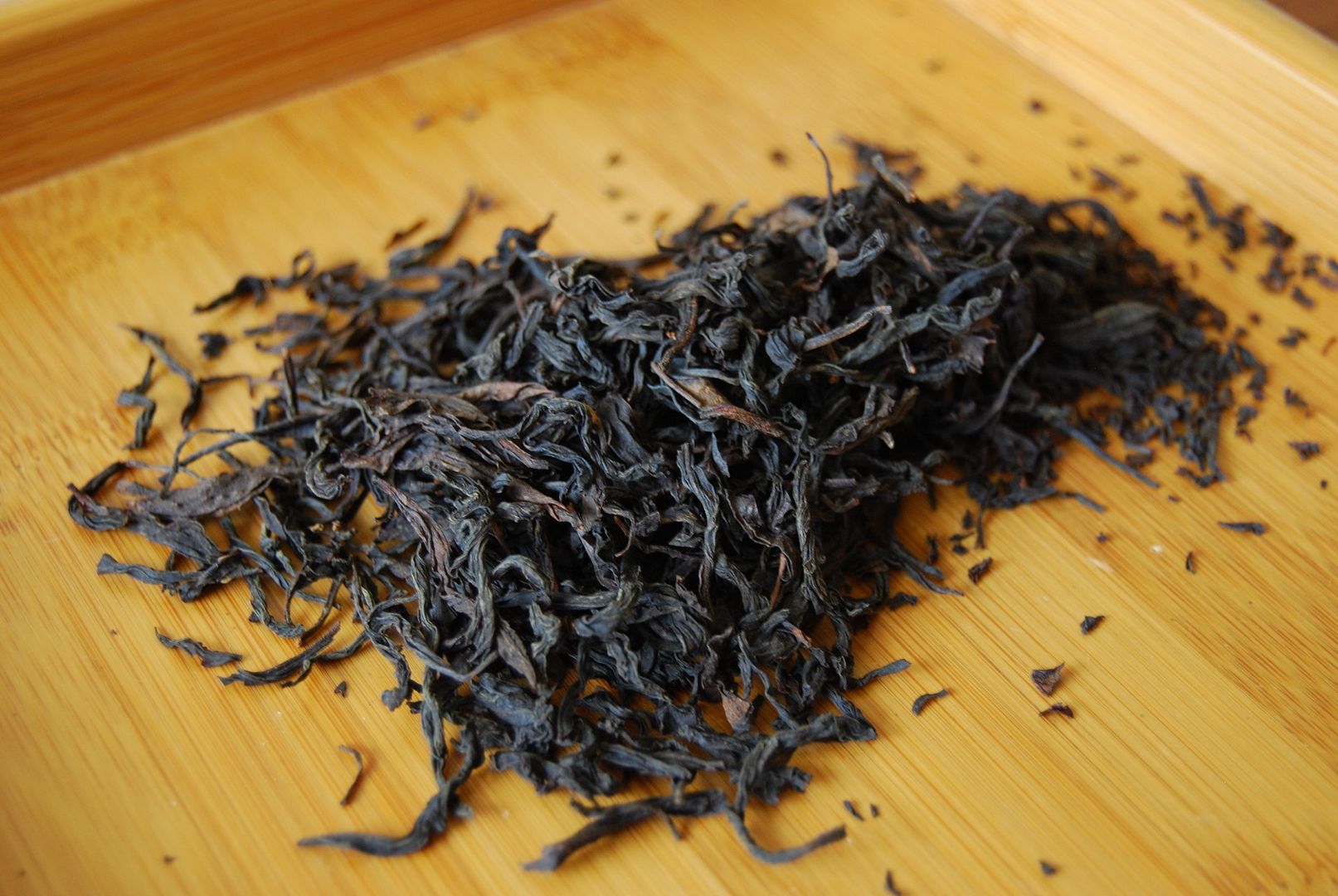
It looks rather like orthodox yancha, in fact, as shown below, although it tastes like a buttery hongcha (which is very pleasant).  Vicony calls this "bohea" which is a synonym for Wuyishan tea.  It seemingly derives from 30-year-old bushes in Tongmuguan.


2011 Tongmuguan Xiaozhong


The scent of this tea is strong - and fills the nose with sweet pine.  We may be onto something here.  It has less pine-smoke in its character when sipped, but much in the way of cooling sensations.  While the opening is a little lighter than the previous Tongmuguan, the finish is much more strong.  My journal has "more hongcha than lapsang", but what it does, it does very well.


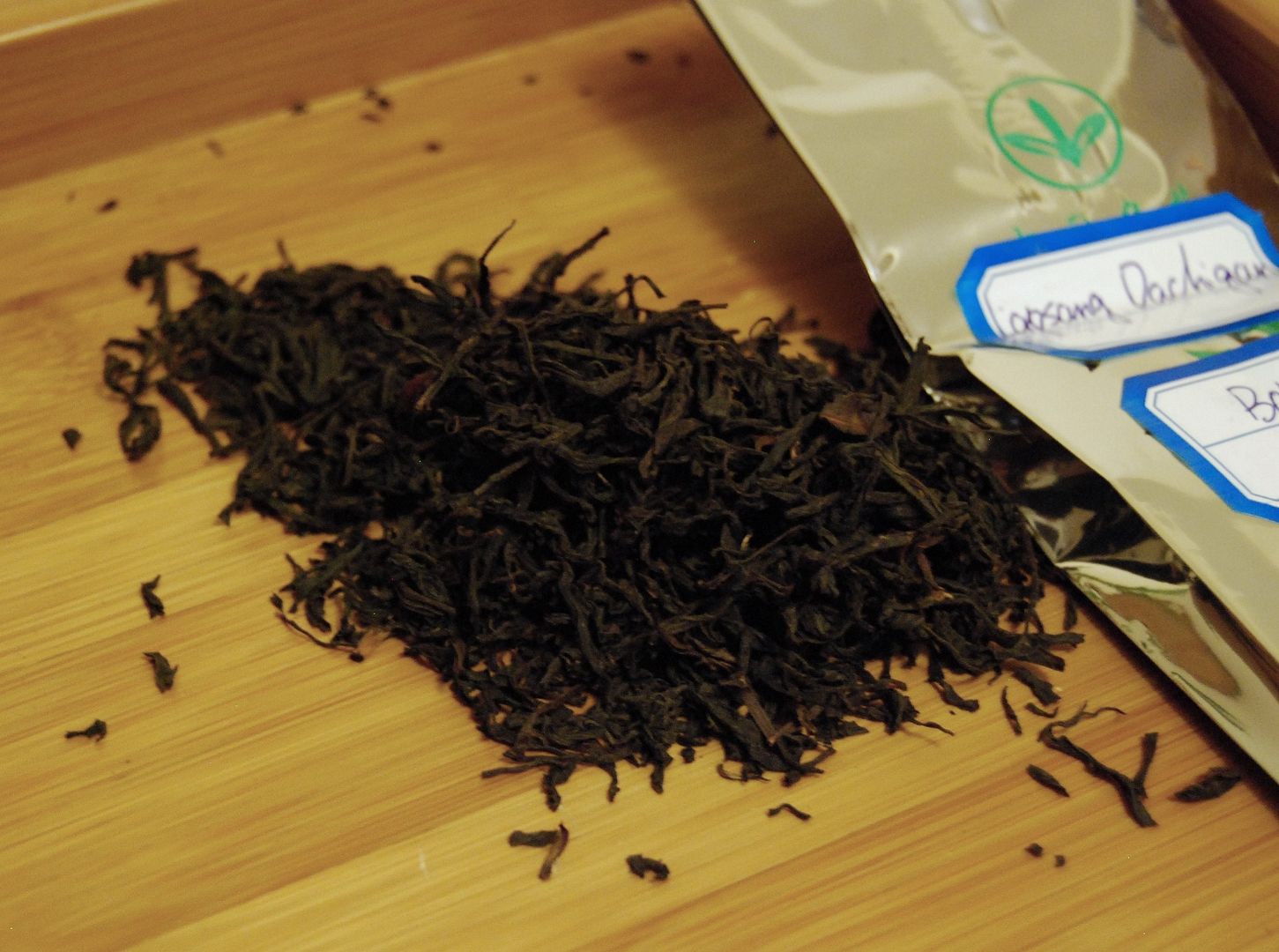
Finally, the 2011 "Dachigan" [great red sweetness] has medium-sized leaves, pictured below, falling between those of the previous two in size.  It is "BOH05" at Vicony.


2011 Tongmuguan Xiaozhong


This also comes from Tongmuguan, but it is not smoked.  Perhaps that doesn't make it lapsang souchong at all.  It also has the name "Tongjunmei" [bronze junmei], which is an adaption of the famous (and frightfully expensive) jinjunmei [gold beautiful (horse)-eyebrow].  "Jin" is interesting in that it means "beautiful" but can only be applied to "jinma", a horse.  I love the specificity of Chinese.  The character has a horse radical that must be changed to a human (while still remaining "jun").


2011 Tongmuguan Xiaozhong

 
This tea took me long infusions to get much in the way of character out of it, and I wonder if its age is getting the better of it.  What remains is gentle, honey-like sweetness.  I could imagine brewing this at work, where little was demanded of it.
 
My search for the ultimate lapsang souchong continues...

18 January, 2013

2012 Douteriah, 2012 Gushu Hongcha

I wrote previously about my closet affection for Darjeeling, and it something that I typically take in restaurants and cafes if it is available, and if lapsang souchong is not.  I never, ever accept "pu-erh" when available; I've had enough rank shupu to last a lifetime, without trying any more...

This Dooteriah version of The 'Jeeling is priced between the Makaibari and Sourenee types that I tried before, all from Pu-erh.sk.


2012 Douteriah 2nd


Friends (admittedly, ones that don't care about tea to any degree) often tell me that Darjeelings all taste alike, which I consider to be heresy worthy of an immediate strike to the panoplies.  This Douteriah is significantly different from both of the other Darjeelings, primarily because it is unfathomably sweet.

It really is very sweet.


2012 Douteriah 2nd


While the broken grade looks very "Whittards-of-Chelsea" (which is not a term of endearment), the quality far exceeds anything that you'll be able to find in such grotty outlets.  The character is immediately refreshing, clean, and very well-made.  The sweetness piles into the mouth from the very first infusion, and simply refuses to leave until the session is finished, some eight or so infusions later.


2012 Douteriah 2nd


If you enjoy second-flush Darjeeling, then something like this is a textbook example of the lightness and accessibility for which the genre is typically appreciated.  As a diehard Dianhong fan, I prefer something a bit more aggressive, though, which leads me nicely on to...


2012 Gushu Hongcha


...a hongcha seemingly made out of gushu leaves.  Yes, this is a crazy fate for such lovely leaves, akin to "gushu shupu", if perhaps not quite so eyewateringly cruel to the leaves.  However, if you are going to turn your gushu into hongcha, then you want to be doing it this way.


2012 Gushu Hongcha


The beauty of the leaves, pictured above, has been preserved, in stark contrast to the fragmentation of the Darjeelings that I have been recently enjoying.  Every now and again, the bright orange fur of a tip can be seen; the entire room smells of bright, clean hongcha maltiness on opening the sample bag.  This was a very good session, even before the water boiled.


2012 Gushu Hongcha
My Xishi pot for hongcha is rather, how can I put this?, "nipply"...


As far as hongcha goes, this is really very good.  It even has something approximating huigan, and leaves the breath in the nose feeling positively iced, such was the cooling sensation.  It is sharp, heavy, very beefy, and entirely enjoyable.  You can't fault a bit of beef in your hongcha.

If there is but one criticism, it is that, being hongcha, it tends to give up after around six-eight infusions.  This is churlish, given that the leaves have been fully oxidised, but is worth noting; even good leaves, as these undoubtedly are, cannot hold up to a long onslaught if they have been entirely reddened.


2012 Douteriah 2nd


A final flourish is shown above, with the long leaves of the gushu hongcha and the chopped sweetness of the Douteriah on the left and right, respectively.

I need to drink more hongcha.  I am therefore exceedingly grateful to Peter for giving me the opportunity to step outside my usual routine, and enjoy a genre of tea that constantly thrills me; while less exalted than the complexity of pu'ercha, a good hongcha is a very different and almost incomparable experience.  Great stuff, when done right, as in the case of this set from Pu-erh.sk.

11 January, 2013

2012 Makaibari, Sourenee

There is a significant part of my "tea life" that never makes it onto these pages, merely because it is such an integral part of the background radiation that exists behind the pulsars and quasars of pu'ercha.  A recent package from Peter of Pu-erh.sk (thanks again) gives me the opportunity to write about that background activity: Darjeeling.


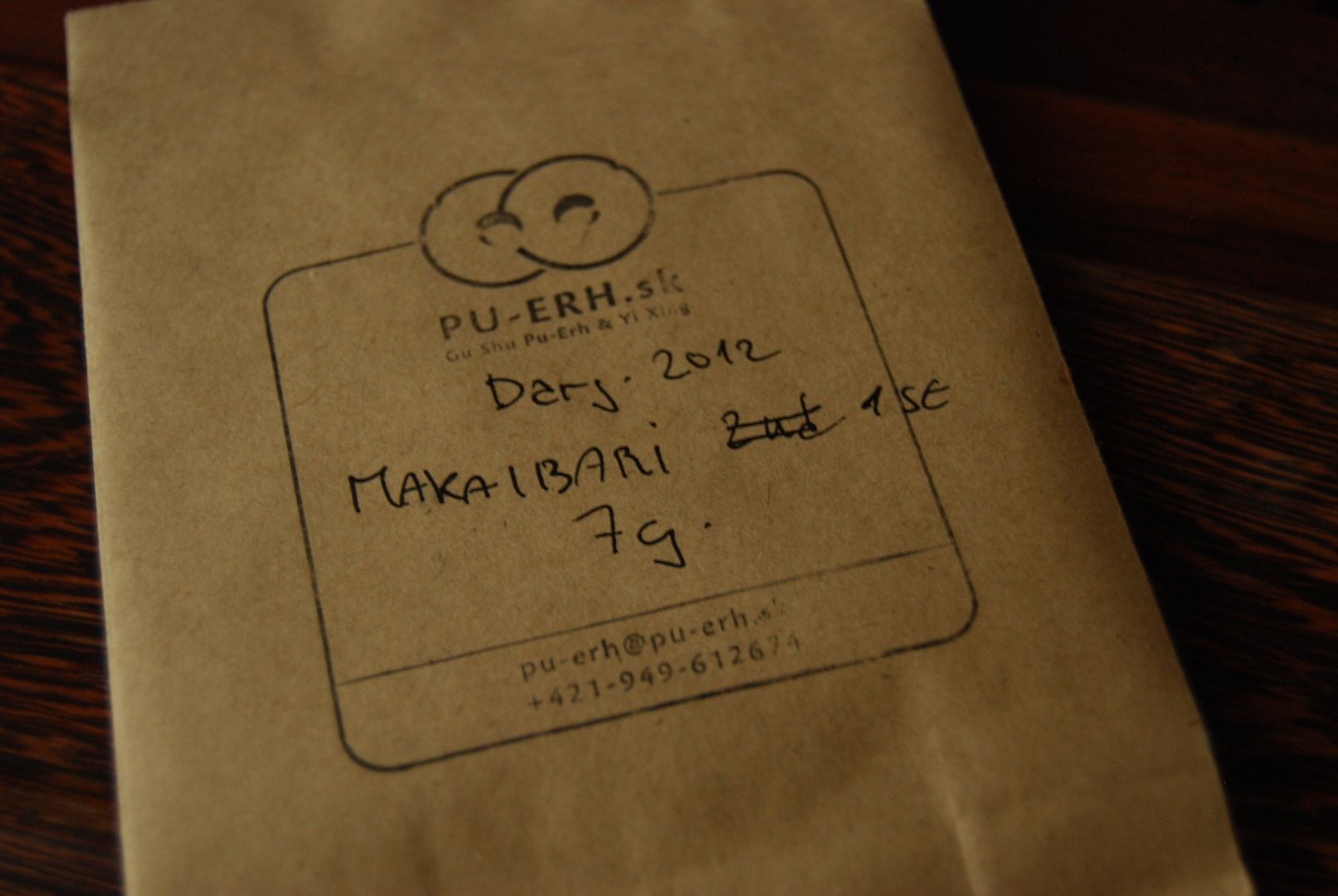
2012 Makaibari


Darjeeling is often referred to, in those Western books on tea that exist (all of which are entirely horrific and need to be pulped by their publishers) as being the "champagne of teas".  This is a disservice to both champagne and tea, but suggests that the writer is aiming to say that Darjeeling is, in some sense, refined.  A quest for "refined" tastes is doomed to failure, and is more than a little pretentious.  Darjeeling is so much better than that. 
 

2012 Makaibari


Peter's Darjeelings are three, and this Makaibari is the first and best.  It is also the only first-flush Darjeeling in his trio, whereas the others are second-flush.  The distinction in Darjeeling is perhaps not as enormous as with pu'ercha; the difference between spring and autumn crops in pu'ercha can be marked: springtime leaves are vivid and powerful, autumnal leaves are usually more easy-going, fruity, and less potent.  With Darjeeling, some of this is true: first-flush leaves are usually more vivid and, I think, more complex; second-flush teas are often a little lighter.


2012 Makaibari


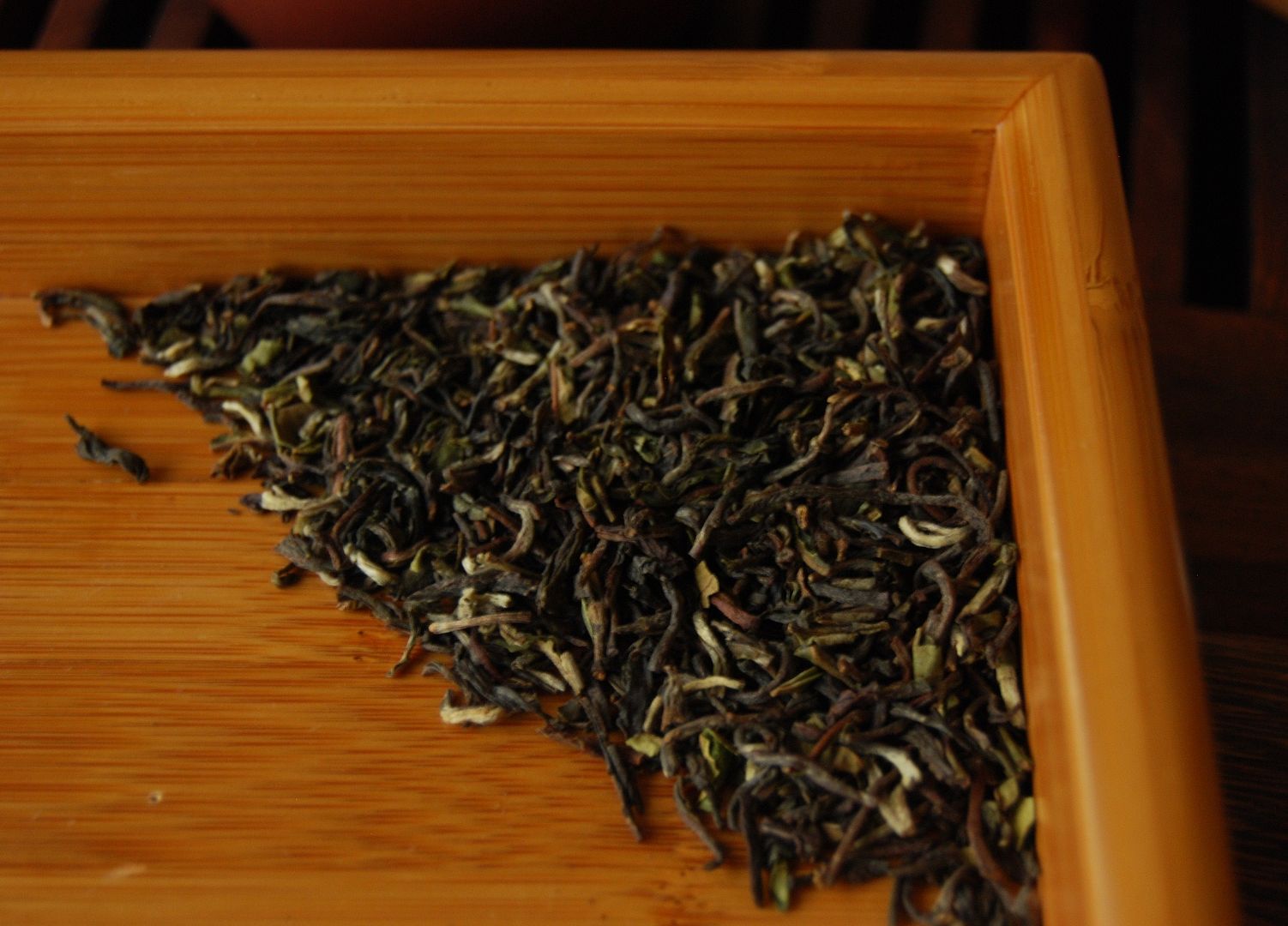
The Makaibari is seriously delicious Darjeeling which I enjoyed hugely.  At 6.90 Euro / 50g, it is nicely priced.  Some of this reasonable pricing should be attributed to the grade: I recall from the web-page that all three teas are listed as "SFTGFOP", which is the very highest grade of Darjeeling (or "seriously far too good for ordinary people").  While the leaf quality is there, you'll see from the photographs of all three of these teas (two of which I tried today) are really very broken; they should therefore be some derivative of FBOP (flowery broken orange pekoe), for which the prices are considerably depressed with respect to those for actual FOP (flowery orange pekoe).  You lose quite a bit when the leaves are almost entirely halved or quartered, including endurance.

That comes through in the brewing of this tea, where it runs out of steam after a half-dozen or so infusions; however, the quality of the leaf is clear, and makes for a rather thrilling set of brews while the leaves can hold up to it.  This Makaibari is a very complex example of Darjeeling, and contains the whole spectrum of chocolate, malt, honey, and sugar-sweetness, drenched in a heavy overcoat of wildflowers.  It is not too fanciful to write so, I maintain, because the entire body feels like heather and lavender.  It is quite a magnificent little tea.


2012 Sourenee SFTG 2nd Flush


At the other end of the scale is Sourenee, a second-flush version.  As with the Makaibari, the leaves are broken:


2012 Sourenee SFTG 2nd Flush


It is also a much more mainstream Darjeeling, that does not scale the heights of the Makaibari, and made for an excellent comparitor.  This is very typical "everyday" Darjeeling, with a good range of maple and muscatel, although presented in a much lighter soup courtesy of its second flush.


2012 Sourenee SFTG 2nd Flush


After seven or so infusions, it continued to doll out enjoyable jugs of pinewood sweetness, with some subtle flavours of good honey.  I would take the Makaibari any day of the week, however, and am beginning to look longingly at the product web-page, which is a sure sign that I will be getting some soon, for consumption in meetings, where its quite high caffeination will keep me awake (as is typically my problem in meetings).

Thanks again to Peter for the introduction to these very enjoyable Darjeelings.