Today's subject: a few cakes bought for me by proxy (thanks MarshalN), also covered here and here. The first issue with this cake is, of course, its name. It doesn't really have one. The wrapper:

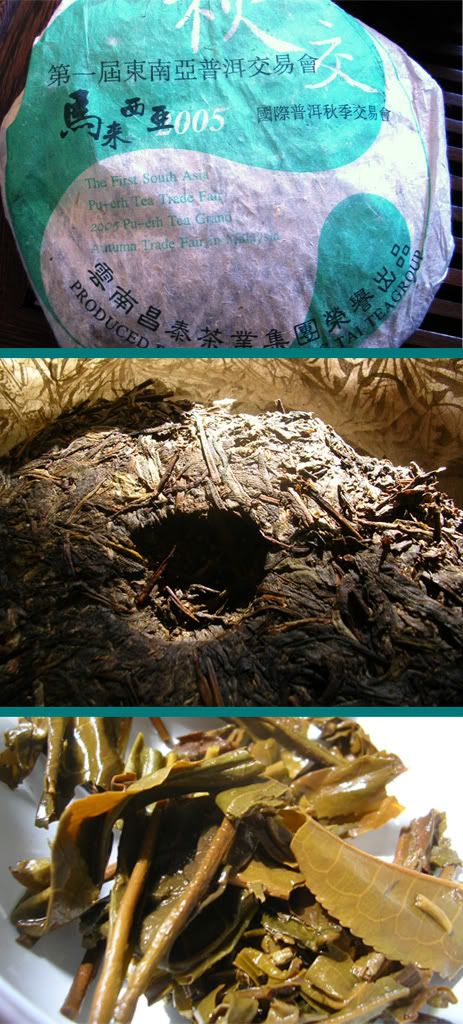
The title, just clipped off the top of the frame, is the usual "Yiwu Zhengshan Qizi Bingcha", [Yiwu Proper-Mountain Seven-sons Cake-tea]. The name of the manufacturing company is a little tortuous, in the traditional manner: "Zhongguo Yunnan Yiwu Xingshunxiang Chachupin" [China Yunnan Yiwu Prosper-Good-Luck Tea Factory Export Products]. Hmm. In the absence of a "real" factory name, as you can see from the title of this article, I've plumped for "Xingshunxiang".
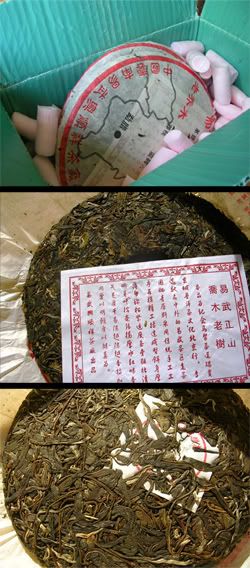 Interestingly enough, the main wrapper is in Simplified Chinese, while the producer's name is written in Traditional Chinese, presumably for the traditional handwritten effect. Small factors like this prove to be obstacles to my poor abilities in Chinese.
~10cl Caledonian Springs @ 100C in 20cl shengpu pot; ~6-7g leaf; 1 rinse
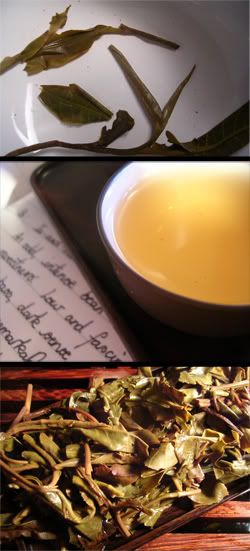
Dry leaf:
Fairly tippy, quite dark, with a good number of whole leaves. The two bing have been sitting on the dining table for an hour, and the room is filled with a sweet, rich aroma. It has a slight hint of smoke to it.
3s, 3s, 5s, 5s, 5s:
Good, clear soup. The initial infusion's beidixiang is startling: solid, low, roasted beans - quite unique. It then gives way to a long lengxiang of Yiwu sweetness. This complexity of aroma lasts only for the first two infusions: it then becomes just gently sweet. Does this have a parallel effect in the flavour?
Thankfully not. The flavour is low and fascinating, - genuinely very interesting. It is definitely "tea", but it has a rich, low surround that is quite unusual. It is almost food-like, being something of roasted grain. There is a hint in the nose of a smokey hint that could develop if the infusions were not kept short.
 Keeping the infusions to the lengths above almost completely avoids ku [bitter astringency]. Just to see if any was present in the tea at all, I brewed one a little longer, and sure enough it appeared - but it can be completely avoided, and the tea kept excellently flavoursome, by keeping to such short infusions.
The texture is thick, being smooth on the lips and coating the mouth. The patience is moderately slow. The key feature to this tea is that remarkably rich flavour: so "foodlike", but also so clearly straight "tea".
Some green character starts to show around the fourth infusion, in which it becomes a little rougher.
Wet leaves:
Strong, healthy, with representation from all grades. Quite whole and appealing.
Overall:
The Yiwu flavour is definitely present, sweet and enjoyable, but there it is accompanied by that rich, sub-Yiwu flavour that makes this cake quite unique. Time can, I trust, knock out the corners of this cake, most noteably the green that stepped up around the fourth infusion, and the hint of smoke in the aroma (the development of which can be avoided with care).
It is infuriating that such cakes are unavailable outside China.
The title, just clipped off the top of the frame, is the usual "Yiwu Zhengshan Qizi Bingcha", [Yiwu Proper-Mountain Seven-sons Cake-tea]. The name of the manufacturing company is a little tortuous, in the traditional manner: "Zhongguo Yunnan Yiwu Xingshunxiang Chachupin" [China Yunnan Yiwu Prosper-Good-Luck Tea Factory Export Products]. Hmm. In the absence of a "real" factory name, as you can see from the title of this article, I've plumped for "Xingshunxiang".
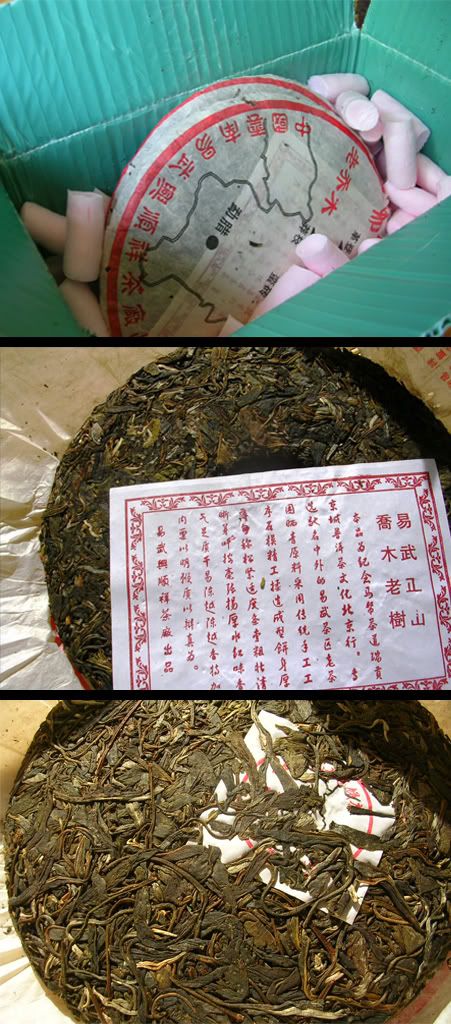 Interestingly enough, the main wrapper is in Simplified Chinese, while the producer's name is written in Traditional Chinese, presumably for the traditional handwritten effect. Small factors like this prove to be obstacles to my poor abilities in Chinese.
~10cl Caledonian Springs @ 100C in 20cl shengpu pot; ~6-7g leaf; 1 rinse
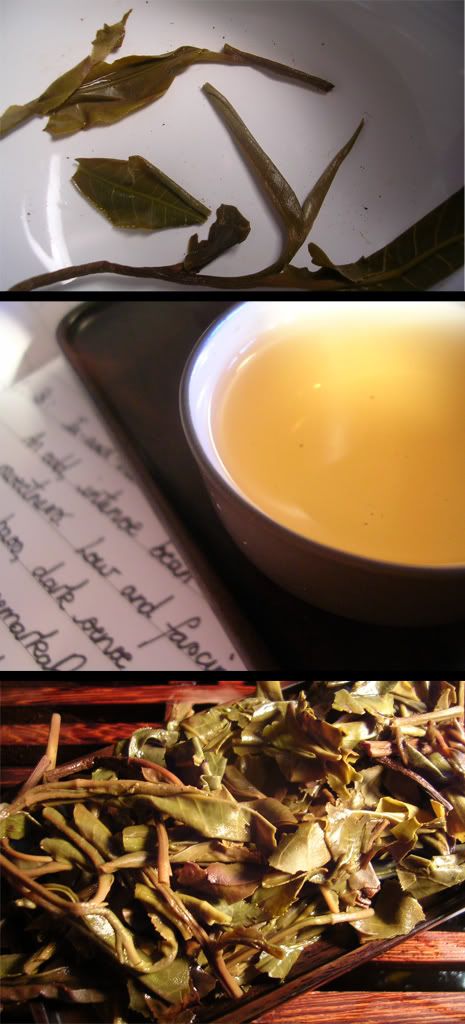
Dry leaf:
Fairly tippy, quite dark, with a good number of whole leaves. The two bing have been sitting on the dining table for an hour, and the room is filled with a sweet, rich aroma. It has a slight hint of smoke to it.
3s, 3s, 5s, 5s, 5s:
Good, clear soup. The initial infusion's beidixiang is startling: solid, low, roasted beans - quite unique. It then gives way to a long lengxiang of Yiwu sweetness. This complexity of aroma lasts only for the first two infusions: it then becomes just gently sweet. Does this have a parallel effect in the flavour?
Thankfully not. The flavour is low and fascinating, - genuinely very interesting. It is definitely "tea", but it has a rich, low surround that is quite unusual. It is almost food-like, being something of roasted grain. There is a hint in the nose of a smokey hint that could develop if the infusions were not kept short.
 Keeping the infusions to the lengths above almost completely avoids ku [bitter astringency]. Just to see if any was present in the tea at all, I brewed one a little longer, and sure enough it appeared - but it can be completely avoided, and the tea kept excellently flavoursome, by keeping to such short infusions.
The texture is thick, being smooth on the lips and coating the mouth. The patience is moderately slow. The key feature to this tea is that remarkably rich flavour: so "foodlike", but also so clearly straight "tea".
Some green character starts to show around the fourth infusion, in which it becomes a little rougher.
Wet leaves:
Strong, healthy, with representation from all grades. Quite whole and appealing.
Overall:
The Yiwu flavour is definitely present, sweet and enjoyable, but there it is accompanied by that rich, sub-Yiwu flavour that makes this cake quite unique. Time can, I trust, knock out the corners of this cake, most noteably the green that stepped up around the fourth infusion, and the hint of smoke in the aroma (the development of which can be avoided with care).
It is infuriating that such cakes are unavailable outside China.
Addendum
August, 2009
You've got to be really careful with cakes from Taobao. While searching for this, one of my old favourites from MarshalN, I found many other cakes that used the same wrapper, but with a few characters changed to represent a different factory. I very nearly bought a big pile of tea that happened to look 95% similar to my old favourite.

This is a very desirable tea. MarshalN once gave it the praise "I can't find anything wrong with this cake", which is, as his many readers will know, high praise indeed! MarshalN is not one to suffer fools gladly, nor bad pu'er. So, I had great confidence in his selection of this cake, and it turned out to be unsurprisingly delicious.

The leaves have darkened a few shades over the last two years that it's been in my possession. As you can see, they are very long, throughout the cake, and have a fine down on each leaf.
In fact, the leaves are so whole and separate, when I showed Lei the leaves in the chahe [CHA-HER, lit. tea-lotus, the dish for holding leaves] as she passed through, she asked me if it was maocha.
In fact, the leaves are so whole and separate, when I showed Lei the leaves in the chahe [CHA-HER, lit. tea-lotus, the dish for holding leaves] as she passed through, she asked me if it was maocha.

The soup is yellow-orange, with a hint of savoury brown to its colour - though this latter hue doesn't come out very clearly in the photograph below. I often find that this correlates with a savoury character in the flavour, and it's a beany, savoury component in this tea.

It has a broad base of "tea" flavour, with some tangy melon or grapefruit. This hands over to a long huigan, and a yunxiang [YOON-SHEEANG, return-aroma] of tobacco. "This ends in tobacco!" agrees Lei. "A very nice tea."
It is a little "loose" and watery, despite my use of tons of leaf, but it is decidedly thick, and has some vibrancy on the tongue.
It is a little "loose" and watery, despite my use of tons of leaf, but it is decidedly thick, and has some vibrancy on the tongue.

We agree to buy two tong of this tea, which is rather a landmark, as Lei is typically very conservative about buying in quantity - and rightfully so, I'm far too eager.
From the fifth infusion onwards, it is woody, pleasantly straw-like, and very sweet. It lasts happily into 15 infusions, by which time we are thoroughly filled with good tea.
From the fifth infusion onwards, it is woody, pleasantly straw-like, and very sweet. It lasts happily into 15 infusions, by which time we are thoroughly filled with good tea.
Addendum
June, 2010
It's nice to be back with an old friend.

This trial cake from Taobao turned out rather nicely, in that it's the same as the originals kindly provided by MarshalN.

At just RMB75, it's a complete bargain. While I can no longer agree that I "cannot find any flaws in it", it remains thoroughly excellent for its price.

I continue to appreciate its straw-like sweetness, but both this and my original cakes seem a little less complex, and a little more straightforward and "Division B", than I'd like. That is merely to state the obvious, that this isn't flawless tea. Indeed, these are minor quibbles when set beside the price - what 2006 cakes can you get for $10 these days?
Addendum
January, 2014
I am drinking this at 3 a.m. This tea, in its current state, reminds me why I drink pu'ercha. Now eight years of age, it is "old fashioned" and reminds me of the honest, solid teas that I have enjoyed in Maliandao over the years. Now orange, its robust Yiwushan sweetness-and-tobacco is pleasing - that and the fact that it cost something like 75 RMB. The body is now clean and dense; it has a heavy kuwei [good bitterness]. I am pleased to see that it has "Oxford" storage: it is neither damp nor dry. Our cold, temperate humidity has brought in on well.
It later surprises me by developing the character of slightly-scented wood; it is akin to pine and herbs. "Just like Maliandao", I wrote in my diary, and that is something of a compliment.
It later surprises me by developing the character of slightly-scented wood; it is akin to pine and herbs. "Just like Maliandao", I wrote in my diary, and that is something of a compliment.