You have to admit, this tea has a great name. I don't know if "Hong Kong Henry Trading Co." really exists, but if doesn't, it should. Fantastic.
This cake is $78 from
Houde, where it is noted that the cake sports a neifei in both faces of the bing. I've had the notes for a while, and thanks to DV for reminding me to publish them.
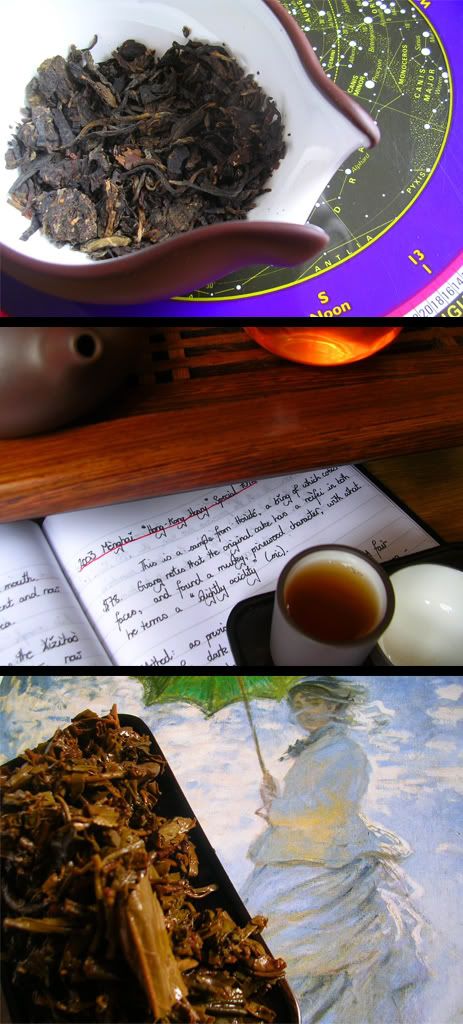
Dark brown, with large fragments of leaf. A fair number of tips are visible. It is sweet wood in aroma, which agrees with Guang's observation of "pinewood". There are some good tobacco notes underneath the main scent.
The Houde description draws the similarity between this cake and the aroma of inksticks used in Chinese calligraphy, nicknaming it the "Scholar 7542". Given the brutally acidic nature of this tea, I am inclined to be less complimentary.
The soup is lucid orange. Some initial smokiness fades into a long, rich super-lengxiang of molasss. It lasts forever, dolling out plenty of dark sweetness - really, it is quite remarkable in this aspect.
Also remarkable is the aforementioned acidity. There isn't a lot of straight flavour here, as the acidity really dominates the proceedings. The closest I got was the sensation of that dark molasses undercurrent after the swallow.
The texture is decent, with a fine coating of light tea-oil on lips and tongue. As with the
1985 Yiwu Tuocha and the
2007 Xizihao Dingji, the contact-based energy of this tea is quite special, and leads to that similar numbing sensation wherever contact is made.
It settles down into a green, menthol opening, before quickly diving into pure acid in the centre of the tongue, and in the throat.
If battery acid were made out of molasses, this is it.
"This tea is like drinking earth", notes Lei as she briefly passes through, and indeed the opening flavour in the later infusions does taste like soil suspended in water - prior to the attack of the omnipresent acid.
Small and green, the wet leaves are chopped quite deliberately.
Overall:
For me, this isn't quite so much a "Scholar 7542" as much as it is a young waif with a bitter, acidic temper. It is hard to make judgements as to its future given that the majority of the molasses-based flavour is obscured by the acid. I'd like to revisit this in five years. Ouch.
Addendum
February, 2012
Superthanks to HC for providing me with a sample of this tea that I had previously written off, due to its acidity and bitterness during its youth. With some extra years on the clock, has this cake settled down?
In 2007, this cake was $78, which seemed a huge amount, at the time. That Houde's proprietor called this a "scholar tea" used to make me weep big tears, but it is now almost a decade old, and perhaps the times they have a-changed.
I am reminded that the blend contains plenty of stems and other welcome additions to the mixture, such as the odd huangpian [yellow-flake, the outer leaves that are often discarded by hand], pictured below.
Much has happened: this orange-souped little fellow now delivery a sweet, sharp, pinelike cup with an excellent body. The texture is heavy and smooth, a far cry from the rough terror of its immediate youth. The acidity has helped it along the way, and I enjoy the result very much.
What pleasant surprises may be in store for those acrid, aggressive cakes... HC has converted me to the delights of this most enjoyable cake, with his generously-provided sample. The infusions march on longer after my capacity to drink them has passed. The future for this cake looks good indeed.
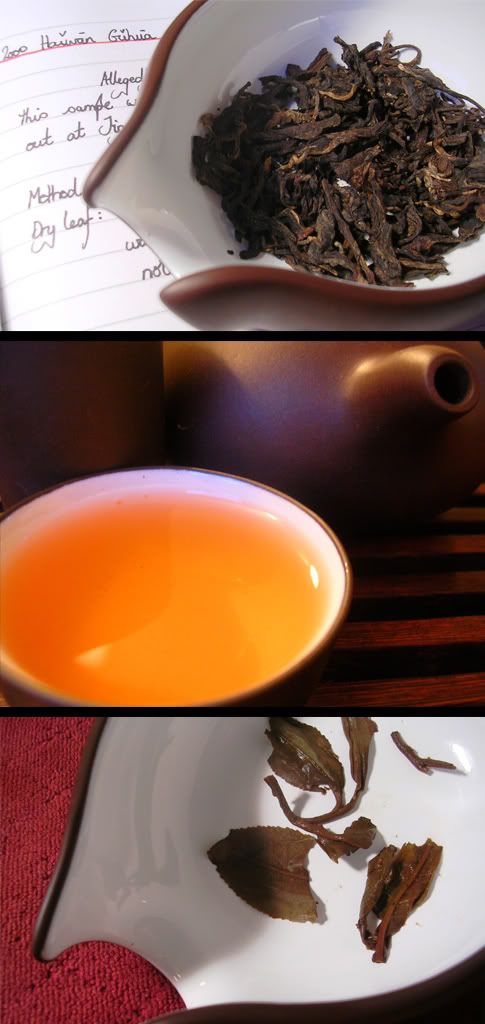 Dark leaves and in good sized pieces. They are clearly scented with a certain "ash"-like character.


