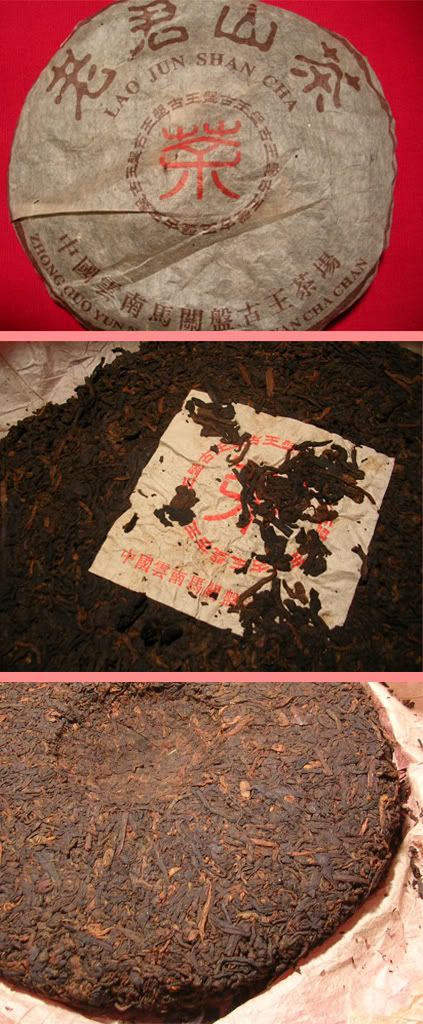
 Forming a part of Xiaomao's recent purchases from her hometown, this is a collection of just over five tongs (shupu being Xiaomao's daily drink), most of which have been left back in the Chinese house. Like the Guangnan Fenghui shengpu, she has been singing this one's praises while in China, and I'm trying my best to catch up.
Again, "Maguan" is the region and "Panguwang" is the name of the factory, which is named after the Ancient who separated Heaven from Earth in the old Chinese creation myths. "Laojunshan" [old-man mountain] is the name of the bing. I notice that their pinyin isn't quite correct... then again, it seems that only Westerners and Chinese below the age of five years care too much about pinyin.
Caledonian Springs @ 100C in 10cl shipiao pot for shupu; ~5g leaf; 2 rinses
Dry leaves:
Tiny and tippy, the cake is as dark as one would expect. There isn't much of an aroma, rather unusually. I tend to look for some dark fruits and whatnot in my shupu, but at least it isn't unpleasant.
12s, 15s, 20s, 30s, 45s:
The lack of a dry aroma is immediately dispelled by the wenxiangbei, which opens with a smooth scent that reminds me of creamed corn. There is almost no lengxiang, though.
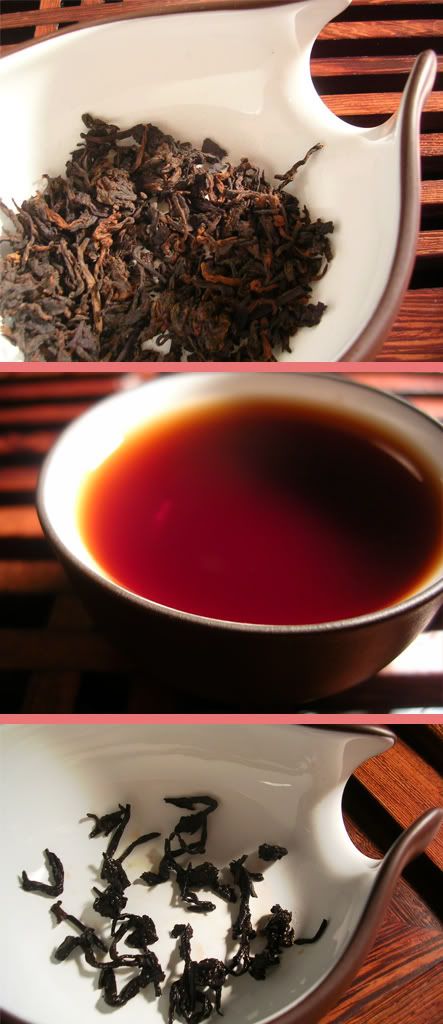 The soup is a rich burgundy, and is very crisp in its presentation and delivery. This is clearly shupu, being of the sandalwood and raisin variety, but is very smooth, and quite malty. Henan Province's naturally dry storage has been kind to this cake, which (theoretically, at least) has reached the shupu peak of ten years. I am of the firm opinion that older shupu, if the grade and manufacture are decent, can be very satisfying.
The feeling in the mouth is of a light oil so viscous that it is almost a jelly-like sensation (which, while sounding odd, is a smooth and pleasant affair). The tips have been very kind to the texture of this tea.
My lips buzz with chaqi; like most good shupu, the feeling is one of calm and comfort, which makes it a fine choice for an evening session.
Later infusions open up in the wenxiangbei to become more warm and woody. The flavour reminds me of the low, heavy wooden beams in the Tudor kitchen of my grandparents' farmhouse.
Wet leaves:
Dark little tips - fairly inscrutable.
Overall:
Courtesy of its excessive tippiness, it seems almost impossible to overbrew this tea (which I tried). There is no real huigan per se, more a gentle mouth-watering finish to the woodiness that is smooth and enjoyable. It is fairly simple, as is the lot of all shupu, but it works well.
It's a smooth, time-worn Buddha made out of sandalwood - not exquisitely refined, but the kind of practical beauty that such things acquire through careful processing of a basic product, and good conditioning over the years.
Addendum
October, 2013
Back when I encountered this tea first, we were in the middle of China, in my wife's hometown, and I was writing journal 30something. Almost a decade later, and I am up to book 55...

Each time that my wife's family comes to visit, they bring with them some of the (rather large!) stores of pu'ercha that we have aging in central China. There, the weather is baking baking baking, and, due to the proximity of one of the country's largest rivers, it is also humid. This is a good place for tea, I think. Where flora grows abundant, due to temperature and humidity, so too flourishes pu'ercha.
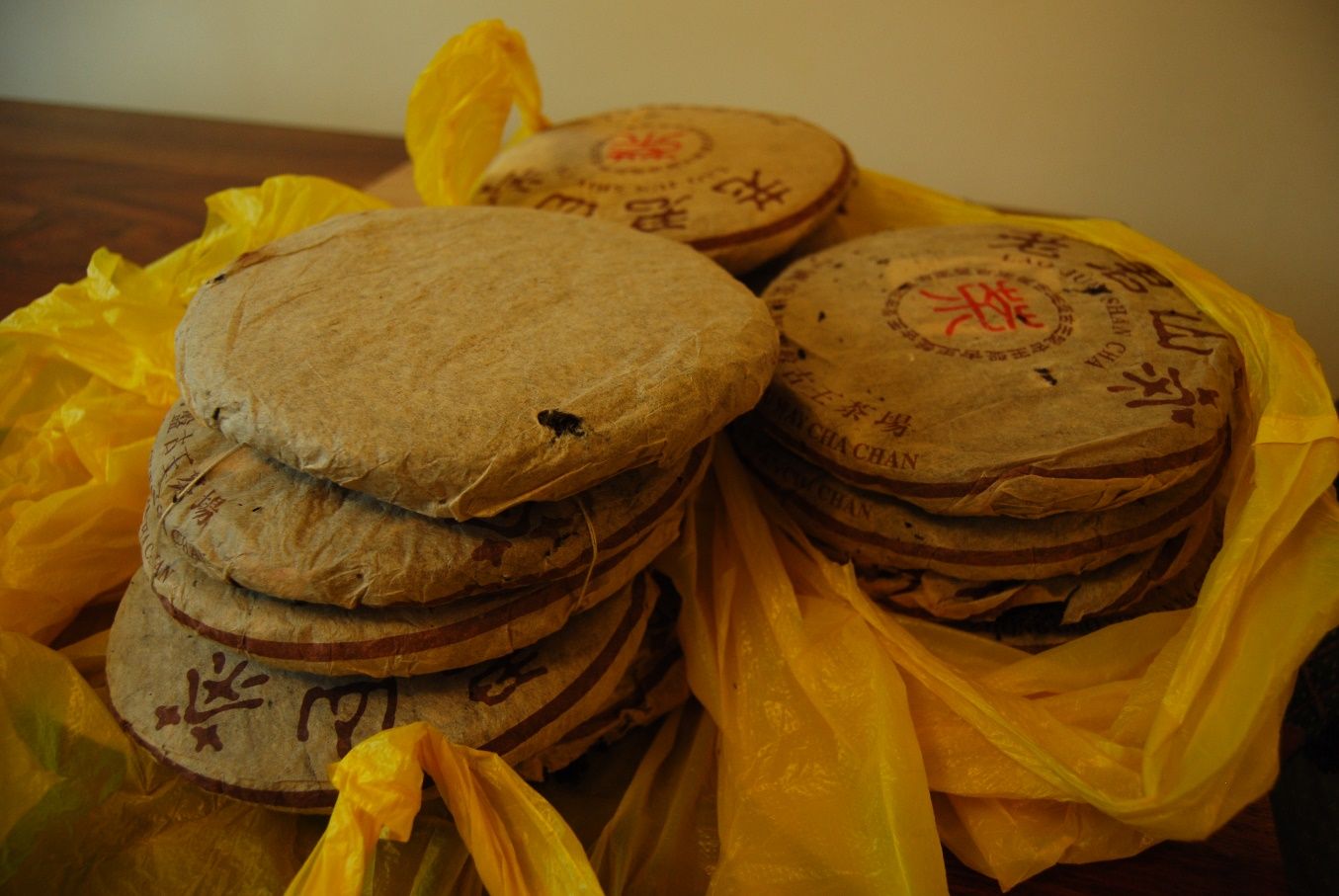
This charming old shupu was most inexpensive when we bought it. The shopkeeper had kept it since setting up his shop in the late 90s, he claims, and hence places its age around 1997. The wrapper is distinctly dated in its design; it cannot be older than the later 90s.
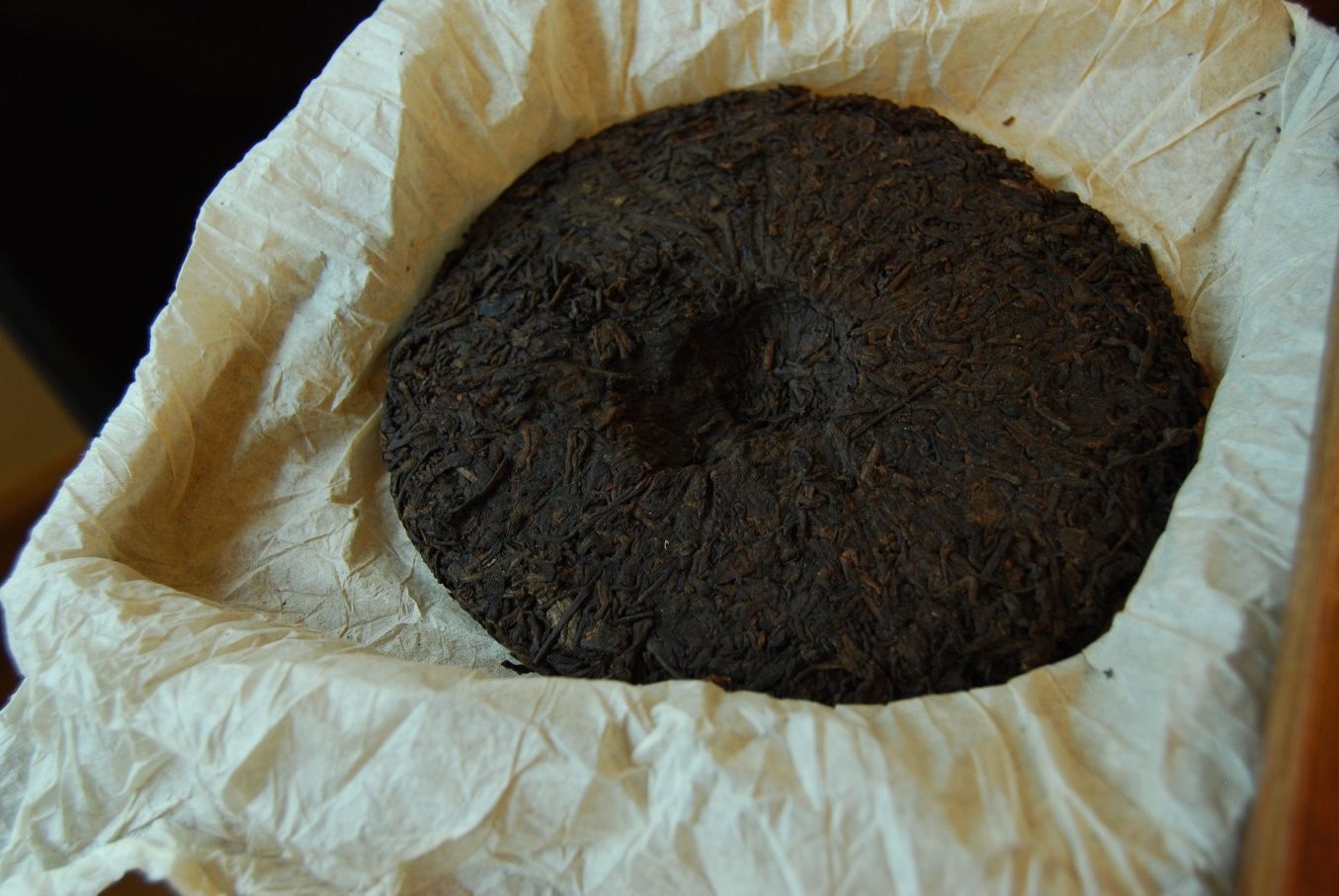
However, the age of this tea is apparent even from its appearance. It is certainly older than 10 years old, and 15 years feels approximately correct, give or take a year or two. The aroma and character are immensely smooth, like an old stone.
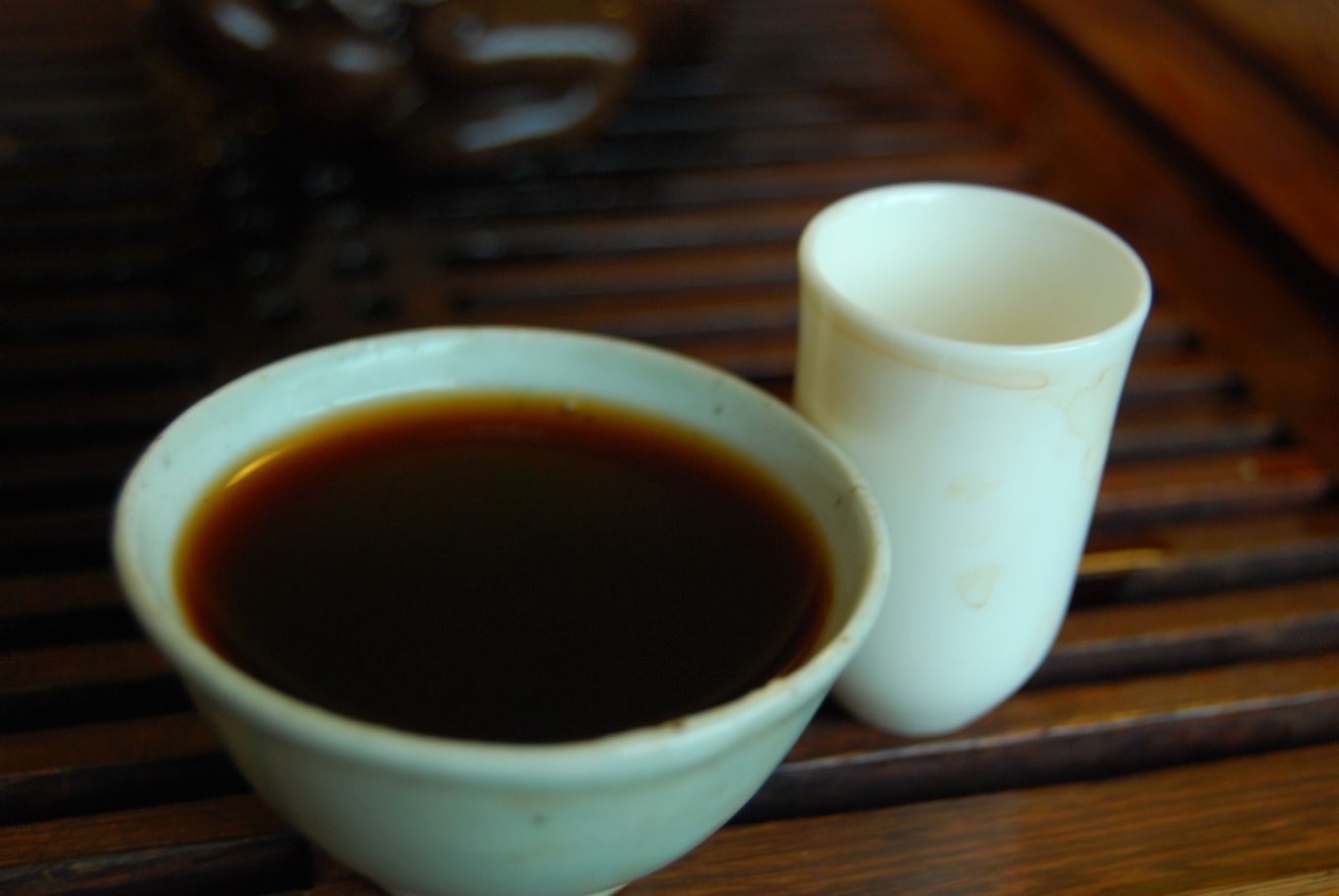
It is easy enough to find old, bad tea, and hard to find old, good tea. These shupu cakes, while inexpensive, must have been very strong when young, because they still pack something of a punch. The heavy soup, pictured above, brews thick from the first infusion, and has a great deal within it. The vanilla warmth of rounded shupu is very pleasant, and I am quite happy to be able to drink this as a frequent, low-maintenance, high-reward tea.
No comments:
Post a Comment