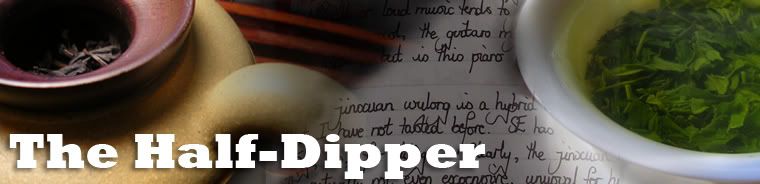
The cake's name means "Spring of Youle", and the product page at Yunnan Sourcing states that the maocha came from Longpa Village [lit. "Dragon Fear"!]. At $32, this cake is less expensive than the $50 Guafengzhai, though the latter was, in my opinion, the star of the show by quite a margin.
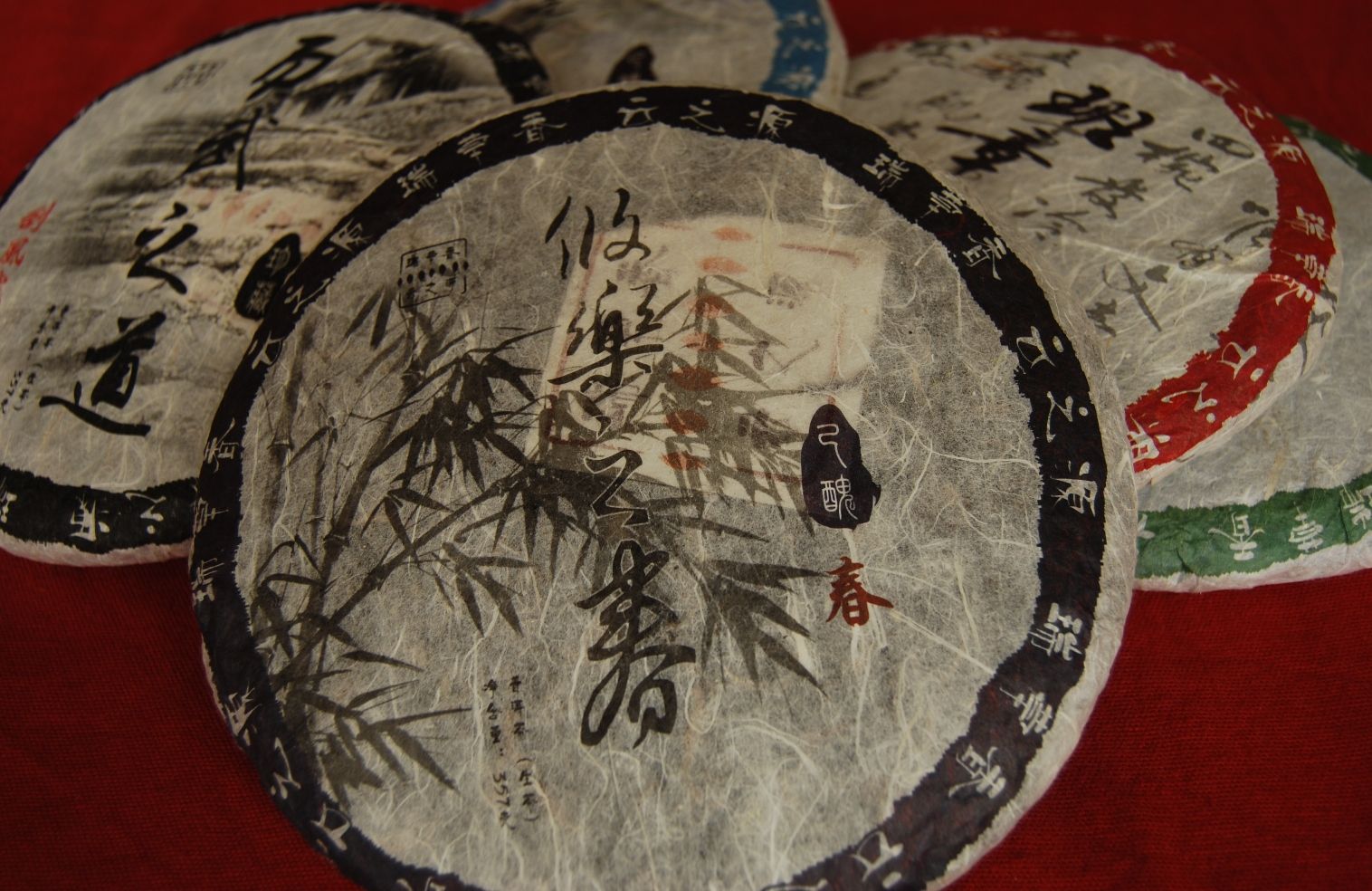
The medium-large leaves, pictured below, are covered in down, and are already quite dark. As with all of these super-fresh cakes, the aroma of green shengpu leaps from the foil sample-bag. A heavy fruitiness is buried in that scent.
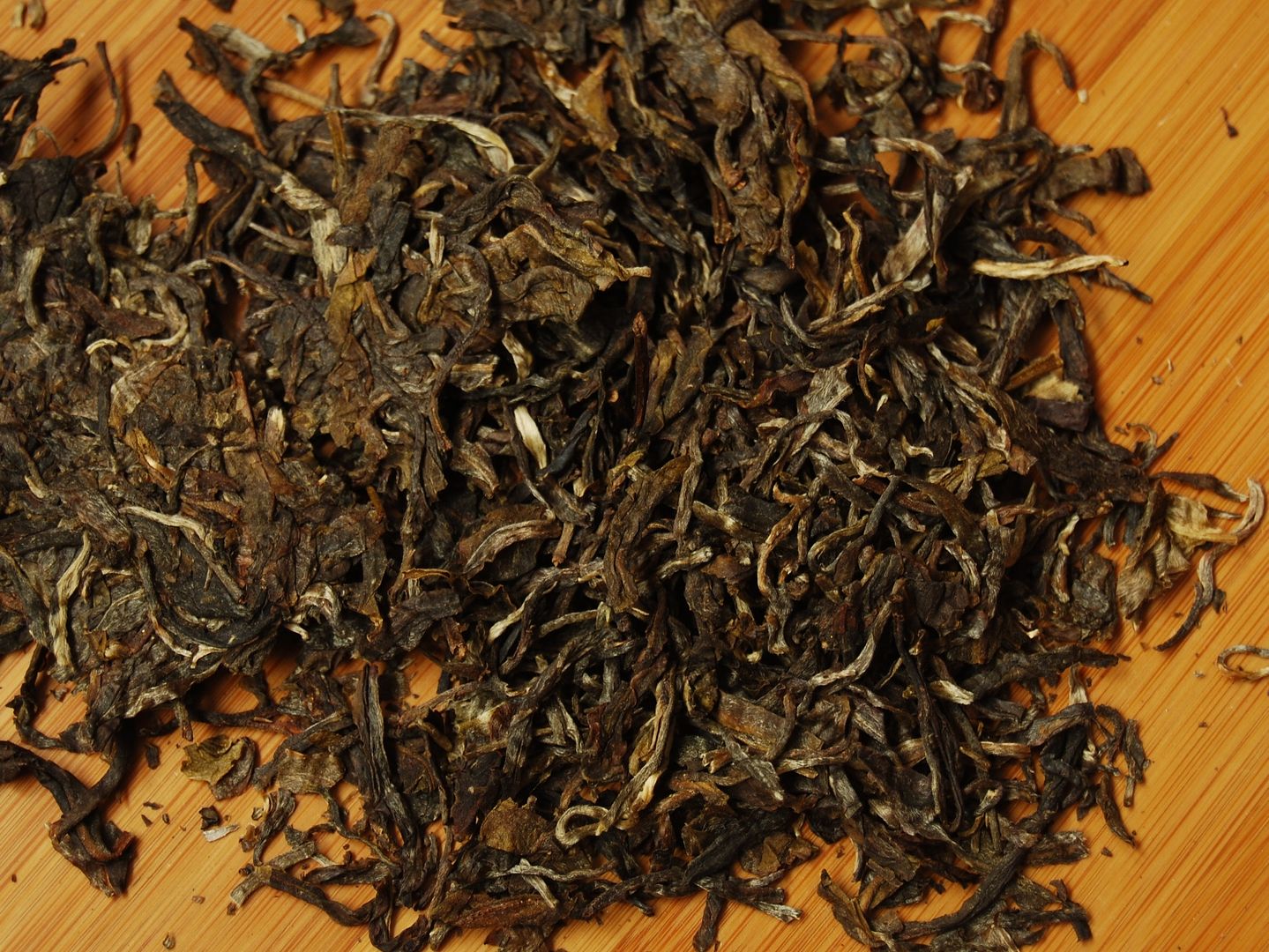
As with the Guanfengzhai, the soup is a straight, encouraging yellow. It has a base of unusual watery sourness, which then ends sweetly - it is an odd combination, but not unpleasant. Beneath it all, a low, earthy, "tea"-like flavour, that mixes with the fruitiness and the sweetness.
"Lightly roasted, like barley tea", notes Lei, referring to the shaqing stage. "Very gentle."
The slightly overcooked sensation is noticeable in the tobacco-esque aftertaste. The quality of the original leaves is good, as it does not become at all rough. Over the infusions, the combination of sourness and fruitiness fade into a generic sweetness. Its degradation is graceful.
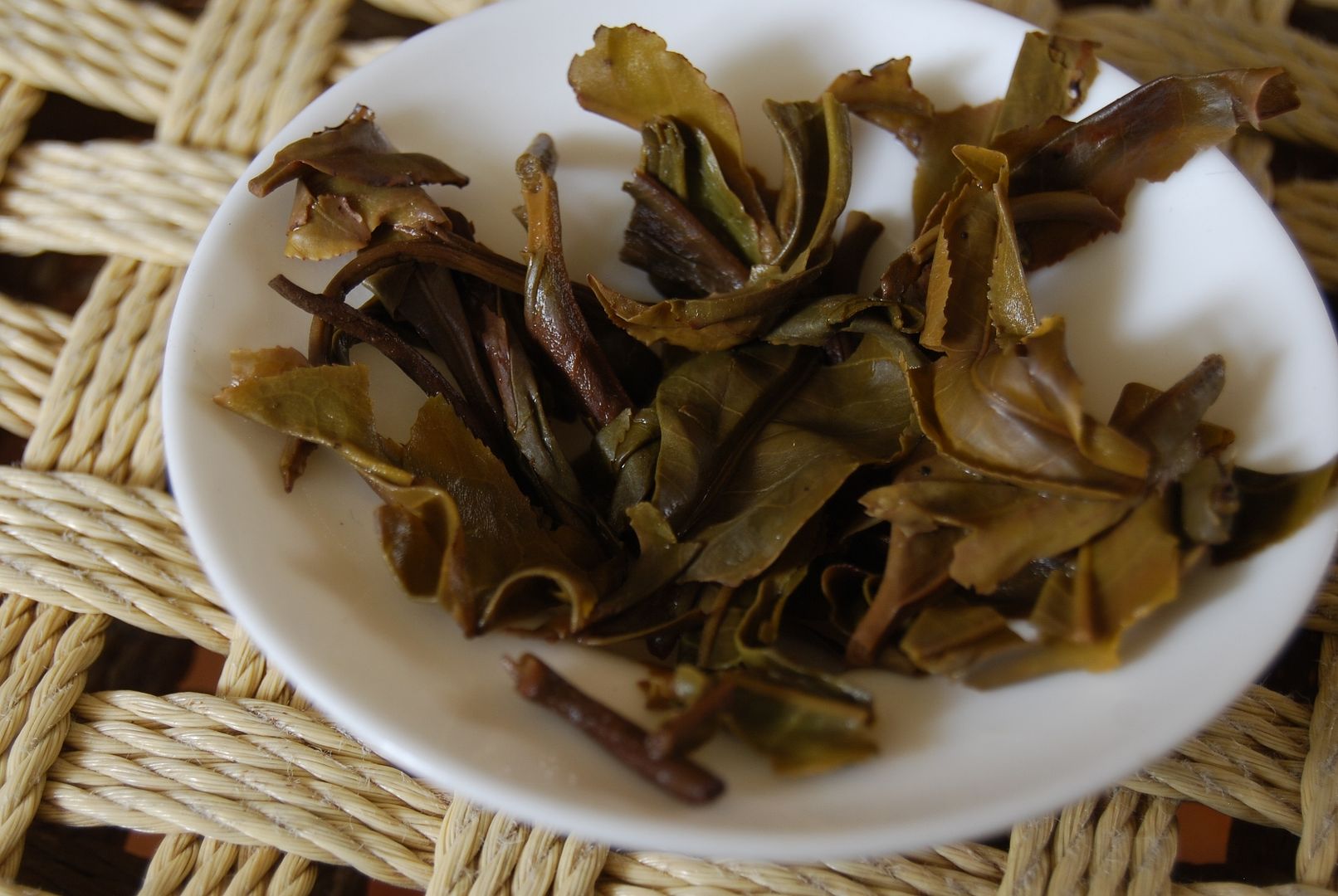
Less impressive than the Guafengzhai, I can't see myself buying more than the single cake of this that I did. The mixture of leaves shown above indicates that the processing was not even, and $30 is a bit of a stretch for a tea of this quality. Nonetheless, it has an interesting blend of characteristics that eventually settle down into a constantly sweet tea that lasts quite well.
(This was "beta" in our tea-tasting event.)
Addendum
August, 2013
This cake should have been called DRAGONFEAR. Such a wasted opportunity.
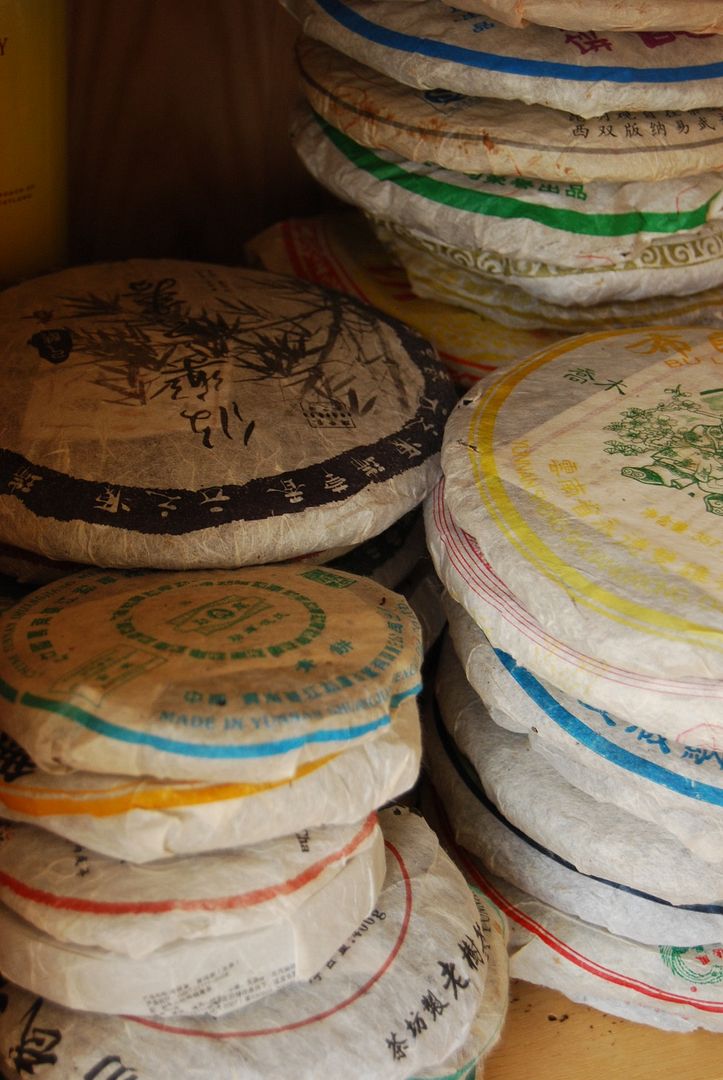
Pictured above, this cake has been residing in my "miscellaneous" stacks since I bought it, in 2009. As shown below, the cake remains untouched. However, much has changed.
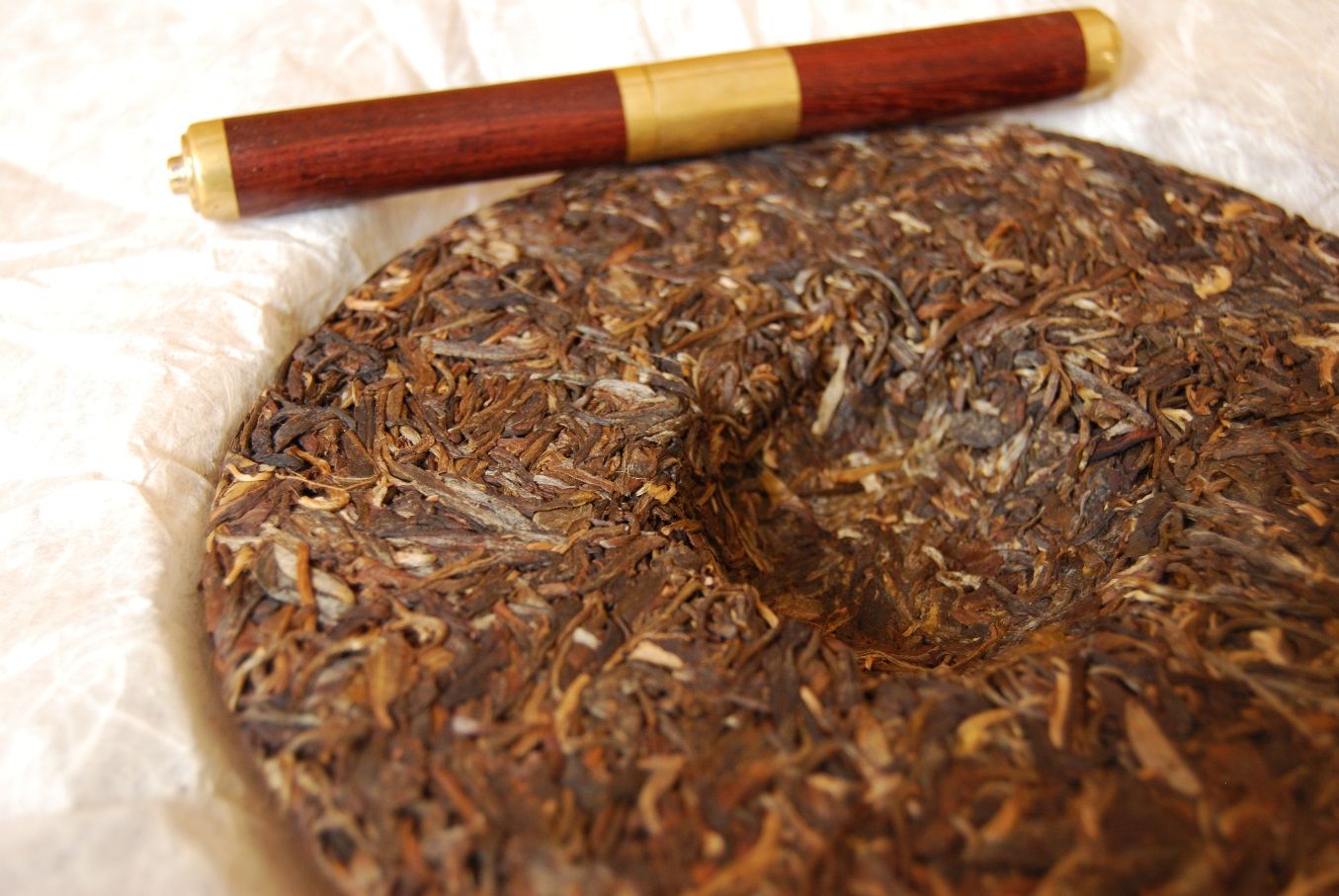
The leaves have the strong scent of deep humidity: sweet, potent, and slightly mineral. While always dark, these leaves have become richer, and a little more brown-hued, as time has passed.
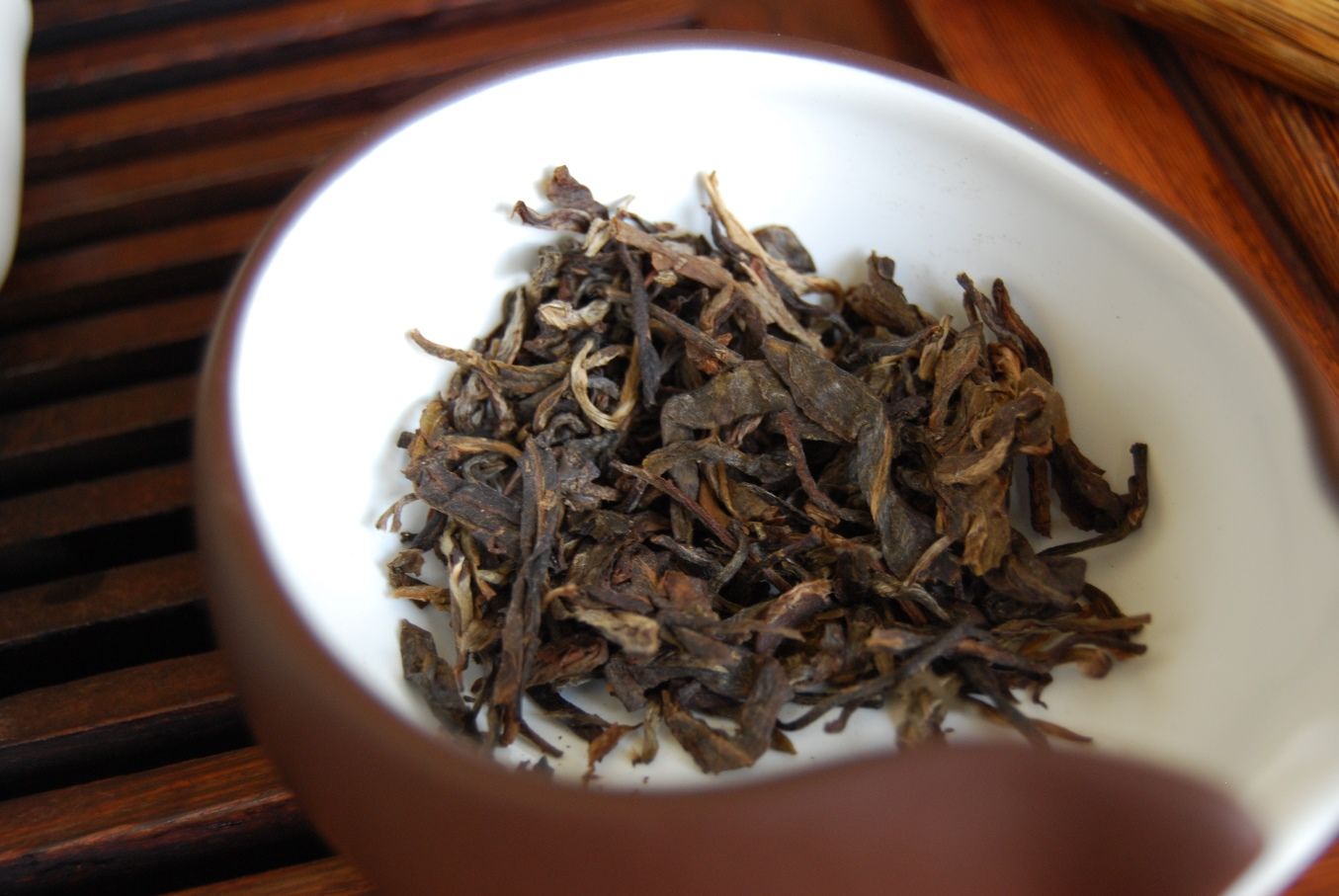
The character in the pinmingbei [tasting cup] is very positive: it is long and sweet, with a rich base of solid "tea" flavour much beloved by fans of Youleshan tea. The sourness that I found in its youth is gone. There is a tangy, sweet-straw finish and a solid cooling sensation. I am rather pleased to have a cake of this - my old notes suggest that I nearly decided not to buy it.
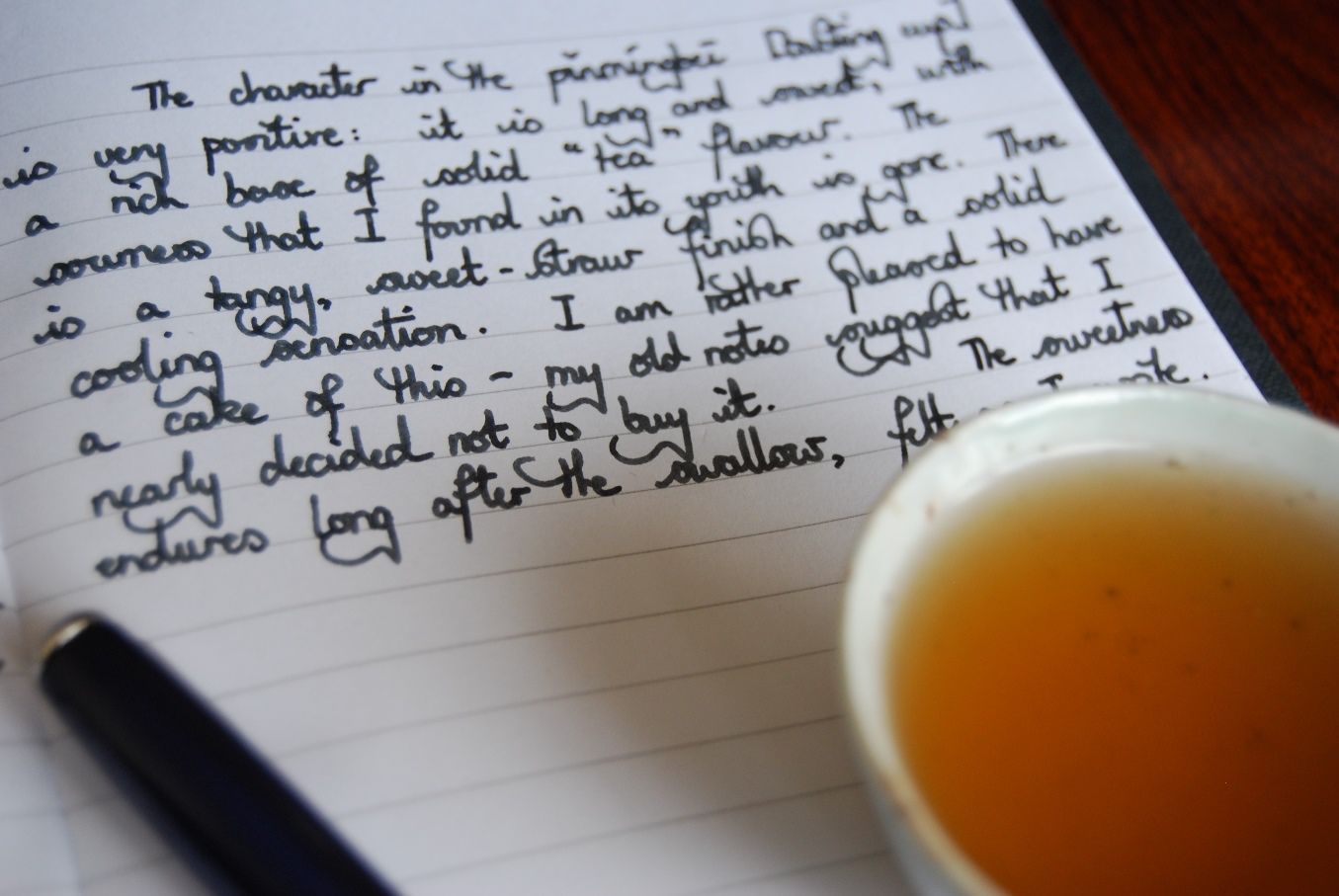
As the infusions pass, the tea settles into a long sweetness, without really fading noticeably until the session closes. What once was sour and strong is now sweet and straw-like. There is scope for further aging, as it remains tangy and punchy, but it was an enjoyable sampling of a cake that is in the middle of its "change".
29 comments:
Betas leaf is pungently green and tart. Enough sweetness to cut through the sour smell. The brew is an intense yellow with brilliant clarity. Green, grassy / herbaly and tart, some light tobaccoish notes. Just enough sweetness to cut through the green apple acidity. Meadows and some florals are present. Fades out very well. Not a tea I would go to for satisfaction but fine for an afternoon session.
Tasting notes on this tea @
http://mattchasblog.blogspot.com/2009/09/yunnan-sourcing-mystery-sample-beta.html
Peace
Thanks, chaps!
The leaves of this sample are even prettier than the leafs in sample alpha. They smell less sweet but more fruity.
The first infusions gave a light bitter taste, some sourness and some returning sweetness on the back of my tongue. The flavor in the first few infusions was of fruit together with some metallic taste like dried apricot and with a lot of creamy smokiness remembering me of smoked bacon (tough I'm vegetarian). The fourth infusion showed a more vegetal aroma with some good matching bitterness - similar to a good sencha but still smoky. But the tea didn't last long, from the 8th infusion on the tea lost its body and developed an unpleasing sourness.
Conclusion: A really nice complex tea, sadly it didn't last long. And still missing some wildness.
Just saw that this is up! My notes are here http://puerhcollection.blogspot.com/2009/09/tea-tasting-event-half-dipper-ys.html
Lei's comment is spot on 'very gentle' barley tea. I was using a heavy brew 10g:100ml and still felt it have a thin and light broth perhaps lack of richness.
I think those who enjoy young sheng might just enjoy this for a light bodied drink.
Thanks, Bert and Kenny.
Beta:
Opening the foil bag released a blast of sweet and sour yumminess. The leaves are in great shape and the chunk is fairly loose. This is either very loosely pressed or broken up by a pro.
Quick rinse: Soup is pale yellow with a hint of brown or orange. Not bright yellow. I taste flowers and straw with a good bit of sweetness in the rinse water.
5s: Light sweetness. I'm surprised by the smokiness combined with florals and straw. Like a hybrid of Xiaguan and numbered Dayi teas. That's an odd sensation. Soup is pretty sedate, maybe needed a longer rinse to awaken. Mild bitterness but in a way that tells me it will develop later. Brown sugar? The empty cup yields an aroma similar to very slightly unripe pears and a touch of hay.
10s: Much stronger ku but still not overbearing. Some tobacco. Sugar scents are darkening.
20s: (Too long! Wife handed over the baby in a hurry. Protesting would bring the pain!) Big ku... still not on par with the punishing ku of Cang'Er but big enough to show this tea has some balls. Tobacco, dark flowers, deep sugars.
20s: Same as last infusion but a touch more restrained.
35s: Much better. Spicy. This infusion is really alive and jumping! The dark sugars are turning maply. How did this happen so late in this process?! Best infusion so far. I don't know that the sample is large enough for me to learn to reproduce this.
45s: Same as previous but with more ku. Nicely done.
From here we start to decline and fade out. I didn't chart these because we all know this process by now. I push and the tea chooses to give it up or not.
Summary: This wasn't a bad everyday tea. The Xiaguan-ness is somewhat confusing to me. I haven't seen many that ride the boundary between the styles this closely. I'm intrigued and will savor this sample. If nothing else, I wouldn't mind having some of this around to drink. I won't pretend to know how this tea will age.
Tasting notes here:
http://39steeps.blogspot.com/2009/09/review-series-pu-erh-2-beta-by-yunnan.html
Quick question: I am finding the green pu-erh seems a bit rough on my stomach. Is this common?
Hello Steven,
it's common that green pu'er (and also other green teas) can have an aggressive effect on one's stomach. Though in my opinion this teas from yunnan sourcing are quite on the mild side.
Steven Knoerr,
This 'You Le' specifically has the potential to disrupt and disturb your Spleen/Stomach qi. Because it has very little balance or variety of leaves- it is strictly comprised very young powerful hairy buds. Its energy is very one-sided, almost over powering at times, thoughout the session.
If you are of a certain constitution, if your Spleen/ Stomach qi is susceptible to attack, the energy of this 'You Le' can surely reek havoc on your innards. But if not, the energy of this 'You Le' can be quite profound, assuming you don't drink it everyday.
Notice how people made comments like “super fresh”(Hobbes), “Not a tea that I would go to for satisfaction but fine for an afternoon session” (Bret), “missing some wilderness” (Bert)..
Why? Perhaps they can intuitively sense that this tea would be disruptive if consumed too frequently?
Peace
Beta:
Opening the heat-sealed bag for Beta, a fresh, almost grassy
aroma greets. (This worries me a little.) If it weren’t for a
couple of telltale flattened bits, I would say this is maocha.
Big, long leaves, everything from silver tips to yellowed ones, a
motley conglomeration. In the wengxiangbei, a lightly smokey
vegetal aroma morphs quite slowly into a light, refined sugary
sweetness, like cotton candy. Delicate silk on the lips and
tongue. Taste is simple and vegetal, almost grain-like, but a
little greener than that. No ku, no huigan. Aftertaste slightly
minty, slightly sweet, all in the mouth and not in the throat.
Nothing overtly objectionable, nothing remotely interesting
either. It’s an ok drink now, but it has no strength to age in
an interesting way.
Thanks, all!
You Le - not as good as Alpha - http://tuochatea.blogspot.com/2009/09/beta-you-le-zhi-chun.html
Ah, thankfully the talk drifted once again to the energy of the selection. I'm pleased to hear about how this tea could spiritually be a kick in the gut and perhaps difficult to drink therefore as an everyday tea. And that's because there's no mixture of leaves but just powerful young tips? I've had these experiences myself (though personally I'm not so sure I don't prefer that kind of kick.) --Teaternity
Have you tried this tea again recently? I just sampled it and really liked it!
Dear Sketch,
I have not, but perhaps shall do so given your timely comment! I was just looking for a cake to drink today. :)
Toodlepip,
Hobbes
Note to self: the price has increased from $33 in 2009 to $52 in 2013.
Dear Sketch,
Just for you, I sat down with this tea and have updated my notes as above.
The aroma of humidity was striking - the cake has aged into a sweet, straw-like affair with a bright, pick-me-up energy to it.
Toodlepip,
Hobbes
I have consistently found the Road to Yiwu samples not to have been aging well, but I consistently see positive reviews of the aging process of Ruicaoxiang teas. Haven't ever had any, though.
Thanks Hobbes, I appreciate that! I also found it very bright. I have updated my blog with a sketch and some notes on this tea also.
All the best,
Sketch
Dear Shah,
I'm in the reverse situation: no "Road to Yiwu", as far as I recall, but plenty of Ruicaoxiang! I wonder what happened to the latter - it was a Korean collaborator, was it not?
Toodlepip,
Hobbes
Dear Sketch,
Your comment led me to find your blog, which is truly delightful - what a novel idea.
I look forward to seeing your sketches if you ever try a rancid, dirty ol' Baoyan. :)
Toodlepip,
Hobbes
You've had two Road To Yiwu teas, Manzhuan and DingJiaZhai. I guess those are all collaborations with that Korean brands, and I've had such tea before. The Road To Yiwu are fall materials, though. So I haven't had the spring stuff.
I stand corrected. :)
Perhaps I can find them to try again!
Toodlepip,
Hobbes
Thank you Hobbes! I'll be sure to not miss sketching if and when I get my hands on a Baoyan :)
Your revisit motivated and inspired me to dig out a cake and have a session with some yesterday . The last time I had a session with some of this was a couple of years ago . It seems to be ageing really quite well here in the uk . I was particularly impressed with how thick and textured the soup was - very nice ! The qi was rather good to ! All the best ! p.s. - while I was rummaging about I also removed a sessions worth from the 2006 Twelve Gentlemen Yiwu cake - the one which made you shudder recently ! I'll let you know how I get on .
Dear Tofu,
I didn't realise that you were in the UK! Whereabouts? If you're near Oxford, we may have a quartet of us to get together sometime. :)
Toodlepip,
Hobbes
Dear Hobbes , I live in Hereford . Not exactly a stones throw from Oxford , but easy enough to get to by using the straight through London Paddington train . All the best !
Dear Tofu,
That's fairly close! Maybe you'd like to join us, if we get a critical mass together at some point in the remainder of 2013 or during 2014.
I have been mugged once in my life, and that was in Hereford. Good times. :)
Toodlepip,
Hobbes
Post a Comment