I've been meaning to write about the "post-pu'er" phenomenon for a quite a while now, but time hasn't been on my side. We're all acutely aware of the recent pu'er speculation bubble and how it has affected the quality of output, particularly in 2006-07.

I've met some who ascribe this to mere investment fashion, in which the "commodity of the month" attains value simply because it has become popular, or because its returns each year have been good, to date. I've met others who put it down to the presence of excess capital in the hands of Mainland investors; with stocks being the conventional option rather than banking for the domestic Mainland investor, and with growth (and hence returns) relatively low in stocks, this floating cash looks for whatever profitable home it can, much to the detriment of the pu'er trade.

We witnessed the dark days of countless hundreds of factories opening almost overnight - I met one chap in Beijing whose uncle had just opened a factory, admittedly knowing nothing of pu'er, because of the boom. ("Buy leaves, compress leaves, ???, profit", as they say...) We witnessed previously respectable producers capitalising by quadrupling their output (17+ Xizihao productions in 2007, and counting). We witnessed the cheapening in quality of favourite brands in order to meet demand.
Prices inflated, the middle-men got out early with their fortunes, the financially-foolish sheep pumped in further capital, before the bubble inevitably burst, leaving the aforementioned latecomers sitting on warehouses of low-quality bingcha.
Prices inflated, the middle-men got out early with their fortunes, the financially-foolish sheep pumped in further capital, before the bubble inevitably burst, leaving the aforementioned latecomers sitting on warehouses of low-quality bingcha.

Happily, the boom cleared out a lot of nonsense, and 2008 has been a significant improvement. In order to weather the reduction in demand, there has been a noticeable emphasis on quality. Surely, that's good for us, the folk who are here simply to enjoy good pu'er.

2008 is the year of a resurgent Xiaguan (and the majority of their "FT" brand has been really very good this year), and a solid year for other stalwarts. Douji, Shuangjiang Mengku, and my other safe bets have been decent, on the whole. The wary consumer has been reverting to stable brands, and the eternally-dominant Menghai have been making hay while the sun shines - never genuinely enthralling, but generally producing the sound benchmark for which they are famous. The 7542, 8582, and other baseline cakes have picked up in quality, and even the fashion-driven 0622 is decent.

This by way of context for today's article on the Menghai Peacock range ("Wu Cai Kongque Bingcha" - five coloured peacock bingcha), a selection of inexpensive and decent cakes. Each is taken from leaves of a single region, and, while invariably fragmented (not a bad thing) as it equalises large and small leaves in the blend), each has its own particular charm.
Distributed throughout, photographs of the Menghai-region "Peacock", with appealing leaves taken from a variety of sizes, and blended together with fragmentation such that each is equally represented. The blenders at Menghai really do know their work, and it's no coincidence that ex-Menghai workers are responsible for so many spin-out factories (see Dippers passim).
Distributed throughout, photographs of the Menghai-region "Peacock", with appealing leaves taken from a variety of sizes, and blended together with fragmentation such that each is equally represented. The blenders at Menghai really do know their work, and it's no coincidence that ex-Menghai workers are responsible for so many spin-out factories (see Dippers passim).

Remarkably fragrant dry leaves fill the room with sweetness - a touch of Menghai -region spring brought to the winters of Blighty.
On a tangential note, Menghai these days insist on sealing their wrappers with tags and stickers, which means that one must tear the paper to get in. Not good. Mainland China being what it is, I am fairly certain that the right price, or favour, or guanxi, could easily allow an unscrupulous producer to obtain lots of spare Menghai ID stickers, and so they really are meaningless in terms of quality assurance - but I suppose it keeps the price up.
On a tangential note, Menghai these days insist on sealing their wrappers with tags and stickers, which means that one must tear the paper to get in. Not good. Mainland China being what it is, I am fairly certain that the right price, or favour, or guanxi, could easily allow an unscrupulous producer to obtain lots of spare Menghai ID stickers, and so they really are meaningless in terms of quality assurance - but I suppose it keeps the price up.

A number of teafolk tried this one together, so do please add your comments if you were one. I found it to be candy-like in the wenxiangbei [aroma cup], giving a pure, yellow soup that reassures.
In subsequent sittings, I found chunky fruitiness (akin to the well-known Dehong brick), plenty of wildflowers, and a comfortable leather-like aftertaste. The texture was fairly ordinary, but it stayed decently in the throat.
Overall, very nice indeed for the price (which was the cost of two pints of beer, or an entry-level table wine). I am holding onto a few of these to see how they progress - their potency in character and bitterness is plentiful, but it is easy to control, resulting in stable brews.
I like teas with content, and this has a great amount for the money.
Public service broadcast
The Half-Dipper has been weather a storm of spam, lately - Chinese spam, oddly enough. I've taken advantage of a handy Blogger feature and turned on comment moderation for old posts (> 7 days old) as it is only old posts that are affected, for some reason. Spammers don't ever seem to post in the more recent articles. So, if you try to comment on an old post, don't be alarmed if your post is "awaiting moderation". For commenting on recent posts (which is where 99.999% of posts from real posters are sent) then you shouldn't notice a difference.
Addendum
April, 2013
This was $10 in 2008, and is now approximately double that in five years. Not too bad.
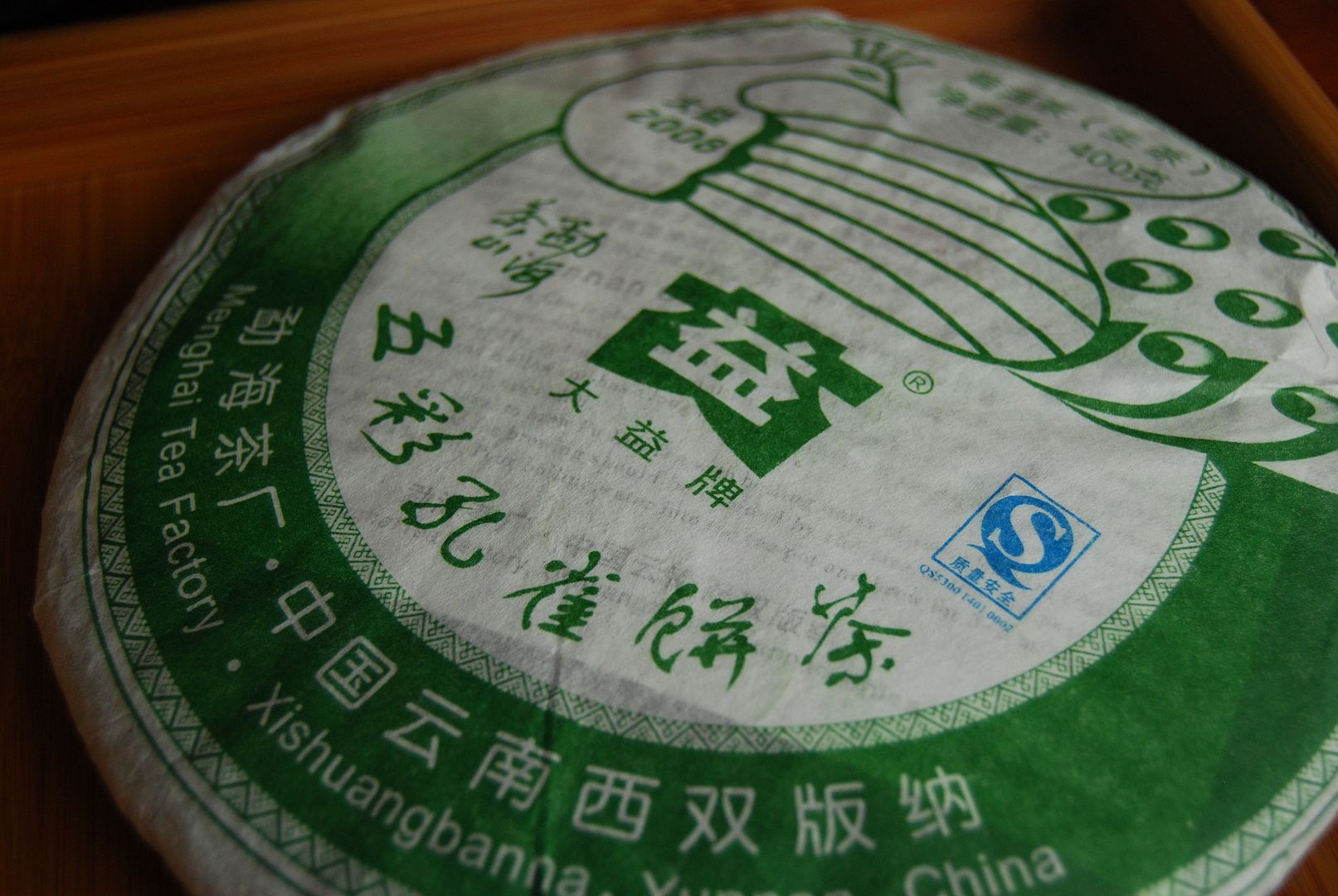
The hideous green colouring of the original has darkened pleasantly - enough to attract my eldest son:

The little leaves separate easily, and I am surprised to see that there are huangpian [yellow flakes] in the blend - more than I had noticed before.

This cake has remained untouched since 2008, and has spent all of its life in our house, making it of particular interest to me.

The soup has become a gentle orange over the last five years. The original aggression has calmed, and it has exchanged this bitterness for a dramatic sweetness that is to be admired.

It remains potent in chaqi, waking me up in the morning. The sweetness is long and entirely unexpected. I enjoy its round, smooth texture as if it were a smooth pebble. The storage is not "dry": the texture is soft and round, presumably from our moisture-laden air.

Adding a few leaves for the second infusion, the flavor of Dayi becomes obvious in the base. The rounded sweetness combined with the cooling huigan [returning sweetness] is really rather decent.

The low hints of tobacco that I noticed in 2008 remain. It has a light, woody character that is tending towards age, with that substantial, comforting, feeling that it deposits in the body. I am very glad to have a quantity sufficient for regular consumption.


