08 May, 2007

1998 Menghai 8582

Today, just some notes: the tea, the whole tea, and nothing but the tea.

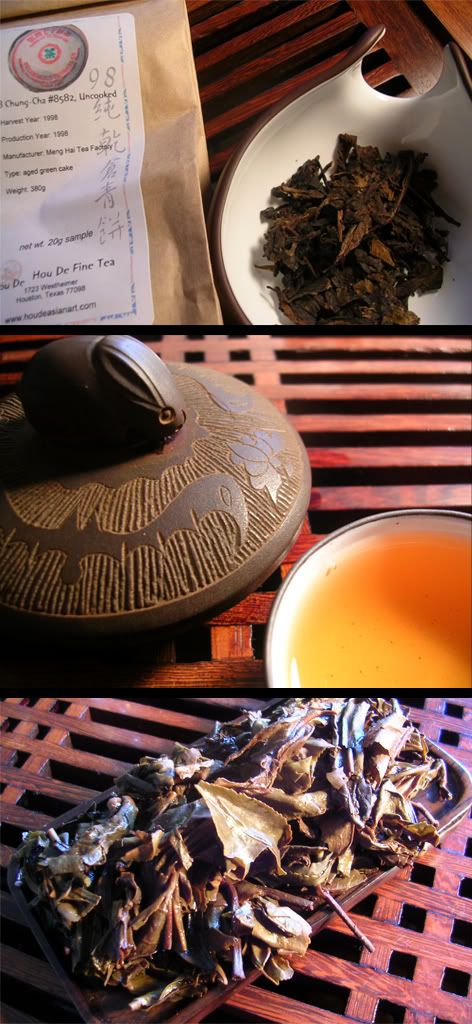
It's a standard Zhongcha [China tea] wrapper, and comes from Houde, where it is labelled "Chung Cha". Guang has further labelled it with the characters "chuan gan cong qing bing" [pure dry storehouse green-cake].

~15cl Caledonian Springs @ 100C in 35cl shengpu pot; ~5g of leaf; 1 rinse

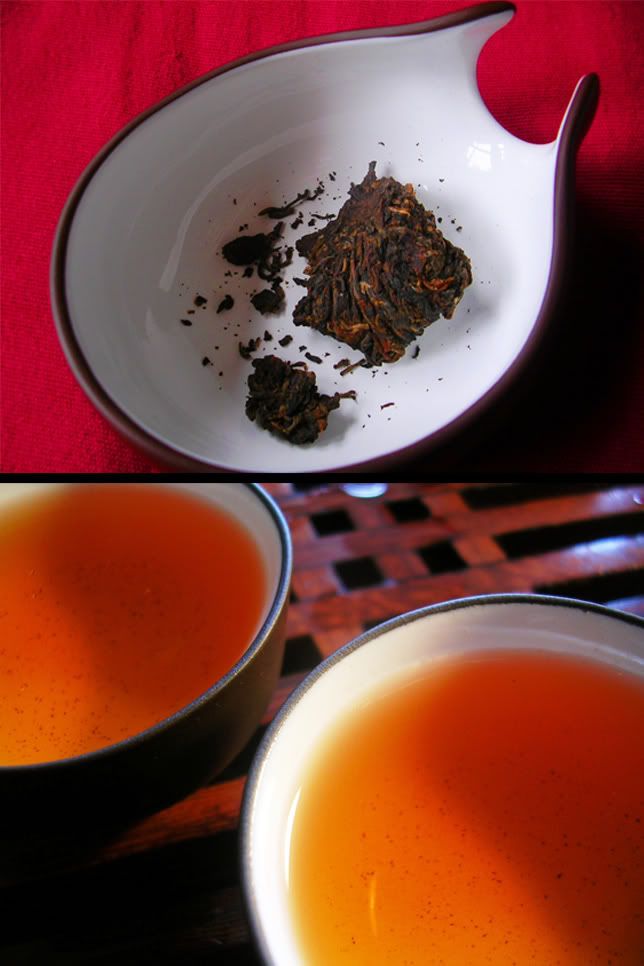
Dry leaves:
Loose compression, what bliss after the Xiaguan-induced agonies of yestereven. The leaves are generally rich in colour, with the majority showing a fine leathery hue. The aroma is classical middle-age shengpu: earthy, leathery tones, with a touch of bitterness left over from its greener days. Quite tippy. The "dry storage" claim looks substantiated in the rich colour and non-damp aroma of the leaves.


15s, 15s, 20s, 25s, 30s:
Orange-red soup indicative of middle-age, with very little of the tippiness making it into the soup; I was expecting a fair amount of fine hair to be suspended therein. The lid-scent (have I coined "gaixiang" yet?) is heavy toffee, with some youthful shengpu strength. The leaves are surprisingly muted. What will this say about the endurance of the tea?

Very little in the wenxiangbei, as if I had suddenly lost my capacity for smell. Very pleasing soup, rushing to a pleasant sour/bitter at the arch of the tongue, and dwelling their with great patience. The huigan is long and pleasant, though the whole feeling of the tea is rather "tart". A broad base of flavours, following the aroma, lives below that interesting rush for the middle-ground of the tongue.

Very long and very sweet, with an almost alkaline finish - which Xiaomao once likened to Chinese steamed buns.

Later infusions see the aroma turn to long, sweet treacle. The flavour of later infusions is reminiscent of varnished pine.

Used leaves:
Rather a mess, as can be seen above. Considerably chopped, from a grade of apparently smaller leaves - interesting, given its "8" grade rating. Age is turning most of them a stable, sludge colour.

Overall:
I enjoy this very much; it's a pity that it is no longer available as I'd like to get a whole bing. It's a little ragged in the throat, particularly nearer the end, but is developing some of the richness of character that one would wish from an old tea. Plenty of youthfulness remains, and that sour/bitter charge for the centre of the tongue is fascinating. Very sweet indeed. Is this tea really unavailable?


Addendum
June, 2011

Four years later, I return to this sample from Houde.  Much has changed in four years.


1998 Menghai 8582


In the intervening years, I have started to suppose that I enjoy aged 8582, but that it doesn't thrill me.  In comparison with some beefier recipes, the 8582 can be sweet, appealing, but somewhat lacking in complexity, and a little underpowered.

Today's tea session confirmed that supposition.


1998 Menghai 8582


This is a very pleasant tea.  It is crisp, smooth, and sweet.  However, it is distinctly impotent.  I used a very large quantity of leaves, in order to use up the remainder of my sample.  The first two infusions were quite potent, in a charming pine-like manner, but they rapidly tailed away into a gentle, monotonic sweetness.

While very enjoyable, it isn't a tea that I can see myself paying large quantities of money to obtain.  8582 simply doesn't have the basic stamina required to become a big, complex cake in its age.  This is a conclusion that several samples of the same recipe from Essence of Tea, Skip4tea, and gifts from friends have led me to reach.

Fine, fun, but not a grand tea - I bid my sample farewell, but am not resolved to chase more of it.

07 May, 2007

1980s Xiaguan Zhubao Tuocha

It's the Mayday holiday: traditional English folk dancers (Morris dancers) are combing their beards and polishing their batons, young girls are getting ready to dance around the maypoles. Best of all, it's raining, and we're going to try this tuocha from Houde.


In the product description, Guang notes "fruity acidity", and then goes on to talk about the "minty" aroma. I've not found any other notes on this tea - as always, do please point me in the right direction if you have.

The "zhubao" [bamboo wrapped] refers to the enclosure of the tong. The "jincha" [tight tea], visible on the wrapper to the left, is no understatement.

The first point to note is that it has that familiar Xiaguan uber-compression. This is one tough little tea. In fact, it rather reminds of me of some of the specimens in my collection of cropolites [fossilised dinosaur droppings] that I so proudly maintained as a boy. The pieces dropped into the pot with an ungainly "thunk". Not a tea for polite company.

~15cl Caledonian Springs @ 100C in 35cl aged shengpu pot; ~5g of leaf; 1 rinse.

Dry leaves:
Excepting the previous comparison with thunder-lizard excreta, this is dark tea, with a few lighter-brown leaves that look as if they could have once been tips, from the fur. A good, shiny appearance all over. A wry smile crosses my lips as I detect no mint whatsoever in the aroma.

15s, 15s, 20s, 25s, 30s, 35s, 40s, 45s, 50s, 55s, 60s, 120s:
Fusty lid-scent with an alkaline finish. The wet leaves are, as Fate would have it, a bit on the minty side. The soup is a good orange, but nothing that would indicate the supposed 20 years of aging; this looks more like 10 years, from the colour. Clearly, the tight-as-tight-can-be compression has hindered its aging.

Already, in the first infusions, the potent chaqi is evident. This reminds me of a recent article penned by MarshalN regarding the potency of some Gedengshan maocha. This is a deeply powerful tea, seemingly loaded with caffeine - it sits right in the forebrain, like a strong coffee.

The character of the tea is very sweet, with a broad base of honeyed woodbine (particularly in the aroma), but covered and interpenetrated by a constant tone of bitter-sweet gan. This tea still has much of youth about it.

The finish in the back of the throat is particularly green, leaving a certain rawness that was quite surprising for a tea that one would have hoped was leaving middle-age.

The greenness in finish and power continue throughout the infusions, during which a 2-hour intermission took place as we went out for our daily walk. This tea is long, and strong.

Used leaves:
Diced, thoroughly. A decent grade, in that the leaves were once small (when whole), but they have been rather brutalised.

Overall:
The immensely high compression is this tea's undoing. It reminds me of a pupil who spends a lot of time in class, doing all the homework, putting in the hours, but not getting anywhere. This tea has been aging for two decades, but has the accomplishments of one but half its age, which is a shame indeed. It's a good tea, with good aging "potential", given its lovely woodbine flavour and continuing potency, but... do you want to wait 40 years to get a 20-year-old aging? It's almost too harsh to enjoy at the moment, but is drinkable enough.

06 May, 2007

2006 Xizihao Banzhang

Given the following mutually incompatible axioms, what do you do?

Axiom 1: It's beautiful outside, and it's the week-end.

Axiom 2: Your supervisor is expecting an article from you.

The solution? As you've probably ascertained from the photograph to the right, you dust down your Mobile Gongfucha Platform (MGP) and head out into the garden. You're outside, but you're close enough to your desk to feel guilty enough to (eventually) get back to work.

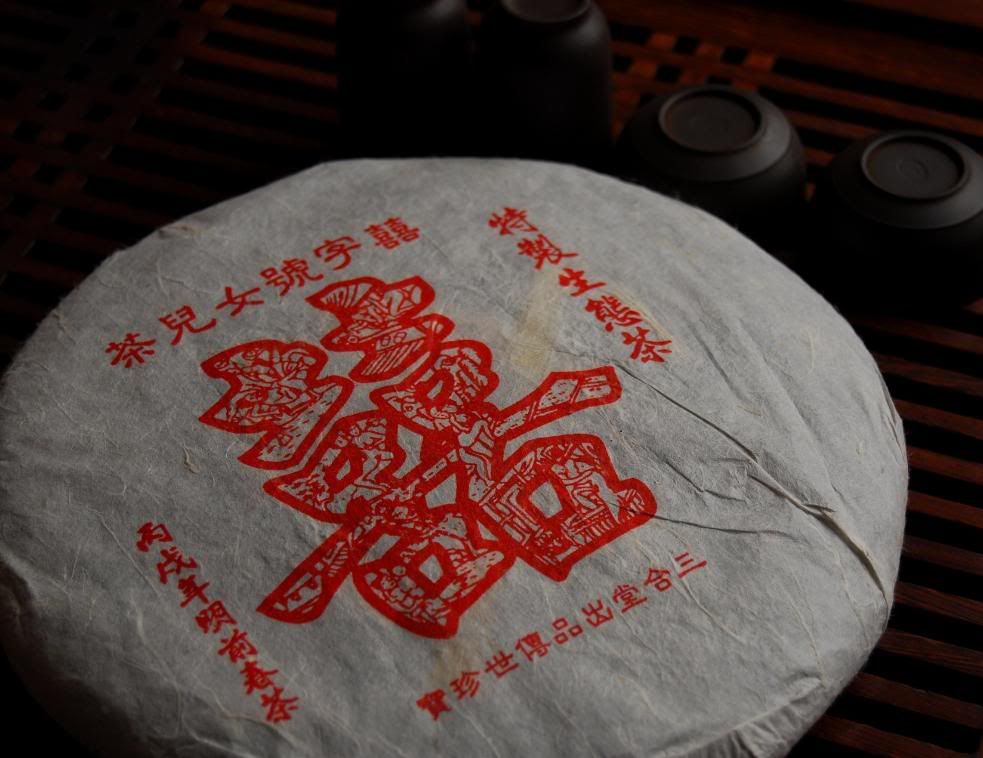
It's high time that a few long-standing inaccuracies were straightened out regarding Xizihao, the first of which is its name. It's "xizihao" [Double-happiness character brand], and most definitely not "xizhihao". Absolutely, this is a Taiwanese product, but by adopting the "x" and "zh" nomenclature, we are already crossing the Taiwanese Strait onto the Mainland and attempting a Pinyin spelling, so we may as well make it correct.

On a slightly less defensible note, the Pinyin spelling of the manufacturer is "Sanhetang" [three-together hall], and not "San Ho Tang". I'm not certain if the latter is Wade-Giles, so do forgive me if it is - in which case it's entirely appropriate, given that the company is Taiwanese. Obviously, the mountain is "banzhang", and not "banzhan" (as appears on my packet), but that's probably a good old-fashioned typo, rather than a conscious error.

Pedantry aside, what else do we know about this cake? I've not seen any reviews for this 2006 Banzhang, and would gladly be corrected. It claims to be a "shengtai" [ecology/natural-habitat] tea, which brings to mind all sorts of camphor-trees-instead-of-pesticide ideas. Of course, these are unquantifiable and uncontrolled terms, but we can dream.

Caledonian Springs @ 100C; 20cl shengpu pot; "normal" quantity; 1 rinse.

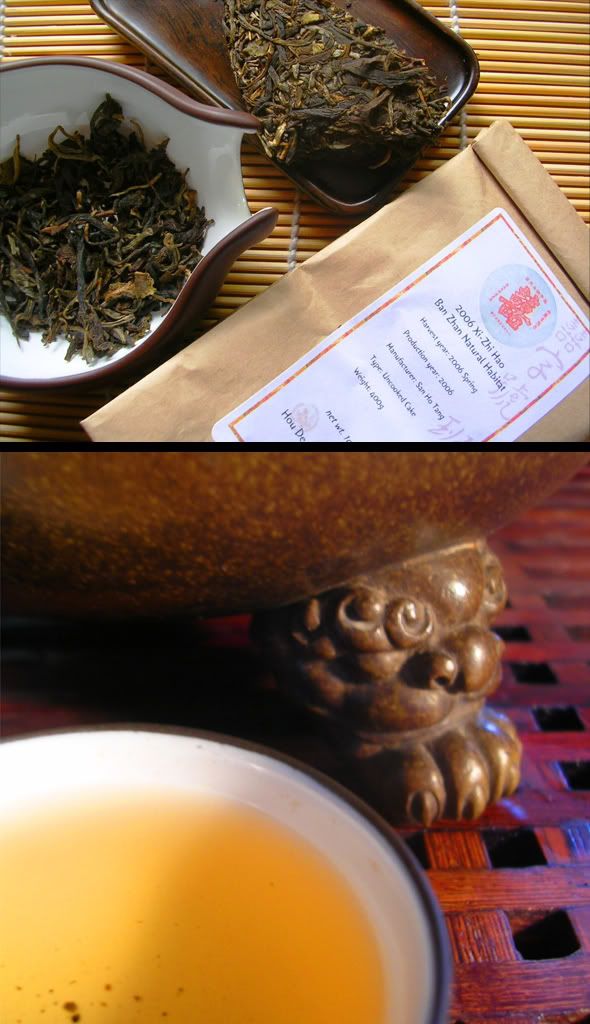
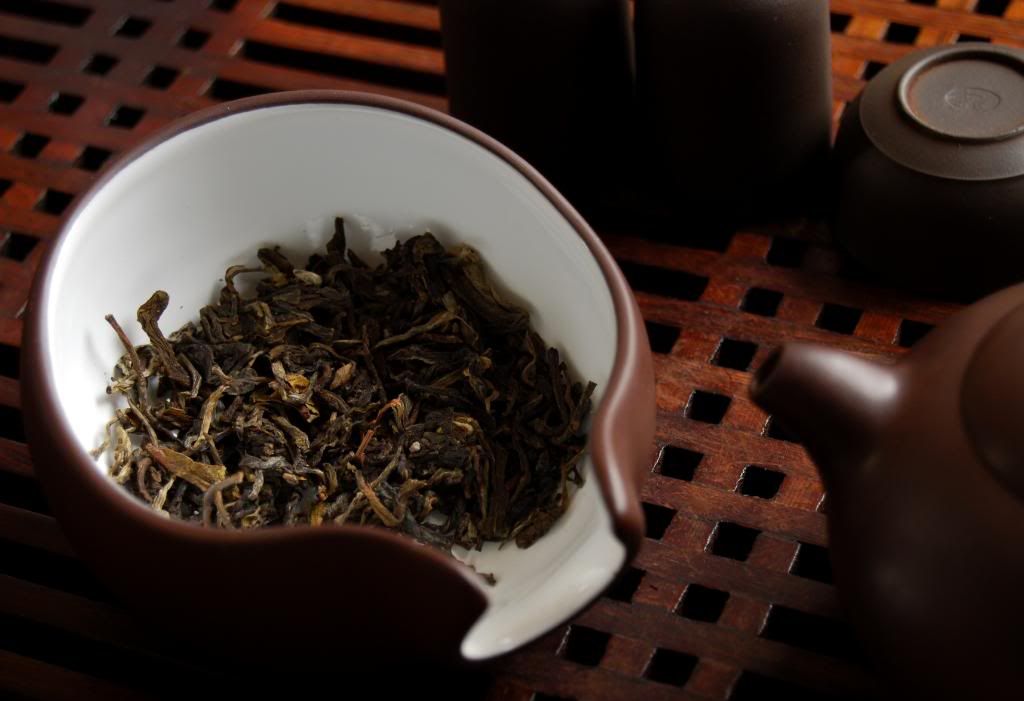
Dry leaves:
Truly desirable. Exquisite, long, full-bodied leaves with many silver tips. A lovely sheen over all. The cake is a fine mixture of dark browns, rich reds, and fresh greens. Classical, crisp aroma, with a healthy basis of smooth mushroom. Say what you like about Sanhetang (!), but they can definitely select fine leaves.

10s, 15s, 20s, 25s, 25s:
Light, golden soup, filled with tip-fur. The aroma is long and rich, unusually for a young shengpu, with plenty happening: the base of mushroom is present, with a fresh sweetness overlain.

The flavour is initially camphor, and astringent - but not unpleasantly so. "Very strong and uncompromising." The feeling is smooth, the chaqi is very positive.

The aftertaste is sweet, and light. The leaves in the pot are surprisingly gentle in scent - I was expecting much more brutality from a banzhang.

The pure astringency in this tea makes it hard to enjoy in a long sitting. I took a break and came back to it, and was refreshed again. It is particularly green in the throat.


Used leaves:

Beautiful, big, and green throughout. Some fairly chopped; is this what Guang means by "a more affordable Xizihao"?

Overall:
Powerful, and very green. It certainly feels as if it has the legs to reach a good age, and there is plenty of mushroom-and-camphor complexity occurring underneath that bodes well. As one of the least expensive Xizihao products, this could be worth a flutter. It is bountifully energetic, and not really a "drink it now" experience.


Addendum:
(4 July, 2007)

Keeping the infusions very short (~3-5s) and using more leaves (~6-7g) reveals a finery in this tea that I missed before. It is not overpowering, brewed this way, and the sweet-but-simple character marches on for many infusions. There is a lovely oiliness that I missed the first time around, which is surely a good sign, clinging to the tongue and moistening the lips with sweetness.

The caffeine content is high - it sits in my mind quite recognisably - making this not suitable for my usual evening sessions (yet).


Addendum
(29 March, 2008)

We are revisiting this cake about about a year later, using very similar brewing parameters to the previous sessions - my brewing configuration has not changed in a long time.


Previous encounters with this tea showed green astringency, sharp character, and the recommendation for storage.


The cake is becoming much darker, even in its two years. The English humidity has been kind to it: what was once green has been "caught in the act" of turning into rich tobacco. The green can be noticed, but it is blending more and more into a base of rich tobacco. The complexity of flavour has dramatically increased, causing Lei to say, "There is so much flavour in here - like a proper cheese."

The body remains thick; the huigan remains pronounced. It is very palatable, and we drink 11 infusions without hesitation.


Coming back to this tea, I did not previous note the very small size of the leaves: there are many tips, but a distinct absence of the chunky "glamour" leaves that adorn more recent Xizihao cakes. I don't consider this a disadvantage. This tea has a rich variety of deep colours and textures in the leaves, and the aroma has become a deep tobacco in correspondence with its flavour.

A fascinating glimpse into the maturing process.


Addendum
October, 2011

It seems that I don't get many lazy Sunday mornings, lately.  That's fine - it's for a good reason.  However, when those rare times do occur, it's time to celebrate.  Reaching for an old favourite, at the behest of Shah, let's revisit this 2006 cake after five years of English storage.


2006 Xizihao Banzhang


I forgot how naughty are the wrappers of Xizihao cakes from this era.  Perhaps you might get a glimpse from the photograph below...


2006 Xizihao Banzhang


It has been so long since I tackled a Xizihao cake, that I also forgot the pomp and circumstance that accompanies them - here, a Menghai-style golden ribbon...


2006 Xizihao Banzhang


My first impression is that the leaves have continued their descent into darkness, which is A Good Thing.  I am also reminded of the small and fragmented nature of the leaves, presumably the cause of the low price, and "accessible" moniker.


2006 Xizihao Banzhang


Checking my records, I cannot quite believe how inexpensive this cake was when I bought it: $35.  That seemed a lot of money at the time.  I would probably have bought much more at that price, these days.  Such is the passage of time...


2006 Xizihao Banzhang


The soup has darkened from yellow (shown in the old photographs far above) to the orange pictured immediately above.  This is in keeping with its progress: it has deepened, and filled out into a dense and sweet pu'ercha, but it still retains its kuwei [good bitterness] from youth.


2006 Xizihao Banzhang


I'm beginning to think that English storage could be very good for people with my taste in pu'ercha: it is a different kind of storage to the humid, dark charms of Singapore and coastal south China.  It has the sharp potency of a north-China cake, but the constant humidity of England (compared with, for example, dry Beijing or Kunming) seem to be most favourable to the tea, keeping it alive, and nurturing it gently.

While this won't prevent me indulging my love of humid Asia-Pacific pu'ercha, I remain hopeful.  The evidence is beginning to look rather good.