26 May, 2015

YOU WIN OR YOU DIE

I have long searched for an accurate analogy for the life of an "early career academic" (for which one should of course read: "someone too ignorant to get a real job").  The nature of this life is well-documented - articles on the difficulties faces by the new generation attempting to secure a permanent academic position crop up quite frequently in the media.  It's a tough prospect, and one that a number of we tea-drinkers share.

I used to think that the situation for new academics was like unto a Ponzi scheme.  There are a very (very) large number of undergraduate students; our lives do not really touch theirs very much, except for whichever quantity of teaching one has to undertake (and which we are actively encouraged to minimise in favour of research) and for the occasional "final-year research project".

There is a smaller, but still quite large, number of graduate students.  These are those brave souls who have not quite had enough of university life, and think that they can tolerate a bit more edumacation.  These days, many grad students have a career outside university in mind - perhaps the majority, given the state of the media.

Next up the pyramid of what I once considered to be the Ponzi scheme, we have the post-doc.  This is a much smaller population than that of graduate students, and comprises people who are usually fairly serious about staying in their discipline (either in academia or industry).  The post-doc lives a vicarious, often nomadic, lifestyle, moving between fixed-term research contracts.  In the sciences, this usually means working in someone's lab.  It is a stage that I know well!

Next up the pyramid is the permanent academic staff, or what seem to be called "PIs" (principal investigators) by recent standards.  In the UK, this is more-or-less the top of the pyramid, with some internal gradation concerning shades of seniority.  Once you make it into this group, you generally stay there until retirement (financial temptations of the private sector notwithstanding).

(In the US, I understand that there is something analogous, but which involves the tenure process - there might be a substantial split between the number of assistant professors gaming for a smaller number of permanent spots, which would put the "safety" point even further up the pyramid.)


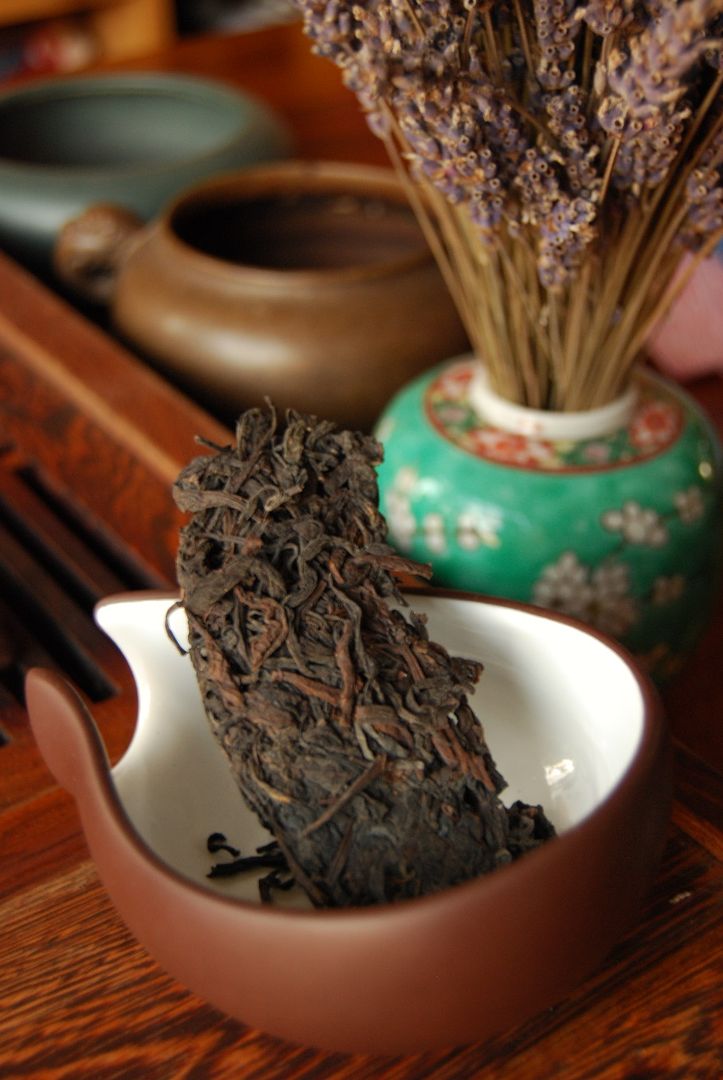
This is the 2002 Smoky LEE from Pu-erh.sk.  I love the capitalisation on LEE, which causes me to bellow the final word to myself, in my mind.


The Ponzi scheme is often used to describe this situation: there is no real value in the system, and it is propped up by one person making good on the situation of a larger number of other people.  Those people, in turn, can make good by having their own number of dupes.  And so it continues.

I bought this for some time, until I concluded that a Ponzi scheme only works if everyone has the opportunity to obtain a set of duped inferiors.  In a real Ponzi scheme, you are selling a nonexistent commodity to a set of people, which they in turn are each selling to others.  However, in the academic pyramid, this latter effect is not possible.  It cannot be considered a Ponzi scheme, because of this lack of flexibility to spread the risk ever wider.

For some time, then, I considered early-career academia to be like unto indentured servitude.


At 53 Eurobucks, this is a decent-value cake.  It has been stored in Guangzhou, and has maocha from Jiangcheng in Simao.  The rustic stems and (of course) bits of Chinese hair really emphasise the lo-fi nature of the cake.


It felt as if one would strive (and strive and strive) and, eventually, one might work up sufficient good karma to be made a freeman, which is to say be promoted to the top of the pyramid.  Put in sufficient effort, and freedom was attainable.

However, this analogy is equally as ill-fitting as that of the Ponzi scheme.  I have seen in those who have gone before me, many times, that there is striving aplenty only never to result in attainment of the ultimate reward.  There is no guarantee that hard work (and perhaps even genius, in some of their cases) would translate into being granted their (academic) freedom as their own independent, permanent researcher.

So, the indentured servitude doesn't cut it, either.

What, then, is the life of the early-career academic like?


It most obvious first impression is (quelle surprise) sweet smoke.  Its purity is remarkable, in that it has no cloudiness at all.  Thick and satisfying, the smokiness diminishes with each infusion, as does the memory of all of that Chinese hair in the maocha.  Perhaps the smokiness is an acquired taste but, as a lover of lapsang souchong, it is a taste that I have acquired.


The title of this article gives you my conclusion: it is none other than the Game of Thrones.

When you play the Game of Thrones, you win, or you die.

And there we have it.  After a certain point, everyone in the game is at least competent.  Incompetence tends to get weeded out earlier on in the process.  By the time you hit the main action of the pre-tenure game, everyone has proven themselves in battle.  Everyone is pretty good at what they do.  Everyone has a campaign or two under their belts.  Everyone has their own code by which they live, their own manner of operation, their own networks of informants and bannermen.

So what is it that makes the difference?  It's a good question.  There is no winning formula, and every early-career path is different.  Some mixture of ability, ruthlessness, patronage, knowing the rules of the game, and sheer willpower is often present.  However, Game of Thrones also teaches us that:

Gold wins wars, not soldiers.

It is a truism that cashmoney really makes the difference in the early stages (and perhaps all stages) of academia.  By this, I mean the sheer quantity of hardcore currency that one's research activity has attracted to date.


This is "Like 7542", and has just been released for 44 Merkeldollars at the Pu-erh.sk web-site.  It has a similar recipe to Menghai's mighty classic, and was stored in Yixing town.


This is not quite so bizarre as it sounds, as depressing at it might be.  Academic work is notoriously hard to "grade" outside one's own narrow field.  What is good research?  It is very difficult even for one's own university to answer that question, let alone ask people from outside.  In the absence of a set of realistic answers to that question, there are a number of proxy quantities: impact factors for journals, the number of citations one's work has attracted, etc.  However, even these vary tremendously from subsubdiscipline to subsubdiscipline.  It really is extremely difficult.  If everyone is at least good, how do you tell who is worth tenure, given that notorious variability in metrics between the tiniest differences in research fields?

Hence, shades of green is one means of determining some sort of proxy.  If a researcher is good, they have probably done good work, and that has probably been recognised by that researcher's peers, and they will have returned good reviews of, for example, academic grant proposals.  I note with some amusement / dissatisfaction that success with big grants tends to be followed by recognition.

Whether or not this is healthy is a different question; whether or not it promotes low-risk research that plays well to reviewers' expectations likewise.  It's not right, but is it OK?

The comic irony of this situation is that in many academic institutions, my own being one of them, one cannot write grant applications until one has achieved a permanent position - and attaining a permanent position is very difficult (arguably impossible) unless one has achieved success in research, by which accumulation of successful research grants is the oft-used proxy.

It is the perfect catch-22.


There is a (very) faint scent of sweetness about the small, dark leaves which certainly look the part of 7542.


Just like the real Game of Thrones, the truth of the situation is that it isn't all this bad.  After all, "if golds wins wars, not soldiers" then how come Robert Baratheon (a soldier) is king, whereas one of the Lannisters (a wealthy noble house) is not?

There are other ways to play the Game, and these vary so substantially that they provide the lack of certainty that exists in early academia.  Some of these actually include excellence in research, which is heartening.


Interestingly, the thick Chinese hair in this tea (there is always thick Chinese hair) is not black - rather, it is entirely white.  I imagine an ancient sage processing this cake, between cigarette breaks.  The flavour (of the tea, not the hair) is warm, and perhaps a touch malted.  It has welcome strength at the back of the throat, and I am pleased to feel that it stimulates the tongue.  This cake feels quite lively, and is noticeably mouth-watering.  Its body is reasonably solid; it tastes like a decent little-factory cake made from quite strong leaves.  There are no points of immensely substantive interest, but the whole is pleasant.


Now I'm not saying that university turns everyone into Machiavelli, but (!) it is instructive to observe the changes that take place between your average human on entering the Game (let's say at graduate student level, to read for a doctoral degree) and leaving.

New grad students are awesome, typically.  When they arrive, they can be rough in manners and tread on everyone's toes with big voices and clumsy natures.  Usually within one or two years, this has changed dramatically.  I see it every year: they become finessed, and it is a change that you can almost see occurring before your very eyes.

The game is playing them.


NOT FOR SALE JUST FOR FUN.  I knew a girl like that once.  This is a 2010 7542, and it came to get down.


How does it end?  It ends the same way it always ends...


The little leaves are surprisingly dark, but then I realise that this 2010 cake was made half a decade ago.  There is the reassuringly fishy scent of bone fide Dayi.  It takes a few infusions to open, but the result is sweet density on top of all that opening fishiness.  The character in the mouth is strong, and it endures particularly well in the throat.  I am as impressed as I am captivated.  It has a sharp, rosewood edge.  It wakes me up, and comforts me.


You win, or you die.


is that pink paint
dripping from the parked car
old cherry blossoms

27 April, 2015

Better Dead Than Red

Ave, Reader, full of tea,
blessed art thou among drinkers and blessed is the fruit of thy zishahu.

It has been one month to the very day, at the time of writing, that I have foisted my missives in your general direction, and I trust that this lunar cycle has been favourable to you and yours.  I have come to conclude lately that my tiny little world is so very tiny, and my mind likewise, that I have very little idea about life beyond my immediate Schwarzschild radius.  

This even goes for understanding that the weather is not the same the world over: as I sit here in Middle England, comfortably chilly, and wearing a cardigan, I am reminded of an academic visit to Paris last week.  The entire city was so very, very hot that I had to [sharp inhalation of breath] remove my cardigan.  Not even a waistcoat.  There was not a single necktie in the entire city.  And this was in May.  Baffling.  Happily, I was back in England within 24 hours for the purposes of seeing my little family, and so I was able to resume normality quite quickly.  However, the experience was traumatic.


I suspect that the root cause of the problem here is that I have trouble understanding that some people are not me.  That doesn't sit easily into my aforementioned tiny mind.  So, when I kick back and write about hongcha, I naturally assume that you are totally into hongcha in the same way.

Imagine my surprise when I tried some of these teas out on friends and colleagues only to discover that some of them did not like the tea.  Again, completely baffling.  This is hongcha, and it's good hongcha - what more is there to say?


You might have guessed from the (pagan druidic?) wrapper that this little cake is from Ee-Oh-Tee.  Check out those leaves, with the rusty tips.  There's your hongcha right there.

It seems to be made from Mengsongshan leaves, and Ee-Oh-Tee notes that it comes from the same leaves as the 2014 "Yuanwei".  Commercial confidence surrounds the exact location of the village, so that comparison might not be entirely helpful, but you get the general idea.  It's pu'ercha gone red.


I admire a tea-maker with both the Jones and co-Jones to use good pu'ercha leaves for the purposes of making either (i) shupu, or (ii) hongcha.  You are, essentially, guaranteeing yourself some chunky, meaty, beefiness.  Never has beefiness been in such strong demand as when you sit down with a pot of the ol' hongcha, because you don't sit down with a pot of the ol' hongcha expecting a prissy, fussy, delicate experience.  No, you expect to be slapped upside the head, and then insulted.  You expect a bit of a fight.  Hongcha is not supposed to go quietly into the night.


At a cost of 28 Britishunits for a mass of 200 S.I. grams, this is not too terrifying in its price.  I think that's appropriate for something like hongcha.  Isn't it interesting that if you just leave the tea as it is, and make a shengpu cake, then the result sells for £54/200g, but if you turn those same leaves into hongcha, then the price approximately halves?  Mystifying.  Cue enraged letters in the "comments" section.

This cake is as precise and clean as one would expect from Ee-oh-tee, and I like the fact that it has been tested for pesticides in a credible manner.  I like even more the results of that test, which suggest that it is clean.  This fact alone rather recommends it to my shelves, for some daily drinkage in the lab.

Like the puer'cha that it once was, this little hongcha lasts forever.  Importantly, its carnivore-pleasing strength seems undiminished when brewed with lesser water-quality, during the working day. 


Some months after drinking the above, I bounced into BIG TREE RED, which sounds like a Menghai special production but is, in fact, hongcha.  I think that outcome pleased me.


As pictured above, this hongcha comes from Dubs.  The web-site suggests that this is priced at $35 for "0.050 kg", and I wonder if there was a problem with the placement of the decimal point there.  Thirty-five bux for 500g would be in line with my expectation for good ol' hongcha, while the same price for just 50g would be in danger of raising an eyebrow.

I suppose that it is at this stage I would be pointed in the direction of the text that describes how the leaves come from 100-200 year-old trees and that they have been massaged by the inner thighs of pretty, nubile teavixens.

Those teavixens really drive up the price.


I like Lincang.  Lincang is rough, unapologetic, and great fun - and that's where these leaves originate.  I can't say that I've ever had Lincang hongcha before, and so I'm attentive as the kettle kicks into gear.


To say that I brewed this tea hard is something of an understatement.  I brewed this tea like nuclear fusion.  I brewed this tea like Odysseus on an Ithacan goat after a decade at sea.  Pile those leaves high, and pack that little pot to the brim.  The result is solid, sharp, and potently cooling.  It soon drops the pretence of being candy-sweet "hongcha" and gets down to the serious business of being red pu'ercha.  It cuts through your life like a hot knife through churned lipid solution.

Drink this tea and conquer the world.  Teavixens and all.


French Windmills


French windmills
always remind me of
English windmills

20 April, 2015

Simulated Anneiling

Hoho, a pun to do with numerical optimisation.  Is there anything funnier than numerical optimisation?  If so, I don't think I've encountered it.

Today's article is about, you guessed it, tea from NEIL.  I.e., tea from Teaclassico.  Thx, Neil.  I have written extensively about "TC" before, and how Neil, simulated or otherwise, has a unique talent for separating me from the contents of my wallet.


At the time of writing, we have just had a partial lunar eclipse.  Being able to see two celestial bodies moving past one another, actually moving while one watches, is quite something.  Naturally, it has a strange effect on the psyche, and there have been outbreaks of lycanthropy, but otherwise we're all fine.

After shaving my palms, I settle down with some "1990s Fu Lu Gong".  I couldn't find this for sale on the Teaclassico web-site, but I am not a clever man and may have missed it.


Most striking is the loose compression, which is clearly "hand compressed".  I think it really means that someone put a large stone on the leaves and then, usually, stood on it, so perhaps it should be "foot compressed".  Such things don't impress me, ever since I was in a restaurant that claimed their salad included "hand-torn lettuce".  My brains have been in a liquefied state ever since, so I am no longer about to judge the hand/foot compression of a tea and its virtues thereupon.


As ever with older teas, I pack my little teapot to the brim, based on the principle that it is almost impossible to overbrew these old fellows.  The result is unexpected: there is absolutely no aroma, and the soup (while richly-coloured, as pictured above) really has very little flavour.

I know, I know: people who hope for flavour from their tea are such newbs.  We should be content with the feeling of the all-consuming CHAQI that surrounds us and penetrates us and which binds the galaxy together.  Hoping for some character to enjoy in the mouth immediately marks us out as a dilettante.

Nonetheless, this is thin and watery tea.  It ramps up (just a little) in the second infusion, to give the scent of heavy plums (the fruits, not the genitals).  Happily, it begins to smell just like an English country garden in summertime.  It is almost the precise simulacrum of my grandmother's old farmhouse garden, in fact, and this immediately makes me happy.  That said, there is not much going on in the flavour, still, nor anything in the throat.  It is cooling on the breath, and active on the lips and tongue, and is, perhaps, therefore more of a "sensations" tea. 


The night (morning) is young, and so I ditch the Fu Lu Gong and head into 1999 YIWU OLD TREE territory.

I miss those days, when every cake was YIWUZHENGSHANLAOSHUCHAWANG, but they are gone forever.  We can revisit them, though, with tea sessions such as this.


Once again, due to my innate dimness, I fail to find this tea on the Teaclassico web-site.  Once again I hope you will, Gentle Reader, take pity on us miserable offenders and point out my inevitable mistake.


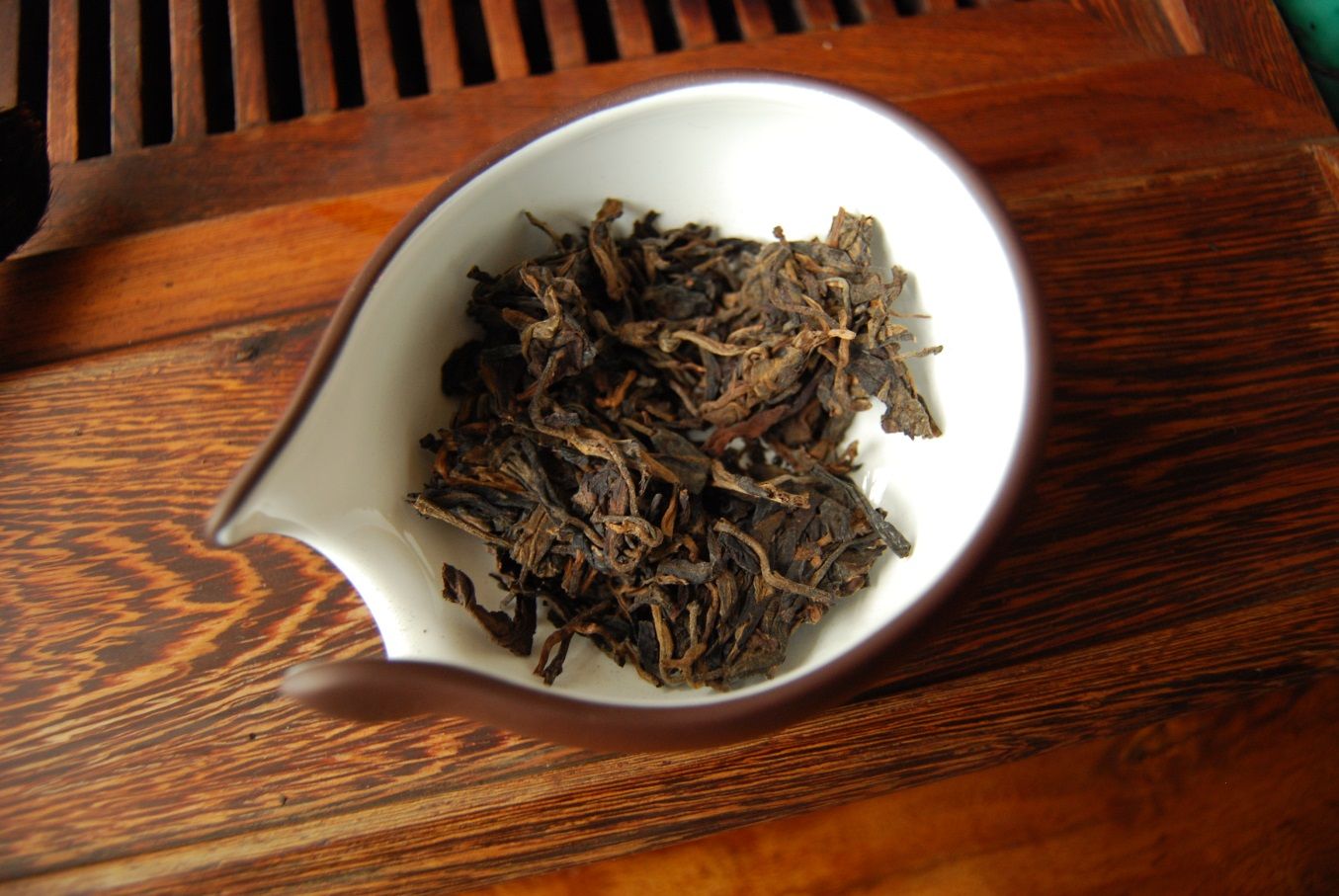
The photograph above makes me thirsty, again, and I have just consumed nine pints of tea.  Such is the power of good leaves.  We can see large fragments - these have a sweet scent that already trumps that of the Fu Lu Gong.


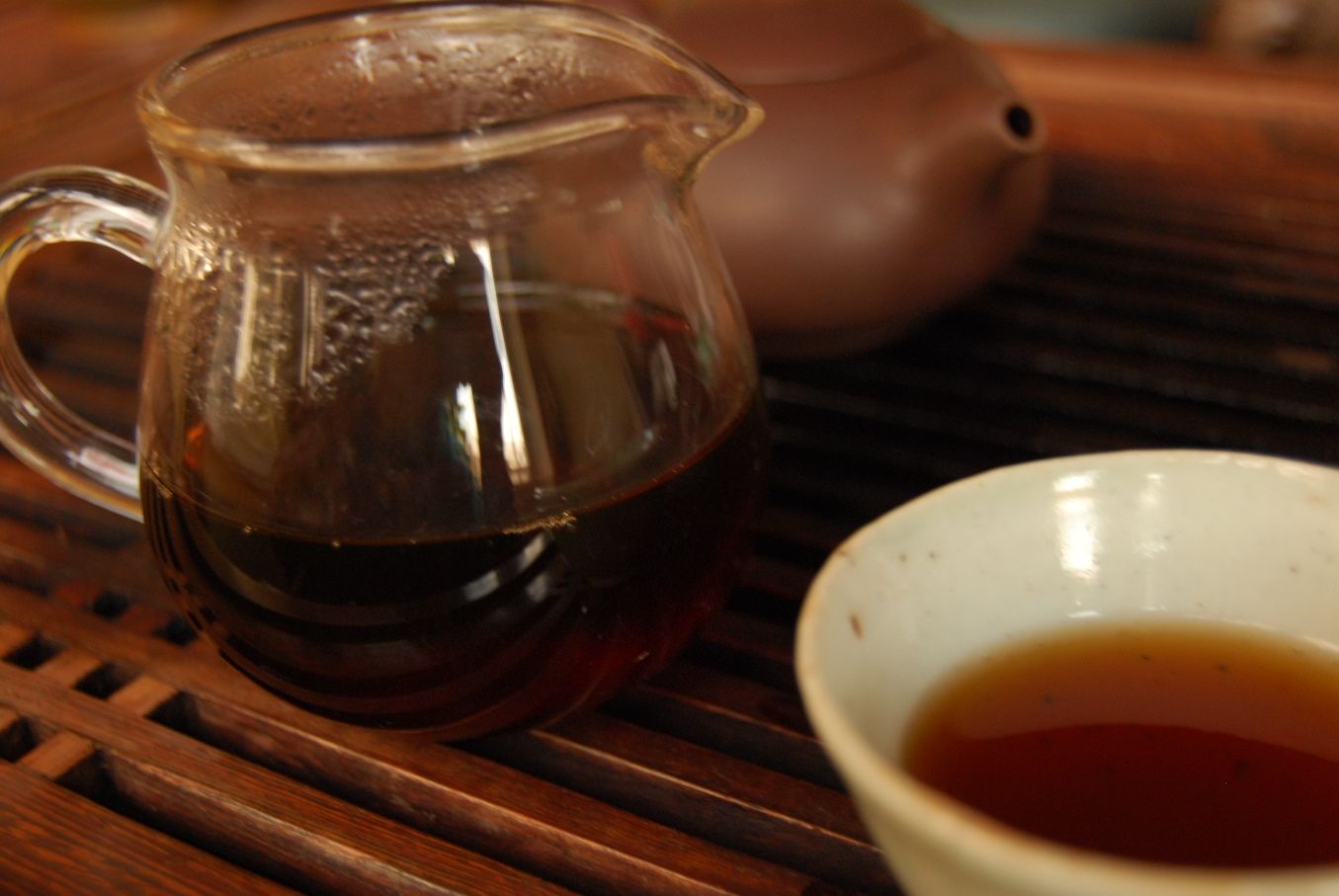
The smooth, woody stability of this tea reminds me of brewing up an old table.  The colour, pictured above, is as satisfying in its heaviness as is the (for want of a better word) CHAQI.  While the mystical forces of the cosmos surge through my body, leaving my shakras and dantian trembling, I conclude that this sweet, sharp little tea is most welcome on a cold morning in March.  It is simple, it is a touch thin, but its woody sweetness just keeps on giving.


Young Boy's Sweets


young boy's sweets
rolling towards the back seats
ready for take-off