05 July, 2007

2006 Yiwu Zhuancha

This is an inexpensive brick of tea (£10/250g) from TeaCuppa. Lisa provided this as a "thank you" following the tasting event from several weeks ago - an appreciated gesture, but entirely unnecessary. The following notes are, as usual, taken directly from my journal.

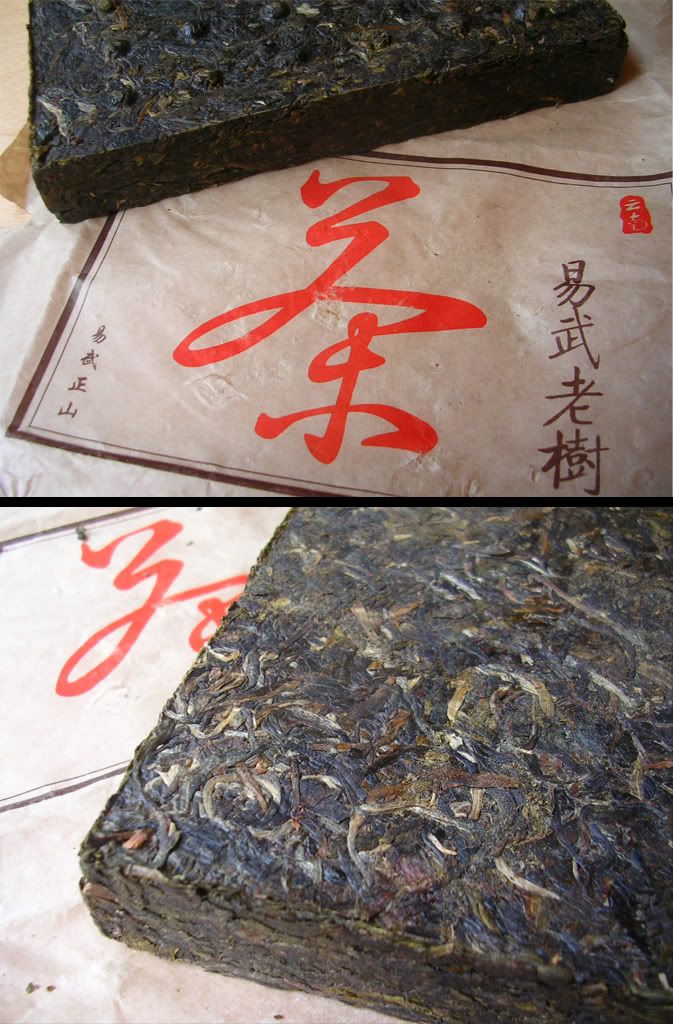
The wrapper discloses little, short of "Yiwu zhengshan" [proper mountain] and "laoshu" [old tree] - no factory name is given, unfortunately.

Caledonian Springs @ 100C in 12cl pot for young shengpu; ~5-6g leaf; 1 rinse

Dry leaves:
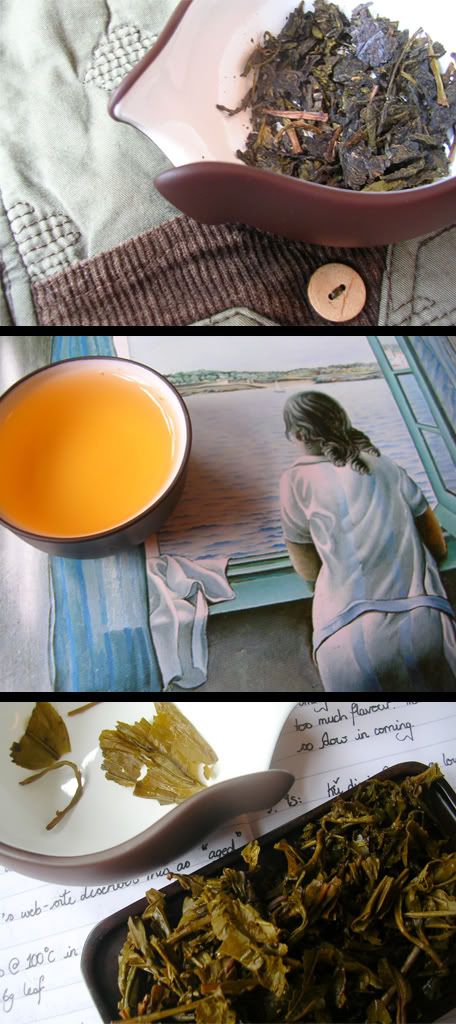
Dark on the outside, where they have been ground by the compressor, but very green on the interior. A blend, from stems to tips. The aroma is fresh and similarly green.
3s, 5s, 9s, 15s:
A strong, orange soup, though fairly murky. No aroma at all. The body of the soup is thick and heavy in the mouth. There is strong ku, but not an immense flavour - what there is remains low, and lightly interesting. The aftertaste is slow in coming, and is eventually sweet - something akin to my understanding of Yiwu, but not too clear.

The third infusion sees a diminishing level of ku, but the character of the tea becomes slightly rough. The final, fourth infusion is rough in the throat.

Wet leaves:

Messy. "Leftovers?" Very green, almost like young lucha. Lots of stems.

Overall:
A daily shengpu. I can't imagine that the somewhat understated flavours could carry it very far in aging, but it does have a ton of bitterness. Not too thrilling in quality, but not "bad".
03 July, 2007

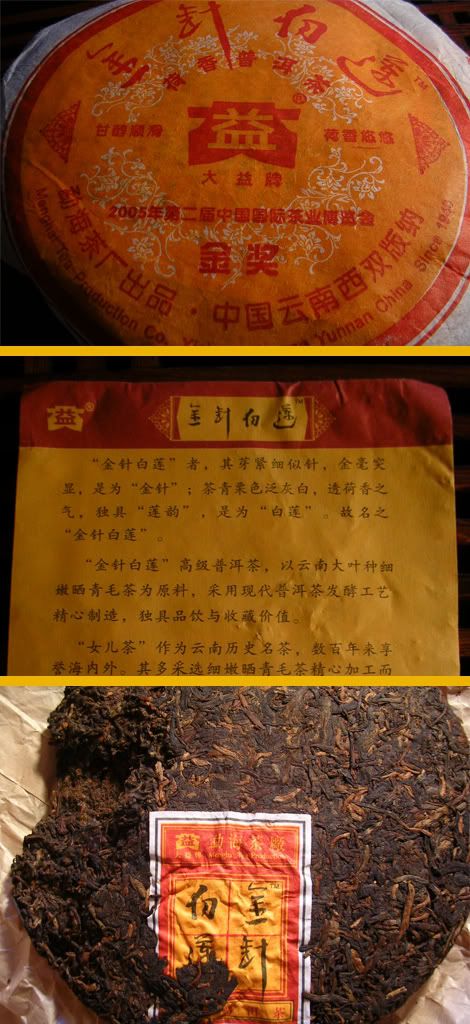
2005 Menghai Dayi "Jinzhen Bailian"

Wrapper:
"Jinzhen Bailian" [gold-needle water-lily]
"Hexiang [lotus-scent] pu'er cha"
"2005 2nd Chinese Tea Industry Exhibition"
"Jinjiang" [gold prize]

Neipiao:
Obvious golden tips; water-lily [bailian] scent.

A 250g xiaobing from DV [many thanks again, Dustin - it's delicious], originally $23 from Houde.

Caledonian Springs @ 100C in 12cl shipiao for shupu; ~5-6g leaf; 2 rinses

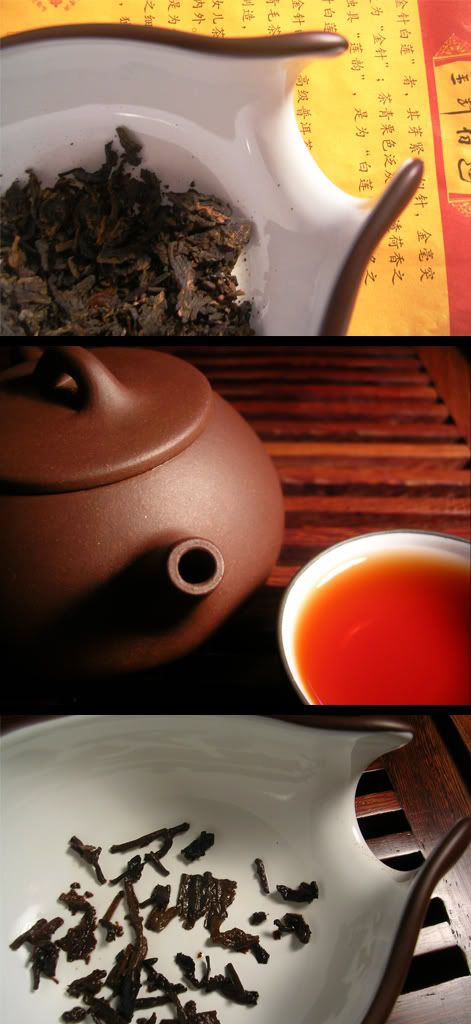
Dry leaves:
As the name suggests, plenty of short, golden tips. The scent is light and clean, and fairly floral.

12s, 20s, 30s, 45s, 60s, 90s:
"Strong bass note." Buttery beidixiang, followed by a long, low shupu lengxiang - boding well for its endurance?

"I can see why it is bailian from the floral feel." Sour opening, with a long and wooden body - fine patience. Rich in the nose, with a pleasant huigan. "The huigan is light in character, but not light in strength."

"Qingxiang gaoyuan." [green-scent high-and-distant, used to describe rarified, and elegantly pleasant characteristics].

It is a surprisingly active shupu, with plenty of pure strength, with a richness of flavour that is rewarding. Undergoing stress, unlike many shupu that become merely "industrial", this bing becomes strong and enjoyable.

Later infusions becomes sweeter and lighter, turning the corner around the fifth infusion - but remaining enjoyable, definitely not the usual falling apart of lesser teas.

Wet leaves:
Fairly short, but surprisingly possible to unfurl, given the brittle and hard nature of many shupu. This is suggestive of lower fermentation levels, as is the green hue in the wet leaves - this may also explain the floral character of the tea. I might expect lower fermentation levels to retain much of the ku of the green leaves, some of which remains in this shupu, moreso than many.

Overall:
"Really a very decent shupu." Plenty of boldness but without obvious flaws, this combines good strength and interesting character. It doesn't have the legs to get too much further than five or six infusions, but is a satisfying evening brew.

01 July, 2007

2000 Bailin Gongfu, 2007 Bailin Gongfu

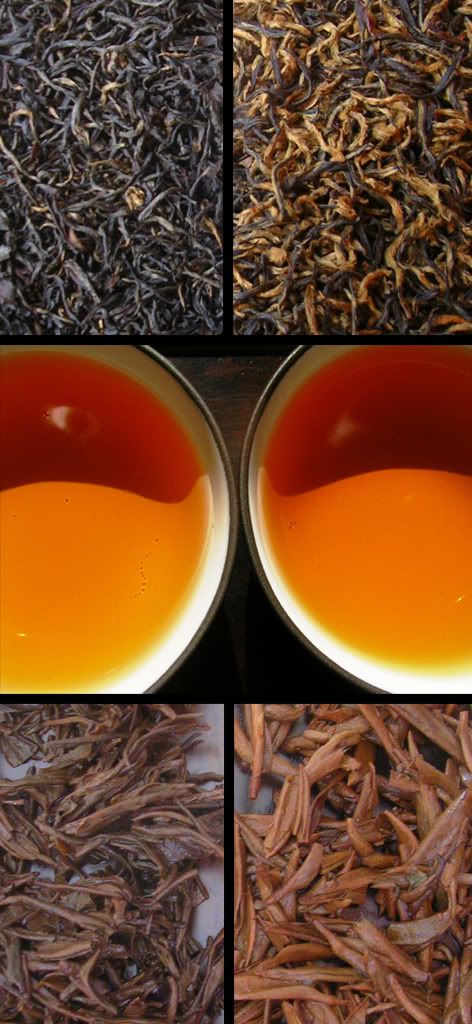
Both Fujian hongcha, these were bought on Maliandao. 60 RMB/100g for the 2000, 27 RMB/100g for the 2007. Left and right in accompanying illustrations, respectively.

Caledonian Springs @ 100C in 10cl daoba xishi, used for hongcha; ~5g leaf; 1 rinse; teas tasted sequentially

Dry leaves:
2000: not the best grade, as many smaller leaves are evident. The best grades of hongcha have bigger, furry tips, while the lower grades are mixed with tiny, darker non-tip leaves. This is the reverse of many other tea grades, in which smaller leaves are generally taken as higher grades. In the case of this 2000, the tips have turned black. Malty aroma of old grapes.

2007: yellow and black, a higher grade. Fresh, red aroma.

12s, 16s, 32s:
2000: The aroma is dark, husky, and long - giving a good sign of longevity for the tea, which is orange with a red hint. Very smooth in texture, but not the extraordinary silk of the 2006 Premium Gold-Tips Dianhong from Yunnan Sourcing, provided by CB.

The malty flavour is refreshing, and fairly long in patience for a hongcha. This Fujian variety is higher and sweeter than some other provinces, ending in the sweetness of old honey and treacle. There is a little hongcha sourness, but the edge has been eroded over the years. Delicious.

2007: Currant-like, reminding me of the 2006 Xinzhu County Oriental Beauty from Teamasters. A quick change into a sour lengxiang makes this a fairly acrobatic tea in the wenxiangbei. Yellower soup than its cousin, which stabilises to become identical in the second infusion [pictured].

A touch simpler in flavour, with a tendency towards the currant-bun noted in the aroma. It's a touch more sour, and not quite as delectably sweet as the 2000.

Wet leaves:
2000: ubiquitously dark, with some stems and broken leaves indicating its lower grade.

2007: plush, full, bulging pea-pod like tips, which are classically red.

Overall:
It's an interesting experiment to compare two similar teas (if of slightly differing grade) with considerably different maturity.

Received wisdom places hongcha at its best at, or after, one year of aging - authority seems divided. Experience from this tasting indicates that the 7-year-old is smoother, more well-integrated, and exhibits sufficient endurance to make limited aging a worth-while prospect. The 2000 is clearly the better tea, despite its lower grade of content.