At the eternally excellent Babelcarp, I learned that Bingdao [Ice Island] refers to a grove of qiaomu [arbor] trees in the Mengku region, famed for the cooling sensation that its soup imparts in the mouth. You know you live in a fine area of the world when groves of trees become famous.

This maocha is from Puerh Shop, and is one of their more expensive maocha ($8.40/50g). Many thanks to the vendors for including a sample of this tea with my previous order - I wouldn't otherwise experienced what turns out to be a rather decent maocha.
The product description did not mention the Bingdao cooling sensation, and so I thought that it would be an interesting investigation to determine if such a quality exists in this maocha.
The product description did not mention the Bingdao cooling sensation, and so I thought that it would be an interesting investigation to determine if such a quality exists in this maocha.
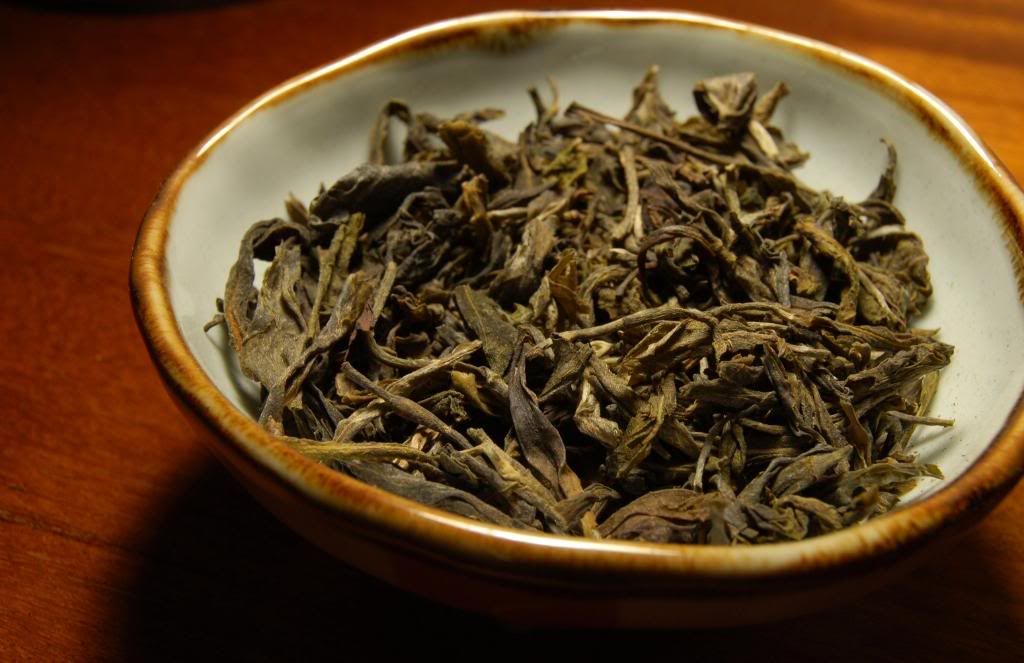
The leaves are very large and, despite appearances in the evening photograph above, are very green. The sweet, clean aroma of good, young pu'er is always refreshing.
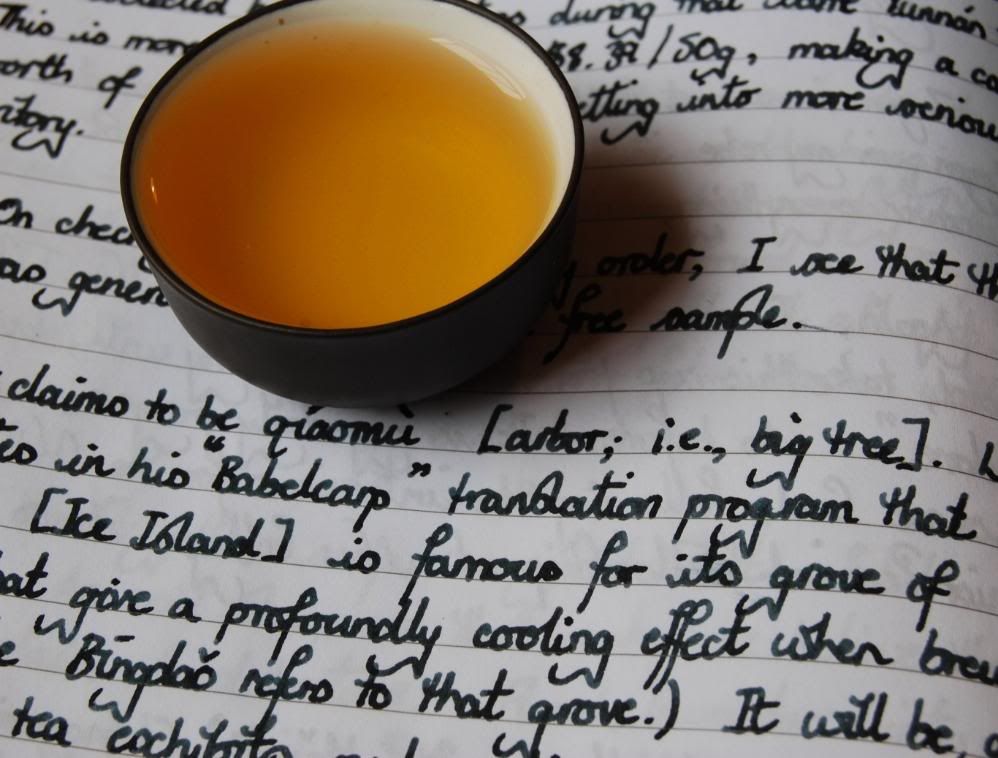
A clean yellow soup results (pictured below), which has a brown, clear sugariness in its aroma. If only more 2007 bingcha were this honest and unprocessed, my personal tastes would be satisfied.
A clean yellow soup results (pictured below), which has a brown, clear sugariness in its aroma. If only more 2007 bingcha were this honest and unprocessed, my personal tastes would be satisfied.
The flavour is sour and complex. It exhibits plenty of tingling energy and, if I look for it, there is something of that cooling sensation in it. As ever with this characteristic, it is accompanied by a slight numbing of the lips and tongue - it sounds terrifying, but is somehow not unpleasant.
The effect is not as striking as some other teas, however, being rather muted (you have to look for it, whereas some teas it is strikingly clear) and I wonder if this implies that whatever qiaomu leaves exist in this tea have been blended with some "filler".
The effect is not as striking as some other teas, however, being rather muted (you have to look for it, whereas some teas it is strikingly clear) and I wonder if this implies that whatever qiaomu leaves exist in this tea have been blended with some "filler".
At $8.39/50g, a 375g equivalent weight would cost $63 - that's fairly significant; we're no longer talking about cheap, disposable maocha. For the same cost, the 2005 Mengku Chengguan could be obtained from the same vendor. All these costly exercises are, of course, ultimately down to the individual, but comparing the pleasure provided by the 2005 Mengku Chengguan to the decent but limited pleasures of this maocha makes me wonder if this is a touch overpriced. I can see myself obtaining a small amount (100g?) for fun, but would rather have my money work a little harder with other teas.
4 comments:
Now, I'm really wondering whether you have any more of this tea stashed somewheres, as it might be reasonably real...Of course, I'm assuming you originally got 50g.
Welcome... to history!
Gosh, it's dusty back here. I even had to resize the old-size photographs. Everything was rather low-resolution, back in 2008, was it not? We're so much older and wiser, now. Well, if not older and wiser, at least our internet connections have greater bandwidth. That's almost as good as wisdom.
I just checked my spreadsheet (I have a spreadsheet!), and it seems that I didn't buy this tea, after all. There could, feasibly, be the remainder of the tea in my "unfinished samples" bag, but I tend to pass on half-tasted samples (en masse) to unsuspecting teachums. I wonder if this tea improved.
Toodlepip,
Hobbes
I mostly thought it could be interesting since the rise of Bingdao as uberexpensive was only since about 2007-2008. The actual stuff was probably superexpensive as soon as people figured out the gushu angle, but it would have been an interesting concept to review what people thought was "Bingdao" 2007-2010.
True enough. Earlier Bingdao was certainly not abnormal in price, as far as I recall. I do like the "icy" nature of good teas from this area, but haven't invested much in them - aside from a few cakes from... w2t? YS? I forget.
All the best,
Hobbes
Post a Comment