People who write about tea are a famously grumpy bunch. A number of us, as far as I can tell, are students or academics or similar, and we are therefore not in the profession of suffering fools gladly. This can lead to the impression that we are miserable, grouchy, Grinch-like individuals, who like nothing better than to steal Christmas.
Although I try to maintain an optimistic outlook*, I was particularly grumpy when I sat down to this session. This is because, at the time of writing, it is August, I am sat at home with a cold, and am generally feeling quite grim.
Against all the odds, this session with shupu from Teasetter truly lifted my spirits. I would like to recount the story to you, Gentle Reader, if you will bear with me.
Although I try to maintain an optimistic outlook*, I was particularly grumpy when I sat down to this session. This is because, at the time of writing, it is August, I am sat at home with a cold, and am generally feeling quite grim.
Against all the odds, this session with shupu from Teasetter truly lifted my spirits. I would like to recount the story to you, Gentle Reader, if you will bear with me.
*My students call me "Dr. Who", only partly because of my dress-sense.

The tea world is filled with hucksters, charlatans, swindlers, mountebanks, and scumbags. It seems that everyone wants to start up a little business on the side, buying cheap tea from China, obscuring it with a suitably evocative name (presumably so that customers cannot buy it elsewhere for the actual, cheaper price), and then selling it at a significant profit margin. Every web-site is dazzling white (in the "Apple" style); everyone claims to be selling something unique. They typically last a year or two before the owner gives up, and goes back to the "day job", or perhaps focusses on selling something else.
Wulong is the prime focus of this industry, given its untraceable origins and accessibility for novice drinkers; pu'ercha (usually labelled "pu-erh" as if we were writing via 19th century Wade-Giles) is by no means immune.
Wulong is the prime focus of this industry, given its untraceable origins and accessibility for novice drinkers; pu'ercha (usually labelled "pu-erh" as if we were writing via 19th century Wade-Giles) is by no means immune.

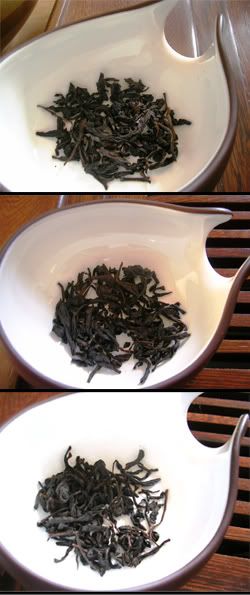
Clockwise from top: 2010 "Ethical Agriculture's Wild Grown Pu-erh" [sic],
2011 "Old Capitol" [sic], 1992 "Sweet Fragrance Pu'ehr Tea" [sic]
You will, therefore, excuse me if I am rather prejudiced concerning new ventures that seem to fit this pattern. This is merely because we have all seen far too many of them come and go.
It is against this backdrop, while grumpy for the reasons listed above, that I sat down to drink three 4g samples of shupu from Teasetter.
It is against this backdrop, while grumpy for the reasons listed above, that I sat down to drink three 4g samples of shupu from Teasetter.

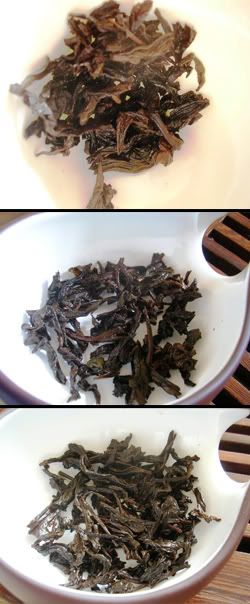
All three samples mixed, with fannings removed
I started browsing the company web-site, and alarm bells started to ring. It was then that I came to realise that I was viewing the web-site through the rheumy, yellow-encrusted lenses of my own prejudice. I watched the company's Youtube-hosted instruction video, and was confronted with the honest, sincere face of a young man, which was as free of guile as any innocent soul could ever hope to be.

It also made me realise that the world of tea is much greater than the tiny niche that I inhabit. If people wish to recommend using a microwave for 3-4 minutes to heat the water, then why should they not? The whole affair smacks of passion and personal commitment, and I rather like it, grammatical errors and inkjet printing included.

Napolean famously called the English a "nation of shopkeepers", which he intended to be an insult. However, the entrepreneurial instinct is to be congratulated, I think.
I suspect that the primary market for Teasetter is the USA (the tea may only be purchased in "oz", which Google informs me is approximately 28g). Certainly, the customers of Teasetter are pleased: there are 128 people who "like" the company via Facebook, and reviews quoted on the web-site rate the teas as being "100/100". Ultimately, if it contributes to lowering the body mass, blood pressure, and cholesterol levels of your average Westerner, then such ventures are to be applauded.
As far as the tea that I tried, when mixed all together, it was absolutely delicious. The session lasted a good hour, the tea had no signs of exhaustion, and it remained thick, sweet, and highly invigorating - a welcome cure in between cups of "jiangtang" [ginger soup]. I look forward to seeing Teasetter convert more Americans to drinking decent tea.
I suspect that the primary market for Teasetter is the USA (the tea may only be purchased in "oz", which Google informs me is approximately 28g). Certainly, the customers of Teasetter are pleased: there are 128 people who "like" the company via Facebook, and reviews quoted on the web-site rate the teas as being "100/100". Ultimately, if it contributes to lowering the body mass, blood pressure, and cholesterol levels of your average Westerner, then such ventures are to be applauded.
As far as the tea that I tried, when mixed all together, it was absolutely delicious. The session lasted a good hour, the tea had no signs of exhaustion, and it remained thick, sweet, and highly invigorating - a welcome cure in between cups of "jiangtang" [ginger soup]. I look forward to seeing Teasetter convert more Americans to drinking decent tea.