Showing posts with label 1996. Show all posts

30 December, 2013

Aging Tea: A Mixed Bag

I have been sampling my own shelves widely, of late, and have come to some conclusions on the relative merits of my cakes ability to age.  (In each case, I have added notes to the original articles, which you are invited to inspect by following the corresponding links.)

The Good

The 7542-801 is quite good, although a little akin to a "dry storage" cake. The 7532-801 is better - it tastes more humid and more developed, and does not have the "dry storage" straw of the 7542-801.  Oddly, the 7542-901 is absolutely first-class.  Made just one year later, it is dark and heavy in that classical Dayi manner, and tastes very nicely aged indeed.  I suspect that most people would enjoy it - they would certainly enjoy it for the sub-$10 price in 2009.

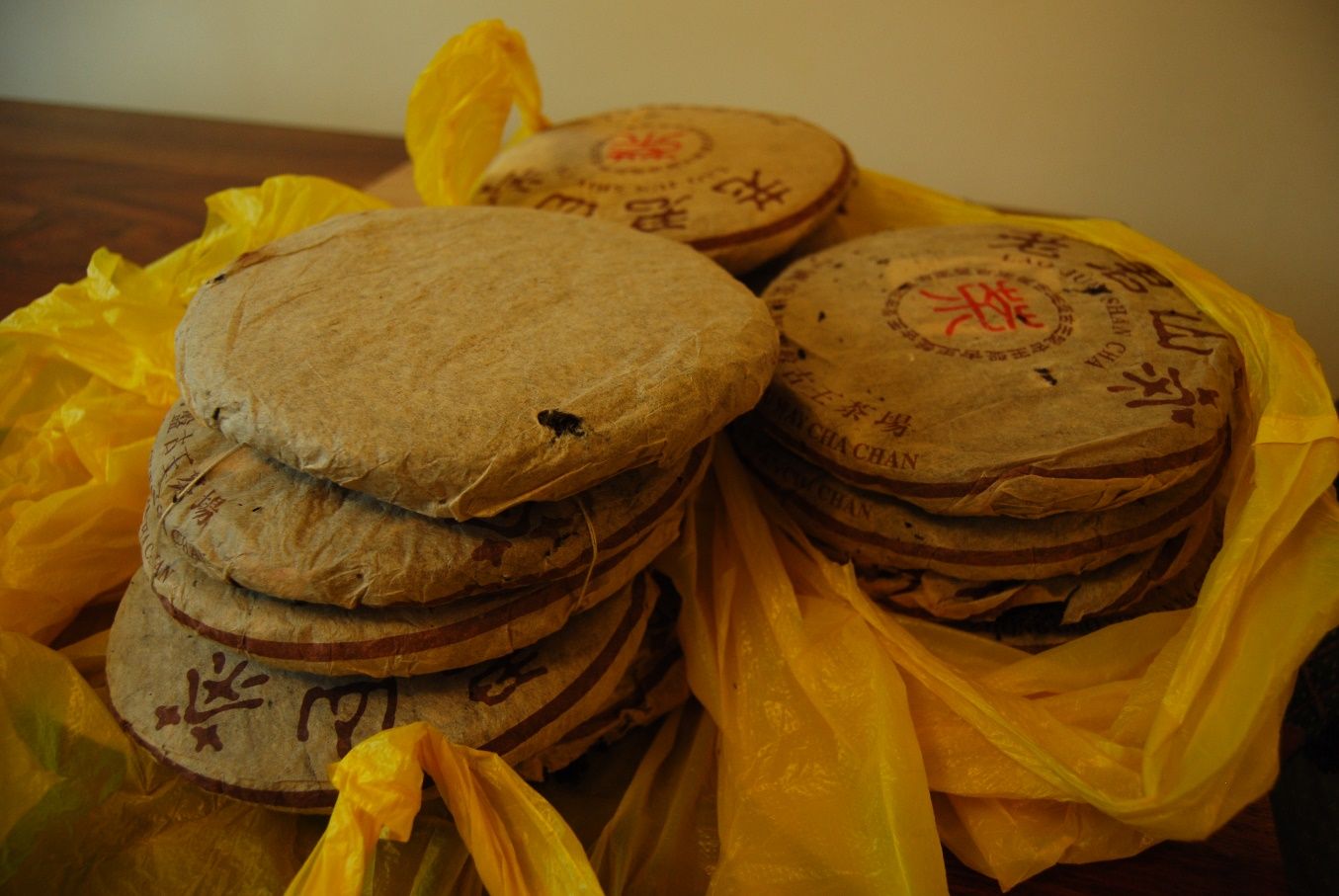
Another success story is our aging experiment in central China, where Chinese Mama and Baba have recently brought us a few tong from our stores there.  The 1997 Laojunshan (pictured below), being one such cake brought to England, even though it is shupu, is heavy, round, and excessively sweet with old vanilla.  I look forward to trying the shengpu that we have.


My post-viva Hongjie cakes, bought in 2009 in Maliandao, when my dear wife was unknowingly carrying Xiaohu, our eldest son, has come on very well (much like dear Xiaohu himself!).  The change in the tea-leaves from their original green to a husky red-orange is very encouraging.

Finally, the 1996 Xiaguan bricks from Maliandao (pictured below) are coming on a treat - somehow, they are superdense carriers of vanilla and smooth huigan.


The Not-So-Good

Oddly, the 2003 Zitenglu Zipinhao [Wysteria Teahouse purple-label], pictured below, fits in this category. The original sample that I tried, stored in Singapore, stopped the clocks and was unfathomably excellent.  The actual cake, stored in Taiwan, was less amazing.  I managed to overcome some of this simply by using many more leaves of the Taiwanese-stored cake, which got it a little closer to the Singaporean version.


Perhaps most concerning of all, the 2011 Yunzhiyuan "Autumnal Xikong" (pictured below) has collapsed into tasting like purple tea.  I am deeply concerned for its future, and will take this as a warning concerning the purchase of super-sweet, unaged autumnal cakes in future.


Tea is such an education, and an experiment in itself.

29 December, 2011

1996 Xiaguan Zhuancha

Long before Baoyan bricks, there was the original ODB. 

Wasn't it Shakespeare himself who once famously explained this as being, "Cuz there ain't no father to his style"?


  1996 Xiaguan Zhuancha
"Xiaguan"

These two angry gentlemen came from Beijing Taochaju, from my last trip to Maliandao.  I've written before about my success with "The Friend Method" of obtaining good prices (listen to the price that the seller is giving his friend), which is a card that should be played with caution, depending on the audience.  It worked out well in this instance, because these wrapper-less fiends were thus priced at a humble 200 RMB.


1996 Xiaguan Zhuancha
Dimples from the hydraulic press

We drank these quite a bit, the owner (Yunqing), the friend, and I.  For 200 RMB, I was expecting ungood tea.  However, the results were pleasantly startling.

Yunqing pointed out that the leaves are small and chopped throughout the majority of the brick, with the thinnest imaginable layer of large leaves on the facia.  Shown below, the brick in cross section, where the upper plane represents the front of the brick, with its slim layer of big leaves.


1996 Xiaguan Zhuancha


Now at home, I wished to try some of the chopped leaves, rather than concentrate on the covering of larger leaves, and so hacked into one corner.  The brick duly relinquished, with some reticence, a number of nuggets, as pictured below.


1996 Xiaguan Zhuancha


You'd think that such a tea wouldn't be up to much, but the results are much better than that.  Even the very first brew, which you expect to be watery because the leaves remain in their little chunks, was thick and darkly coloured (shown below).

Throughout it is smooth, thick, and "bookish" - that wonderful taste of old libraries.  I have never had the gumption to actually taste some of our library's books, but I bet they'd taste like this.  (When you join the university, you undergo a special ceremony called matriculation - a kind of inverse graduation - during which you swear not to burn any books*.  They didn't say anything about eating them, though.)

*I hereby undertake not to remove from the Library, nor to mark, deface, or injure in any way, any volume, document or other object belonging to it or in its custody; not to bring into the Library, or kindle therein, any fire or flame, and not to smoke in the Library; and I promise to obey all rules of the Library.  (Translation from the Latin.)


1996 Xiaguan Zhuancha#


Yunqing did us a huge favour at selling these for such a modest price, and I feel very grateful, enjoying them back at home.  Later infusions build, constructing an ever-darker, ever-sweeter brew.  I come back later in the day (a rare treat to enjoy tea, let alone in the evening) in order to give the leaves the full amount of time that they deserve: after twelve infusions, the brews are still thick, sweet, and powdery.

When even humble leaves such as these can be aged to give such a decent result, I am heartily cheered.


Addendum
September, 2013

It is 4 a.m. at the time of enjoying this tea, where the term has just begun following the long, productive summer. I expect the first infusion of this tightly-compressed tea to be weak, but it is, on the contrary, thick and heavy with vanilla. The powdery-sweet character of bookish old pu'ercha is a surprise. Spring water brings out a brighter, clearer, and more well-defined tea than the initial infusion with filtered tap water.

By the third infusion, the sweet vanilla has taken the fore, where the scent in the wenxiangbei is long and active. The soup has darkened to a heavy red-brown and looks the part. By the fourth infusion, it reaches maximum strength, where all the leaves have separated from their tightly-compressed nuggets. It lasts well and has an energy that I would not expect for zhuancha.

01 October, 2011

A Longitudinal Study of 7542, Part the Second

Following recent notes on the delicious first half of a session with local hero, Apache, in which we encountered a series of recent 7542s, we then embarked on the following excursion into more remote times.


2000 7542
2000 Menghai


The 2000 Menghai 7542 is a large sample, provided by Grand Tea.  My companion has some unspoken reservations concerning this tea, which he withholds until I have had the chance to try it, to see if my experience matches his own.

My first impression is that the neifei [inner ticket, pictured above] is dazzingly white - moreso than one would anticipate for a cake that is nominally 11 years old.  


2000 7542
2000 Menghai


The scent of the (rather pretty) leaves, which are shown above, is one of humidity.  When brewed, the soup is a decent colour of heavy orange, as in the image below.  It is at this stage that I begin to suspect what it is that Apache is not saying: there is almost no aroma.  In the mouth, the character is faded, empty, and light.

It has the "fishy" character, for want of a better adjective, that was common to the 2003 and 2004 versions described previously.  It is clearly 7542, but seems so absent that I wonder if the storage has tired it out.  Apache agrees, and we discuss the reliability of Grand Tea.


2000 7542
2000 Menghai


Onto more familiar pastures, next, as Apache reveals a sample of the 1998 "Shuilanyin" 7542, from Essence of Tea.  I have tried the same (with notes here) from Houde.

The leaves are shown below, which are quite small in this sample.  I long for more of the same delicious nature that I first encountered sometime in 2007.


1998 Shuilanyin 7542
1998 Shuilanyin


We are not disappointed - this is "proper pu'er", and the two drinkers each breathe a heavy sigh of relief and contentment.  As one would hope, it is long, heavy, and densely sweet - with that peculiarly powder-like texture much beloved of some old cakes.

I wrote that it is "bookish and humid", which is a compliment.  Examine the image shown below, if you will, and observe the dense central colour of the soup, with its thinner meniscus.

Amusingly, some of the bean-like "fishy" character of the other cakes may be discerned in the complex structure of this tea, and I am pleased to detect at least some similarity between them, even if difficult to describe.


1998 Shuilanyin 7542
1998 Shuilanyin


Ordinarily, Apache and I would have dedicated the remainder of the session to a pu'er as fine as the Shuilanyin [water-blue label], and yet, boisterously, we march on to the next encounter...


1996 7542
1996 CNNP


I have only tried a 7532 from the year 1996, which was a sample of "green-in-orange" from Essence of Tea.  This cake comes from an undisclosed location.


1996 7542
1996 CNNP


It is a shaggy, untidy cake, which makes it instantly adorable.  Perhaps you can see that the colour of the tips has tended towards the orange, rusty colour of age.  The aroma of the dry leaves is fresh and sharp - no humidity may be detected here.


1996 7542
1996 CNNP


Exhibiting his Asian deftness, Apache relieves the bing of a quantity of leaves...


1996 7542
1996 CNNP


This is nicely orange, although less dense in colour than the 1998 Shuilanyin.  We wonder if this is a consequence of its lack of humidity, because this cake is dry indeed - and entirely delectable. 

It remains big, bold, and surprisingly astringent, courtesy of its storage conditions.  Present and full such as it is, I would never have guessed that it was created in 1996.

Such is my delight at this cake, that I tuck the remainder of the wet leaves away into a gaiwan for further rumination on some later day.


1996 7542
1996 CNNP


So the last shall be first, and the first last: for many be called, but few chosen.

Apache reveals the '88 "Qingbing".


1988 Qingbing 7542
88 Qingbing


I have come across one incarnation of this old classic (which was actually made in 1989, rather than 1988) before, thanks to the exceptional generosity of KC, the notes for which may be found here.  I found that sample to be mighty fine, but "loose" and watery.  It was easily exhausted, rapidly requiring longer brews.


1988 Qingbing 7542
88 Qingbing


Apache's sample comes from Essence of Tea, and is a different tea: it is long, cooling, and so very sweet.  Its texture is one of extreme heaviness, and its smooth body is remarkable.

Residual scents of vanilla linger in the nose after the swallow, and the separation of colour into a red centre and a golden meniscus is clear, as shown above and below.

"Subtle, but there", remarks Apache, as we discuss the huigan.

1988 Qingbing 7542
88 Qingbing


And so it is.  The 88 Qingbing and the 1996 7542 both live on in their respective gaiwan to give me days of pleasure thereafter, reminding Lei and I of the most excellent tea session with Apache.  After the main consideration of enjoying good tea with great company, I feel as if I have learned a little regarding the common features of 7542 - particularly from 2003 and earlier.  Even though it is undoubtedly changed incarnation many times through the years, there is a kernel of constancy that does not abandon it.  

We will give the parting words to Apache himself,

"I cannot strain my imagination sufficiently to find a link between these older varieties and modern 7542."

18 March, 2009

1996 Menghai 7532 "Green in Orange"

With cause to celebrate, I crack into a sample bought from Nadacha: the mighty 7532 from 1996. This is the "Green in Orange", referring to the fact that the cake has a green neifei [ticket embedded into the cake], while the wrapper has an orange "zhongcha" logo. This is a later blend from the year to the 7532 "Orange in Orange" which, unsurprisingly, has an orange neifei.

Mmm, orange...


Fruit Bowl


This cake costs £200, which I'm unlikely to be able to justify spending on a single cake, even if it does work out to be quite cheap per session. So, time to enjoy a sample while it lasts!

This is desirable tea. If my 7532 from this year age so well, I will be a happy tea-drinker.


1996 Menghai 7532


It's fascinating to compare 7532 from 1996 to 7532 from 2009. It allows us to try and extrapolate from existing characteristics to what may be observed in the more mature leaves - making the fairly strong assumption that the two are comparable in production.

The leaves, pictured above, are small once again, and the pleasant rusty orange of tips that have gained some maturity. While dry, the aroma is asleep. When added to the rinsed pot, it awakens to reveal beautifully rich, damp, sweet wood.


1996 Menghai 7532


Oh, this one is smooth - so very, very smooth! It opens with plenty of sweet vanilla in the wenxiangbei [aroma cup], while the soup is heavy in its red/brown colour. It has a golden meniscus, a sign of aging shengpu.

This tea is alive, and it cools the lips and causes tingling sensations on the tongue. The huigan builds, and endures for a whole minute.


1996 Menghai 7532


This cake is a real treat. The surprising smoothness is remarkable, and that citrus-like tang of 7532 lives on despite its years, but attenuated and smoothed out, becoming part of the rich, woody background.

Will our 7532 be this good in 13 years? Wouldn't that be something...

09 December, 2008

1996 Menghai - Purple Dayi

Changing gear on the Menghai front, this 1996 example produced for their Dayi brand comes from Skip4Tea.


This is a mid-to-late 90s cake, and so 1996 is believable. The silver tips (shown above and below) have turned a bright copper, while the basis leaves have become rusty. The compression is relaxing a little, especially around the edges, in line with its supposed age.


The aroma of the dry leaves is noticeable shicang [wet store-house], but in the distant manner that suggests it has been stored in drier conditions in more recent years. I love a bit of shicang, it has to be said, and I don't have very much of it to choose from on my shelves.


The soup moves from deep orange to rich red as the leaves open, with that welcoming aroma of almonds and shicang. It's quite a tea to behold.

Surprisingly energetic in the mouth, it causes instant effervescence on the lips and tongue, followed by a strong cooling sensation. These are striking - by comparison, the flavour takes a back seat. However, the flavour is pleasant: good, old honey.

From two small cups, I have flushed skin and bright eyes. Just recently, I read that historical health claims for pu'er included "improved eyesight", and it is interesting (though perhaps coincidental) that I observed a tangible, sharpening effect when drinking this.


Even from the first infusion, it is thick, and adheres to the roof of the mouth. "The coolness is obvious on my tongue, even if I do not draw air into my mouth!" notes Lei. The whole gamut of sensations ends up nicely in the throat, and dwells there for some time.

Menghai made good tea in 1996.

Is it worth over £200? You decide...


ABC Woods

Say goodbye to autumn...