It must be our lucky month for tea-meetings: two weeks after seeing Nada, Mr. and Mrs. GV came to visit, despite dark skies and heavy summer rain.
We scuttled around college quads under the cover of umbrellas, then headed back to base...
We scuttled around college quads under the cover of umbrellas, then headed back to base...

Duck and cover
...for some warming teas. Setting up the teaware on the dining table, we had a good view of rain pummeling the outside of the house, windows whipping the leaves of our cherry tree in the front garden. The rougher it is outside, the cosier it is indoors - especially with friends.

I'll never get used to moving my tea-table - I'm a creature of routine
GV has some incredible cups, pictured above, which my imperfect memory suggests are Qing Dynasty. They made some great cups back then. These four little friends were particularly dense, meaning that they retained heat forever. I particularly loved their wide aspect, which promotes cooling of the soup. As you may remember from previous articles, I'm used to tiny little brown cups (pictured at the end of this article) with partnering wenxiangbei [aroma cups]. However, I could easily be converted to cups like these!
Let's fire up the tetsubin and push away the cold...
Let's fire up the tetsubin and push away the cold...

Ninja Zen photography courtesy of Lei
We started out with the bingcha version of the famous 2004 Taihe cake that GV bought from Zhou Yu himself (respected owner of the Wisteria Teashop in Taipei). I previously tried the maocha from this "benchmark" cake, and was struck by its thin character. The cake is infinitely more potent: the same reedy, straw-like nature, but with strength and texture that I found to be absent in the maocha. The face of the cake is covered in huge, long leaves all aligned in the same direction such that their stalks are parallel.
GV noted that the 2004 is Zhou's favourite, with the quality falling off rapidly in successive years, until cessation of production in 2006 at which point he became unimpressed with the farmers. To try this cake at our own tea-table was a great privilege, but to do so with tea-friends was a singular luxury.
Next up: a beautiful 1970s roasted Baozhong, from the shop that made the "Wang process" famous, where tea is roasted using wood burned beneath holes in the shop floor - rather than conventional charcoal roasting. The result was a sweet, fruity flavour, where the roast was complementary in its sweet-chestnut character, rather than dominating.
A dalliance with the delicious 2009 Nada "Yiwu Mahei" proved a little green for the physiology of our guests, so we headed into the star appearance...
GV noted that the 2004 is Zhou's favourite, with the quality falling off rapidly in successive years, until cessation of production in 2006 at which point he became unimpressed with the farmers. To try this cake at our own tea-table was a great privilege, but to do so with tea-friends was a singular luxury.
Next up: a beautiful 1970s roasted Baozhong, from the shop that made the "Wang process" famous, where tea is roasted using wood burned beneath holes in the shop floor - rather than conventional charcoal roasting. The result was a sweet, fruity flavour, where the roast was complementary in its sweet-chestnut character, rather than dominating.
A dalliance with the delicious 2009 Nada "Yiwu Mahei" proved a little green for the physiology of our guests, so we headed into the star appearance...

Hushed tones as the 1960s Huangyin is opened
Heavens, our guests seem to have some insanely good tea. Nada spoiled us with 1930s liu'an, and GV spoiled us with this landmark tea from the "masterpiece" era: the 1960s "Bazhong Huangyin" [BAH-DJONG HWANG-YIN, 8-zhong yellow-mark], which follows the famous red- and blue-mark cakes.
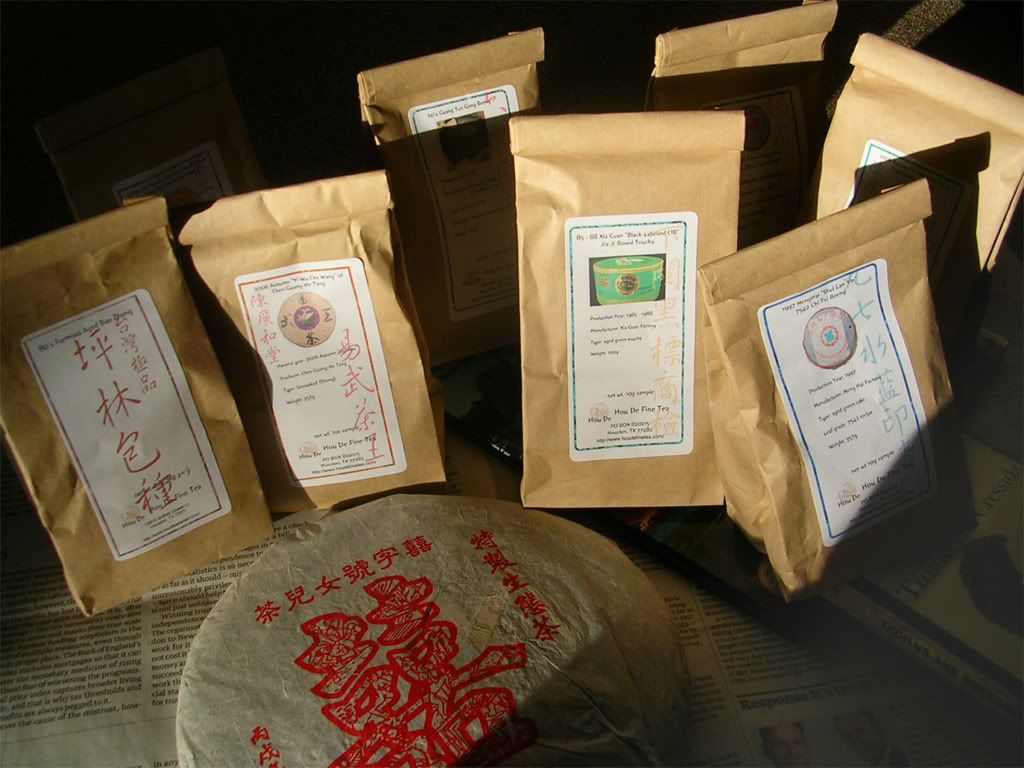
The notes at Houde, where this sample comes from, indicate that it falls into the era between the mark-cakes of the 1950s and the "qizi bingcha" [7-sons cake-tea] era. It is one of the first, if not the first, cake with the now-familiar CNNP wrapper, with zhong-cha characters in the centre, but with pinyin romanisation of the upper and lower character strings.
The notes at Houde, where this sample comes from, indicate that it falls into the era between the mark-cakes of the 1950s and the "qizi bingcha" [7-sons cake-tea] era. It is one of the first, if not the first, cake with the now-familiar CNNP wrapper, with zhong-cha characters in the centre, but with pinyin romanisation of the upper and lower character strings.

Crikey, that's a lot of Huangyin
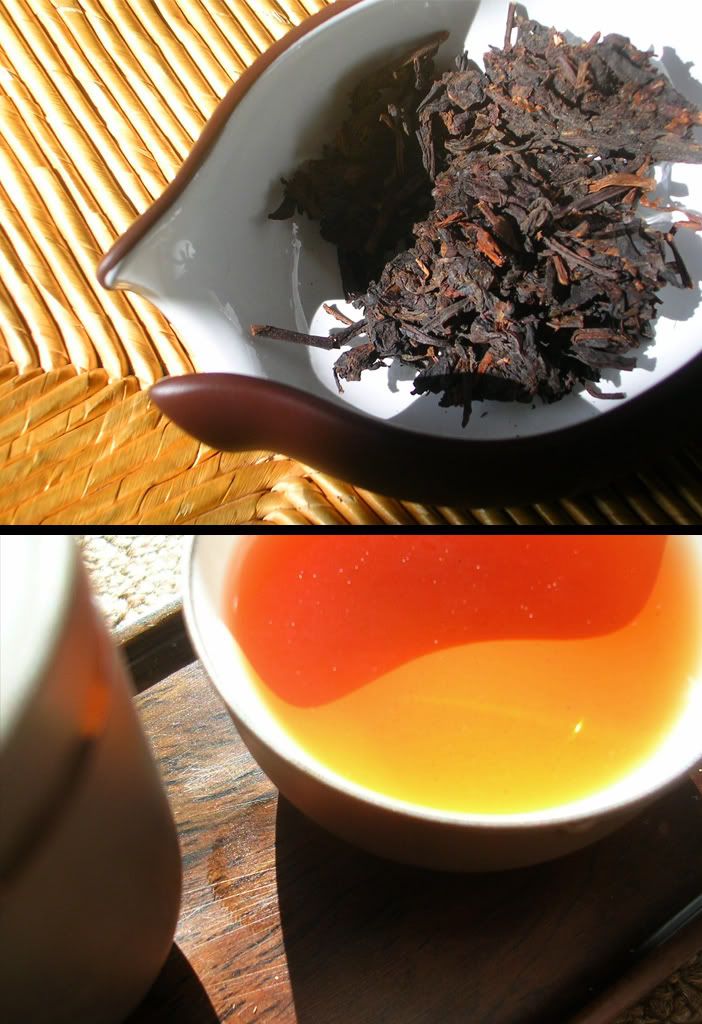
We used the whole 10g sample (pictured above), brewed in a lovely pot of GV's (pictured below), which he bought in Shenzhen. The pot's mottled skin began to glow under the rinse. It looked very happy to be brewing Huangyin.

Huangyin seems to like it hot
The leaves are large fragments of big leaves, with a mild shicang [wet storehouse] aroma. The particulate nature of the tea entirely blocked my filter - that is, it totally sealed the filter preventing passage of the tea. Later infusions became much cleaner, courtesy of the big leaves.

Burgundy
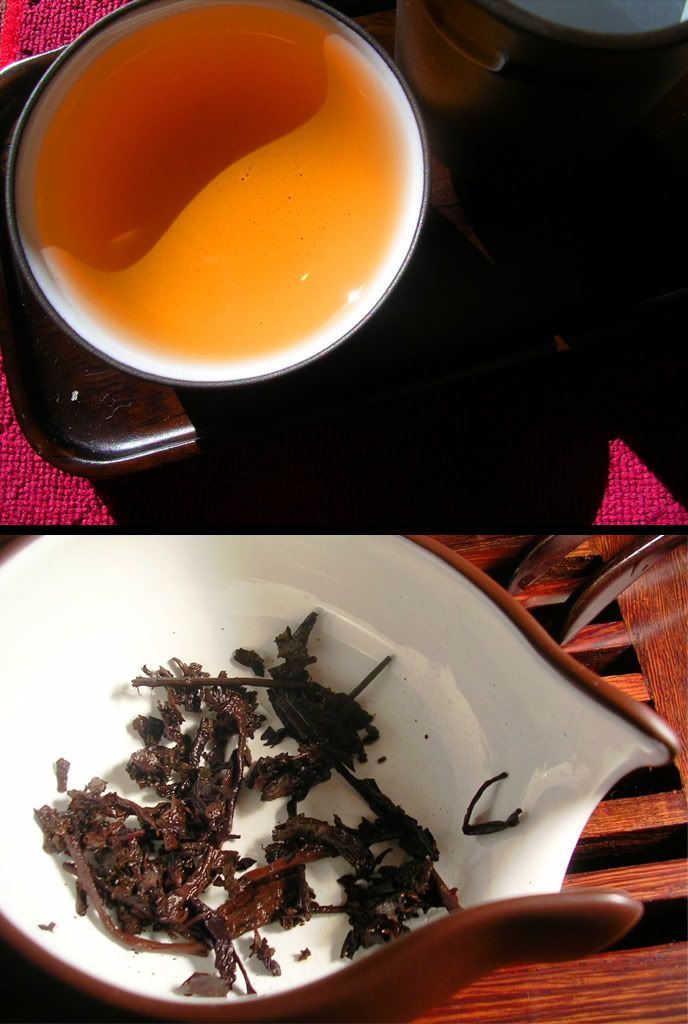
The soup is rich and dark. I've been drinking this for most of the next day (a Sunday, thankfully), and even after 25 infusions, it remains dark red. This is a hugely potent tea. The longevity is greater than anything I've encountered to date.

The tea that never dies
It's also one of the sweetest old teas that I've ever encountered: the aroma and flavour are sweet, sweet, sweet in their woodiness. As you can see, the soup has a shining clarity about it.

It's surprisingly forgiving to brew, too
Thick and chunky, it dwells in the throat forever, resounding long and sweet. Even the very first sips in the session the next day feel significantly narcotic. Something is at work in this tea, and my pulse rate decreases noticeably.
I breathe out a whole world of cares in one long sigh...
I breathe out a whole world of cares in one long sigh...

Note the yellow miniscus and depth of colour in the centre
During the next day, the malty, sweet character continues undaunted. After two days of drinking, I box it up to take into my office to keep me company during the coming week. A remarkable experience.
After such a treasure, there was only one way to finish the evening: the mighty huoguo [HWOH-GWOH, hot-pot], a dish traditionally made of napalm into which one dips chunks of food, rather like a fondue.
Thanks again to Mr. and Mrs. GV for braving the weather, and for great generosity in making the tea-session so special with their presence and tea. I look forward to a repeat performance on the "away" venue!
Late edit: day five, over 60 infusions later, and the Huangyin soup is still thick and woody, orange-yellow in colour, and giving a heavy chaqi that makes me feel exceedingly calm. Five days!
After such a treasure, there was only one way to finish the evening: the mighty huoguo [HWOH-GWOH, hot-pot], a dish traditionally made of napalm into which one dips chunks of food, rather like a fondue.
Thanks again to Mr. and Mrs. GV for braving the weather, and for great generosity in making the tea-session so special with their presence and tea. I look forward to a repeat performance on the "away" venue!
Late edit: day five, over 60 infusions later, and the Huangyin soup is still thick and woody, orange-yellow in colour, and giving a heavy chaqi that makes me feel exceedingly calm. Five days!