Showing posts with label 1997. Show all posts

10 October, 2014

Bigtime Bibendi

"OK, hard drinkers: let's drink hard."

Perhaps George Clooney's finest hour.

In keeping with the spirit of George's famous utterance, Neil of Teaclassico has kindly provided us with some hard drinkin'.
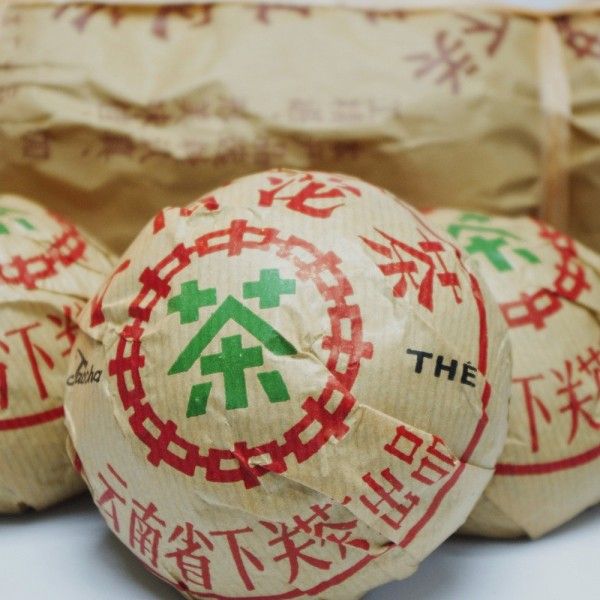

1999 "Xiaofa" Xiaguan French Export shupu


Surprisingly, this "faguo" [French] export tuocha smells of neither garlic nor onions.  It has had 15 years of Hong Kong storage, which might account for that.  The leaves are on the larger side, for Xiaguan, and in truth they do have a distinctive aroma of what can only be called "fish".  This is not a problem, just an observation.
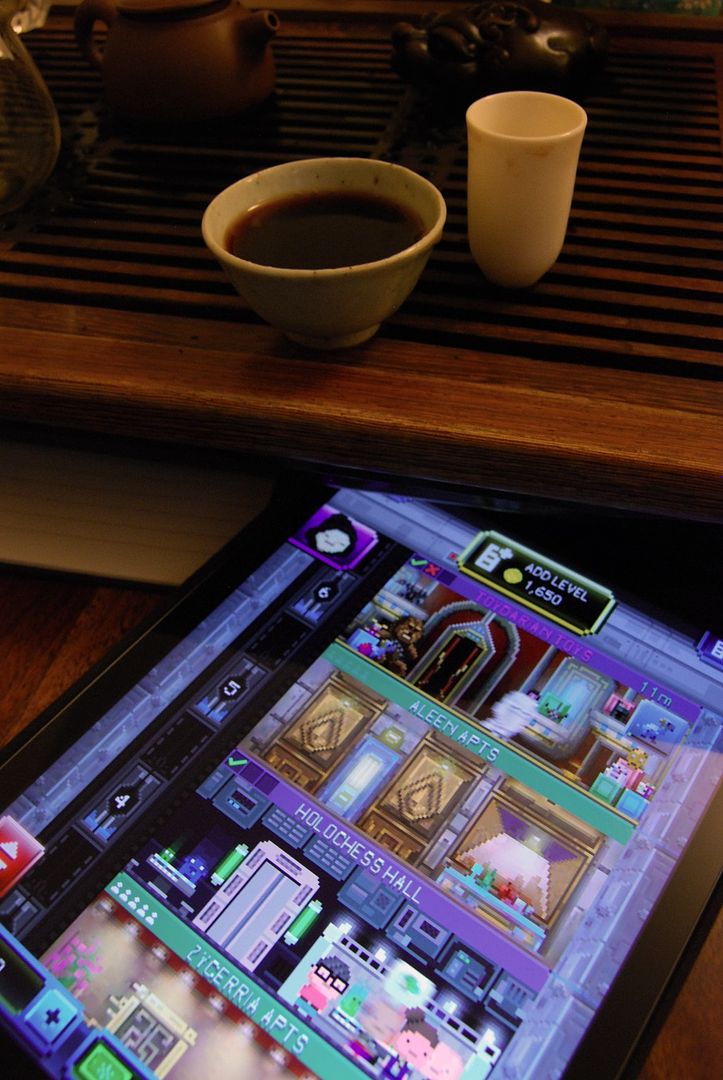

Tiny Death Star + shupu


The piscine aromatics do not continue into the cup.  What we do get is a big, stable, and enjoyable dose of shupu.  There is a particularly silky and thick texture that reminds me Xiaguan really know their way around the manufacture of tuocha.  I enjoyed it very much, but perhaps not quite enough to spend $89 on it.


Yet more serious is this: a 1980s maocha from the Yiwushan area.
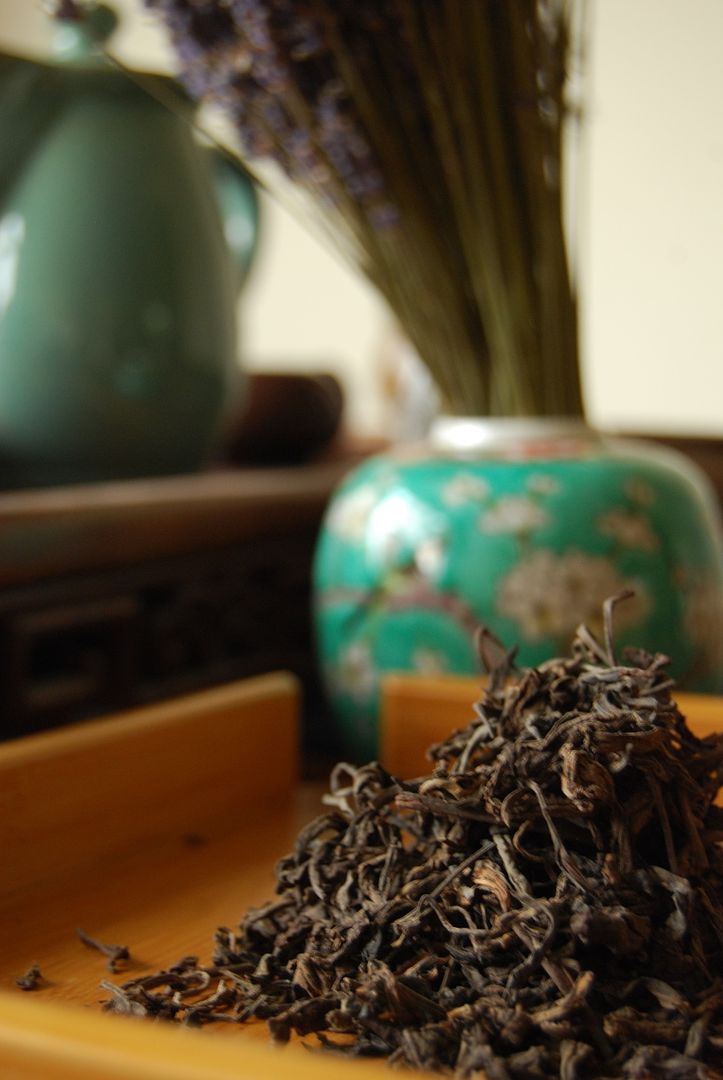


Pictured above, this is a big, deluxe pile of a tea.  My expectation is that the older maocha gets, the weaker it gets.  This one, however, still seems to be quite strong, which makes me wonder if it is actually 1990s, rather than 1980s - not that such things matter, anyway.
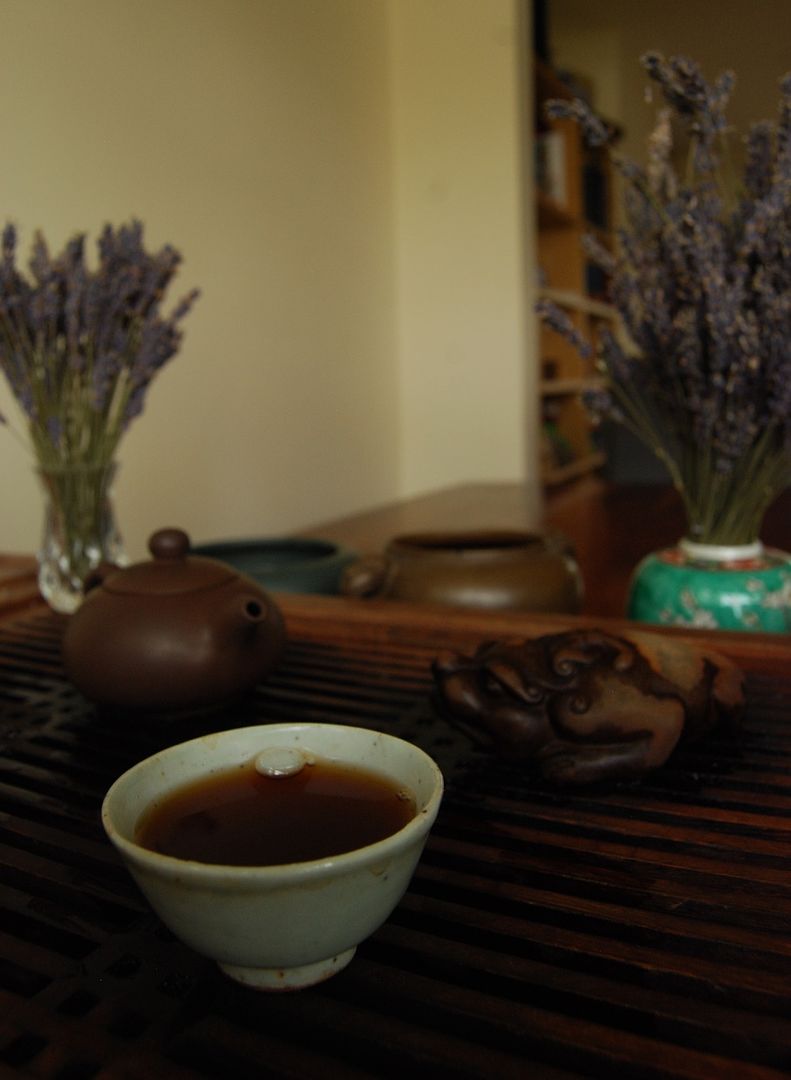


The colour is a more solid red than might otherwise be expected, which again leaves me thinking that it might be 1990s.  Its body is smooth, if a little thin.  There is a detectable trace Hong Kong in its history, but this has been aired out - presumably in Taiwan, along with many of the teas sold by Teaclassico.  HK then Taiwan is a good route to take.

Aged well, with deep HK mineral characteristics, this is a gentle, warming tea.  I read this tea in the background while annotating an MSc thesis for submission, and I think the tea put me in a good mood.


The star attraction, and one worthy of George Clooney's attention, is the following:
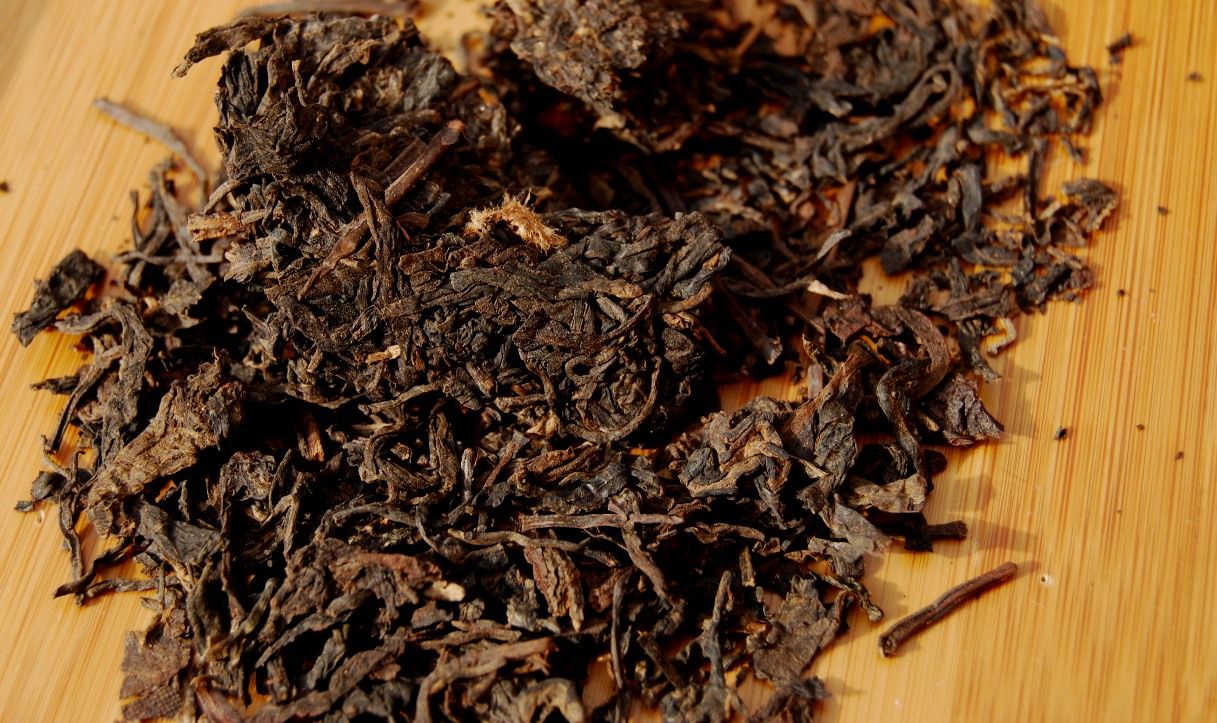


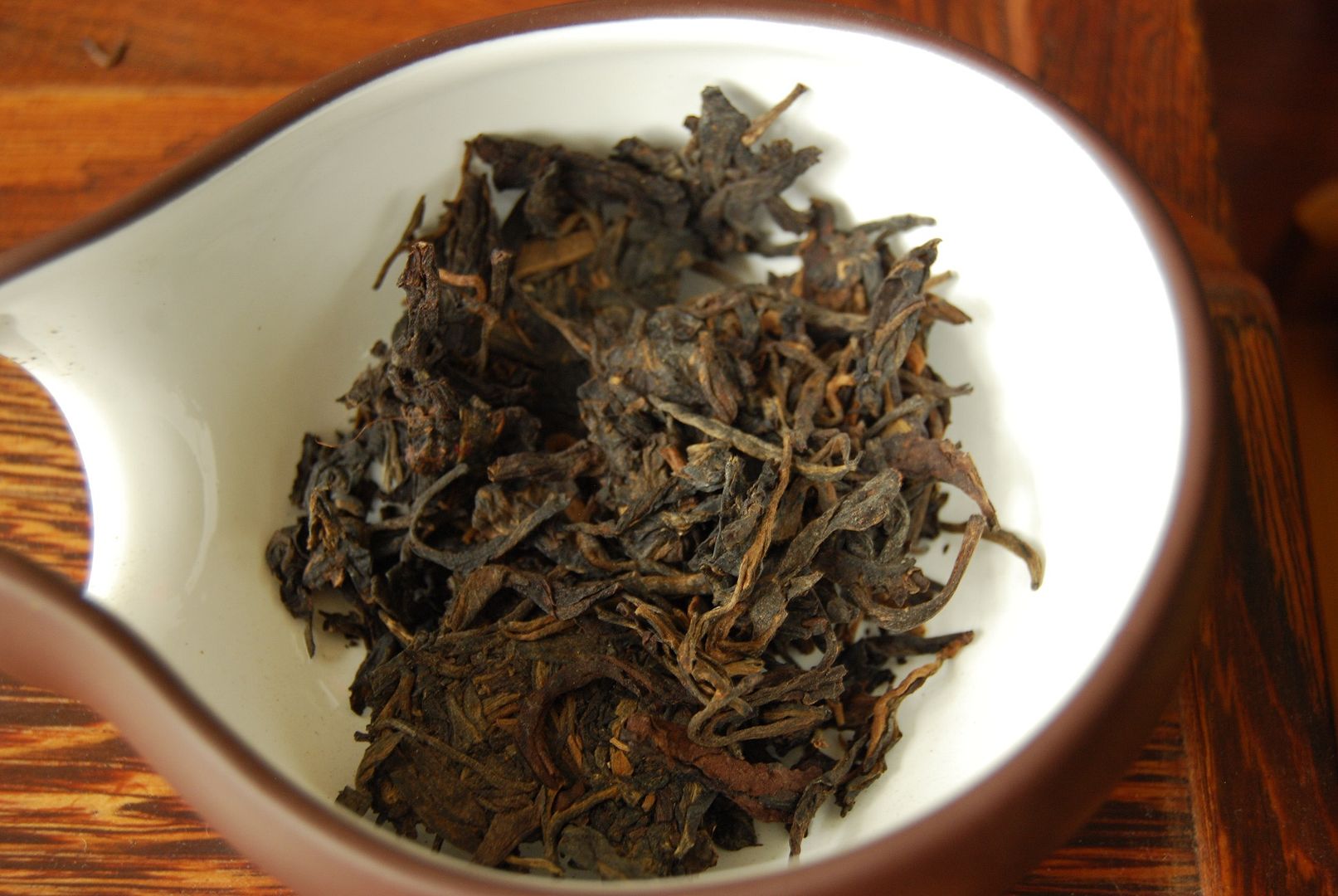
This 1997 Tongqinghao "Chi Cheng" is quite special.  It came in a sample bag as "Tung Ching Hao", and so I suspect that the cake's pinyin name is not actually "Chi Cheng".  Without seeing the characters, it is difficult to disambuigate Taiwanese (or, rather, Wade-Giles) romanisation.

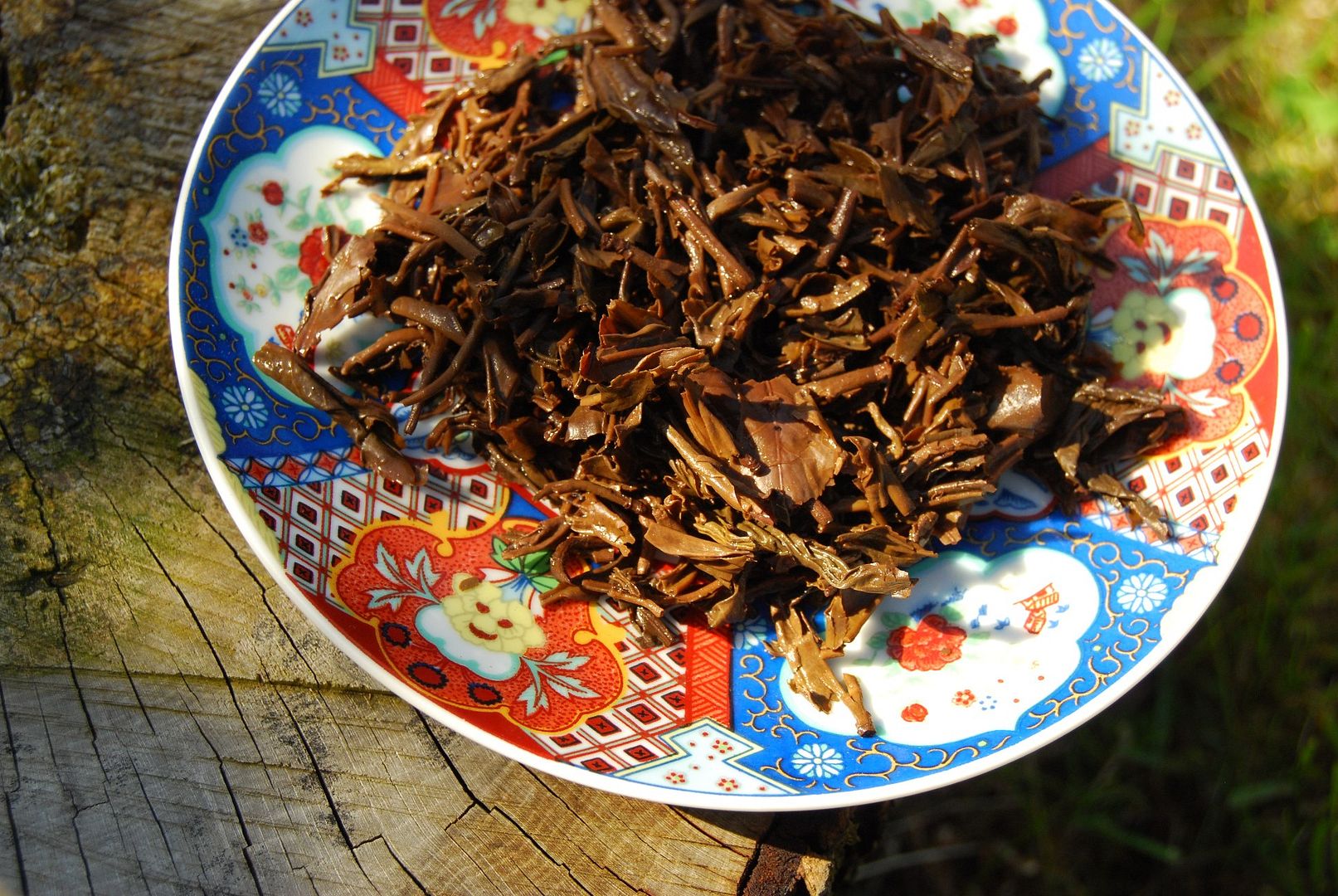
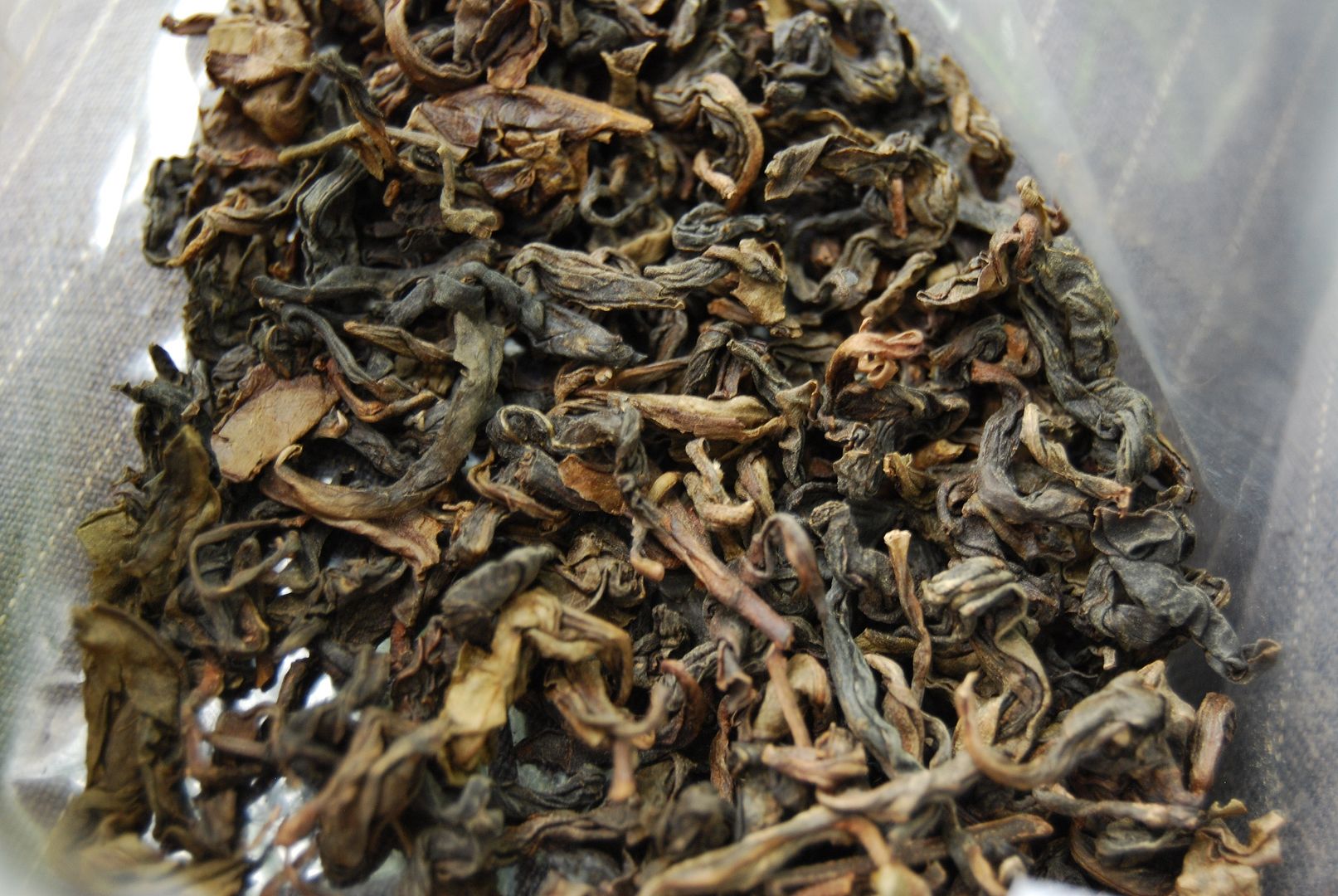
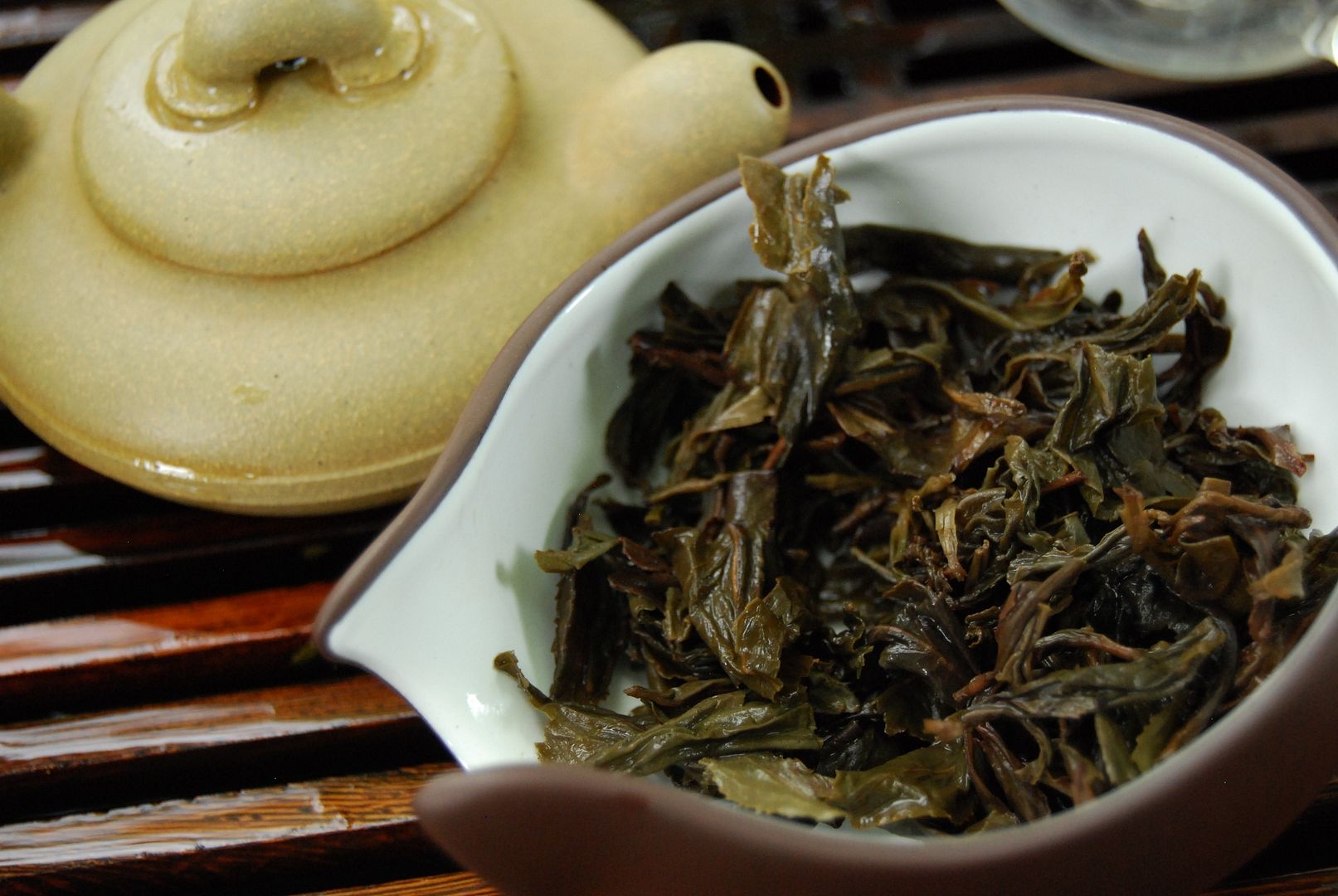
The leaves, pictured above, surely already have you whipped up into a frenzy.  They have the scent of (you guessed it) Hong Kong.  The scent of the HK tea, that is, not the scent of the HK teargas.
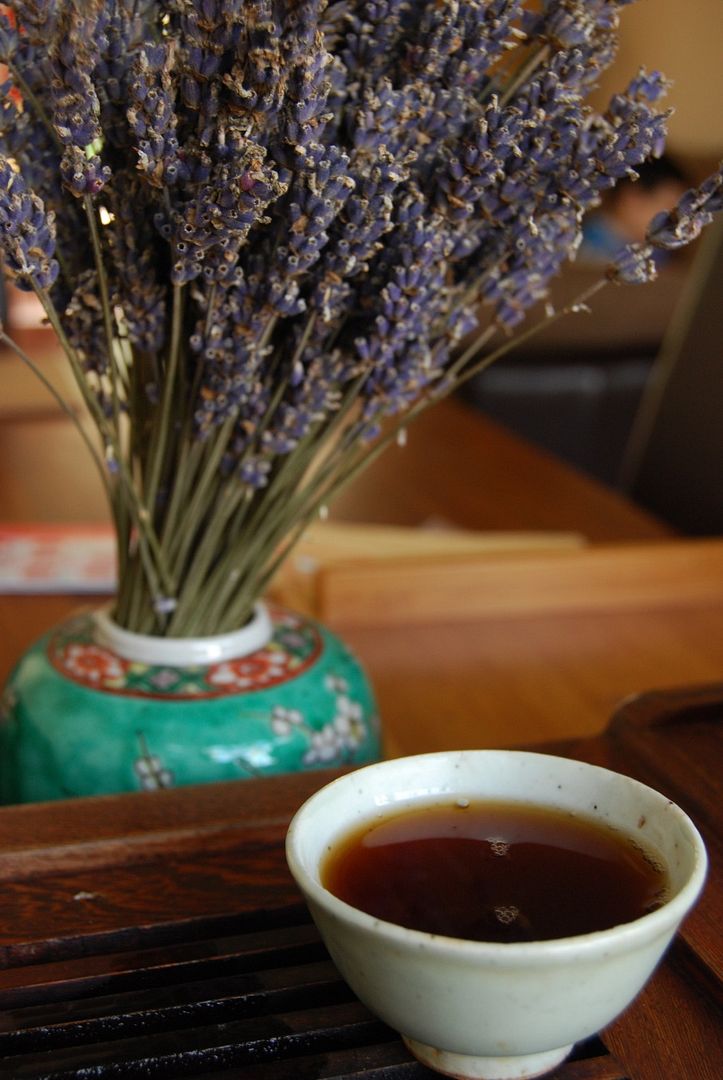


The brown-red colour and BEEFY flavour are very welcome.  I used lots of leaves, knowing that it would not become overbrewed (HK tea, aged), and the result is a vivid and vibrant fizziness on the tongue.  It leaves a humid bookishness in the nose which, for a serial university type, is quite alluring.

Not that anyone ever goes in libraries any more.

With passing infusions, as the leaves open fully, the centre of the soup darkens in colour.  There is a wildflower note that reminds me of the 2003 Zipinhao from Zitenglu / Wisteria Teahouse.  Its core of deep, sweet mahogany is enjoyable and I am already beginning to wonder as to its price.
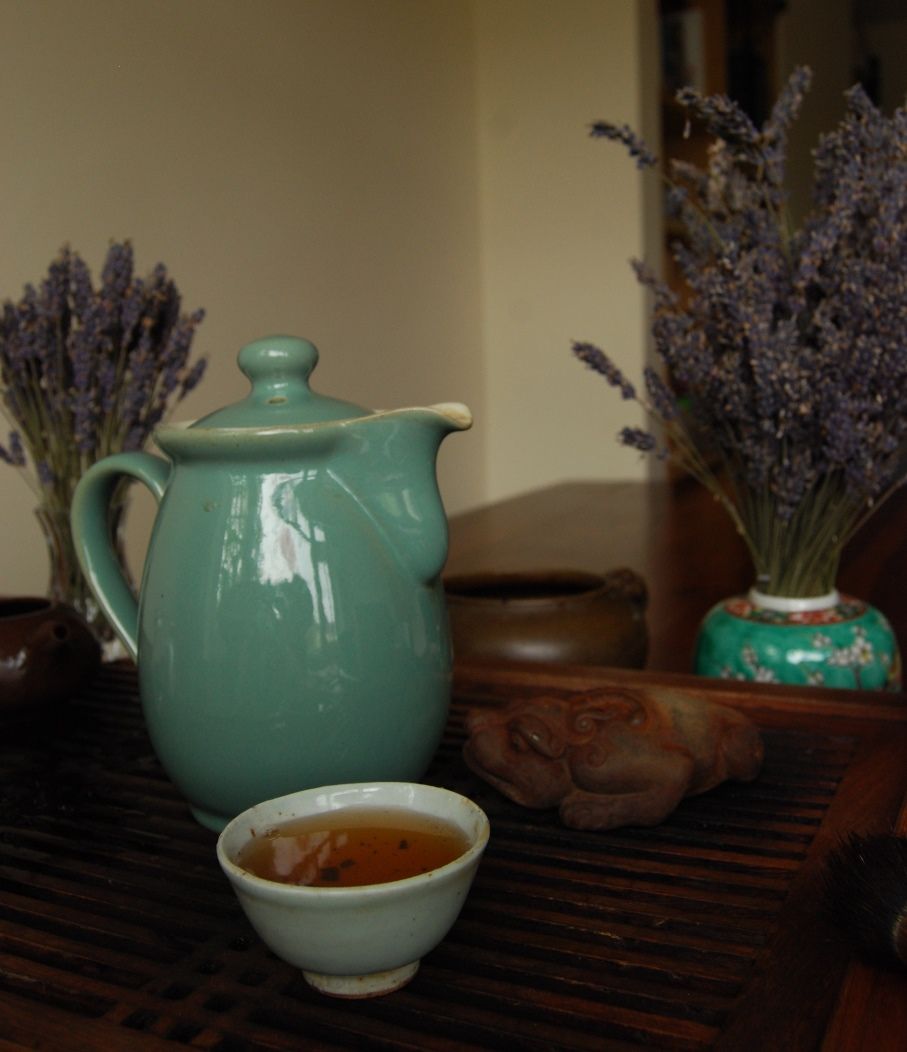


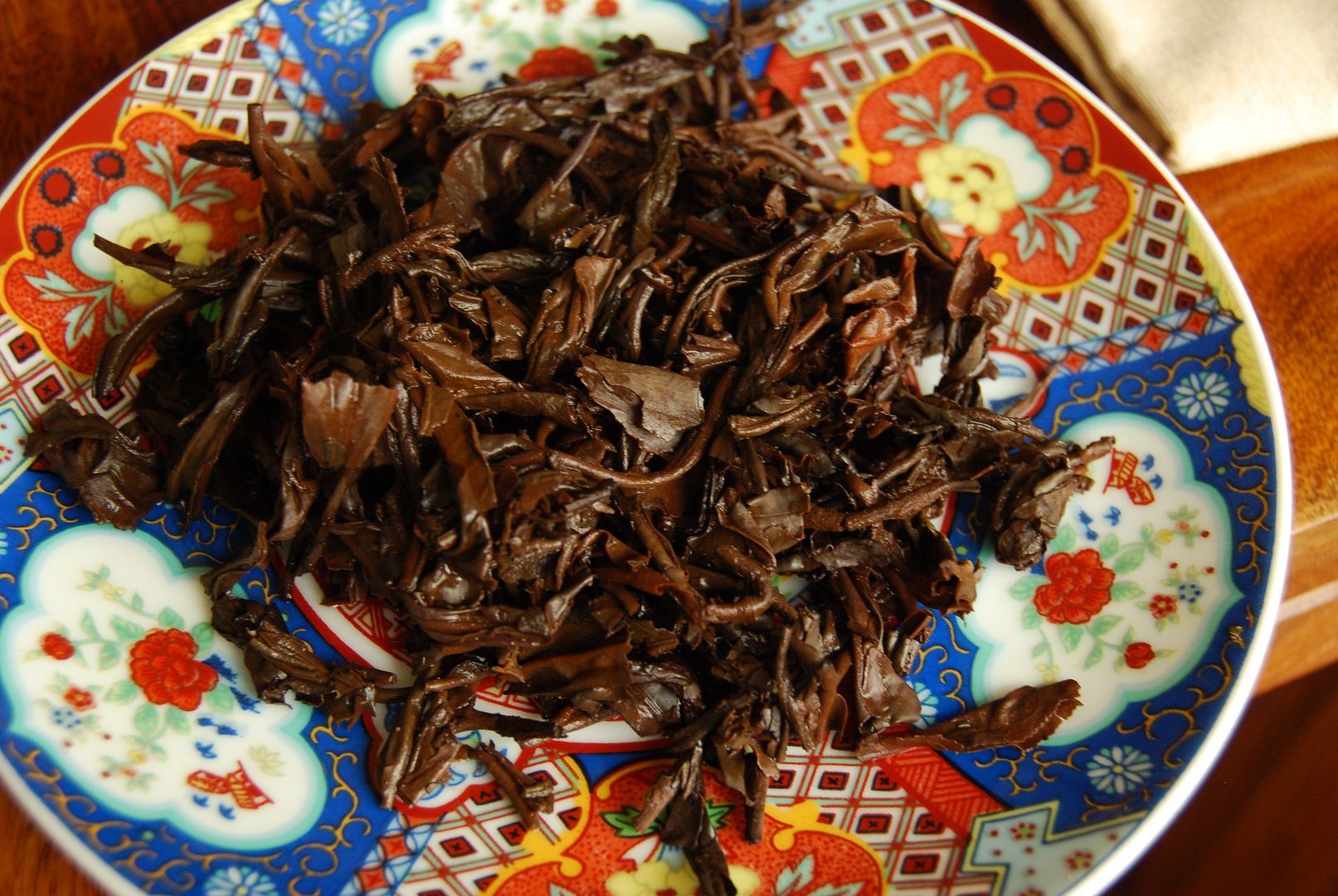
I kept adding leaves to Zidu, my pot, to prolong the session - so good was this tea, that I did not want to stop.  Eventually, Zidu was so full that I had to decant the leaves into a larger pot - and (its bulk pictured above) it was almost half-full when I did so.  I brewed them for two days, and they were decent.

Teaclassico will, I understand, be stocking this in future, but one cake could already be enpurchanised and coming my way.  Be ready, ye shelves, for Tongqinghao is very decent indeed.

22 August, 2014

You're a Dinosaur - A Relic of the Cold War

Despite M's famous words, sometimes it's OK to be a relic of the Cold War.

Today, I am going to show you some photographs of black, gloopy teas from bygone days, one of which is definitely from the Cold War period.  All three of these teas were provided by Teaclassico, a splendid outfit of which I have written before.


1999 Tongcanghao

First up: shupu.  It's cooked, it's composted, and it's suitably old so that the rank dampness has departed.  This is the 1999 (or 1997?) "Tongcanghao".

I'm not too sure what's actually happening with this cake, because it isn't for sale at Teaclassico, but only at Generation Tea - although it was supplied to me in a Teaclassico sample bag.  Hence, the tiny image above is from Generation Tea, where it sells for $135.  There is some overlap of the inventories of Teaclassico and Generation Tea, but the former has lower prices than the latter.  The owner of Teaclassico assures me that there is no relationship between the two teashops.

My eyebrows wobble slightly at the fact that Teaclassico has actually replicated the Wade-Giles spelling of this cake ("Tung Chang Hao") that is also shown at Generation Tea.  If there is truly no relationship between Teaclassico and Generation Tea, then I suspect that they simply buy their cakes from the same Taiwanese dealer.

I am aware of Taiwanese spelling habits!


Either way, this is some MEAN looking shupu.  Checks ye out the leaves above: they really put the proverbial lotion in the proverbial basket.  If you are going to buy composted tea, then you may as well buy composted tea made out of some seriously chunky leaves.  The Tongcanghao does just that.

The leaves do, it must be admitted, look a little grey.  This is usually a sign of some substantial Hong Kong influence, or, alternatively, the use of a hose to spray down the cakes as if you were Boris Johnson trying to calm down a rioting crowd of Londoners with a high-pressure water cannon.  Kek.


What does the combined effect of shupu composting AND tons of water do to a cake?  What on earth do you think it does?!  It makes it humid!  And dark!  And super black!  This is like drinking liquid evil.  It is Lucifer's tears, or some other even worse bodily fluid.

Unsurprisingly, given its moistmoistmoist treatment, there isn't much in the way of power or duration, here.  Everything it had has been accelerated out of it, and traded away for pure, gloopy, darkness.  It is a deal with the Dark Side, and its soul has certainly been transacted.

That said, if you were going to drink only one Tea of the Thrice Damned this week, you might like to try this one.  As hellbound beverages go, this one is quite enjoyable.


Washing ourselves down with holy water and then having the teatable re-sanctified by a passing exorcist, we turn our attention to something a little less macabre.


1999 Commissioned 8582


"Commission" usually means "rocking" when it comes to Menghai Factory.  Believe it or not, I used to find 8582 a little underwhelming.  Apache, among (very) many others have since turned my eyes to the light, through a substantial exercise in collective generosity, and I now admit the error of my ways, and enjoy older 8582s on a semi-regular basis.  The big ol' leaves certainly make for some decent aging, in the world before Dayi.


What was 8582 like in 1999?  If this cake is anything to go by, then I'd say it is not too bad.

The difficulty with this cake is that we have to peer at it through the lens of Hong Kong storage.  This is no bad thing, but it is not a lens that leaves it subject unaltered.  It has been aired out in Taiwan, apparently, and this leads to a good, clean, crisp edge that pleases - its Hong Kong background is entirely pleasant.


As always with older teas, I use tons of leaves.  It's not like you're going to be able to overbrew something like this (assuming that you use water-in, water-out infusions as is my habit).  It has a "beefy" sweetness that reminds me of non-Dayi Menghai, and which I like a lot.

It is sharp and abrupt, and, it must be stated for the record, that it doesn't really endure particularly, either in the mouth or in its number of infusions.  Its starting storage conditions appear to have taken the wind out of its sails.  The overall effect is very positive: the Hong Kong storage has focussed and heated its sweetness; the Taiwanese storage has opened and crispened it somewhat.

I was on the edge of thinking rather seriously about this cake (price $199), but the trio listed here eventually trumped a purchase decision.


Let's now return to the title of this article, and end with a relic of the Cold War.


1980s Yinminghao


Admittedly China was a very different place to Europe in the 1980s, but there remains a certain feeling of nostalgia for those of us who were alive at that time.  Not that I remember it particularly well, but I am definitely delighted to try some tea from that era.


This is a serious $329, which is far beyond my limit, and so, thus freed from any other considerations, I therefore get to enjoy the tea without worry about whether or not I should be buying it.  This is a considerable freedom, it must be said.

As pictured above, this is a blend of just about everything, from tip to stem.  It has the red-grey colour of old Hong Kong tea, and is faded and distant in appearance.


The first infusion requires absolutely no time to open, and this cake slams its foot onto the accelerator right from the start.  It is smooth, dense, and very slippery.  There is a fine, enjoyable core of Hong Kong mineral humidity.  The older this mineral character becomes, the more dense it becomes, as if being compacted by gravity.  The first few cups entirely clarify my mind, and feel most positive.

This is a big, soft tea, and it requires maximum attention.  Its consistency prevents extended description: it is long, vanilla-like, and smooth, and stays that way as long as I stay at the table.  It is quite something, and you might be well-advised to procure at least a sample, to acquire the data-point in your training set.

With thanks again to Neil of Teaclassico, it has been a fine week for tea.

06 June, 2014

Wistful Thinking

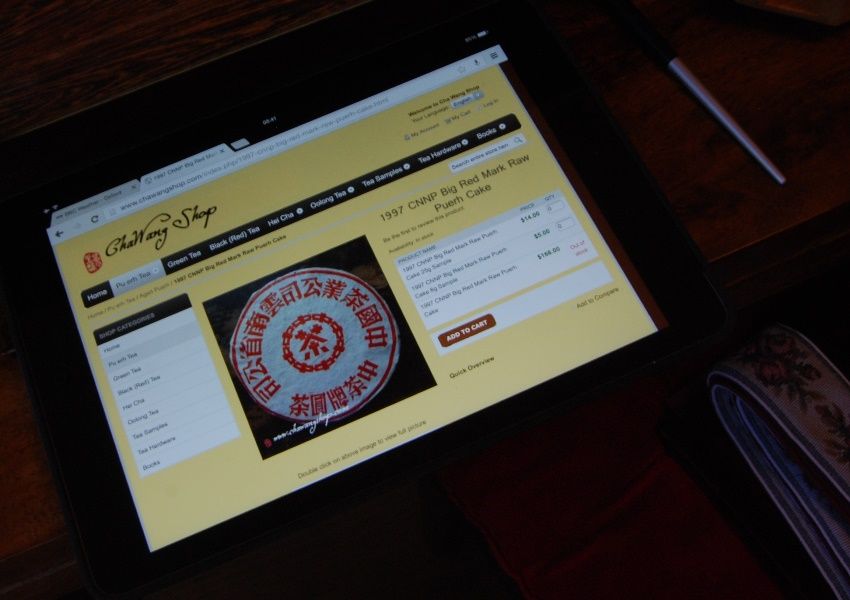
$168 seems like a good price for 1997 "Hongyin" [red mark].  Such was the price when this cake was available at Chawangshop, available no more.  Perhaps it is this unavailability that makes it even more desirable.  It is out of reach, and I am its Tantalus.


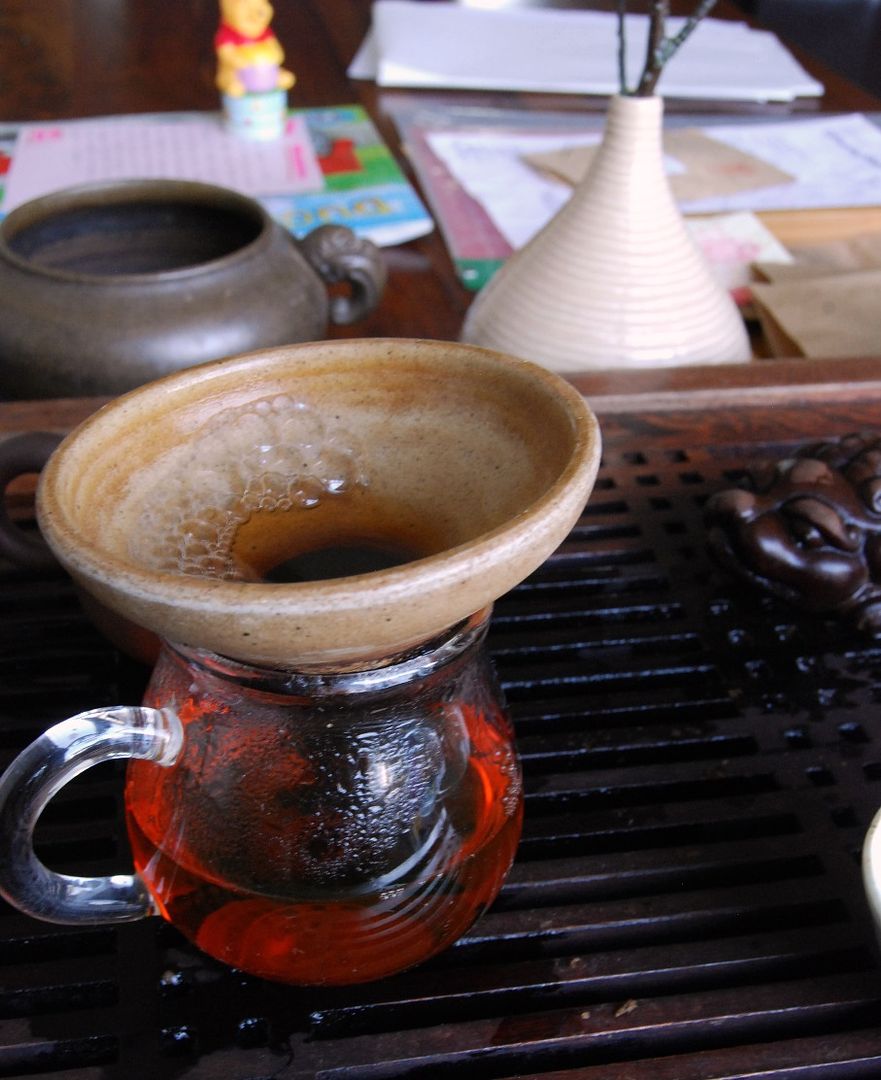
This cake has had some storage in Malaysia, it is whispered among those who know about such things.  The first infusion, predictably enough, is a delicious red-brown.  The scent is, in accordance with scripture, humid.


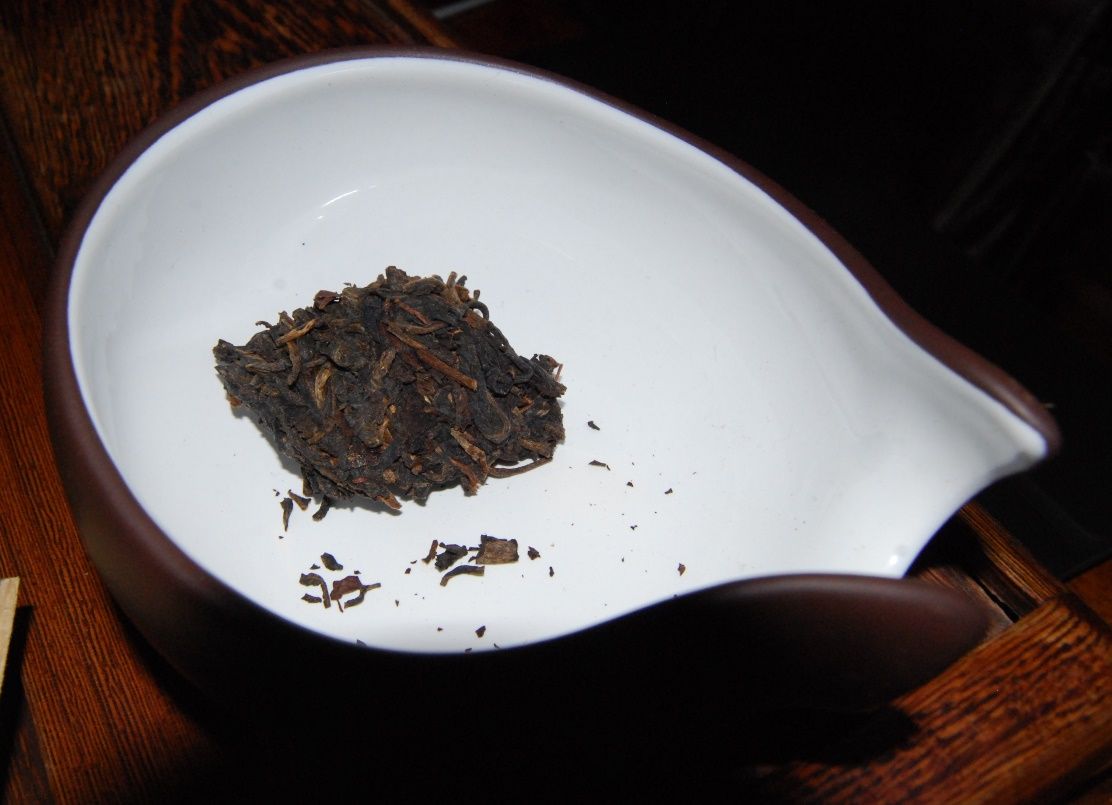
The size of the sample was not enormous, as pictured above, and yet it completely dominates the teapot as if it were a tea twice its quantity.  CNNP / Menghai, back in the day, had access to some seriously serious seriousness.  This cake reminds me of how older tea should be: strong, well-developed, unambiguously saturated in sheer trouser.  It is a bold tea and no mistake.


The tea endures long with its huigan [return sweetness], and has such a strong body that I am instantly, and continuously, impressed.  The Malaysian storage has been well executed: there is a complementary mineral tone, but it is not all-consuming.  It is like unto latter-day albums from Sepultura.  We know Max Cavalera (the original force behind the band, long since departed for Soulfy and Cavalera Conspiracy) left behind a legacy from which even the modern post-Cavalera outfit benefits: this CNNP cake, though a product of more recent times, harks back to a golden age of straightforward and uncompromising strength.  Perhaps unsurprisingly, this cake goes rather well with some of the more recent Sep albums; The Mediator Between Head and Hands Must be the Heart performs just as well as Roots, with this tea. I had time to try both, such was the longevity of this cake.

At the very end, it begins to get a little thin, but who can stand up to not one but two Sep albums, back-to-back?  Surely there are few teas that can pass such a difficult test.

With thanks to The Jakub for the sample.

30 December, 2013

Aging Tea: A Mixed Bag

I have been sampling my own shelves widely, of late, and have come to some conclusions on the relative merits of my cakes ability to age.  (In each case, I have added notes to the original articles, which you are invited to inspect by following the corresponding links.)

The Good

The 7542-801 is quite good, although a little akin to a "dry storage" cake. The 7532-801 is better - it tastes more humid and more developed, and does not have the "dry storage" straw of the 7542-801.  Oddly, the 7542-901 is absolutely first-class.  Made just one year later, it is dark and heavy in that classical Dayi manner, and tastes very nicely aged indeed.  I suspect that most people would enjoy it - they would certainly enjoy it for the sub-$10 price in 2009.
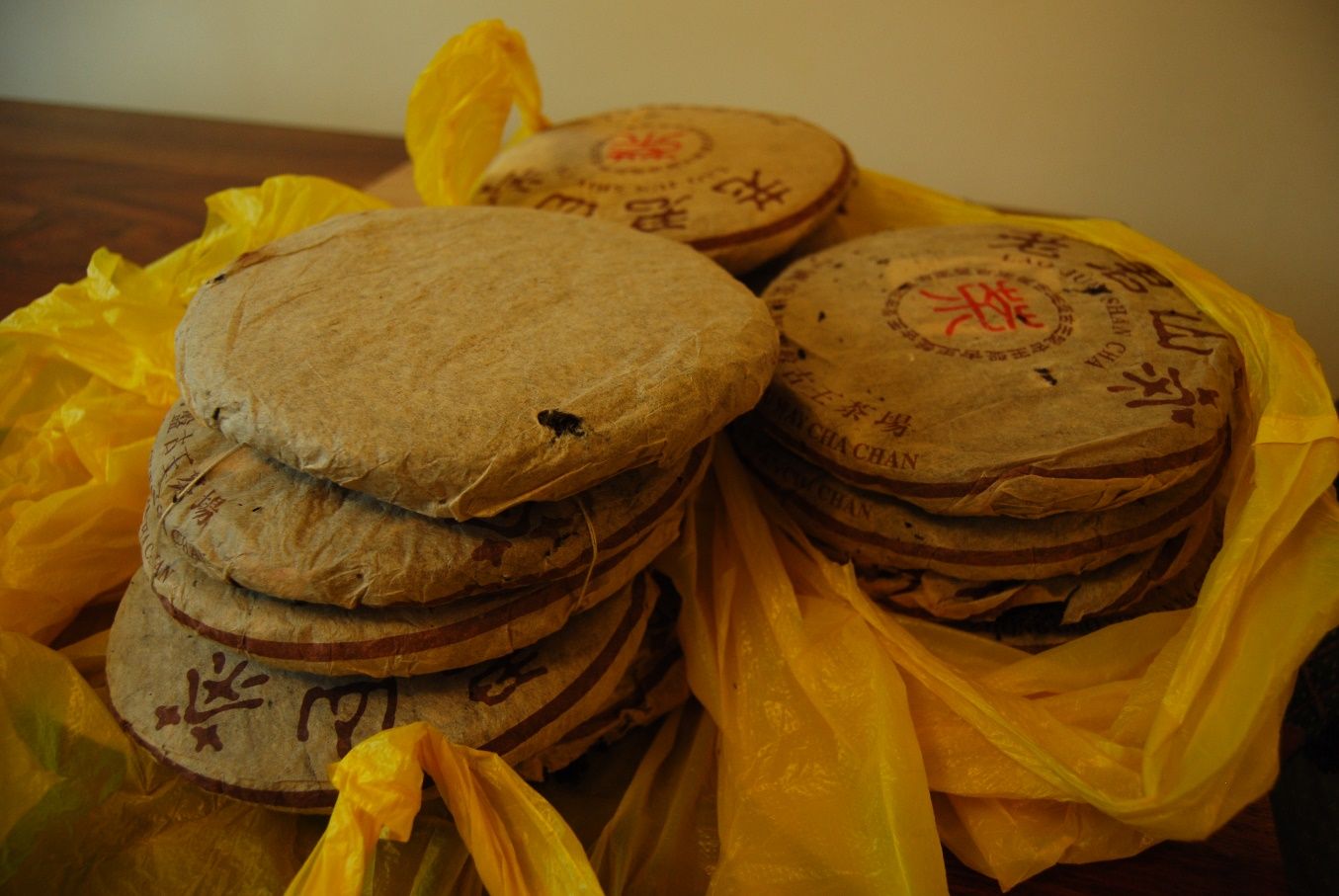
Another success story is our aging experiment in central China, where Chinese Mama and Baba have recently brought us a few tong from our stores there.  The 1997 Laojunshan (pictured below), being one such cake brought to England, even though it is shupu, is heavy, round, and excessively sweet with old vanilla.  I look forward to trying the shengpu that we have.


My post-viva Hongjie cakes, bought in 2009 in Maliandao, when my dear wife was unknowingly carrying Xiaohu, our eldest son, has come on very well (much like dear Xiaohu himself!).  The change in the tea-leaves from their original green to a husky red-orange is very encouraging.

Finally, the 1996 Xiaguan bricks from Maliandao (pictured below) are coming on a treat - somehow, they are superdense carriers of vanilla and smooth huigan.


The Not-So-Good

Oddly, the 2003 Zitenglu Zipinhao [Wysteria Teahouse purple-label], pictured below, fits in this category. The original sample that I tried, stored in Singapore, stopped the clocks and was unfathomably excellent.  The actual cake, stored in Taiwan, was less amazing.  I managed to overcome some of this simply by using many more leaves of the Taiwanese-stored cake, which got it a little closer to the Singaporean version.


Perhaps most concerning of all, the 2011 Yunzhiyuan "Autumnal Xikong" (pictured below) has collapsed into tasting like purple tea.  I am deeply concerned for its future, and will take this as a warning concerning the purchase of super-sweet, unaged autumnal cakes in future.


Tea is such an education, and an experiment in itself.

19 August, 2013

Battling the Elven Hordes

I used to read Tolkien when I was a teenager.  I played Warhammer.  I played Warhammer 40,000.  I played AD&D.  Yes, I owned a d20.  I had a range of model paints with colours such as "Chaos Black".

So, you can imagine my delight when a teafriend from Singapore by the name of Elvin came to write to me, sending a batch of extraordinarily tasty goods.  I imagine this particular teafriend with slightly pointed ears, moving stealthily through woodland groves, wearing a cloak of invisibility.  His chadao knife probably has the name "Grymthir" or "Orckiller".

Even the packets in which the samples arrived reminded me of lembas waybread from The Lord of the Rings...

"One small bite is enough to fill the stomach of a grown man."


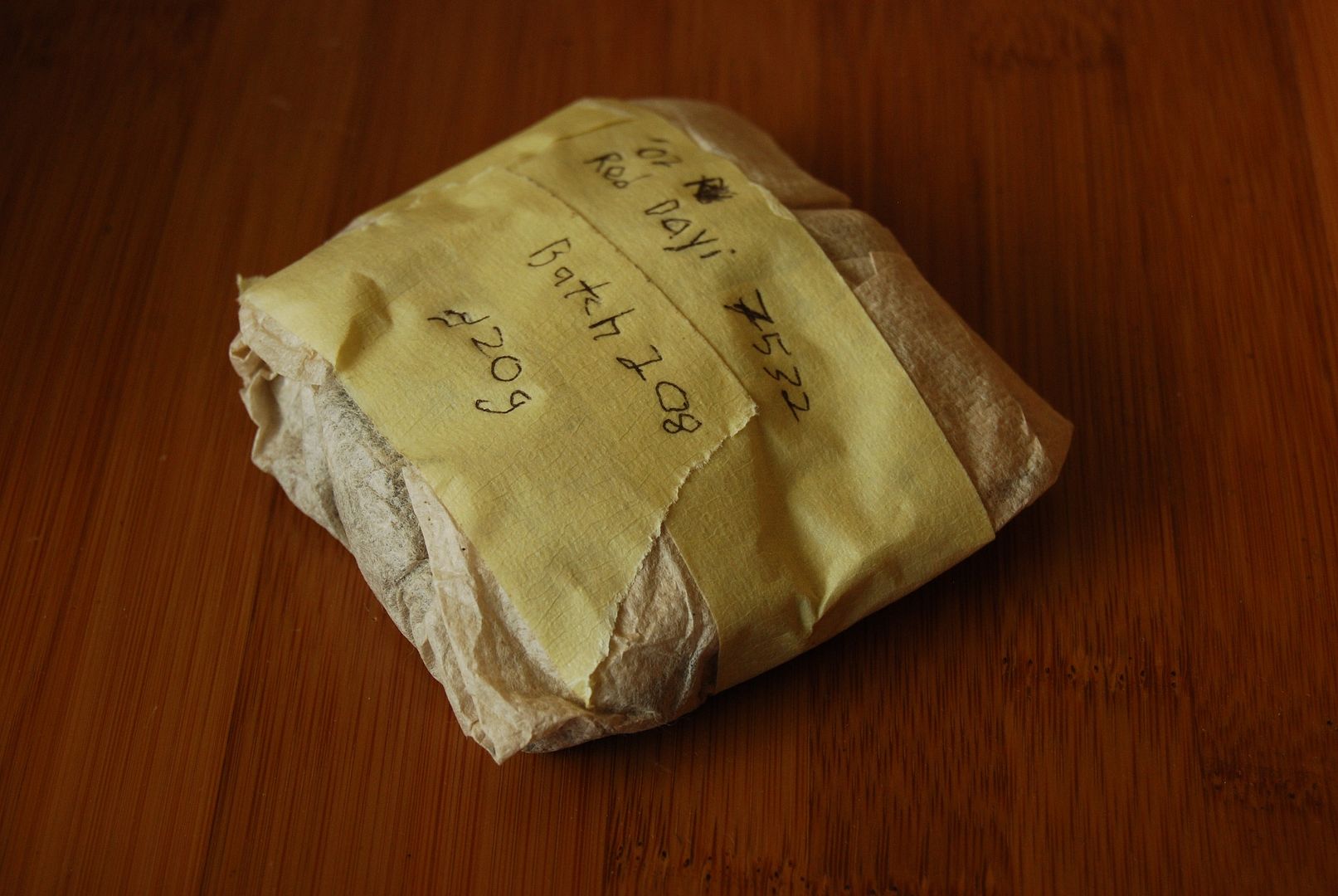
"Red Dayi" 7532-208

These two particular teas were reliable stalwarts, to which I fled in terror following sessions with particular unpleasant young shengpu (which shall remain nameless).  In each case, Elvin's teas fortified me like lembas and reminded me that pu'ercha should be delicious.


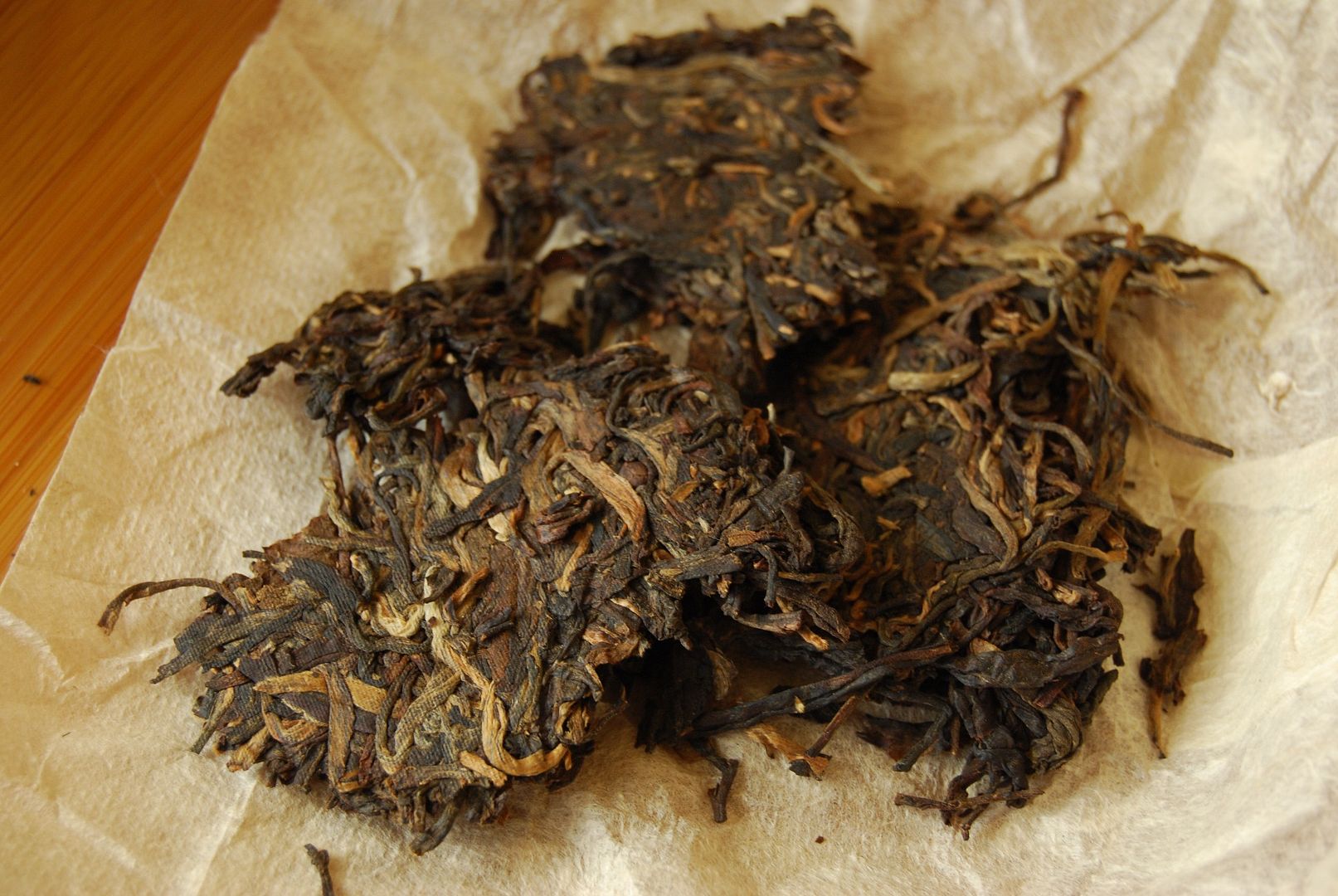
7532 is a pretty-looking member of the Menghai family, in my opinion.  It has some glamour, and probably drives a car that is far too ostentatious.  As pictured above, the leaves tend towards the small-to-medium sizes.  When the warm water hits the leaves in the pots, it releases a scent which makes me recall the immortal words of  RZA, "That's how you know it's on."

Suddenly everything is good in the world, and the memory of the shockingly bad young shengpu from the previous sessions is instantly erased.


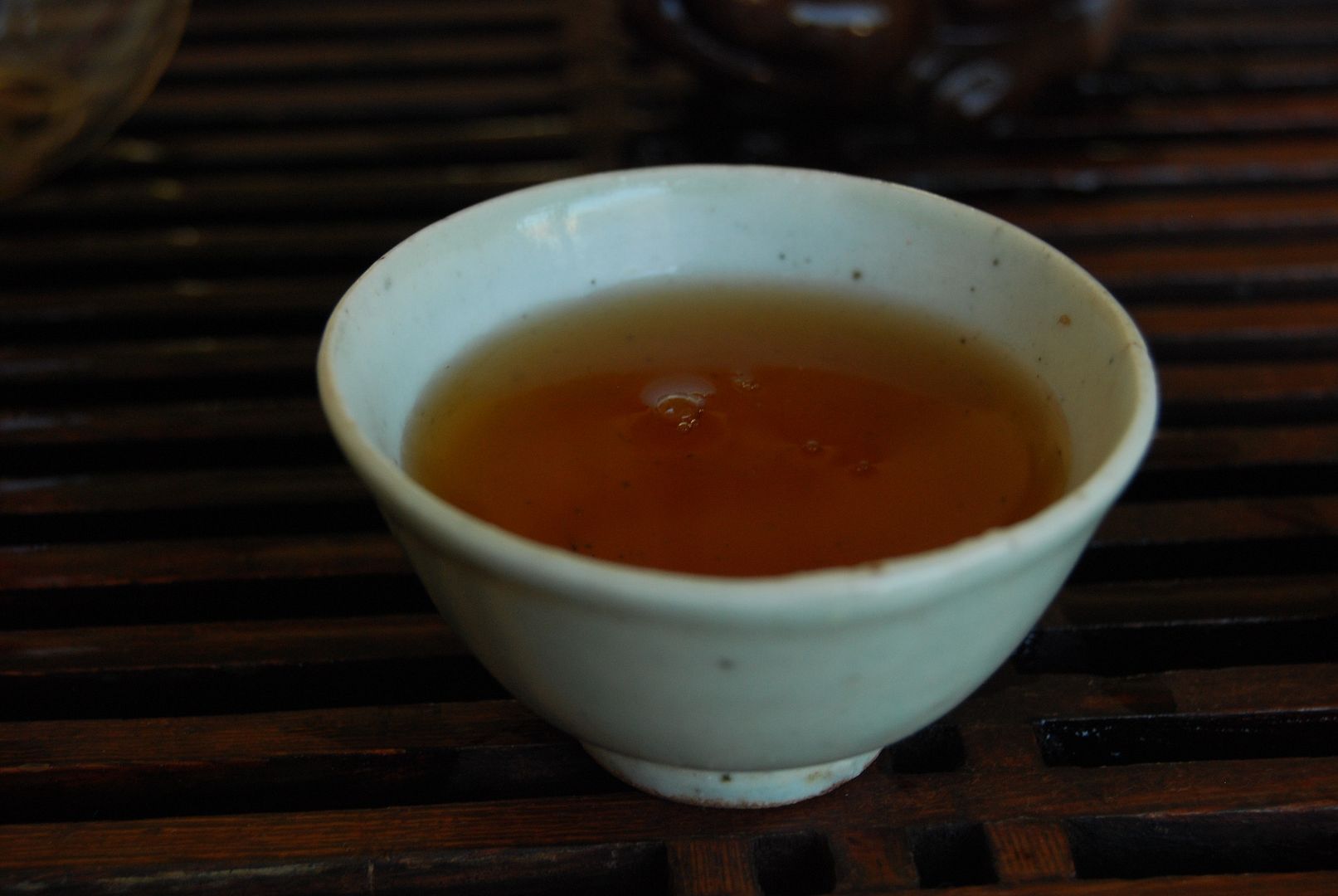
This warm and comforting classic has the spiced character of good tea, aged somewhere warm and humid.  Singapore is good for tea.  This particular example is solid, and imparts a vibrancy in the mouth which is entirely different to the immediate, gripping numbness of the pesticide-soaked shengpu that I just fought.


Every aged tea is an education.  Every data point demonstrates something new, and this is one of the (very many) reasons that I enjoy pu'ercha quite so much.  In this 7532, we have the residual deposits of its initially floral nature, retained in the nose, but tempered with time.  Evolution of personalities is a subject that I find infinitely fascinating, for it is something in which we each have a stake: whether they be the evolutions of our own characters, those of our sons, or those of our tea-cakes.


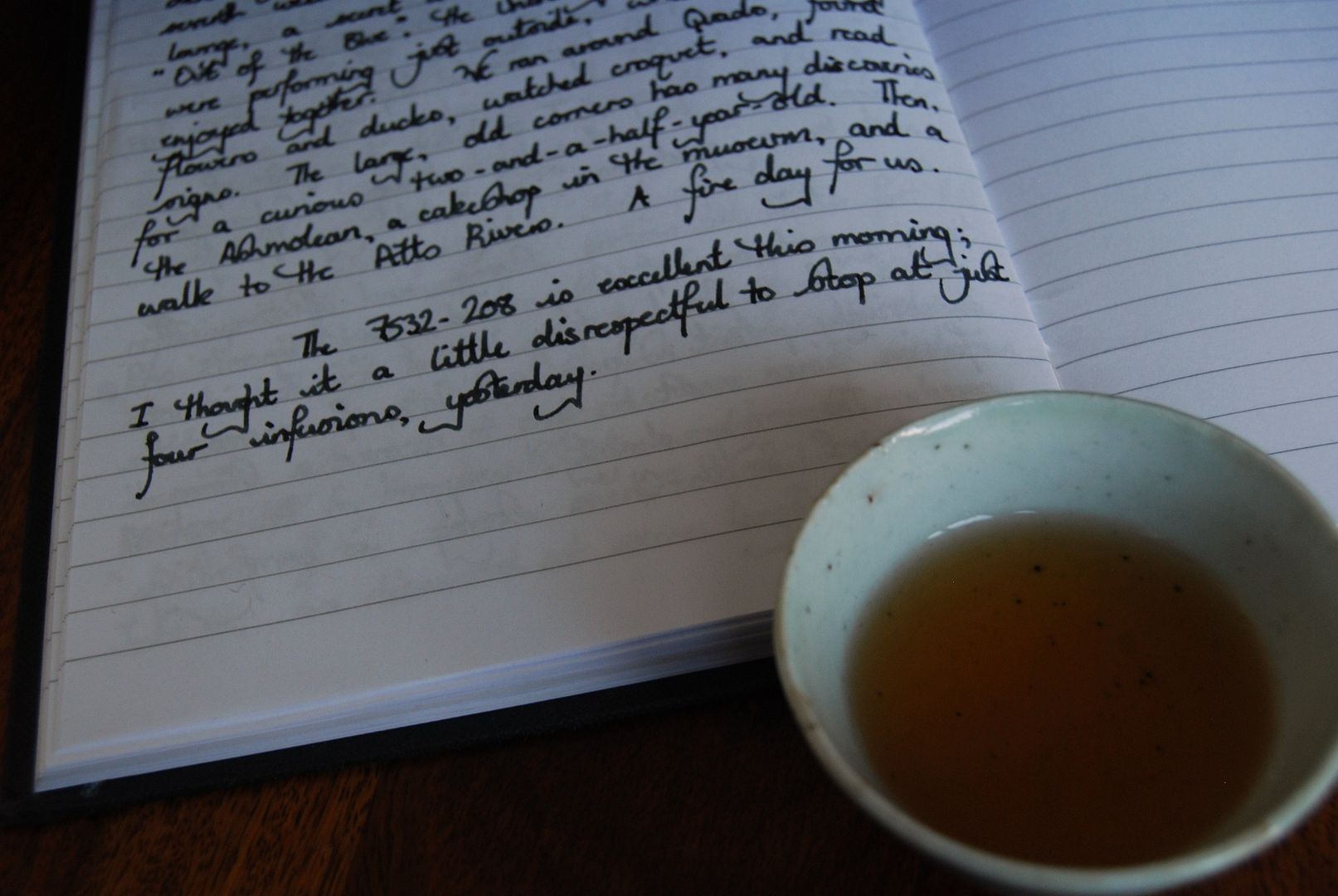
My journal page above may give you the hint that this tea was so good, in fact, that I had to spread it over two days: to abandon it after a single session, and not to return to it, seemed something of a sacrilegious act.

(Old) Dayi cakes are famously sturdy.  Even this eighth batch of 2002 (the "208") is fine indeed, suggesting that the stability of Dayi across multiple flushes is retained.  My general rule-of-thumb is to buy as close to the first batch as is available, given that the youngest (and usually strongest, most potent) leaves occur at the beginning of the year's production cycle.

That said, while it is woody, with a good base of solid pine, it rapidly requires longer end-to-end brews, whereby the next infusion sits in the pot while I enjoy the current infusion.


"Reliable" is Dayi's by-word.  While the price of more recent cakes has gone through the roof, they used to be very humble in pricing, and consequently worth keeping around on one's shelves.  Perhaps the prices will return from the stratosphere once market forces return to something resembling the "norm" over the past few years.


Following another shocking session with a to-remain-nameless young shengpu, I again turned to Elvin's sack of redemption.

This time, it was the 1997 7542 - as reliable as it gets.


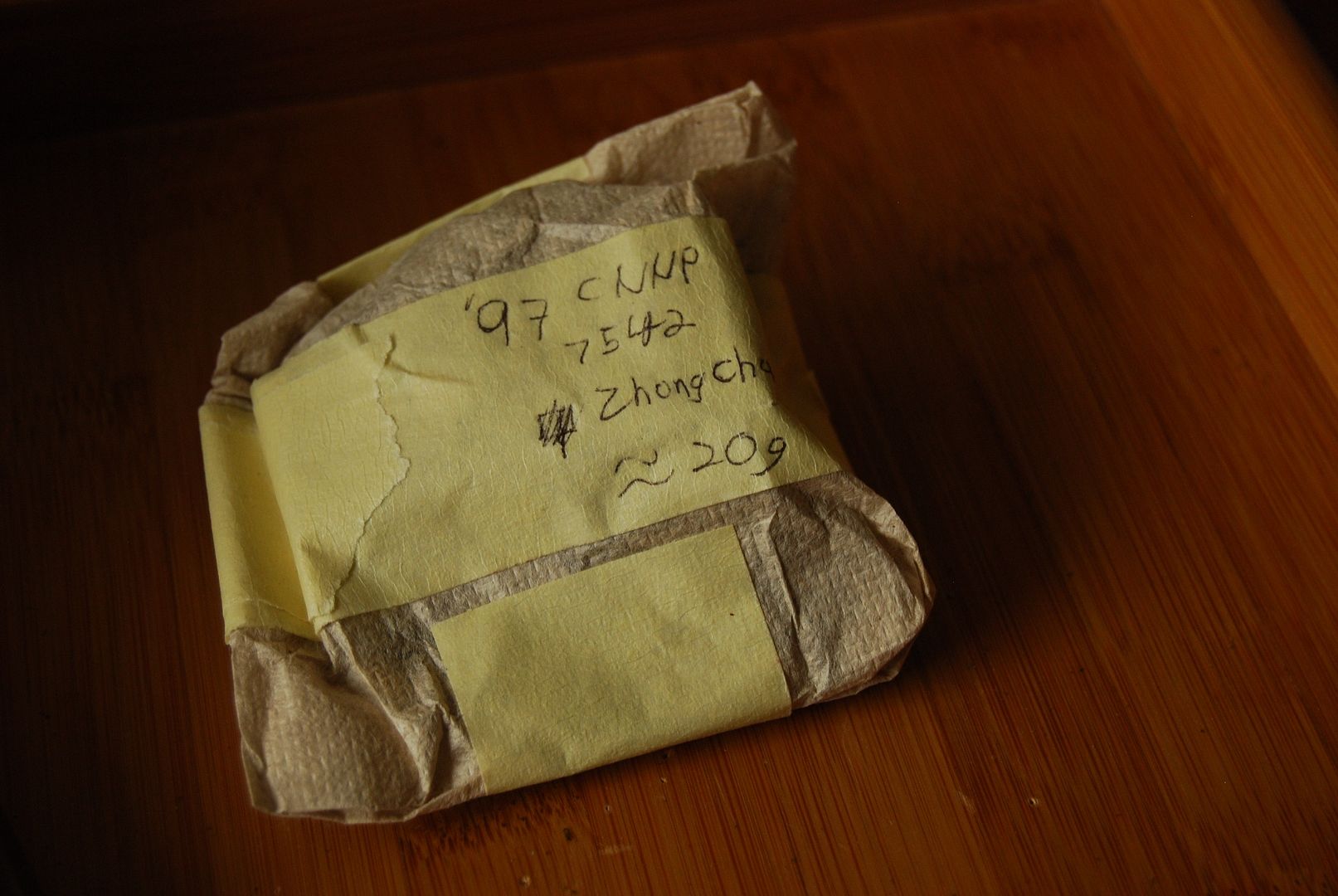
Another day, another bag of lembas, pictured above.


7542 is not pretty.  It was, dare I say, smacked with the Ugly Stick when it was young.  However, it tends to age nicely, given its youthful vigour, and we can all hope for such forgiveness of our difficulties as we age.


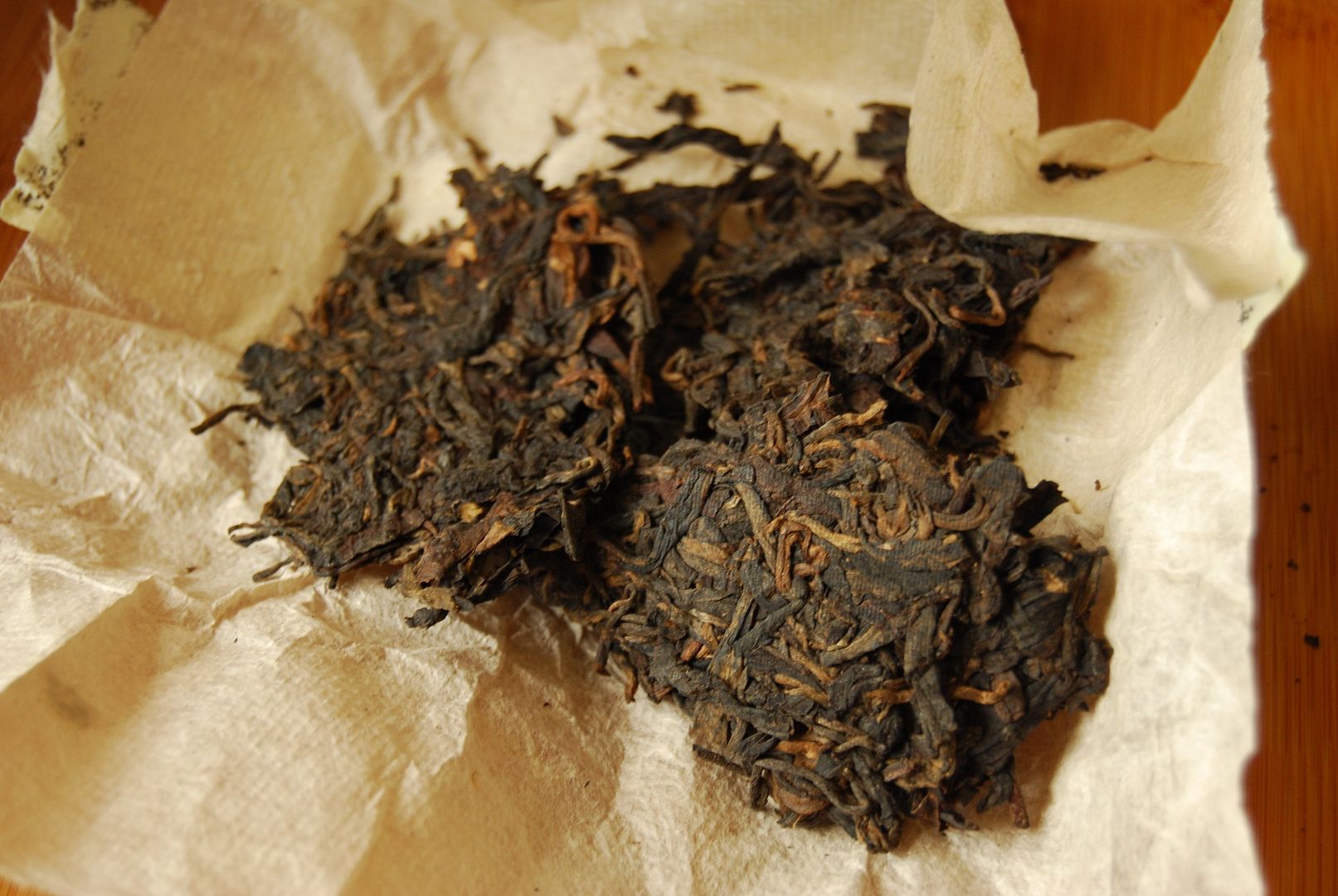
Examining the photographs of the leaves, above, you will be able to guess their approximate age directly from the colour.  Unsurprisingly, the mineral humidity of Singaporean storage hangs about them, promising good brews ahead.


The dense aroma of that tea-scent that I seem to map onto the word "vanilla" is all over this pu'ercha.  In contrast to the 208 described above, this 7542 has plenty of staying power, and its duration suggests that it has been stored well for its 16 years.

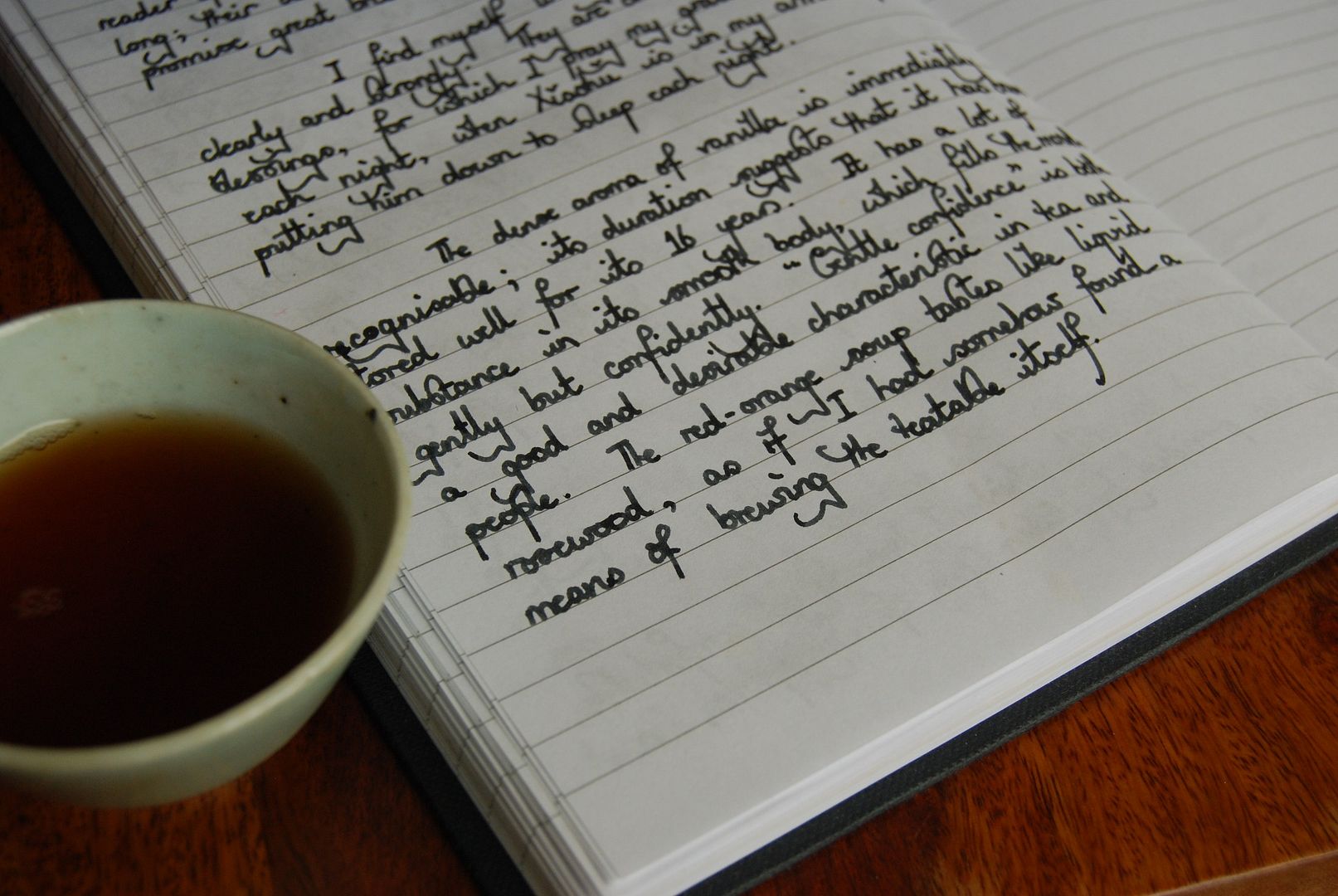
The body is as smooth as one would hope, conveying plenty of substance - the mark of, in my opinion, a tea that has something to say.  "Gentle confidence", I have in my journal, pictured below, which is a fine characteristic indeed.  This tea has mellowed with the years, but has a spine of iron.
"The red-orange soup tastes like liquid rosewood, as if I had somehow found a means of brewing the teatable itself."


The dense vanilla sweetness, with the scents of mineral sharpness, grants me the comfort I seek.


"This is tasty!  Tasty!"

My dear wife seems to like this one, and I can only agree with her enthusiasm.

We both raise a cup to Elvin and his charming gifts.


Addendum
May, 2015

Deeply satisfying, this is the scent of "real tea".  It fill the throat, and stays there, with heavy rosewood sweetness.  It is not complex in original flavour, but age has made it so.  The orange-red soup brings a sense of peace.  What more would one require of a tea?

05 August, 2013

Outdoors with the... Wulong

Let's make hay while the sun shines.


1997 Xianfeng Jipin Anxi


First on the menu: a 1997 Xianfeng "Jipin Anxi", pictured above and below.


1997 Xianfeng Jipin Anxi


This sample was kindly provided by HC, and is wulong supreme.


1997 Xianfeng Jipin Anxi


Buttery, sweet, and smooth; charming, like old honey, long-lived in the throat.  I know next to nothing about wulong, but found this to be exceptional. 


1997 Xianfeng Jipin Anxi


I wonder where it comes from.  I can see this going down very well throughout the remainder of the summer...


Just one year younger, the 1998 Fenghuangshan ["Phoenix" mountain] dancong was also provided by HC.


1998 Fenghuangshan Dancong


I drink dancong about once every three years, and yet seem to have a pot dedicated to it.  I find this strange, and should consider repurposing the above for other uses.


1998 Fenghuangshan Dancong


"Not much here", notes my dear wife.  The soup is quite flat, while lightly roasted, and I suspect that it has tired throughout the years.  Certainly, it lacks the charm and zeal of the Xianfeng.
 
That said, everything tastes fine when one is out in the garden, hiding from the sun, under a willow tree.


With thanks to GV, we change gear and head into qingxiang [green scent] wulong territory, with a 2010 Alishan.


2010 Alishan


This Taiwanese tea is rolled, as shown above, in the usual manner and is a "self import", as GV notes on the label.  I've noticed that professors of finance do tend to travel quite a bit.


2010 Alishan


We last met when he came to visit me at my old college.  Being the totally hardcore teamaestro that he is, he even brought his own pyramid bag, filled with roasted wulong.  You have to admire that.


2010 Alishan


This is the last, and best, tea of the day.  Honeysuckle in aroma, sweet gingerbread in flavour, long-lasting in the throat, and with the longevity to taste excellent even after a dozen infusions, both my wife and I love it.  The day draws to a close as the water begins to cool.
 
Fantastic wulong.

22 April, 2013

Real Books

If all has gone according to plan, then you are reading this while I am eating snails, wearing a beret, and playing boules in Paris.  Fingers (and baguettes) are crossed.

---

What do you do at the tea-table, apart from drinking tea?

Some days, I just drink.  Sometimes, that involves being slumped over the table looking like a zombie, staring vacantly into the middle-distance.  Most of the time, I drink while writing in my journal (a small proportion of which corresponds to my tea-notes), and I have racked up a truly surprising number of journals.  I first started writing in the back seat of my father's car while he drove me to university for the first time, when I was 18.  I was "leaving home".  Since then, the number of journals that I have filled has reached 51, and they have travelled a reasonably-sized chunk of the world.

My journals remind me of my favourite films is "Se7en", directed by David Fincher.  In that film, the atrocious master criminal, played by Kevin Spacey, fills piles of identically-appearing notebooks with bizarre thoughts, unlabeled and unordered, in homogenous handwriting.  Line after line after line.  My journals are just like that (minus the vitriol).  I can't imagine what I am going to do with them all.


1997 8582


Sometimes, however, I take my current book to the tea-table.  Often, it is a book on whatever variety of statistics has recently absorbed me.  The tea-table is a very good place to read difficult books, given the sharpness of the mind that occurs as a result.

Today, I have been reading the Lunyu ("Analects") of Kongzi / Confucius.  I first read this book when I was an undergrad.  It was interesting, but a bit stuffy.  These days, it is absolutely different, and reads like a handbook for the professional academic.  I was genuinely surprised by how entirely relevant each page seemed to be to my own situation, as if a fantastically-experienced and thoroughly proper mentor had seen fit to dispense some wisdom for a junior wannabe.  Maybe I have grown into the book a little, but I can see why it is held in such regard by traditional Chinese.  Have a go yourself, if you have not; if you have, be tempted to re-read it!


1997 8582


Today's article is the concatenation of two sessions, which have my reading of the Lunyu in common.  The first session explored the 1997 Menghai 8582, kindly provided by BH (first tried here).  I heartily approve of the maximum amount of re-use that this sample bag has experienced!


1997 8582


An old 8582 is a perfect companion for the Lunyu.  Recalling that the "85" refers to the year in which the recipe was standardised, the subsequent "8" refers to the large size of the leaves used in the blend.  Pictured above, we can see that these are substantially larger than the usual Dayi mixtures, and I wonder if this contributes to the excellent aging capability of the 8582s that I have been encountering of late.


1997 8582


There is plenty of humidity about these leaves, which is no bad thing.  The resulting brew, pictured above and below, looks not dissimilar to a beautiful Burgundy.  There is no disputing the fine qualities of this particular example of 8582.


1997 8582


The cup, pictured above, was a generous gift from Mr. and Mrs. Essence of Tea, which seems perfectly paired with this rich old tea.  The cup has a smooth thickness in common with the soup of the 1997 8582, and is quite obviously very happy to be filled with Good Soup.


1997 8582


Sometimes, you just have to drink a solid, fragrant, sweet and everlasting tea when the chips are down.  It is, after all, what it is "all about".  For my part, young shengpu is my usual diet, but older teas such as this example so kindly provided by BH are a treat, and a reminder of where I would like my cakes to go.


2002 Liming Banzhang Zhuancha


Regular readers may recall my description of a recent, and mighty, tea session with Apache at chez nous.  I omitted one particular tea, preferring to focus on it at some length in an article that would do it justice: this is, as pictured above, the 2002 Liming Tea Factory "Banzhangzhuan" [brick].

Pleasant photographs are all very well, Hobbes, but do you have any rancidly-lit images of this brick, perhaps ripped from a vendor web-site?

I am, if nothing else, a slave to your wishes, Gentle Reader:


2003 Liming Banzhang Zhuancha


The frightful thing above is, believe it or not, that which gave birth to the decent leaves shown below...


2002 Liming Banzhang Zhuancha


This cake takes a million years to get going, which is why Apache and I didn't really get into it during our mutual tea session.  Given a day all to itself, this brick goes on to reveal its true colours - a heavy orange/red, in this case, as pictured below.


Tea with Apache


This comes a very close second to the 2002 Menghai "Chawang Qingbing" that Apache took home for further drinking, following our session.  The Liming is darned, darned fine.  And it is a brick.  What a curious conjunction.


Sweetness and heaviness of character abound, this tea sits in the throat, churning out huigan [returning sweetness] for many minutes.  The massive weight of its body leaves my tongue slightly numbed, in the pleasant way of good leaves.  It has the low sweetness of aged, actual Banzhang and I love it very dearly.


2002 Liming Banzhang Zhuancha


The bad news is that this currently sells for 1800 RMB on Taobaowang, which is just under £200 (approx. $300).  That is one heck of a lot, but it is very lovely.  Apache has expressed a temptation to buy this.

Writing about this Liming cake led me to recall the only other time I have encountered teas from this factory.  Around five years ago, I wrote about the Liming "Tuowang" from Royal Puer.  Back then, the 250g tuocha cost $40.  I liked it, rather a lot, and only just came down on the side of not buying it.  On checking the vendor's web-pages just now, I see the price has only increased to $47.20!  Needless to say, I snapped some up and look forward to their arrival.  They will, perhaps, reflect the glory of the 2003 "Banzhangzhuan" upon me.

Maybe I'll get the Lunyu out when the Liming "Tuowang" arrives.