Showing posts with label Musings. Show all posts

30 July, 2018

Thoughts on Aging

Like the ouroboros, I am turning in on myself and drinking a lot of my own cakes of late.  This seems almost indecent, after a recent lifetime of continually trying new tea, and continually buying new cakes.  However, sufficient time has passed that the game is afoot!  Changes are apace.

This article is about two things: (i) cash money, and (ii) aging cakes.

If you've been here since the very beginning, Gentle Reader, or if you've read some of the older articles in the archives, you might remember that I started out writing articles for this humble site when I was but a graduate student.  In those benighted days, when my every waking hour was lived within the shadow of The Thesis, I was being paid a "scholarship", which is to say, I was not rolling in disposable income.  My university likes to trade on its name, which means it's almost preternaturally disposed to paying far below the going rate at all career levels.  You might have experienced the same.

It is ab-so-lutely striking to read some of my old articles, in revisiting my teas, to learn what I considered to be quite a lot of money in those days.  For example, check out the two teas below, which I have updated with recent tasting notes:

2007 XZH Longfeng
2006 Douji "Dayeqingbing"


These are cakes that were super, super cheap back in the day, at £23 and £13, respectively, for the 2007 XZH and the 2006 Douji.  Taking the more expensive (!) of the two as an example, that £23 in 2007 is now approximately £28 in 2018, via inflation.  Back then, as I take great delight in reading, the price was a matter of huge concern.  These days, that gets me approximately 30 minutes of swimming class for one (not both) of my young children.

This is not to say that I have become entirely profligate, but merely: how our expectations have changed when it comes to tea-prices!  How great is the distance in price between a "solid" cake at £13-£23 pounds and the modern equivalents!

(Note also the important fact that these are proper 357g bingcha, rather than the cheeky xiaobing that are now commonplace, such that vendors can reduce somewhat the effects of the enormously high "sticker price" for a 357g cake.)

Now, I'm not here to punch vendors in the metaphorical ganglia.  As with all of us who've been around a little while, it might come as a surprise to learn that vendors are human beings, and that some of them are not (entirely) douchebags.  Most of the time.  Probably.  (Love you, vendorchums.)

I used to take it as a personal insult that someone might want to be remunerated for sweating into their grey knitted underwear up a mosquito-laden mountain in Yunnan, etc.  These days, I'm happy to see these folks turning a profit; after all, tea businesses need to be sustainable (i.e., making bank) otherwise there won't be any tea businesses.  Heaven forbid we return to the dark days of Houde being the only place to buy tea (love you longtime, Houde).

However, expectations have changed, that much is clear.
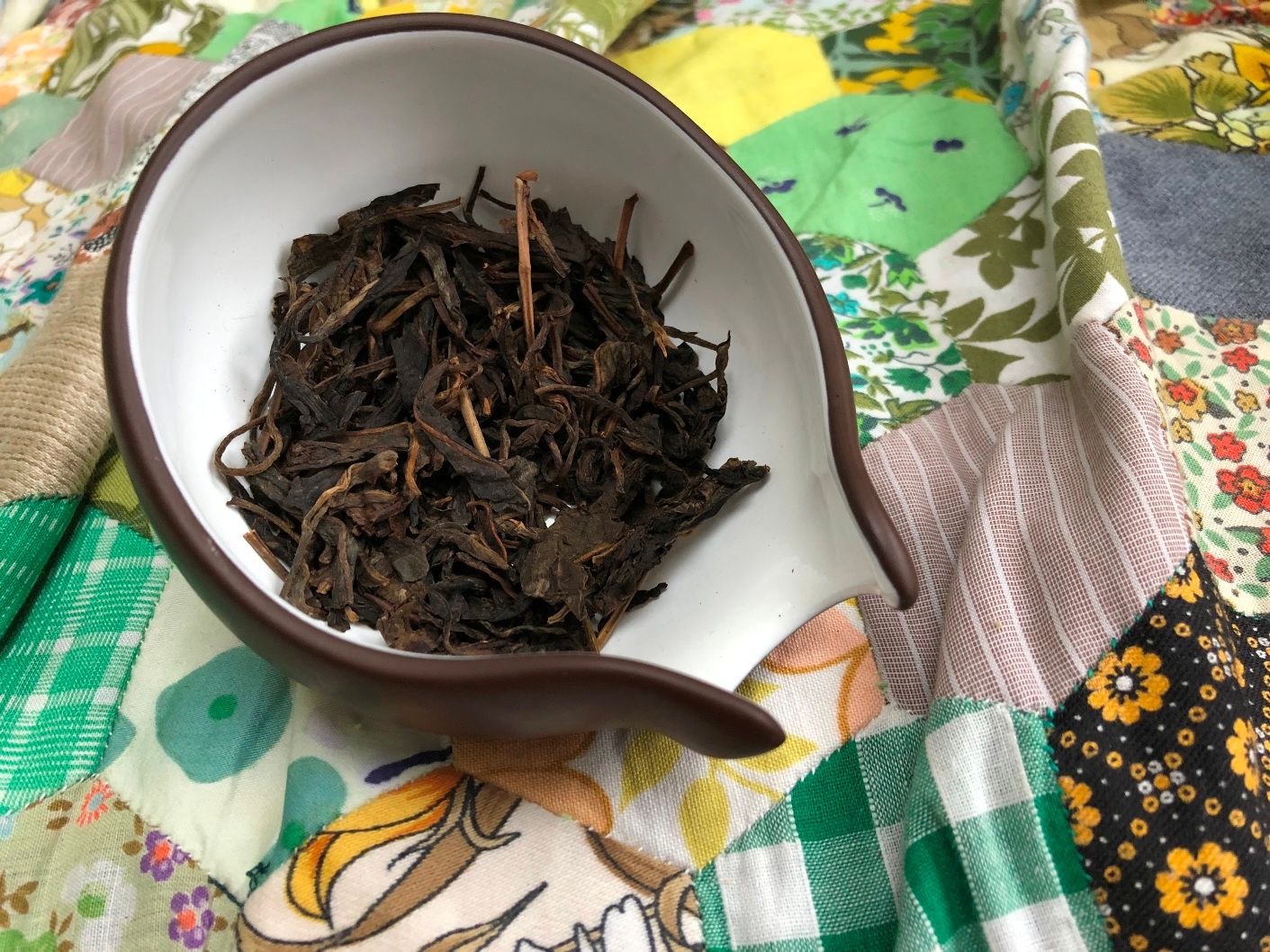


The irony is so very, very sweet!  When prices were at their most affordable, my budgets were at their least amenable to purchase.  Now that personal circumstances have changed, well... you know the price of modern bingcha as well as do I.  It's not bad, it just is what it is.

So, prices are higher than they were, such is the outcome of a developed China (always a good thing) and a maturing market for pu'ercha (likewise a good thing).  There's not much to be done on that front, except enjoy older tea when we have it.

Hence onto the second aspect of this article: the introspection of a tea writer, disappearing up his own proverbial collection.  This is dangerous.  I am thus writing about cakes that are quite probably not available any more and, if they are available, might be murderously expensive.  Of course, half the fun in the teasphere is the shared experience of trying out cakes together, picking up tips on which one might buy next, and so on.  That simply can't happen if some dude starts vanishing into his own shelves.

However, I hope it might be helpful.  It's certainly turning out to be extremely instructive for me.  The last time that I revisited cakes in any number was around half a decade ago, in 2013, typically much earlier even than that.  So, we have a good number of years now from which to make our observations, form hypotheses, and maybe even draw a tentative conclusion or two.

From the above two articles, we might conclude that even quite basic teas (as those above) can do nicely with age.  £23 and £13 are not objectively high prices, and the teas were almost certainly from plantations, in my opinion.  That plantation character exists within the aged versions, but, like rancid ol' 7542 (which I adore), it has come out well.  The raw strength of the early days has smoothed, mellowed, and become elongated into a very substantial sweetness that just continues on and on.  The texture is much improved, too: these teas are thick, viscous fluids and they are rewarding.  They are not dark teas, but they have the rounded character of sanded and varnished wood, in a good way.  I like 'em.
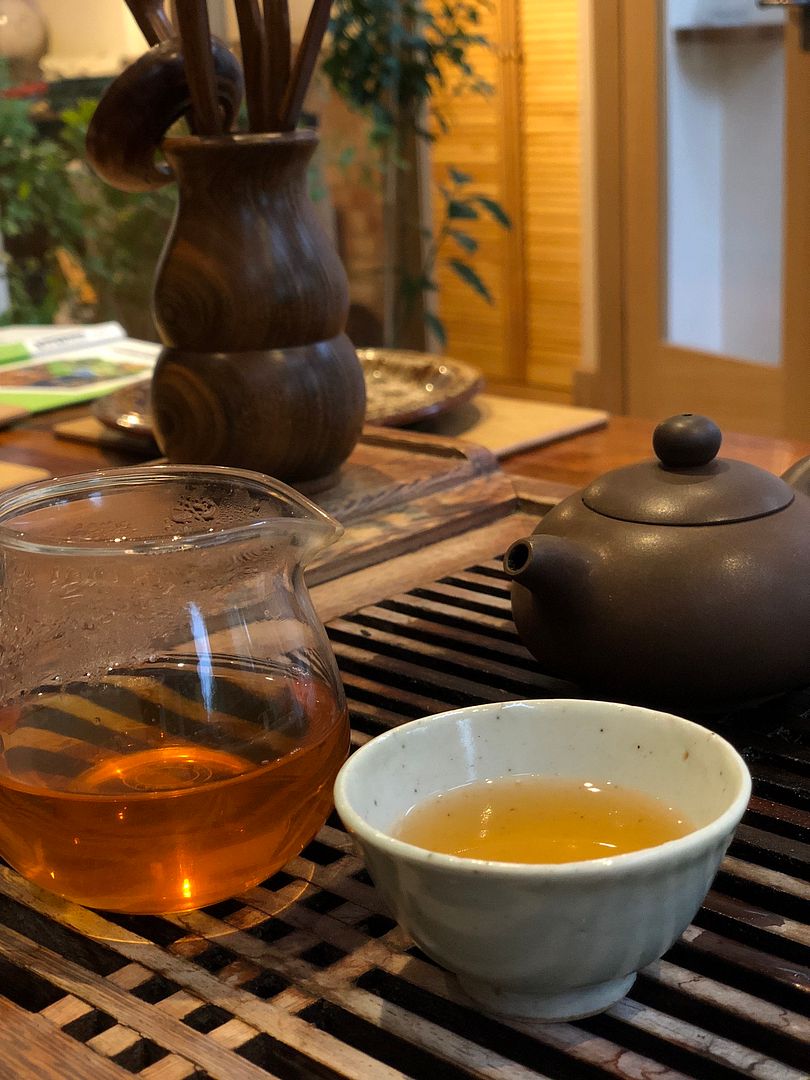


I am also able to draw some conclusions about English storage: as you might have read in the articles above, the sheer dampness of England, and Oxford in particular, is great for keeping these teas "fed" with moisture, such that they don't die.  I believe that a lack of humidity is the death knell for pu'ercha, which I understand is commonly-received wisdom.  However, British climates are not tropical: we don't have searing heat for much of the year (almost no houses have a.c., for example), and we get high(ish) temperatures for a short part of the year.

(Climate change might have something to say about that!  As with most of the world, we're experiencing an unusual heatwave at the moment.)

The cooler temperatures mean that the teas, while staying nicely alive in the humidity, are not accelerating towards redness.  Such is the price of not aging one's tea in the tropics.  This is something that you can also see from humid-yet-cooler regions of China.

Heresy incoming: I did not choose my place to live based on its capacity to age pu'ercha.  I know, what a newb!  Thus, I mus live with the consequences.  Happily, those consequences seem to be reasonable for tea, in that it's not dying and that it's getting somewhere - albeit slowly.  If we are being generous, we might wonder if this is a similar effect to compressing one's tea extensively: tuocha age much more slowly than loose bingcha, of course.  As with the prices, it is what it is.

A final conclusion concerns the "black" character beloved of some "house styles", which seems to originate, as far as I can tell, to the mid 2000s.  Think of, for example, the recognisable house style of Xiaguan, as typified most clearly in its "FT" range, or, in the extreme, its "Baoyan" products for Tibet (from which perhaps the style originates, given that Baoyan is very much older than the mid 2000s).  Douji cakes have a similar, but noticeably different, house style.  There is processing afoot such that these teas start a little darker than they might otherwise - and, in the case of Xiaguan, very much more dark.  This brings smokiness, richness, and, sometimes, a "tobacco" association.

When these cakes were being processed in this "black" manner, there was not a huge amount of evidence to say how they would age.  We have older Baoyan, of course, but most of the FTs, Doujis, and the like come only from the mid 2000s.  So, how do they do, after some 12 years?

I rather like the result.  The power of youth has smoothed into the sweetness noted before, and the blackness lends a fragrant afterscent that is most complementary, in my opinion.  The smokiness has gone, almost entirely, and we are left with dark fruits, old summerflowers, etc.  Grab one for yourself and see if you agree.

P.s. Holy smoke: more than 7,000 views for recent articles suggests that the teasphere is very much larger than once it was.  Hordes of drinkers, unite!

26 July, 2018

Ahoy There

Avast, Gentle Reader!

Good grief, it has been a long time, has it not?  To be precise, it has been, checking the sidebar, at least one year since the previous post here at the ol' Half Dipper.  Perhaps it is not long in the life of a cake of potent, pugilistic pu'ercha, but it seems significant in duration for mere homo sapiens.

It's been so long, in fact, that I received a message the other day asking, "So what's up with your blog these days?"  As you might accurately conclude, the author was from the Americas.

I am writing from a breezy place on the island of O'ahu, which is apparently part of the USA, but which does a very good job of seeming like a lovely little island. I promised myself that I'd set aside a few hours to write to you, Gentle Reader, before I left to rejoin the real world.

So what IS up with my blog these days? I mulled over the question for some time.  I fermented and steeped and brewed over the question.  I thought it high time that some explanation might be necessary, for any old friends that still inhabit the digital nethers of this strange Interweb, and for newbs alike.  After all, are we not all newbs, in the greatest sense?

It took me a while to find my bearings. In the recent year, after swearing the darned things off (successfully) for nearly a decade, I caved in and bought a smartphone, as has become necessary for one part of my life (on which later). The switch from feeds to apps was difficult at first... but now, and I roll my eyes as I write this, I would find it difficult to function, professionally or socially, without my little iProduct.

One of the first baptisms into this brave new world came when I registered for a service that I had, like the smartphone itself, managed to avoid to date:


Instagram seems to be the new teaworld. I like Reddit very much (Mondays would not be complete without gratuitously browsing prequelmemes for half an hour), but this IG thing really seems to be the heart and soul of whatever remains of the teasphere.  I like it!

It has its downsides.

I found friends old and new in the IG multiverse, but then came to feel a certain unease. The ephemeral nature of the beast means that something comes and goes before you know it. There is little permanence, by design, of course. This means that, in order to communicate, I observe that one has to be an absolute slut.  As in, really very slutty indeed.

Many of my favourite vendors are there, and some new favourites (Crimson Lotus and Bitterleaf Teas seem like tea shops I should visit soon, among others).  However, in order to maintain a presence, the level of sluttiness involved is quite substantial.  These guys are posting all day, every day - it must be exhausting.  Every time I check, there are a few new stories (short videos) and a few new posts from each vendor.  The blood pressure on these guys must be sky-high by now!  That's some admirable, full-on sluttiness right there.

Perhaps the master of this medium, in the nicest possible way, is the King of Sluts (you knew it all along), Miss Lin at white2tea.  It's like late-90s MTV in there as far as I can see, with Miss Lin bestriding them all like a rubber-clad, titanic colossus.  There are plenty of challengers for the title, too, with sluts coming out of the woodwork from all angles.

Now, a pro like Miss Lin manages to keep up the quality, because he's been pimping for many years now.  However, the intense sluttiness seems to take its toll on those sluts closer to the median on the distribution of digital promiscuity.  It's simply very difficult to maintain any level of quality when one is pimping quite so hard.  Thus, we have to wade through an infinity of cat videos, dudes attempting to pour tea one-handed (are they gripping their phone in the other hand, or something more sinister?), and so on.

It's not pretty in there.

It is great fun, of course.  Never one to shy from a challenge, I found it a medium of good fit for that substrate of strangeness that you have tolerated here for so long: my haiku (or more properly, my haiga, in their combination with an image).  It was said of a previous president of the European Union that he was "worryingly professorial, in that he seemed to compose haiku for leisure, and read Shakespeare for fun".  This was intended as an insult by the journalist behind the piece, but in me it met with high-fives and exclamations of "my man!" I do both of those things, proudly.

So, come and join me on IG, by doing the clickings of the link below, or by finding half.dipper therein.


So, in the "ghastly private details" part of the post, as promised for my old friends, a quick update to explain the howling abyss that once comprised a pseudo-regular stream of ASCII making its way from my cortex to yours.

It's been brutal, but in a pleasurable way. Kind of like being punched in the face, but with a beautiful boxing-glove, lovingly hand-stitched from silken fibres collected by hand from the polished backsides of selected Chinese silkworms.

These last two months have seen me open a second laboratory in China, funded by the Chinese government (working on AI - are we building Skynet?!), which has been great for acquiring tea, and great for my airmiles balance, but not so great for updates here at the ol' Half Dipper. If you're ever in the Shanghai area, look me up, as there's a relatively high chance I'll be mooching around there with a bunch of similarly pasty "recently escaped from the basement" techie types. Or facedown in a bath of Tsingdao beer, one of the two.  This required the smartphone - you can't buy or sell there without the mark of the beast, or at least a smartphone, equipped with a Chinese bank account (which I now have, after a battle) and WeChatPay + Alipay.

My two dudes are now Big Dudes (being 5 and 7 years old, with better Mandarin than their ignorant father). I'm just about to finish a Research Fellowship, have moved into being an Associate Professor ("Ass Prof"!), and was last month offered a Chair. You know academia is an ancient business when a good job is named after a piece of furniture. Finally, the AI company that was set up last year is about to go through its IPO, which is an education in itself.

I'd like to get back to writing you, Gentle Reader, but I must be realistic with my own aspirations. I manage to drink tea (a lot of tea, in fact), because it seems that 95% of my job these days involves sitting in meetings and talking science. This means that I am, more often than not, in close proximity either to my own gongfucha setup in my lab, or near a temporary equivalent that I've snuck into a meeting. My ability to drink is fine - but my ability to write about it is not forthcoming. So let's proceed on that basis.

Come and join me on IG for the interim, and we can take mutual pleasure in watching all our old favourite companies dancing for our delight.  And it's not a nice dance, but rather something like a rough, abrasively grinding lapdance.

Encore! Encore!
04 July, 2016

Strange Days

Warriors, poets, and warrior-poets: I bid you welcome.  I trust that all is well, with you and yours.  These are strange days indeed, but first, let's fire up the trusty ol' tetsubin before we get down to business.


I'm up before the dawn chorus, this morning, which gives me the opportunity and the means: we have a 2010 Mansai cake from Essence of Tea (nee Nadacha) on the table.  The sweet thrills of this cake rather take me by surprise; I wasn't expecting to be thrilled, at 4 a.m., and yet thrilled I appear to be.  Apricots, dried fruits, humidity, sweetness - I am enthused.

It is my ambition, in the coming months, to write up some of the (copious) notes that have accumulated, as accretion is wont to do, in my journals.  I beg your patience, with respect to their arrival, and your tolerance, with respect to their quality; there is a certain rustiness in my ability to write, but rust can be worn away with sufficient elbow-grease.  Let us grease together.

To say that these days are "strange" is not quite to do justice to the batsh*t craziness that seems to typify life at the moment.

We have come a long way together, you and I, on our respective warrior-poet journeys, have we not?  When the Half-Dipper was started, I was a humble graduate student; I was subsequently a humble post-doc; then, father to two mighty warriors (one of whom has just finished his first year at school!).  I remain humble.  As of ten days ago, I am "tenured", which is to say "sufficiently knackered so as to be put out to pasture".  My colleagues refer to me as "professor", which is both extremely unnerving and simultaneously alienating.  Even my old boss uses the title, although, it must be said, not without irony.

A few days later, my countrymen voted themselves out of the European Union.  Much ink has already been committed to this subject, and I will not bore you with my own opinion, suffice to say that literally every single person in my life (personal, professional, adversorial) is of the same mind on this subject, which appears to be on the other side of the argument from the majority of people in the country.

Imagine the Republican Party and the Democratic Party suddenly having no leaders, nor firm idea of what should happen next, and you have some insight into the substance of these recent times.

Balliol lunch
after the referendum -
sauerkraut noodles

Friends, let us shoulder our lances and our quills. It is time to drink some tea - surely, this is the only cogent response to these Strange Days.

24 December, 2015

Be Careful What You Wish For

Gentle Reader, as we look back at 2015, I am forced to conclude that one must be careful what one wishes for.  You will notice that updates here at the ol' Half Dipper have been sparse since August.

Like many of us, I live my life according to the teachings of the films of Jerry Bruckheimer.  For example, in the Parable of the Top Gun, we are taught that


"Losers always whine about their best.  Winners go home and **** the prom queen." 

I take this as being an allegory for the life of an academic.  I have therefore attempted never to whine about my best, and always to go home and **** the prom queen (figuratively speaking).

What they don't tell you is that, beyond a certain level in academia, a shocking truth exists: it is insufficient merely to go home and **** the prom queen (figuratively speaking).  In fact, to succeed beyond a certain level, one must be ****ing the prom queen all day, every day (figuratively speaking).  It is probably even true that the quality has to stay consistently high - on a long-term basis, you are pretty much only as good as the last ****ing administered to the proverbial prom queen (figuratively speaking).

As you will agree, with all of this (figurative) activity, life has changed somewhat, and my ability to write articles here along with it.

Erratum: it turns out that the above verse is from "The Rock", by Michael Bay.


Now, these are not negative constraints that I am whining about.  For indeed, was it not the very same parable that taught us that only losers whine?  Rather, these are examples of (to quote another gospel) "making you an offer you can't refuse".  It is good busyness, but it is busyness nonetheless.

Combined with the never-ending Sisyphean thrill which is childcare of a 3-year-old and 5-year-old (which is itself a tremendous benefit to the spirit), time is scarce - in a good way.

croc-a-boodle-doo!
it's time to wake up now!
it's morning, daddy!

- 5 a.m. Fatherhood


This leads me on to consider a recently-identified pet peeve: people with one child.  Specifically, academics with one child.  I know quite a lot of such people - this is because childcare is quite expensive, education can be expensive, and having more than one child is a big commitment.  What bothers me is not the fact that an academic might have a single child - more precisely, if you are an academic and you have one child you are absolutely forbidden from telling me how tired you are.

If you have one child, you don't know real tiredness.  You are a dilettante at parenting.  You are wading in the shallow end.  You are a part-timer, who can always hand off the child to your spouse.

While I am rocking my dual-child credentials and dreaming of spending some of my conference travel budget, my single-child academic colleagues are kicking it in the Caribbean, or are off on jollies to the People's Republic of Jaegermeister.

If a substantive part of your academic year is spent on a beach supping coconut milk from the tanned cleavage of nubile natives, and is not spent up to your elbows in soiled nappies and bedtime stories, then you are playing at parenting.  You are subsequently disqualified from complaining to real parents about your lack of time, tiredness, hangover, venereal disease, etc.

So, then, to tea.

I have one-and-a-half books of notes that I look forward to writing-up in due course, which have focussed on a QUADRUPLECTIC whammy of care packages sent by the respective proprietors of white2tea, Essence of Tea, Bannacha, and Yunnan Sourcing.  We laughed, we cried, we drank some decent tea.

However, at our vantage point looking back over the peaks and troughs of the passing year, I would instead like to describe a few teas taken away from my tea-table, which struck me as being variously significant in one way or another.


Tea #1:  The Interview in Brussels

one hundred pages
half-an-hour interview
my first EU grant

The tea was a Darjeeling, served by the quiet Fortnum & Mason outlet in London St. Pancras.  This is the last outpost of civilisation before an Englishman takes the Eurostar train to the continent.  I was heading to Brussels, to face down some Eurocrats for a grant interview.  I had written one hundred pages for this monster, and the EU grant scheme has a 6% success rate.  As I sipped my very decent Darjeeling, I contemplated the 94% of applicants who were objectively wasting their time by writing all those pages.  This is a hugely inefficient process, designed for the convenience of the reviewers, and neatly summarises the EU's approach to science.  As it happens, the interviewers barely let me finish a sentence, with constant (often incorrect) interruptions to my answers of their (often bizarre) questions.  Needless to say, I was one of the 94% on that occasion.

On the bright side, I resubmitted the functional 8-page core of the 100-page monster to a UK governmental agency, which funded it for more than the EU was offering, and with a fraction of the bureaucracy.  It's all about the prom queen, don't forget (figuratively speaking).


Tea #2:  After the Chapel Service at School

from the thin briefcase
the school chaplain produces
the large basketball


My eldest son, Xiaohu, who is now five years old, has left pre-school and started at proper school, in one of the colleges of the university.  Every Wednesday, they pile into the chapel for their weekly service.  Every Wednesday, after chapel, the parents gather in the hall for tea.  Institutional, long-stewed hongcha, of course, but tea nonetheless.

Over those cups of tea, parents exercise their "getting-to-know-you-chit-chat" gland, mindful of the fact that their sons will be in the same class for at least the next eight years.

One week, a guest chaplain gave the sermon, whose past had included being a professional member of the "Magic Circle"; that is, he used to be a professional magician.

As his sermon proceeded, expounding the need to pay careful attention to one's daily life to see the evidence of the divine in the detail, he placed a thin briefcase on the lectern and then produced a full-size basketball from it.

He bounced the basketball off down the aisle, towards the awestruck choir.

Said choir has been travelling, including taking selfies with the Pope, and singing in his local chapel (pictured).  Truth is stranger than fiction.


Tea #3: Shupu in my Parents' House

I leave you with a haiku that recounts a recent conversation between my youngest son, Xiaolong, and his mystified father over a cup of dense shupu, in the house in which I grew up, back in The Other Place.  With this, I wish you all my very best wishes for the Christmas season, and look forward to further correspondence in 2016.


Daddy, my drawing
has a tail - do you know
what it is?

a platypus? no!
a spider monkey? no!
a beaver? no!

then I don't know -
which animal has a tail?
an ambulance!

02 March, 2015

Dark Breakfast

One of my favourite posts over at the Duke of N's boudoir occurred recently ("Breakfast Tea"), in which our erstwhile correspondent showed us his breakfast.  As I mulled over "aged mushroom broth" and other delicacies, I reflected on the fact that it is not by a man's works that we shall know him, but by his breakfast.

One's breakfast speaks volumes.  It is intimate, personal, and absolutely honest.  When the excrement hits the fan, which is the single meal of the day that you just have to get right?  When travelling?  When wanted by the government for crimes that you didn't commit, escaped as a soldier of fortune to the Los Angeles underground?  Of course, that meal is breakfast.

It is the ultimate insight into a man's soul.

I then went on to consider my own breakfast: I have a notion that I have come to call (in the privacy of my own head) by a unique name that sums it all up:

THE DARK BREAKFAST

Now, some breakfasts are just breakfasts.  They are functional; they are getting us where we need to be.  Most breakfasts fit this description.  However, a DARK BREAKFAST is something else: a DARK BREAKFAST is a breakfast that is so powerful, so cosmically significant, that it warps the very fabric of the remainder of your day.  It sends ripples forwards and backwards in time, rearranging meetings, changing schedules, manipulating the very nature of reality itself.

Behold, THE DARK BREAKFAST.


The DARK BREAKFAST has no aged mushroom broth. It has no fresh green tea served in the local style. Rather, it is something darker, more fundamental, more cosmically terrifying. It changes minds, lives, souls.

The tea on offer here is not delicate; rather, the tea suitable for the DARK BREAKFAST is overbrewed, potent, and extremely evil. It has all the charm of antifreeze.

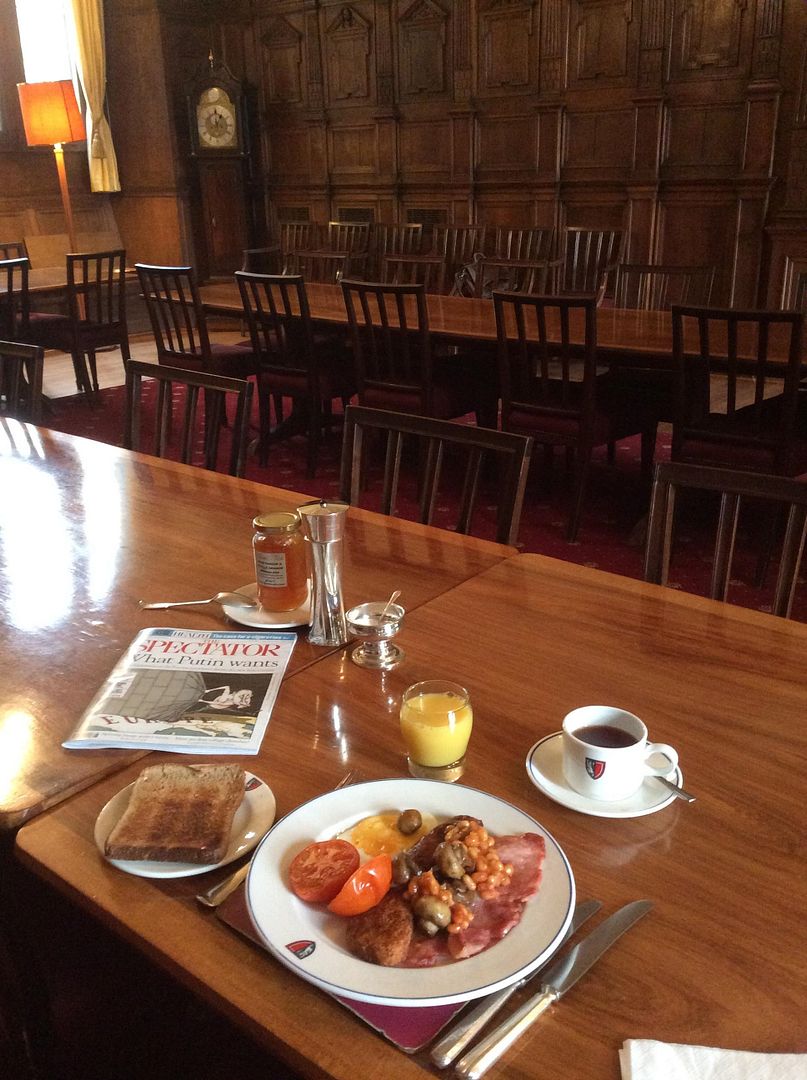
My college is particularly well-suited to the DARK BREAKFAST. Settings are placed four chairs apart, to give we, the humble supplicants of the DARK BREAKFAST, suitable room to spread out our liturgy / broadsheet newspapers / daemonic scrolls.

Quietly, the DARK BREAKFAST works its magic. Timetables subtly begin to rearrange; meetings begin to become more fluid concepts than their absolute presence in one's diary might otherwise suggest; priorities and deadlines themselves begin to shift. Truly, the DARK BREAKFAST is a rarified and incomprehensible ritual.

Happily, college also has a chapel to relieve one's soul of the burdens of the DARK BREAKFAST...

I invite you, Gentle Reader, to share with us your own morning ritual.  You never know, you may also be a partaker in a DARK BREAKFAST.

caught behind
the Chinese elders -
slow breakfast


All work and no play makes Jack a dull boy, as the Overlook Hotel likes to remind us. I set aside time at the week-end to park my rather tired carcass at the teatable, reaching for the velvet-lined container that contains ritual samples sent direct from that archpriest of darkness, w2t.


Like some other teas from Dubs, this is named after a (presumably classic) album from bygone years. My visiting mother appears to know "54-46 That's My Number", which is, according to Google, by Hoots and the Maytals, and which lends its name to this tea.


At $175/200g, this is not inexpensive - but that's fine.  If anything, it actually helps me to relax and drink the tea without being too concerned about whether or not I will be buying it.  We are so far beyond ambiguous purchase territory that we can just drink the tea.  I appreciate the freedom.


Behold the bold soldier: this is a big ol' "gushu" tea in the real style.  "Very nice; where does it come from, Brain?" I ask myself.

My closed fist (figuratively) slams into my own face as I check the Dubs web-page for this tea, to find that it comes from "hush-hush origins".  C'est la vie - another anonymous tea.


This tea is, in a very real sense, "guns of Navarone tearing up your battlezone".  Broad, smooth, punchy, fresh, zesty - and curiously familiar.  That familiarity lingers in my mind, tickling my sensitivities, reminding me of something forgotten, something beyond memory.

The risks associated with buying new tea are non-trivial.  Who knows how it'll end up?  I really appreciate the opportunity to try this sample, however hush-hush its origins (ahem), as it reminds me exactly why I like pu'ercha.  If you like straightforward, potent, sweet-straw broadness with hints of warm breadiness (Mengsong? is that you?), at least a sample of "54-46" could make you as happy as made made me.

It certainly cuts the karmic knot formed from that morning's DARK BREAKFAST, at the least...

Notes added to the 2005 Mengyang Guoyan "Laobanzhang" - this has come on very nicely in six years.

21 November, 2014

An Interview

Today, we interview the proprietor of white2tea.  While the actual proprietor could not be with us for what follows, the part of twodog will be played by selected lyrics from the classic hip-hop album, Liquid Swords, by the GZA.

--


Thank you very much for talking with us today, Mr. Twodog of white2tea. 

Much has been written about your business model of selling a limited inventory of well-selected cakes.  It looks as if you must sample widely; which criteria are you typically applying when you're tasting stacks of random tea?

I judge wisely
as if nothing ever surprise me;
lounging
between two pillars of ivory.

Well, that approach could be said to be working.  What are you looking for in a tea?  I notice that much of your inventory is particularly strong in some way. 

Dynamite force explode through your barrier
rips the retina;
who can withstand the astonishing punishing
stings to the sternum?

I think I know what you mean - the 2000 CNNP 7532 "Tiepai" was just like that.  My sternum, for one, is certainly still stinging.


You have gained a reputation for looking past the label - especially with cakes such as that "tiepai", which is probably a copy.  What advice can you give us about trusting the provenance of a cake from its wrapper?

All those labels
try to lure in like spiders to the web -
know what I'm saying -
you got to read the labels.

Well indeed, but some of us can have trouble identifying if the contents are fake.  How can you tell if it's major label or not?

Major labels:
flavour: tropical
punchlines: its unstoppable.


I suppose that's true - let the tea speak for itself, and the best producers will always demonstrate their special characteristics.  Isn't it a little risky, buying tea in an environment in which fakes are so rife?

Heavily armed military is necessary
it's a gamble.

Yes, it is.  Would you say that you were a particularly fussy drinker, or are you just looking for good, strong tea?

I ain't particular,
I bang like vehicular
homicides
.


Your inventory certainly suggests that is the case.  You have become infamous in the tea world for selling tea at an unsustainably low rate.  We're trying to understand your motivation here - what do you see when you look at the higher prices of other vendors?

What is the meaning of crime?
Is it criminals robbing innocent motherf'ers every time?

Well, no-one ever accused your higher-priced competition of robbing people, but I see your point.  So what is your motivation here?

I'm on a mission that n's say is impossible
but when I swing my swords they all choppable


Your "swords" here presumably referring to your combination of lower prices and decent quality.  Aren't you worried about the effect that this might have on the tea market?

I make the dope sales drop
like the crash in Dow Jones stock.

That's an uncompromising position, but at least the consumer benefits from cheaper tea.  What message do you have for other small-scale vendors out there, thinking about starting in the tea market?

Only raise your hands if you're sure -
Punk n's shatter like a glass jaw.


You do seem to like the "n" word, Mr. Twodog.  Are you saying that there is a large "churn" in terms of vendors, and that typical small-time vendors come and go quickly?

It's an everlasting game
and it never cease to exist,
only the players change.

That does seem to be true, looking back at all those who have tried their hand at selling tea.  Would you say that you are doing well, financially, out of this business?

Yo, I got more mils
than ho b's got birth-control pills.

While I fail to see the connection between female dogs and their contraceptive methods, I do take the point that you are at least breaking even in this venture.


You are, of course, based in Beijing and spend much time on your travels to find the next tea bargain.  Where does this activity typically take you?

I'm deep down in the backstreets
in the heart of Medina
about to set off something more deep than a misdemeanour.

Interesting, I wouldn't have considered the tea market there.  What do you look for when you're browsing a new neighbourhood tea market for bargains?

No neighbourhood is rough enough;
there is no clip that's full enough;
I can't fold I need gold I heat up and reload.


Do you have more white2tea-branded productions coming out soon?  I really enjoyed "Giant Steps", which you made in 2013.

Another production
coming atcha
rza-razor rza-razor sharp

That's fascinating.  Well, that's about all we have time for in this interview.  May we ask what our readers might expect to see from white2tea in coming months?  Are there plans for expansion?

The plan was to expand,
catch seven figures, release triggers
and live large and bigger than my n's
who promised his mom a mansion with mad rooms -
she died and he still put a hundred grand in the tomb.

Mr. Twodog, of white2tea: thank you for your time with us today.

30 July, 2014

How to Read a Haiku

Gentle Reader, you may have noticed one or two haiku cropping up on this humble web-site.  Indeed, at the time of writing, the "haiku" tag has been used here 256 times, which is a pleasingly round number in binary.

However, the appreciation of haiku is not ubiquitous, which surprised me.  My surprise is best illustrated with an anecdote.

A few years ago, I was back at the family house for Christmas.  It must have been five years ago or so.  I had my feet up, and was reading the entirely excellent third edition of Haiku Anthology, by Cor van der Heuvel.  This is one of my favourite books, and I often travel with it, and read it over and over again.

I had just settled down, when my brother, who was also home for Christmas, rounded on me: "Haiku?  How can you enjoy them?! They are so pretentious!"

I was floored.  Haiku, to my mind, are the exact opposite of pretention - after all, are they not maximally wabi-sabi, the very embodiment of the Japanese humble aesthetic?  A celebration of the tiny and immediate?  Infused with the character of Zen itself?

I put this thought to my brother.  He promptly chortled, as if I had just proven his point.  Cosmologists are like that.

This exchange has often returned to me.  How could sentient beings possibly find haiku pretentious?  It is a thought that sits inside me like a koan, a riddle with no solution.

We are led, then, to a demonstration, Gentle Reader: I would, if you will tolerate the indulgence, very much like to read a haiku with you.  If this is not your thing, and you're here for the tea, then I look forward to seeing you at the next article.  For those still with me, let us proceed...


plip! plop! plip!
the sinking plumstones disturb
fish beneath the punt


This is a whimsical little haiku, from a time when my dear wife and I were having some time off together.  Let us this time, however, not explain the haiku, but read it together.

The secret to reading a haiku is very much the same secret as to drinking a very good tea: we must proceed extremely slowly, in little sips, a tiny part at a time.  One. Word. At. A. Time.

The haiku, after all, is very (very) small.  Every single word counts, and therefore every single word in a good haiku has been selected by the writer with the maximum amount of care.  Every possible, feasibly economy has been taken to boil the essence of the haiku down to its essential ingredients.  There is nothing loose, nothing flabby, nothing extraneous: it is lean poetry, from which nothing further can be taken away.  This latter is of crucial importance: it is something from which nothing further can be taken away(If you have ever read bad writing, then you know the importance of constant reduction.  A good editor is fearless in expressing the ability to reduce a text.)

There are "rules" for haiku - they are not (despite what you may have learned in school) groups of 5-7-5 syllables.  Their subject matter is quite well defined, and the manner in which that subject matter is expressed is also quite well defined.  One cannot simply cram any old words into 5-7-5, as a schoolchild might, for the result is not a haiku.

The rules are important, up to a point. Like zazen itself, the purpose of the rules is not to foster blind adherence to some arbitrary framework: the rules are there for a reason.  The rules are there to guide one to an appreciation of what it is that makes a haiku.  The rules are the finger pointing at the moon, and not the moon itself.

Ultimately, when one has come to an understanding of what makes a haiku, then the rules are irrelevant and the rules may be broken.  Just like zazen.  However, the rules cannot be broken until that understanding exists.  Once there is understanding, then there are no rules.  I often return to Basho on this point, master of both zazen and haiku, when he spoke on haiku poetry to his students:

"Learn the rules, and then forget them."

A haiku is, like a great tea, a snapshot of a moment.  It is timely, in the sense that it represents a time: one particular moment, snatched from the stream of moments, preserved forever in the form of a brief, carefully-selected number of words, each hanging on the last, and each bringing the reader's attention to that one, special moment: that "a-hah!" moment, which is the purpose of the haiku.  The haiku is a process, a series of steps, and every step, and therefore every word, is very important.  A haiku is a process of gradual revelation.

Let us return to my humble haiku:

plip! plop! plip!
the sinking plumstones disturb
fish beneath the punt


The first line is a series of three noises, three things falling into water.  They have fallen in sequence.

plip! plop! plip!

They have also fallen with pauses between them, hence the exclamation marks, which obliges us to read the words with pauses between them (if we are reading carefully).  An earlier draft of this haiku had "plip-plop-plip", which is a much faster rhythm.  In the final version, those noises are slow, with pauses between them, and that is satisfying.  Whatever it is that is falling into the water feels as if it has some pleasing density.  Only dense things make that sound when they fall in water.

What is falling?  Are they stones?  We might be reminded of one of Basho's most famous haiku, frogpond.  Allusions to frogpond are a common hobby of the haiku writer over the centuries.  We are, at least, reminded of the zazen connotations of frogpond: the disturbance of the smooth surface of the water by the frog, and the sound: plop!  Frogpond is irreverent, a little silly, and very zen.

We take some more sips from the cup:

the sinking plumstones

Someone is eating!  There is a person in this haiku.  It is important in haiku never merely to document experience, but to describe a moment.  Haiku are not ugly descriptions of past events, but are eternally present - they pull the reader into that moment that they have captured, and they do this by being active.

Therefore, someone is actually in the process of eating at the moment of this haiku - we are not alone, and we are with someone who is eating - someone who is eating plums.  Likewise, the plumstones are falling one by one, just as if someone is currently eating - discarding each plumstone after the flesh has been eaten, rather than sinking a pile of plumstones that have previously been eaten.  The eating is on-going, that is our moment.  We are in this eating moment, active and participating.

We suspect that the person may be at leisure, because the stones are being slowly deposited into water, one after another.  We have also, although we may not have noticed, just read the kigo.  This is the season-word, that places the haiku in time: here, "plumstones".  The rules are there to be forgotten, and not every haiku has a kigo, but this one does.  We know that we are in summer, when the plums are ready to be eaten.

We are also at leisure near the water, and that also suggests summer.  Suddenly, thanks to the kigo, we have a feeling of context, and where to place this haiku in time.  We have a feeling of summer warmth, to accompany the feeling of summer leisure.

We take another sip, from the cup, trying to determine its flavour:

the sinking plumstones disturb

The break formed by the lines is very important to haiku, because it makes the rhythm of the poem.  It is understood that the reader is reading in lines, with breaks between them.  In the original Japanese, there is an additional layer of subtlety (the kireji, or cutting word), which is also a part of the better haiku in English, often achieved through meter or a special word.  Here, we have disturb: a direct and active cutting word, which also happens to fall at the end of a line.

We know that the reader will pause after reading "disturb", and so they are left with the compound feeling of having someone with them, who is eating plumstones, that they are at leisure, in the summer, that they are dropping stones one by one into water - and yet what is being disturbed?  We have some ideas.  What could be disturbed in the summer, in the water?

We finish the cup:  

fish beneath the punt.

 We have "a-hah!"  This is a water-borne eater, sitting on a punt!  We are afloat, in the summer!  We are eating plums, on the water itself, and the plumstones are making satisfyingly deep sounds as they descend into the water, the fish scattering as they are disturbed by the sinking stones.  Perhaps this steady supply of falling plumstones is what attracted the fish in the first place.

And so, we now have the full flavour of the cup.  It has revealed itself, and it dwells long after completion, like the huigan of good pu'ercha.

We have a fine summer scene, and we may know that the punts only go out in summer.  We have a supply of plums - and so maybe, just maybe, we are moored under a plumtree that has spread its branches, and its fruit, out over the water.  How lovely it must be to be on that punt, bobbing on the water, in the summer warmth, slowly eating fresh plums, listening to the sound of the falling stones.  It is surely quiet out there, because all we can hear are the plip! plop! plip! of the sinking plumstones. Suddenly, after careful reading, sip by sip, we are out there on the water, eating plums, watching fish.

--

It is this precise moment that my dear wife and I shared together as we sat out there, on the punt.  The haiku, like a better version of a camera, has both preserved that moment and invited you, Gentle Reader, to share in it with us, on that punt, bobbing gently on the water, under the plumtree. 

We hope you enjoy it with us.

20 June, 2014

Pox Romana

My youngest son recently had a case of chicken pox.  He was generally, in himself, quite well, but he was covered in spots.  This meant that he and I had a good amount of time together during weekdays, as I took the time away from work to look after him.  We had a lot of fun, and spent some of it visiting cafes, in between his usual favourite places (parks, museums, etc.).  I came to appreciate that good tea is getting around, at least a little.  I don't usually get to visit cafes, and to do so was something of an education during my time with dear, spotty Xiaolong.


The first venue that we tried was the "Grand Cafe".  As its name suggests, it is a bit of a tourist trap.  It claims to be "the site of the first coffee house in England" but I can remember that just ten years ago, the Grand Cafe used to be a shop, selling something entirely different.  Specious claims aside, you can imagine the interior from the name: it is a "belle epoque" outfit, with marble columns, ornate mirrors, etc. etc.  I'd had a fantastic coffee (Kenya peaberry) in there a year before, and so thought it time to try the tea. Xiaolong was unimpressed by the decor, and slept through our visit.

The result, pictured above, was a very solid Darjeeling.  With Darjeeling, perhaps more than any other tea, a cafe has the chance to get it right, without risk, while still charging a sizeable price.  England has a long history of buying teas from that region, and so, if you run a cafe, it is not too hard to find a distributor able to sell you something reasonable from one of the good estates.  The quality was not at all bad, and I was pleased to see that Darjeeling is coming back into the popular consciousness, even in just at the periphery.


Next up: a real Oxford education.  We have a concept in English called the "greasy spoon", which is used to refer to a very low-cost cafe that sells basic breakfasts and the like.  I first came to Oxford in 1998, and St. Giles cafe, the greasy spoon's greasy spoon, had already been trading for some decades.  So endearingly bad (in a nice way) was the cafe, that it is commonly known in the university as "the Cafe San Giles", pronounced in the French way (soft "g") to give it some ironic elegance.

Imagine my horror to learn that the Cafe San Giles (soft g) had been taken over by new management in the middle of 2013.  The old greasy spoon looked approximately the same (thankfully), but had been pulled up by its bootlaces and was now distinctly "gastro".

We have another effect in England at the moment: the "gastro pub".  These are pubs that focus on high-quality, quite rustic food, served at medium-to-high prices.  Good ol' Cafe San Giles (soft g) had been gentrified.  Not too much, but enough.

The result was actually rather good.  I had sausages made in the shop (out of meat, no less), and a special blend of Assam and Darjeeling that the owners had bought in especially from a trader in London known to some of us.  It was really very good: heavy, with the malt of Assam, but floral and zesty in the manner of Darjeeling.  I am truly delighted to see that the "gastro" movement can sometimes include proper tea.


Xiaolong didn't sleep through all of our cafe trips - pictured above, in Cafe Coco on the Cowley Road (a rather "studenty" area), my spotty little fellow awaits his order while poking a rubbery ricecake.  Cafe Coco sells "detox tea", which I naturally wouldn't touch with a barge-pole, and so we drank coffee.  Xiaolong had juice, good times were had.

He's over his chicken pox, but we had a fine time together - and we were exposed to some decent tea, as well as to his virus.

20 January, 2014

Running Out of Tea

In all my days drinking pu'ercha, I have never, ever finished a cake.  Not one.  This is deliberate: I cannot bear to be out of a particular cake.  The notion of "running out" terrifies me.  This may explain some of my tea-purchasing habits, in which I buy enough such that if I drink some then it makes no difference to the overall quantity.

It is a form of psychosis, I am entirely certain.


For me to finish a cake, then, is something of significance.  The happy event came recently, in my lab, when I had the final portion of the entirely delicious, and extraordinarily inexpensive, 2006 Tiandiren "Bulang".  I bought this for $11 (eleven US dollars) from white2tea.

I feel... strangely different, after finishing a cake.  It is as if an important mental obstacle has finally been overcome.  It is a feeling with which I am absolutely unfamiliar... but I like it.

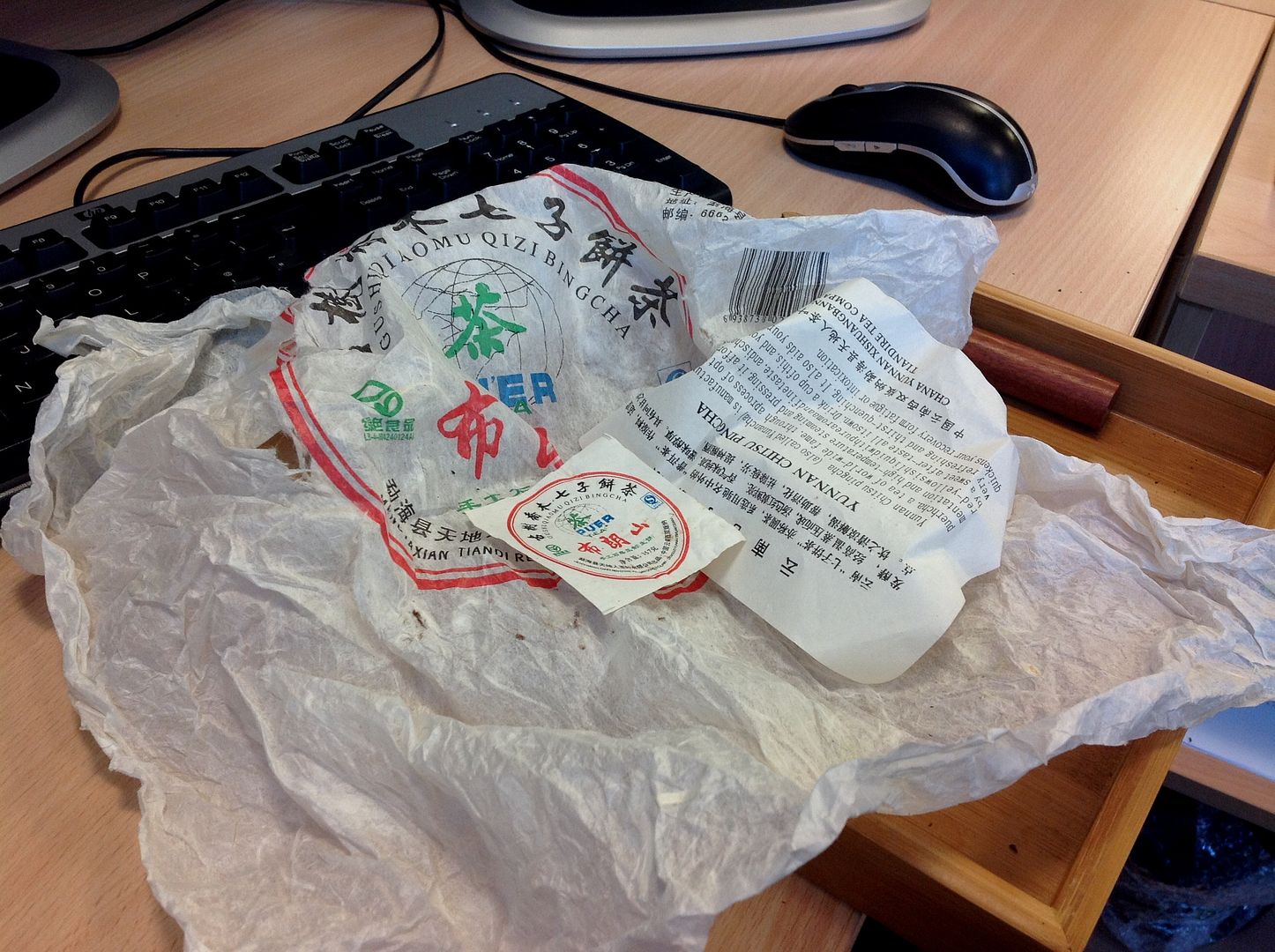
Now, what do I do with the wrapper?

30 December, 2013

Aging Tea: A Mixed Bag

I have been sampling my own shelves widely, of late, and have come to some conclusions on the relative merits of my cakes ability to age.  (In each case, I have added notes to the original articles, which you are invited to inspect by following the corresponding links.)

The Good

The 7542-801 is quite good, although a little akin to a "dry storage" cake. The 7532-801 is better - it tastes more humid and more developed, and does not have the "dry storage" straw of the 7542-801.  Oddly, the 7542-901 is absolutely first-class.  Made just one year later, it is dark and heavy in that classical Dayi manner, and tastes very nicely aged indeed.  I suspect that most people would enjoy it - they would certainly enjoy it for the sub-$10 price in 2009.

Another success story is our aging experiment in central China, where Chinese Mama and Baba have recently brought us a few tong from our stores there.  The 1997 Laojunshan (pictured below), being one such cake brought to England, even though it is shupu, is heavy, round, and excessively sweet with old vanilla.  I look forward to trying the shengpu that we have.


My post-viva Hongjie cakes, bought in 2009 in Maliandao, when my dear wife was unknowingly carrying Xiaohu, our eldest son, has come on very well (much like dear Xiaohu himself!).  The change in the tea-leaves from their original green to a husky red-orange is very encouraging.

Finally, the 1996 Xiaguan bricks from Maliandao (pictured below) are coming on a treat - somehow, they are superdense carriers of vanilla and smooth huigan.


The Not-So-Good

Oddly, the 2003 Zitenglu Zipinhao [Wysteria Teahouse purple-label], pictured below, fits in this category. The original sample that I tried, stored in Singapore, stopped the clocks and was unfathomably excellent.  The actual cake, stored in Taiwan, was less amazing.  I managed to overcome some of this simply by using many more leaves of the Taiwanese-stored cake, which got it a little closer to the Singaporean version.


Perhaps most concerning of all, the 2011 Yunzhiyuan "Autumnal Xikong" (pictured below) has collapsed into tasting like purple tea.  I am deeply concerned for its future, and will take this as a warning concerning the purchase of super-sweet, unaged autumnal cakes in future.


Tea is such an education, and an experiment in itself.

28 November, 2013

Tag Team, Back Again

Being tag-teamed by a Chinese academic brings to mind a highly amusing mental image. 

However, the fact remains that I have been slammed into the figurative ropes of the wrestling ring, and need to extricate myself by means of answering the following questoids.

Make it so.


1. "How were you introduced and fell in love with the wonderful beverage of tea?"

You know, I'm completely the wrong person for such questions.  To begin with, I see only the grammatical error in the question.  I cannot see past it.  Clauses have to agree, grammatically, and in this question, they do not.   It is the kind of error that leads me to wonder as to the nature of the soul behind the question.  So, I start following the chain of links up from the Duke of N, all the way up to the ultimate source: "the tea cup of life".

It is an illuminating journey.  I am familiar with the first link in the chain, because I have reading the output of the Ducato di N for the majority of the last decade.  The Duke of N may be many virtuous things, but a murderer of grammar he is not.  We work our way slowly back up the chain of "tea blogs" and suddenly I am far, far, far out of my comfort zone.  All of sudden we have curly fonts and pictures of white porcelain.  We have pictures of table settings (i.e., with tablecloths) and, may the Lord have mercy on our souls, we have discussions of teacakes.  I don't know where we are, but I am scared.  There are things out there that people shouldn't have to see.

I've seen things... you people wouldn't believe...  attack ships on fire off the shoulder of Orion...

Curling up into a ball, hugging my knees tightly to chest, I begin to regain control of my breathing.  In... out... in... out... My vision returns.  My mind recoils from the horror of an infinity of tea blogs, stretching out in all directions as far as the eye can see.  I focus on the present.  I return to safety. 

Some things are beyond the comprehension of the mortal mind.  The only thing that keeps us from madness is our inability to see the horrific, infinite truth, stretching off into the abyss.

As my hands stop trembling, I realise that I have not answered the exam question.  I steel myself, trying not to prevent my mind from wondering about the remainder of the questions yet to come.

So, then.  How was I introduced and [HRRRNNNGGGG] fell in love with the [HRRRARRRGLE] wonderful beverage of tea?

A searing pain tears across my chest, making my vision white, as I struggle to parse the sentence.  My breathing is laboured, hoarse; my tongue, a dry rag slung against the side of my throat.  A number of pills may have passed from pill-bottle to mouth; I cannot recall.  Merely, I am aware that later, much later, my consciousness returns.

---

Tea.  I was introduced to it in the womb.  It came down the umbilical cord in its unadulterated form.  Tea is the glue that binds life together in England.  We drink it by default.  It is the cure to all ills, the panacea.

Did I "fall in love" with it?  Is a dry, rancid soul such as my own capable of such lofty emotion?  I can tolerate tea in a way that I cannot tolerate much else.

Perhaps I really am the wrong person for such questions.  Let us plough on.


2. "What was the very first tea blend that you ever tried?"

I conclude that the writer of these questions is foreign to me in a way that I will never understand.  Is this the stage of the proceedings at which one should write "mint chocolatte eggnog nipple-tweak energiser"?

Like every other life form in England, I have consumed "tea" since before the day I was born.  I imagine that the real answer to this question, in my case, is "English breakfast", but that really depends on whatever it was that my mother happened to be drinking when I was happily gestating.


3. "When did you start your tea blog and what was your hope for creating it?"

Heavens, we're only on question 3.  At least this one is a little more explicable.  I fired up the ol' Half-Dipper in the spring of 2007, back when I was a fresh-faced young man, eyes wide in joyous wonder at the rapturous possibilities that the future held in store.  Obviously, I am now a decrepit crustacean.

Documentation forms a major part of my life.  I have a some fifty or so journals, stretching back to when I was 18, and two dozen logbooks that describe my work and the details of the experiments that form part of it.  A tea blog was a natural extension of this process.  I cannot remember very much at all, and so having a searchable list of my conclusions concerning matters related to tea seemed to offer the same possibilities as do my journals or laboratory logbooks.

Later, after tonking around for some considerable period, I came to appreciate that the real fun with the web-site came from bouncing ideas off like-minded (i.e., rabidly strange) individuals.  There is a chance, Gentle Reader, that you fall within this category, if you are reading this.


4. "List one thing most rewarding about your blog and one thing most discouraging."

We have may surmised, looking at the above text, that I (and probably you) are not immediately similar to that which the majority of people might call "tea people".  I dislike that label immensely, in fact, because it is a diminutive.  You, Gentle Reader, are so very much more than a "tea" person.  You are, quite probably, entirely fascinating.  You might be a scholar, a warrior, a poet, or perhaps even (as the youth of today might say) a d-bag.  You are, undoubtedly, more than someone who consumes a drink.

I sigh a weary sigh as I realise that I have not even remotely answered this question.  What is rewarding about my blog?  People.  Connections.  If you were not here, Gentle Reader, then I would be just a strange individual shouting at an empty space.  Instead, I enjoy the luxurious facility of intercourse.  Intercourse!  With you!  It is an entirely satisfactory experience.

The most discouraging?  I don't find much, if anything, discouraging about the whole affair.  People come and go - even you and I will go, perhaps sooner, perhaps later.  This transient behaviour of readers and writers is a charming feature of the medium, in fact - it is the constant reinvention that makes for renewal.

Actually, I just thought of something.  The one thing I dislike.  It is the adoption of the word "scholar" when referring to tea.  Ladies and gentlemen, I give you the one discouragement that I have encountered: "scholar tea".  The chap who coined this phrase is a lovely one, whom I like very much.  You might remember him.  It is more the phrase itself that is the problem - the notion that something I love so dearly (i.e., scholarship) could be co-opted to hawk tea.

"That's all I have", as our American cousins might say.


5. "What type of tea are you most likely to be caught sipping on?"

I feel that these questions are quite revealing as to the texture of the mind that generated them.  It is not a texture that is immediately recognisable to me, and I have to feel my way around it in the same way as a newborn might require continued tactile sensation to come to an understanding.

I drink Right Tea.  I do not drink "good tea" or "excellent tea", because that is rather a lazy description.  Sometimes, I drink downright horrible tea.  However, I always drink the Right Tea.  Every day.


6. "Favourite tea latte to indulge in?"

I would like to meet the person that created these questions solely for the purpose of extending my comprehension as to the vast and infinitely-varied spectrum that comprises humanity. 

I am consistently amazed, year on year, by how many new types of people there are out there - people thinking and existing in a manner that I would have hitherto not even thought possible.  Rather, so alien are these souls to my own that I could not even conceive of their existence, let alone their impossibility.

And yet, somehow, such people exist.

It's a miracle, really.  Nature is a miracle-worker, and we, Gentle Reader, are witnessing the results of that magic.  It is a humbling thought.


7. "Favourite treat to pair with your tea?"

Malaise?  Ennui?  Artery-splitting terror that I might be asked such a dread question?


8. "If there was one place in the world that you could explore the tea culture at, where would it be and why?"

If there was [HRRRNNNGG] one place in the world that you could explore the tea culture at [HR-HR-HRRRUNNNNNGGGH], where would it be and why?

My physiology attempts to cope with the brutal violence done to our dear language.  Merely writing it, tapping fingers against keys, has caused my systolic blood pressure to rise beyond that of an exploding sun.

I... I... you win.  You win.  You have challenged me, and won.  You have bested me in combat.  I am honour-bound to answer the remainder of your questions.


9. "Any tea time rituals that you have that you'd like to share?"

I begin to suspect that the victor in this combat, which is to say the originator of these fell questions, may come from the United States of America.  The notion of "sharing" in this context is very definitely foreign.  It makes me feel similar to that sensation I experience when I hear the word "leverage" used as a verb.  It is akin to describing a problem as a "space" or as an "issue".

I have rituals, and plenty of them, all of which are automated and performed without intervention by my consciousness.  I am sure that you have them, too, of your own sort, Gentle Reader.
 
We have learned the rules, and then forgotten them.


10. "Time of day you enjoy drinking tea the most: Morning, Noon, Night, or Anytime?"

Such cavalier use of capitalisation is to be admired, really.  They say that Shakespeare created three times more new words, and new usage of existing words, than anyone else in the history of the English language.  This spirit lives on in the driving force behind these questions.

I would love to experience the complete freedom to play with language and syntax in such a way, but I am constrained and limited in a way that the questioner is not.  The ceiling is low indeed, for me, and I scrape against it, while the devisor of these questions soars high above, in the clouds, free and unbound.


11. "What's one thing you wish for tea in future?"

Tea is just a drink.  My advice would be, if I may be so bold as to venture advice, do not limit yourself by association.

"Buddha is in the details", it is said, and so while tea is "just a drink", it contains so much more.  Do I wish anything for tea?  Not particularly.

However, I wish very much for you, Gentle Reader, and that is surely the purpose of our time together.


 12. "Whom do you tag?"

The buck stops here.  I will be the Atlas to your globe, Gentle Reader, and bear the weight of your subsequent judgement.

I pray you, be favourable.

06 September, 2013

Pesticide: It's What's for Dinner

Attitudes to food and drink vary geographically, and according to socio-demographic groups - typically education level, in OECD countries.  I think it is fair to say that awareness of the benefits of eating healthily is becoming more widespread.  Most tea drinkers, for example, have some sense of looking for good products, and in avoiding the consumption of additives that might be unhealthy.


This desire to "eat well" is mixed up in a whole heap of social and cultural complications.  In the US (and, increasingly, in the UK), the general public seems to be hooked on "low quality" foods.  I cannot speak for other countries, but in England, in which I hold a personal interest, recent studies have shown that this tendency to consume "lower quality" food and drink is most prevelant in low-income, low-education level populations.  Consequently, higher rates of obesity, hypertension, and lower life-expectancy are associated with these groups.  Those groups with "stressed income" are especially likely to be malnourished and consume fast food, as reported in a recent OECD study.

In the UK, and perhaps in other Western countries, our ability to detect unhealthy ingredients in food may be diminished by a diet already heavy in pesticides, fertilisers, preservatives, colourings, and flavourings.  I cannot imagine that someone who has been raised on pizza and fried foods would be particularly sensitive to the presence of small quantities of pesticide in their tea, for example.


In China, the effect is different: culturally, the Chinese prefer "whole food" products, prepared by hand.  The average Chinese has a rightful disdain for the diets of Westerners.  It is not by accident that the majority of Chinese seek out Chinese food when they are abroad.  I have seen, time and time again, visitors from China entirely revolted by Western food.

However, this effect in Chinese from the Mainland is complicated by the fact that their food, water, and air are poisoned - sometimes literally.  Most of my Chinese friends who still live in China are now unable to detect the presence or absence of additives in their food, such is the ubiquity of pollution and agrochemicals.  Indeed, "food safety" came just under "water safety" and "corrupt officials" in a recent (official PRC) survey of popular opinion, reported in The Economist.  My wife refuses to let our sons travel to the Mainland until they are five years old.  My wife's family regularly recounts the latest food-safety scandal to effect everything from rice to garlic.  Only the largest, child-killing scandals such as Sanlu's milk poisoning tend to be reported internationally.

So, I maintain, whether in the West or the East, for different reasons, there are factors that serve to prevent some of us being able to distinguish the presence of pesticides and fertilisers.


Perhaps it might be useful to contribute my own standing at this point: I am not a "health freak".  I was, however, raised in the countryside, with a robust diet of home-cooked whole food, and in an area with minimal pollution.  As a student, I spent a good decade abusing my body with all manner of the usual student libations.  As a father and a professional, now in my thirties, I am back to my usual diet of "straightforward living", kept on the straight-and-narrow by the kindly ministrations of my dear (Chinese) wife, which keeps the quantity of additives in my diet to a minimum.

Additionally, there is a genetic trait in my family that predisposes us (all men, oddly enough) to sensitivity to most allergens.  I inherited this from my father, who was a colonial British growing up in Zambia and Kenya; in turn, I have passed this sensitivity onto my youngest son, Xiaolong, who has my white skin, allergies to most things, and eczema.  (It skipped my eldest son, Xiaohu, as he seems to take after his mother, having her Chinese skin and a lack of allergies.)

This combination of (relatively) "straightforward living", a clean environment, and a sensivity to allergens makes me quite sensitive to the presence of agrochemicals in tea.


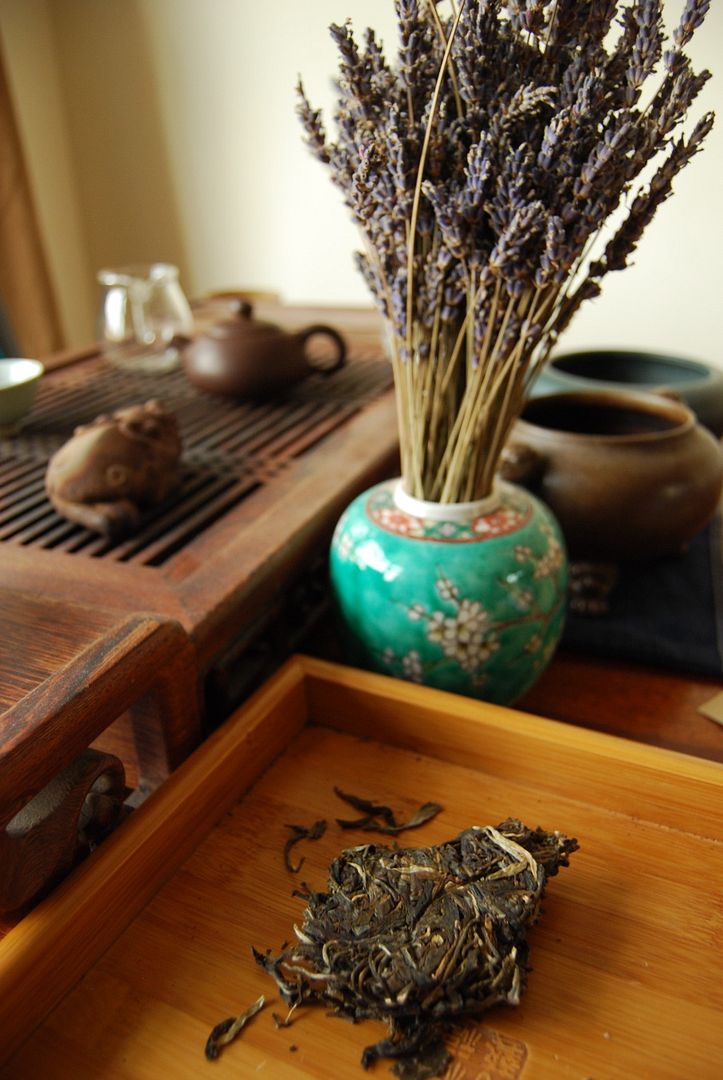
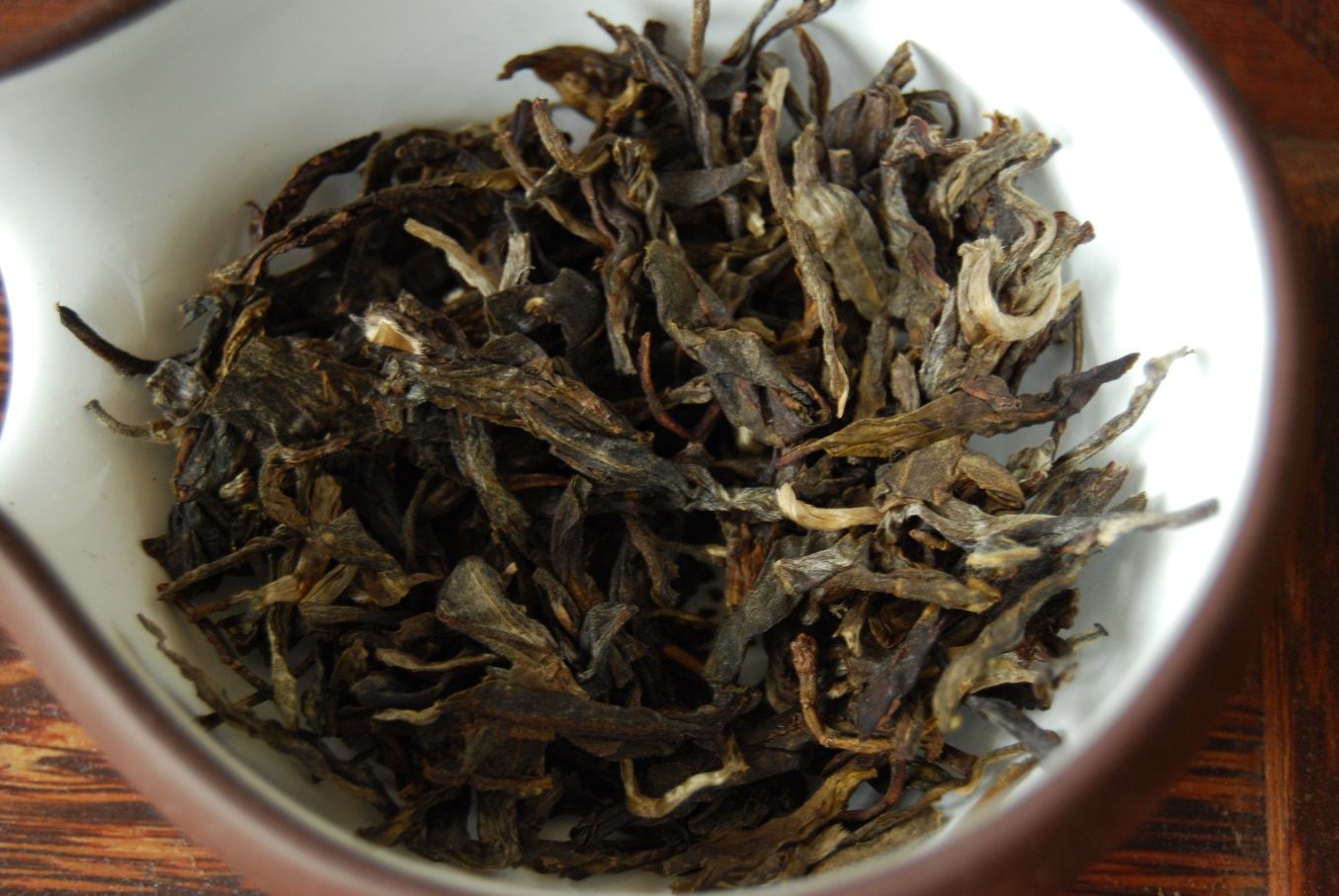
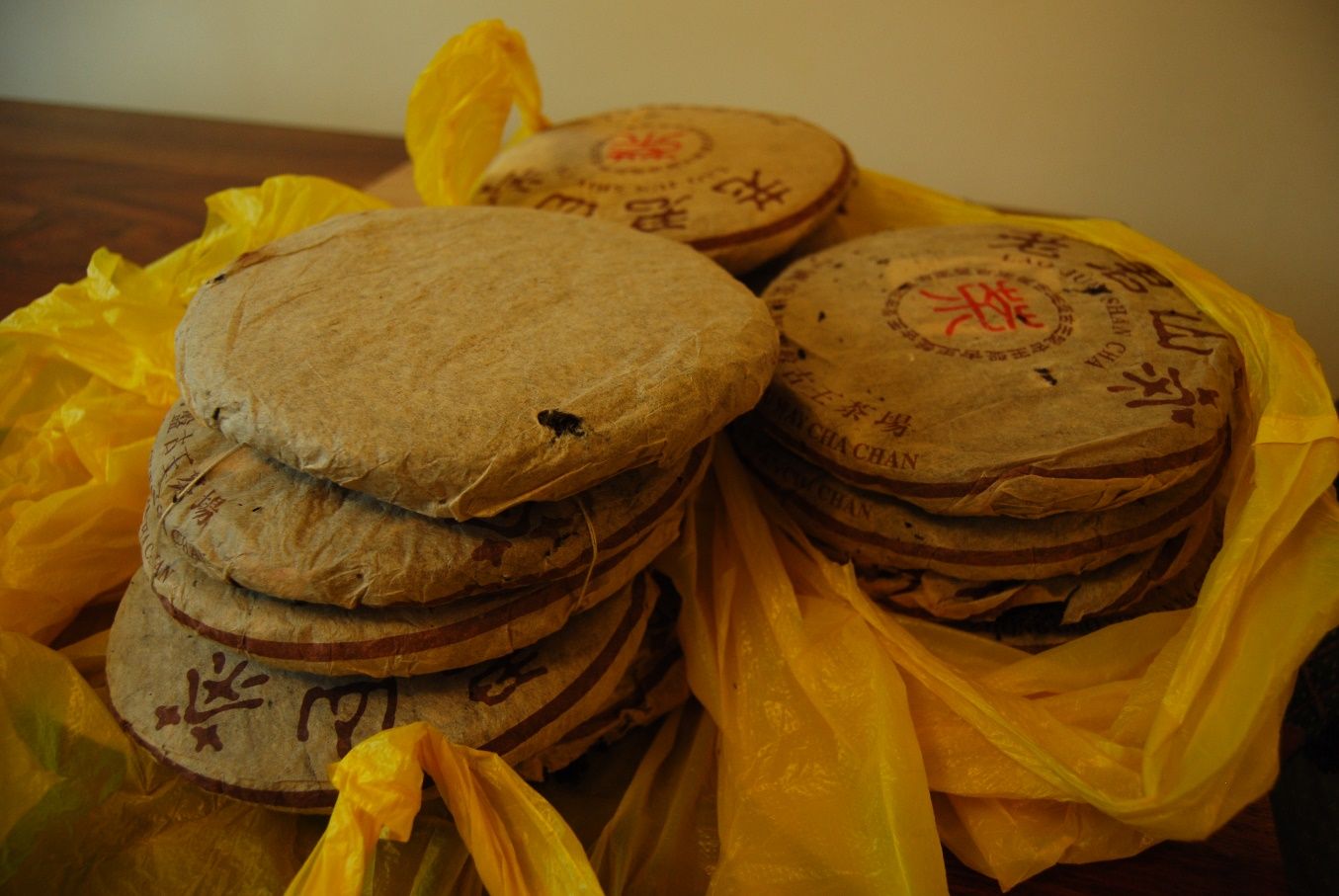
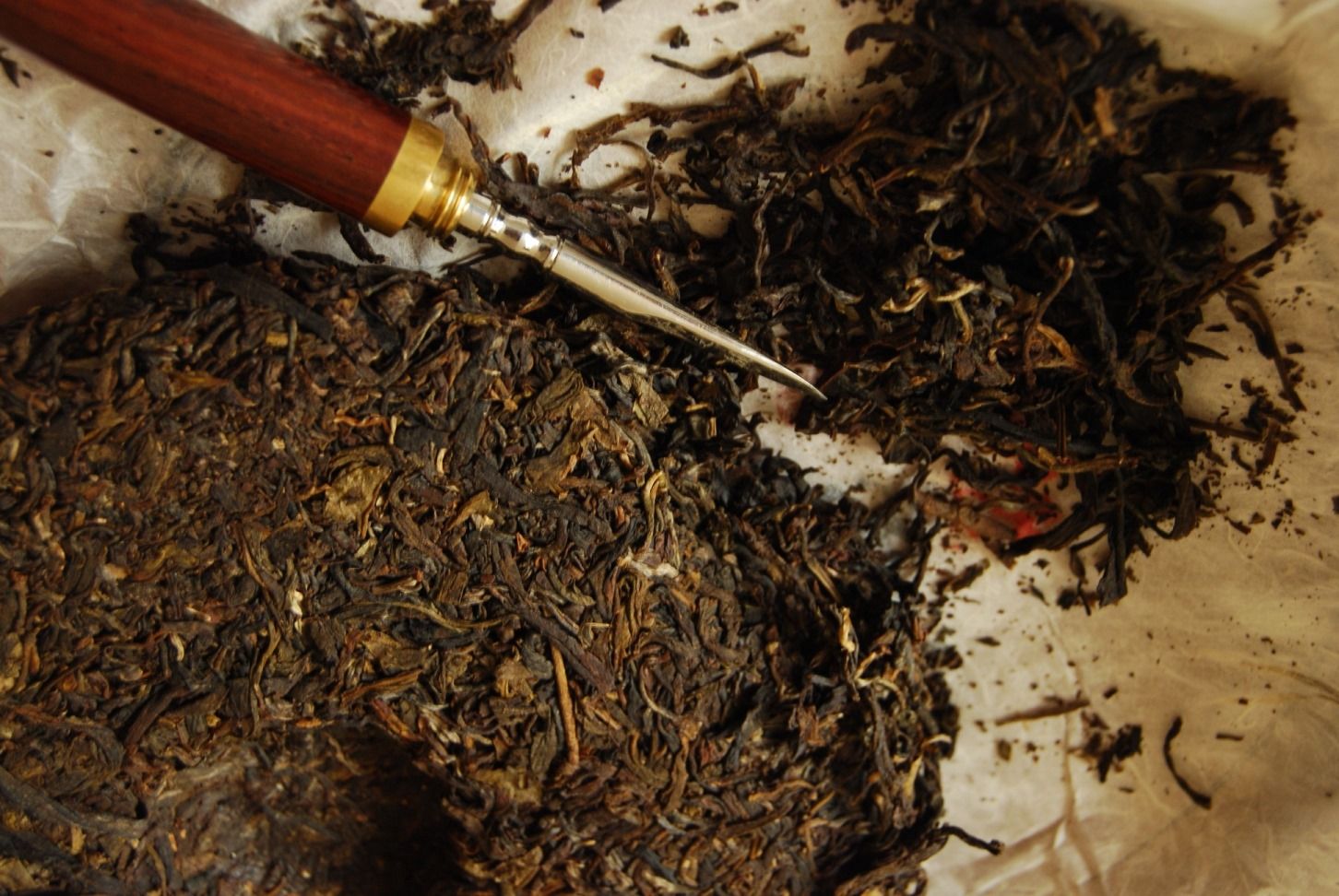
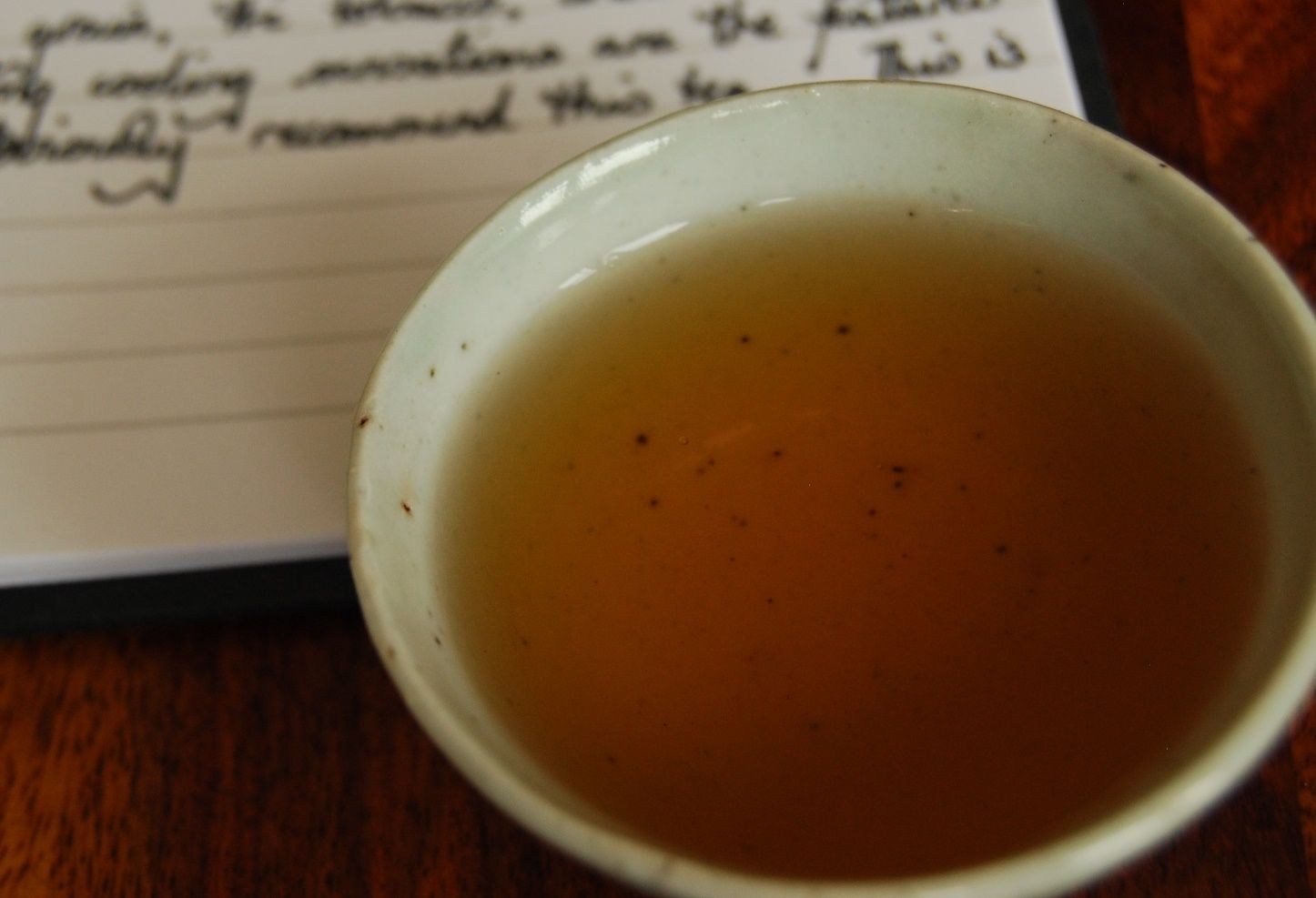
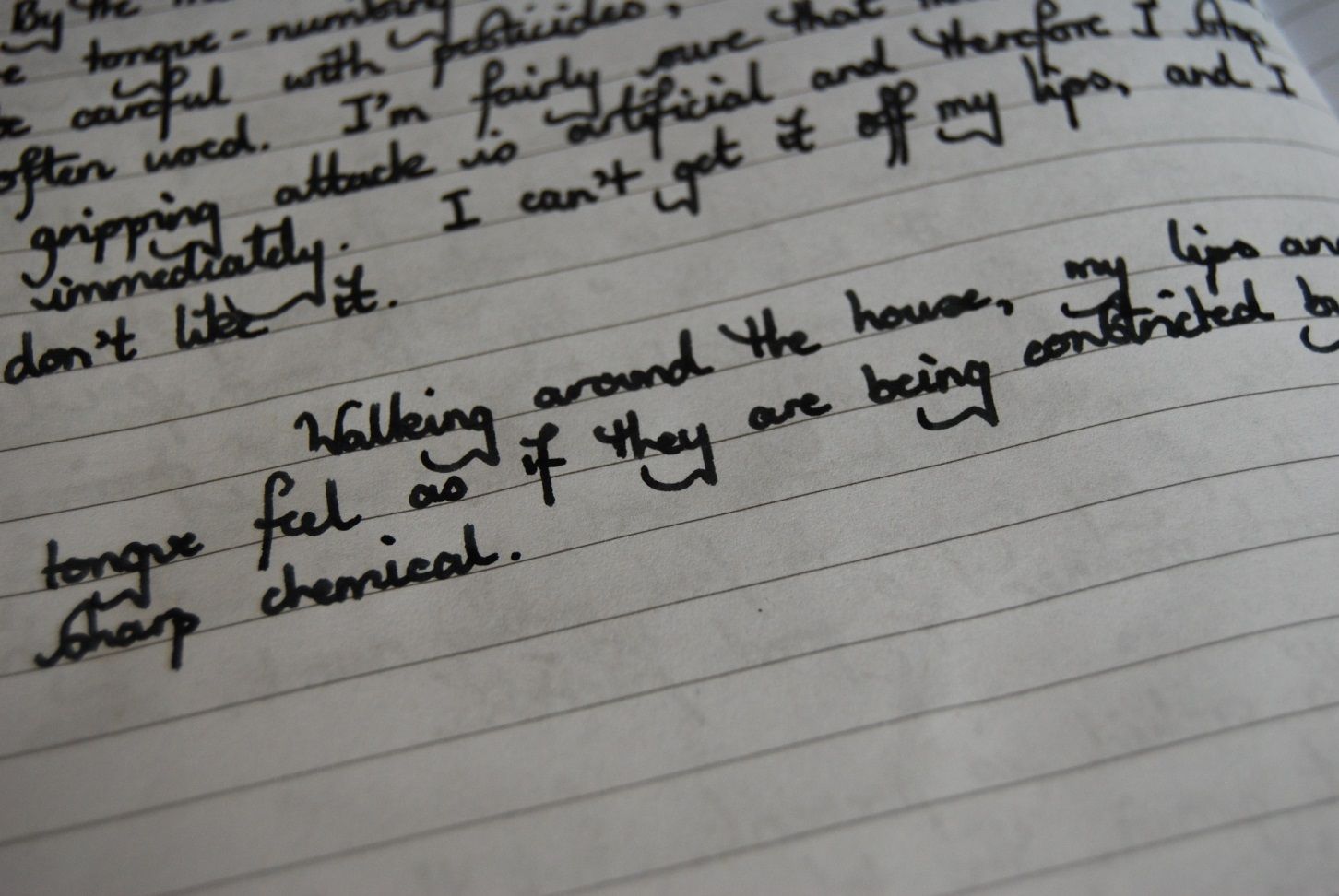
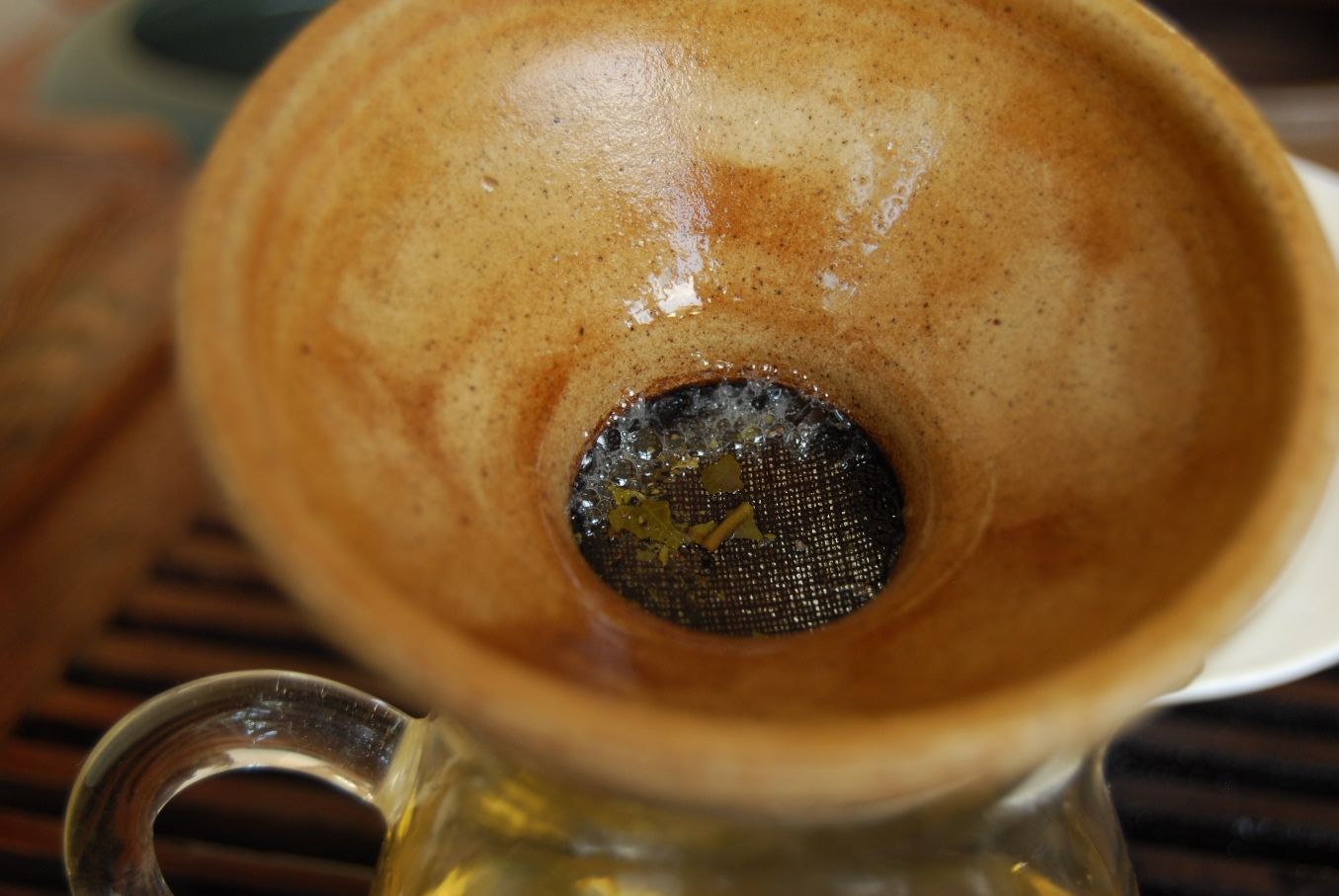
Shown in the first three images for this article is a cake that I tried recently which was remarkable.  It actually tasted like "good tea", in terms of its leaves, but the very first sip filled my mouth with a cloying, freezing sensation that reminded me of getting old-fashioned hairspray in my mouth (of the kind that my grandmother used).  My lips felt as if they were being constricted; the tip of my tongue throbbed; the sensation stuck tight to the sides of my mouth.  I rinsed my mouth several times, and, despite trying to shift the sensation throughout the day, it lasted many hours - even later, when I went to work in my lab.

It turned out, following a later lab test performed in light of my suspicions, that the tea contained a number of pesticides, in quantities between 10% and 78% of those permitted by the EU regulations to be present in tea.  These are the "MRL"s, or maximum residue levels, and which are typically more strict in the EU than in, for example, the USA.  That is, the tea was "legal", the pesticides were within limits, but they were entirely obvious and absolutely negative in their effect.


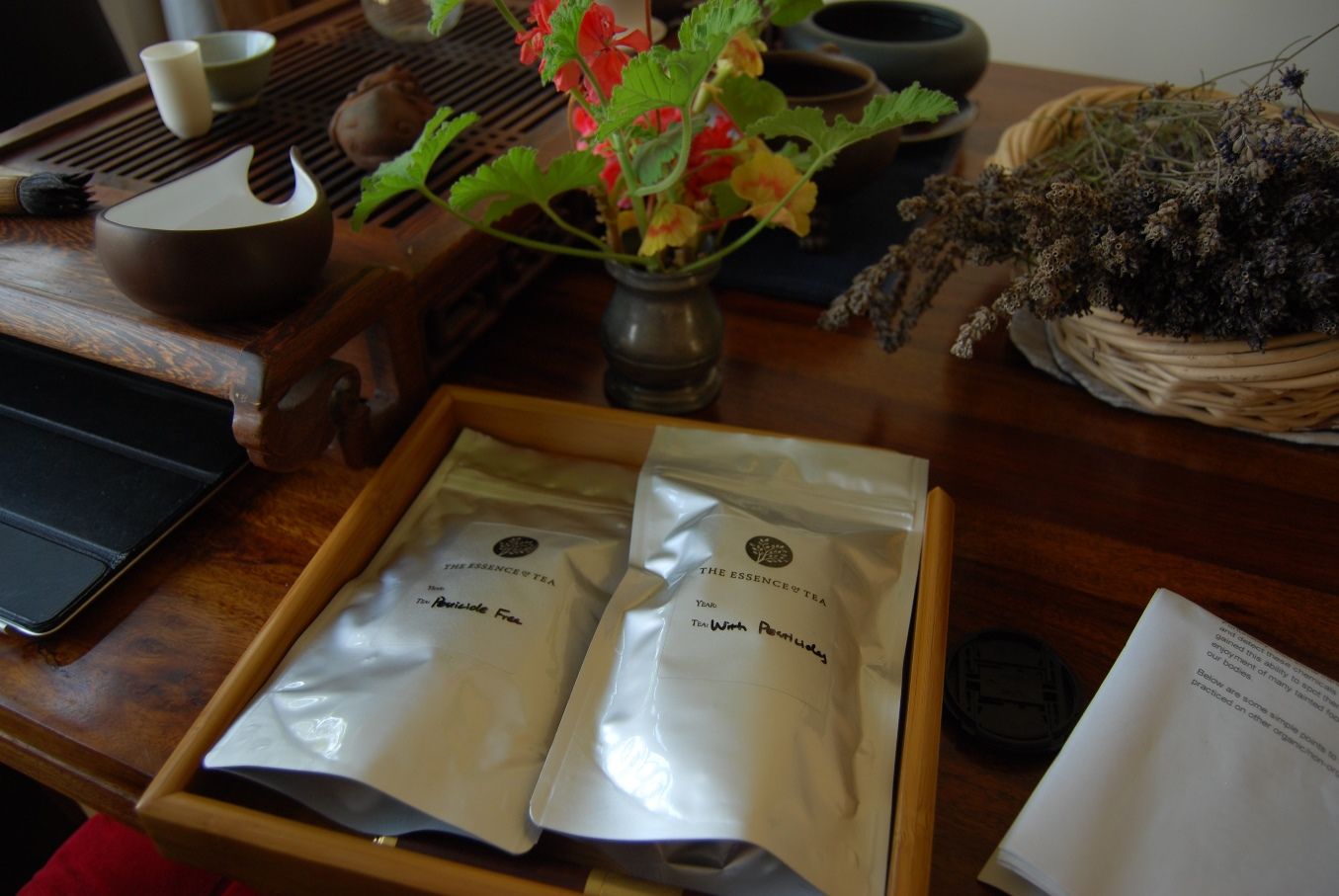
Shown also in this article is the "pesticide tasting sample" from Essence of Tea, which Mr. Essence kindly sent to me, and which may be bought from his web-site.  The accompanying lab report shows that the tea is 2013 Zhenyuan pu'ercha, and that it contains omethoate at 0.02 mg/kg, where the EU limit (MRL) is 0.05 mg/kg.  Again, this is "legal" tea...  (I am happy with the £15 price for the tasting set, because the lab test is expensive.) 

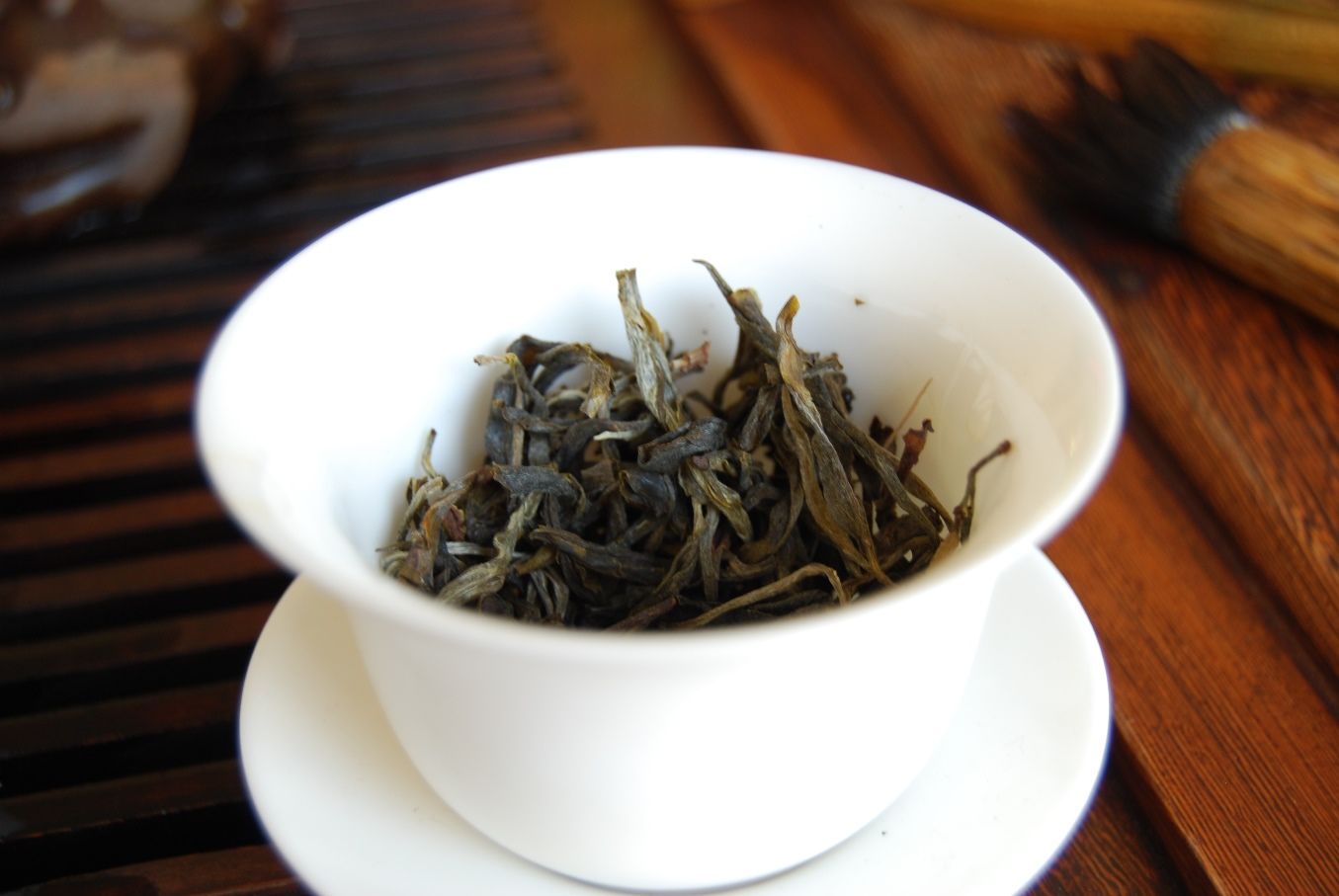
You can see from the above photograph that this is maocha.  When taken as a whole, in the large sample bag, I can smell only a dense fruitiness.  However, when turned out into the gaiwan, the leaves have a background scent reminiscent of sour nicotein.


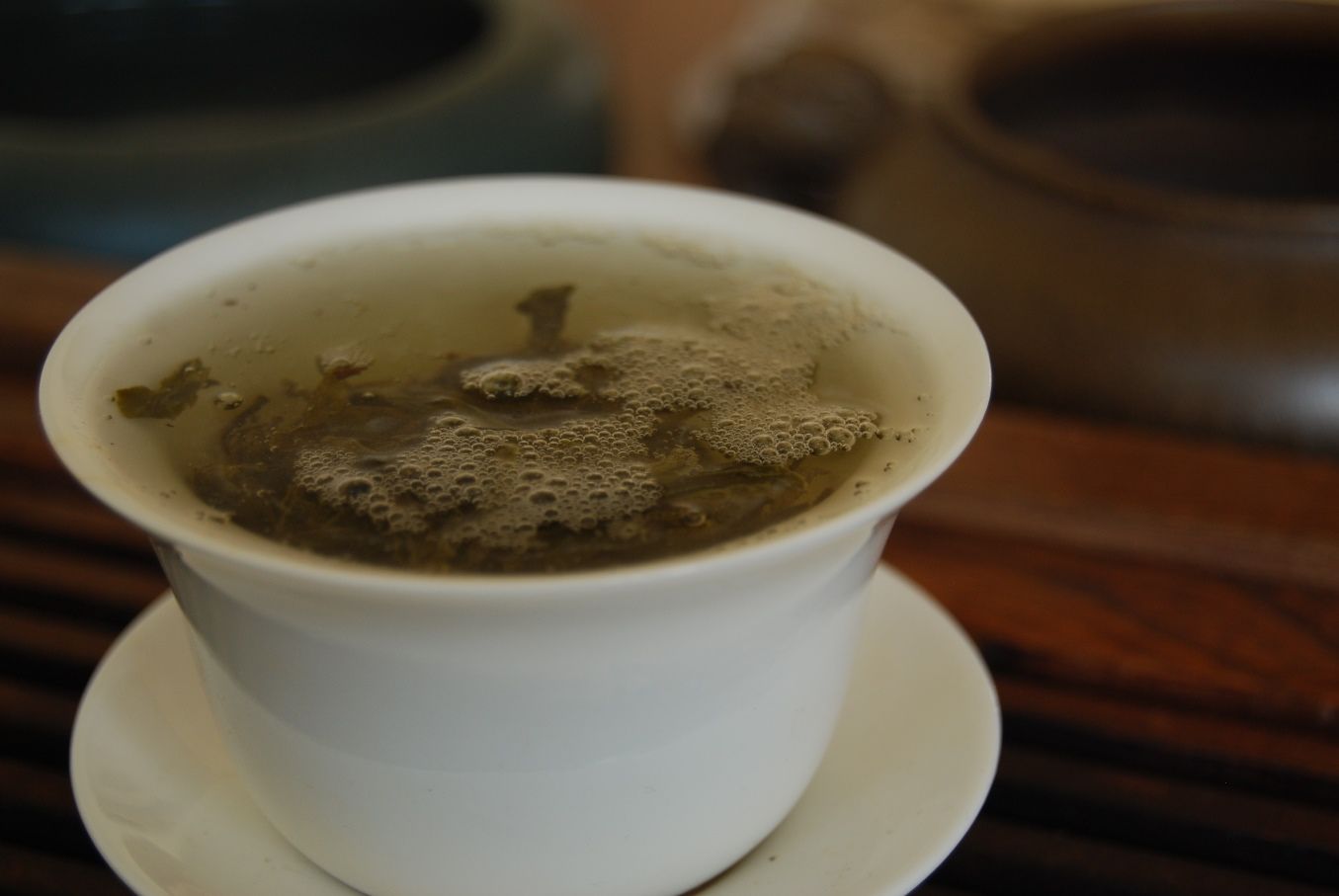
The rinse, pictured above, generated a definite scum.  While many teas have saponins that, my definition, result in soapy bubbles, they are quite different to "scum".

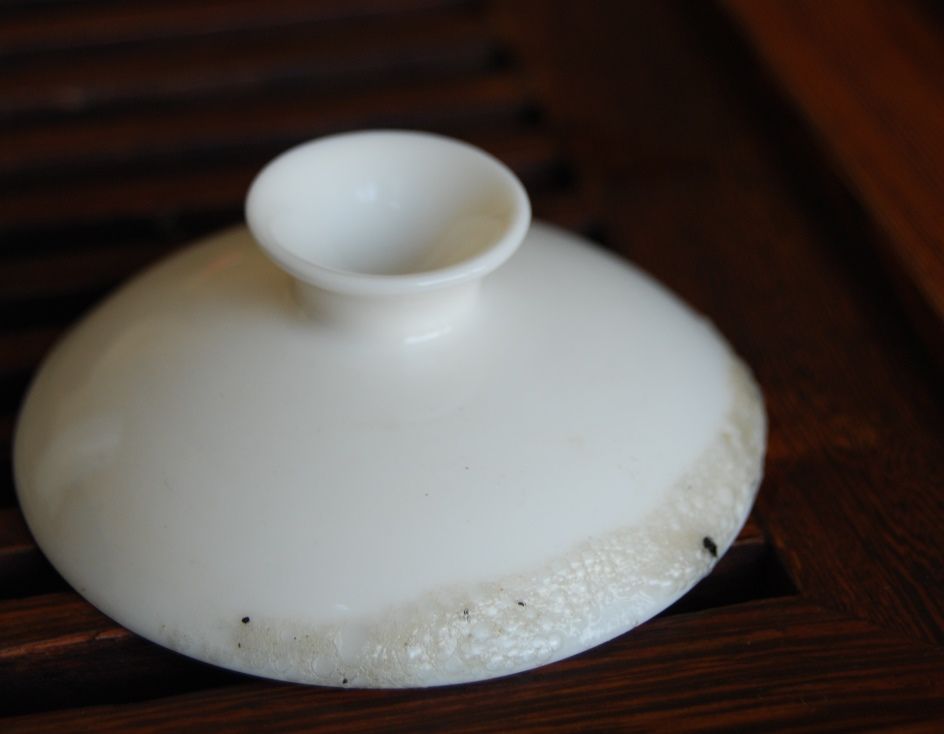
The persistence of this clinging scum is apparent from the photograph below - the scum does not rinse off, preferring to cling to the glazed lid unlike saponin-froth, and which requires a cloth and some actual manual scrubbing to remove.


Even after the first infusion, noting that the tea has already been rinsed (with long duration), some of this scum remains, and gets caught in the filter that I use to strain leaves from the soup before they hit the gongdaobei [fairness cup].  This is highly unusual - most teas at this stage, even if they have saponin-froth, are clean by the first infusion.


The resulting soup has no real scent.  The first sip slams into the lips and tongue just like the hairspray-effect of the cake described previously.  It adheres to the lips and cheeks, freezes and numbs, and constricts in exactly the same way.  It is this tightening and drying of the tissue that is particularly obvious.

After that single (perhaps 5ml) sip, I discard the result of the brew and wash the teaware with soup and water. 


Note that both of the teas that I described in today's article were legal, even by strict EU standards.  A recent Greenpeace report (from 2012) described the random sampling of a number of mainstream Chinese teas, the majority of which were found to contain pesticides, a large number of which were found to contain pesticides banned by the PRC (but which were legal in the EU, oddly).  Amusingly, one of those latter pesticides turned up in the lab report of the first cake that I described.

So, the big question: what are we to do?

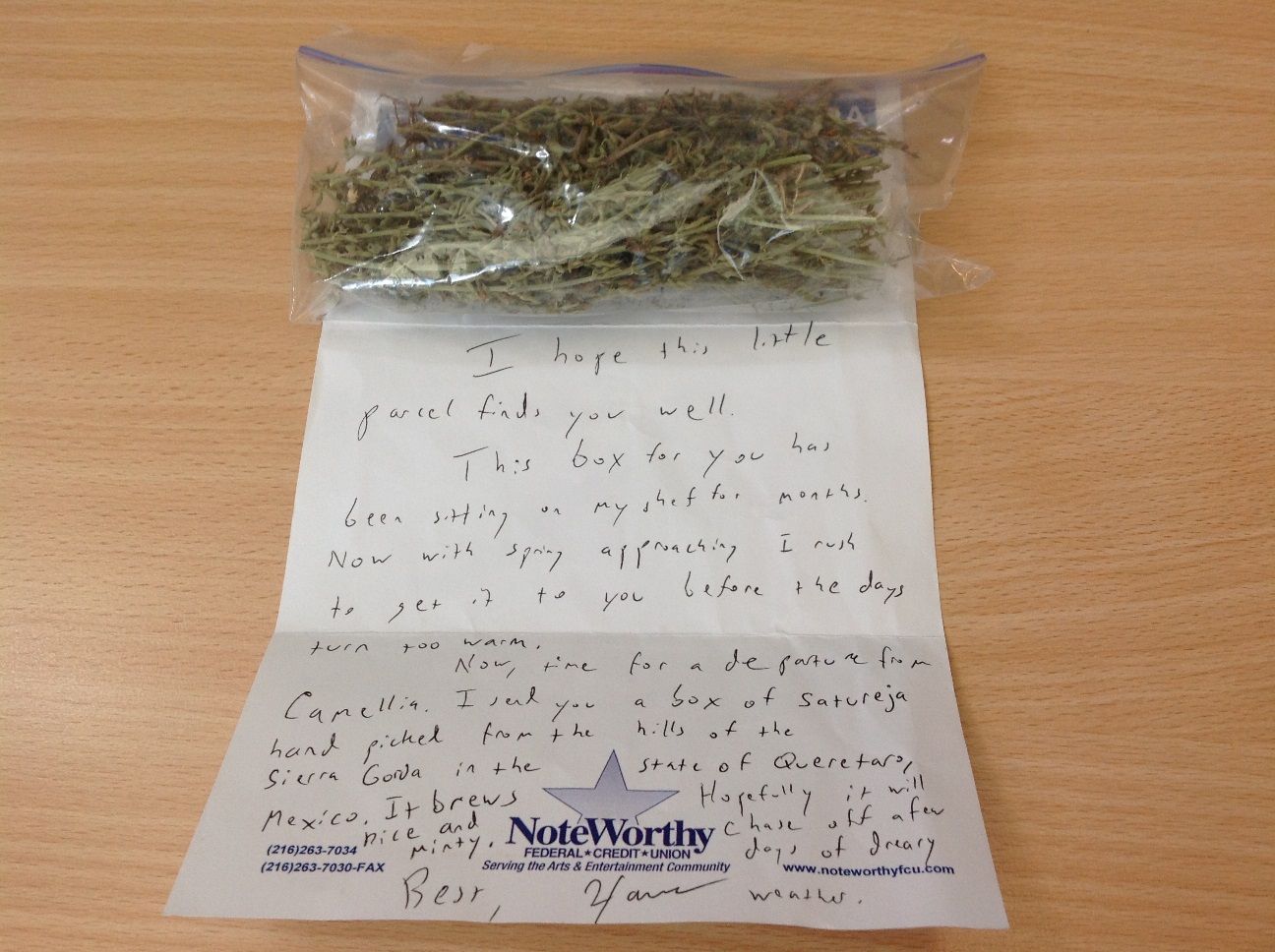
One extreme reaction is to swear that we will never drink anything that has come from the Mainland.  For example, we might drink hand-picked Mexican herbs that look very much like narcotics, as pictured above (thanks to HC - how that got through customs I will never know!).

We just have to be sensible.  A more realistic solution is to exercise some sensible quantity of discrimination.  Depending on your existing diet, environment, and exposure, you may be more or less sensitive to the effects that were entirely, lip-searingly obvious in the samples described in this article.  Have a crack at the Essence of Tea sample, and see how you get on.  Just don't use your favourite zisha teapot.

As for me, I make it a rule to avoid Mainland green and red teas (lucha, hongcha), as the use of agrochemicals in such crops is ubiquitous.  My tastes prefer pu'ercha, where, fortunately, the use of such chemicals is not guaranteed. 

If one were to maximise one's chances of buying pu'ercha that contained pesticides, it would be through buying modern tea (probably 2006+, including the pu'ercha bubble of 2006 when yields increased dramatically) and buying from low-quality labels (CNNP, Haiwan, etc.).  However, the use of pesticides is not limited by year, quality of label, or quality of leaf.  Just because a tea is old, or "gushu", or made from a vendor you like, does not mean that the cake is immune from a farmer contributing a rogue batch to the mixture.

Ultimately, we must train ourselves to be able to discern the good from the bad.  An important part of that process is sharing our findings with others.  So, for the good of the many: keep writing, tea-writers.

For completeness, I have updated my notes for the 2012 Bulangshan from Essence of Tea, which forms the "without pesticide" sample in this set.

01 July, 2013

The Power Behind the Throne

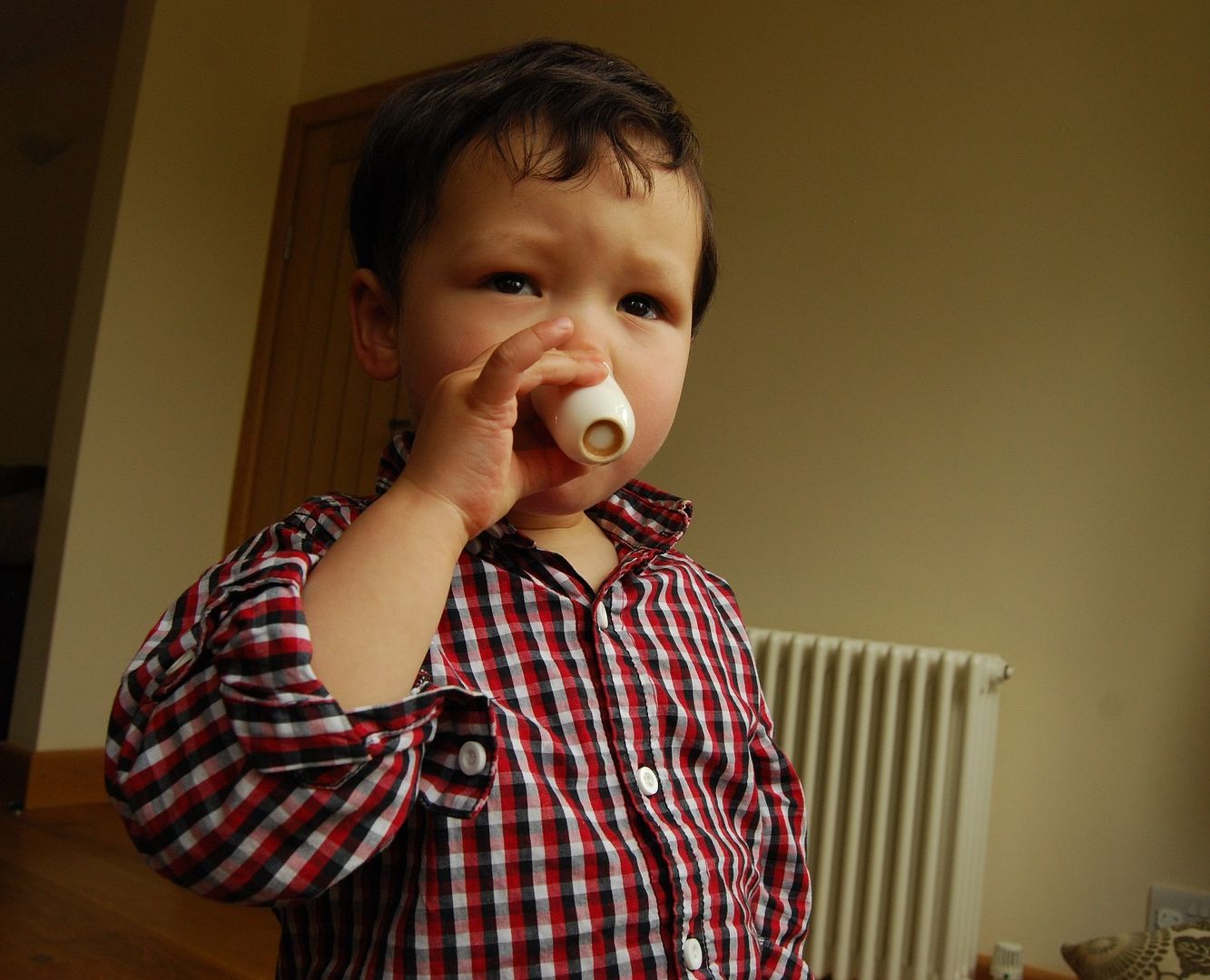
Hi, everyone.  You may be familiar with my Daddy, who usually does the "writing" on this site.  I say "writing", but even someone in pre-school can do better, really.  So, I thought that I'd prove it to you.

I'm Xiaohu, and for today, my Daddy's silly web-site is mine all mine, while he is in Japan, which is far away past China, where Mummy comes from.


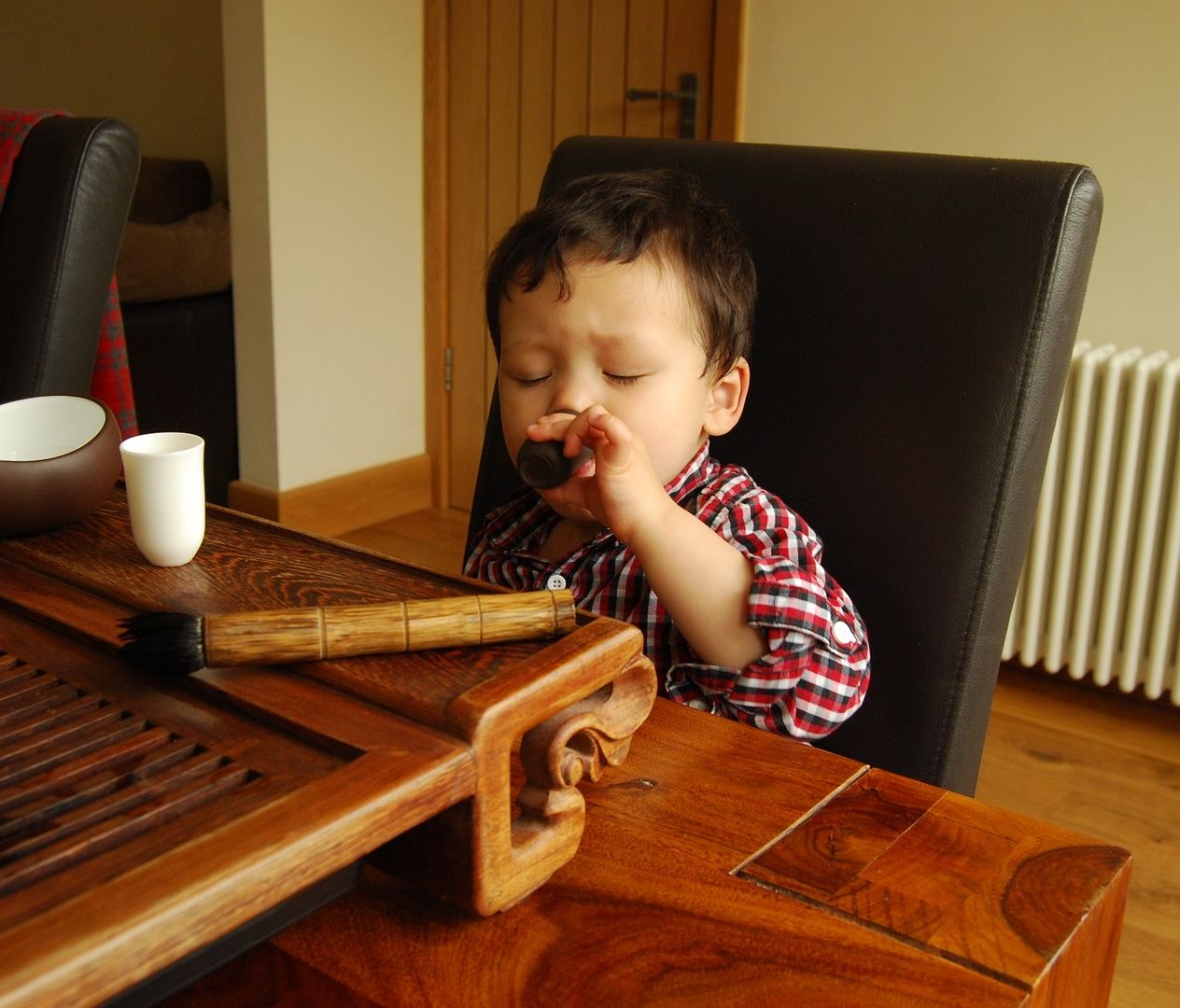
I'm going to show you how to appreciate tea properly - it's all in the nose, ladies.


Now don't get me wrong - parents have their uses.  My Daddy, for example, is great if you want one of the spare rooms filled with tea.  His taste is OK, but he always come to me for advice.  I think that's only reasonable - he's an adult, after all, so we can't expect him to know all that much about anything.  He does try quite hard, though, and that's nice to see.

You just have to know how to keep your parents on a tight leash, as it were.


Step 1: the leaves


The starting point for picking a nice tea is to choose that which has the prettiest leaves.  I'm not really sure that my Daddy knows this, because of all his teas look the same.  I have a cherry tree in the garden with MUCH nicer leaves, for instance.  However, of all the teas upstairs, I went for this one: it's called Mingxiangyayuan Hailanghao Yuanshengxiang.

OK, the reason I really picked this tea is because it has a very difficult name, and my Daddy can't say it properly.  He can't even get the tones right!


Step 2: the colour


One thing that I like about Daddy's pu'ercha is the pretty colour.  It looks like autumn!  The more orange your tea is, the better it is, unless it's red, and then it's really really good.  Make sure you have plenty of orange crayons in your colouring set so that you can draw it properly later, when Mummy gets the drawing things out.


Step 3: the texture


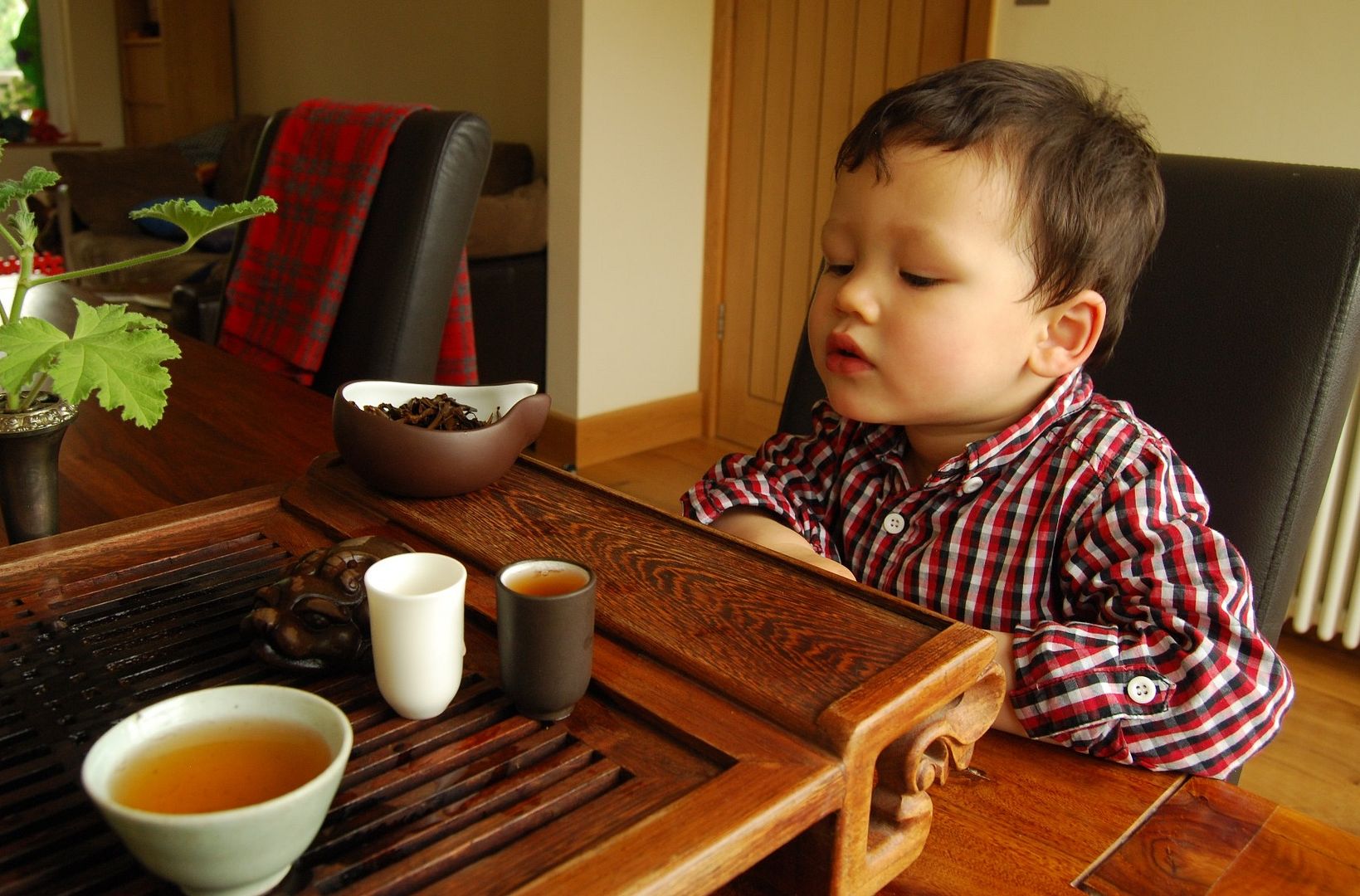
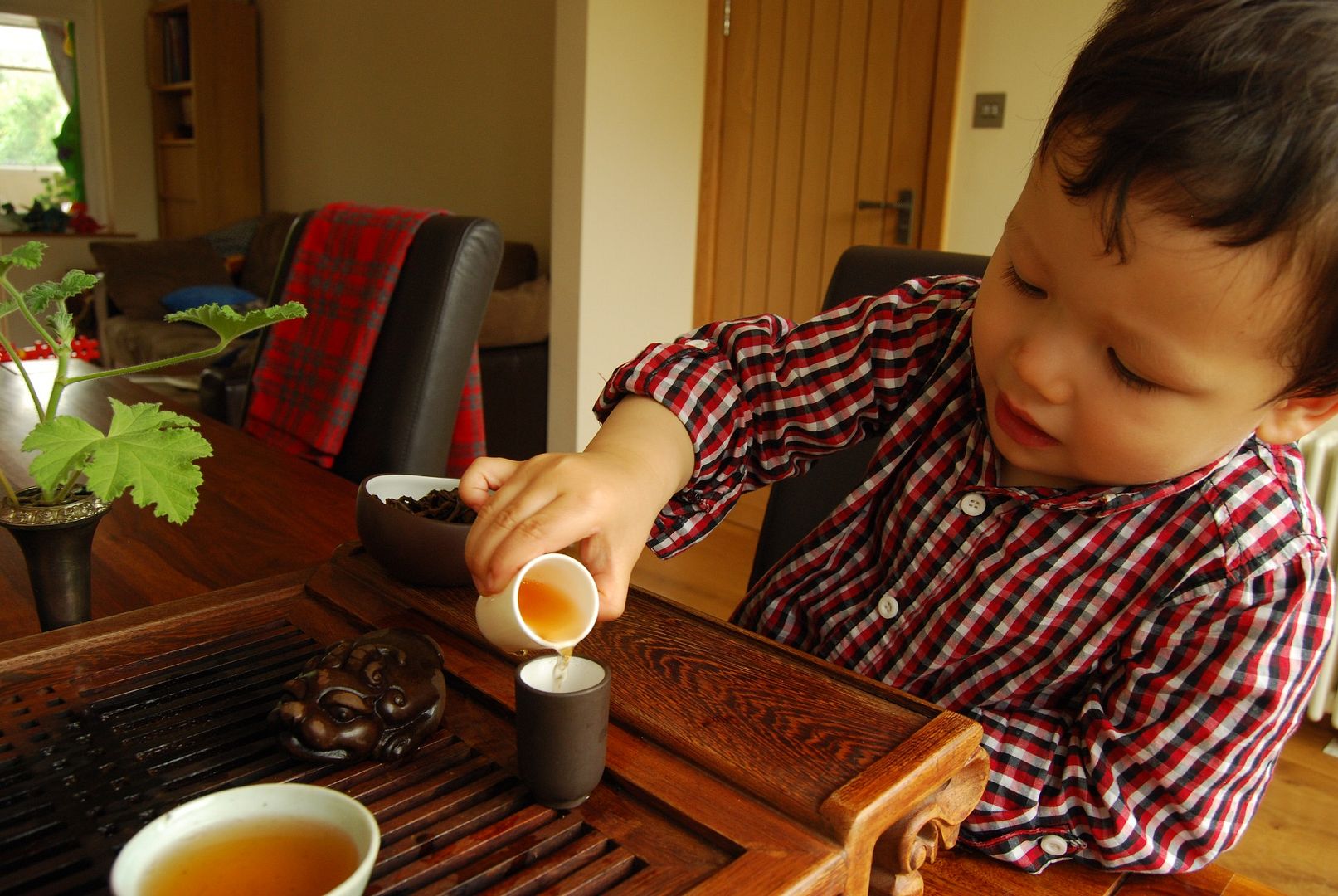
Next, look closely at the thickness.  It should be like really runny fruit juice if you're doing it right - like the nice ones from that pretty lolly shop in town.  I like to put my tea into the tall cup.  Daddy keeps calling this "wenxiangbei", but, as I said, he gets all the tones wrong so I try not to listen to him.


Step 4: the aroma


Sometimes the smell of something tells you lots about it.  For example, my little brother usually smells as if he needs a new nappy.  You can tell when he needs his nappy changing, because he looks really pleased with himself.  I'm a big boy, though, and I don't wear nappies any more.

A nice tea, on the other hand, smells sweet.  Like the special kind of sweets that Granny gives me, which she says we mustn't tell Mummy about.  Sweets always taste better when Mummy says that we can't have them!


Step 5: the tasting


Daddy always says that "the proof of the pudding is in the tasting", but I only like rice pudding.  Actually, my aunty makes some nice puddings, which she says are "dianxin".  Aunty is a really good cook, and Chinese Granny (Laolao) says that Daddy always looks chubby after Aunty has come to visit.

Tea should taste sweet, like Granny's sweets.  Be careful, though!  It's hot!  You have to drink it very slowly, and I like to get my Daddy to blow on it to make it cooler.  (This is really just to make him feel useful - I could do it myself, obviously.)


Step 6: the HUIGAN


Daddy sometimes has friends here to drink tea, and after they have drunk their tea they start talking about huigan and chaqi.  They get very excited about it.  Uncle K. speaks Cantonese, though, so he calls it something else which sounds very funny.


Step 7: feed your qingchan


Wasn't it that old poet, Peppa Pig, who famously once said, "Every nice teaset has a dinosaur"?  That was the episode where Peppa's little brother, George, made a teapot which looked like a dinosaur.

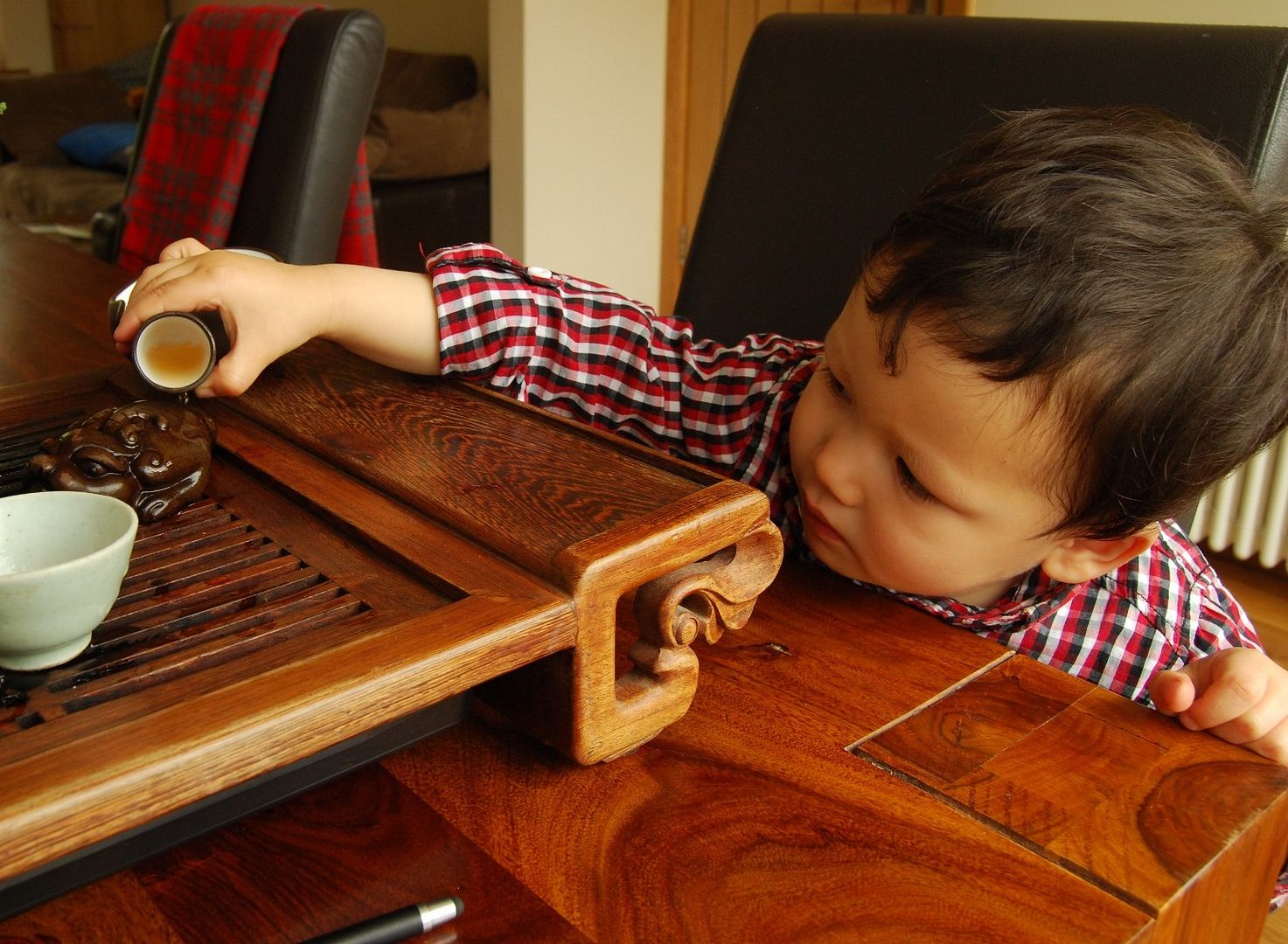
We don't have a dinosaur in our teaset, but we do have a frog with three legs and horns, called Qingchan, which is close enough.  I always make sure I feed him some tea to keep him happy!  Daddy says that a happy Qingchan means your tea will taste better.

I'm tired now, and it's time for afternoon sleep.  Daddy will be back next time.  Byebye!