Following recent notes on the delicious first half of a session with local hero, Apache, in which we encountered a series of recent 7542s, we then embarked on the following excursion into more remote times.

2000 Menghai
The 2000 Menghai 7542 is a large sample, provided by Grand Tea. My companion has some unspoken reservations concerning this tea, which he withholds until I have had the chance to try it, to see if my experience matches his own.
My first impression is that the neifei [inner ticket, pictured above] is dazzingly white - moreso than one would anticipate for a cake that is nominally 11 years old.

2000 Menghai
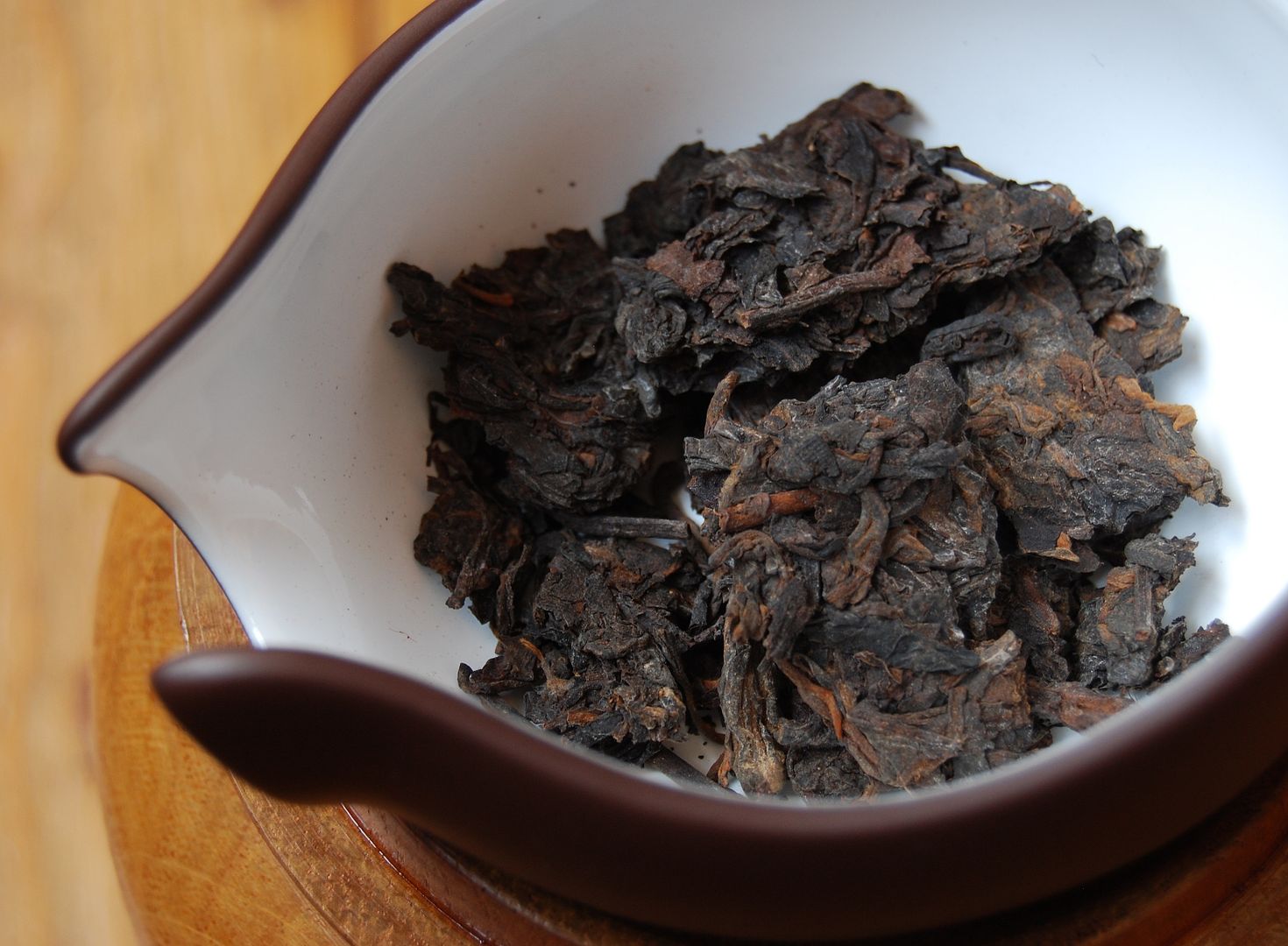
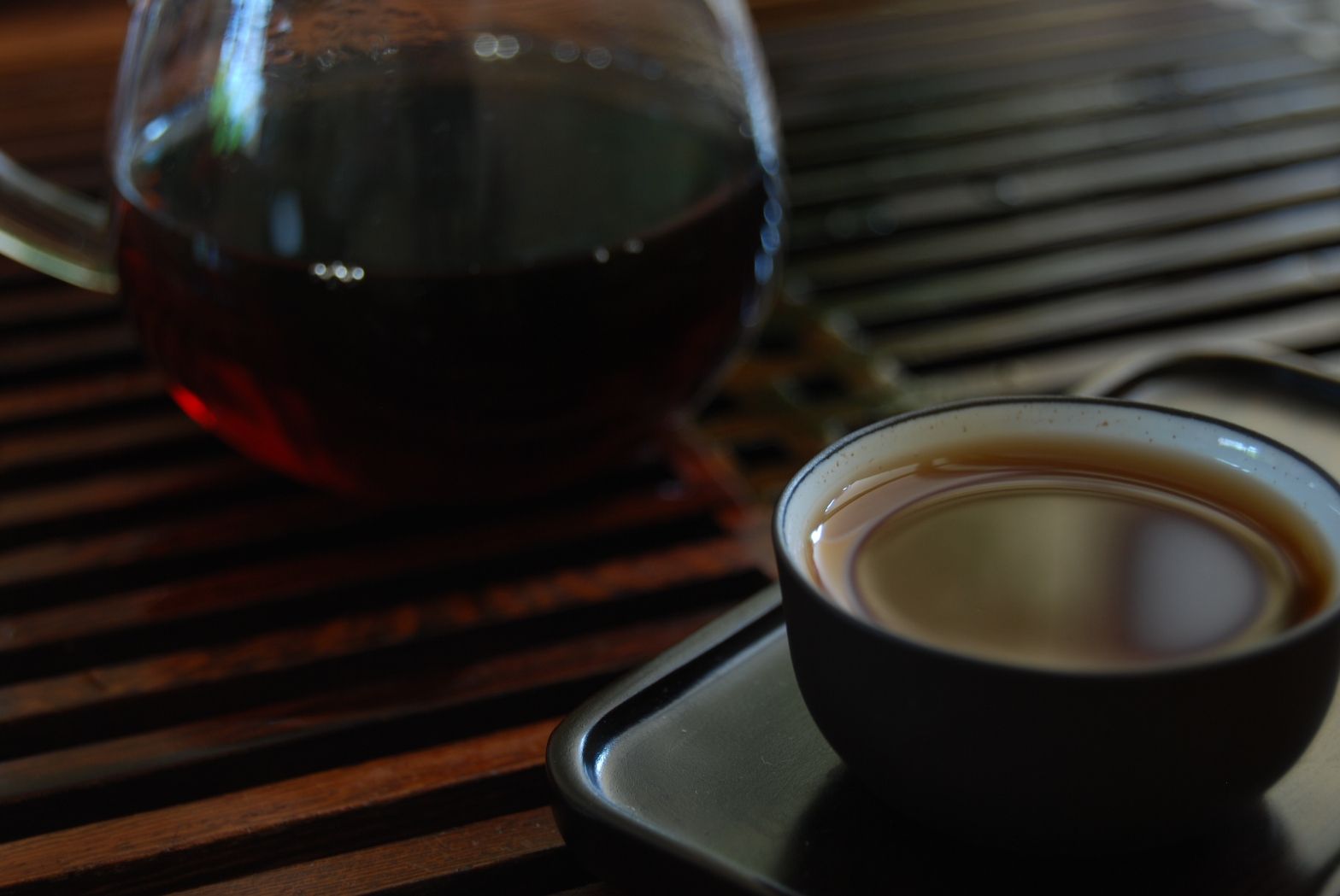
The scent of the (rather pretty) leaves, which are shown above, is one of humidity. When brewed, the soup is a decent colour of heavy orange, as in the image below. It is at this stage that I begin to suspect what it is that Apache is not saying: there is almost no aroma. In the mouth, the character is faded, empty, and light.
It has the "fishy" character, for want of a better adjective, that was common to the 2003 and 2004 versions described previously. It is clearly 7542, but seems so absent that I wonder if the storage has tired it out. Apache agrees, and we discuss the reliability of Grand Tea.

2000 Menghai
Onto more familiar pastures, next, as Apache reveals a sample of the 1998 "Shuilanyin" 7542, from Essence of Tea. I have tried the same (with notes here) from Houde.
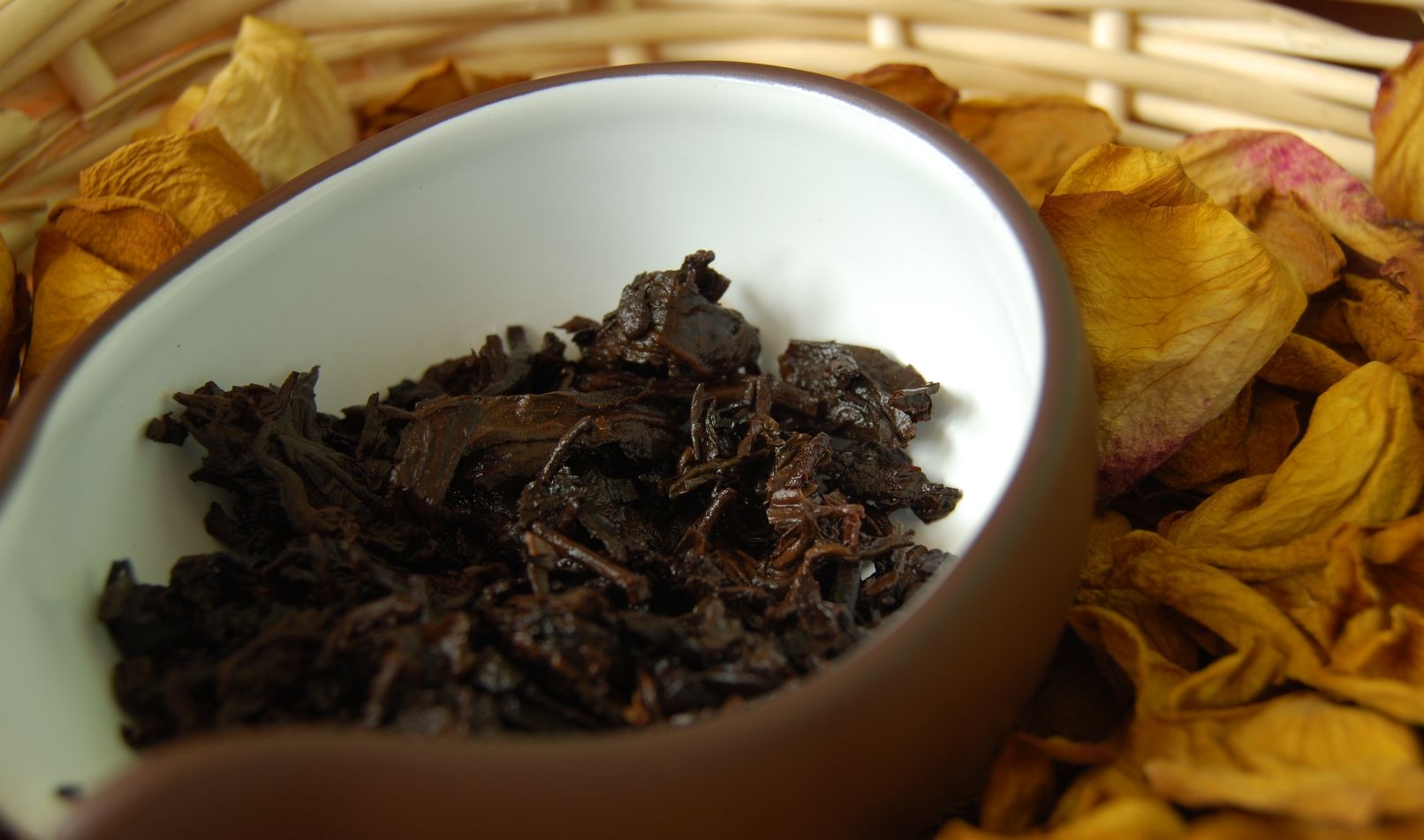
The leaves are shown below, which are quite small in this sample. I long for more of the same delicious nature that I first encountered sometime in 2007.

1998 Shuilanyin
We are not disappointed - this is "proper pu'er", and the two drinkers each breathe a heavy sigh of relief and contentment. As one would hope, it is long, heavy, and densely sweet - with that peculiarly powder-like texture much beloved of some old cakes.
I wrote that it is "bookish and humid", which is a compliment. Examine the image shown below, if you will, and observe the dense central colour of the soup, with its thinner meniscus.
Amusingly, some of the bean-like "fishy" character of the other cakes may be discerned in the complex structure of this tea, and I am pleased to detect at least some similarity between them, even if difficult to describe.

1998 Shuilanyin
Ordinarily, Apache and I would have dedicated the remainder of the session to a pu'er as fine as the Shuilanyin [water-blue label], and yet, boisterously, we march on to the next encounter...

1996 CNNP
I have only tried a 7532 from the year 1996, which was a sample of "green-in-orange" from Essence of Tea. This cake comes from an undisclosed location.

1996 CNNP
It is a shaggy, untidy cake, which makes it instantly adorable. Perhaps you can see that the colour of the tips has tended towards the orange, rusty colour of age. The aroma of the dry leaves is fresh and sharp - no humidity may be detected here.

1996 CNNP
Exhibiting his Asian deftness, Apache relieves the bing of a quantity of leaves...

1996 CNNP
This is nicely orange, although less dense in colour than the 1998 Shuilanyin. We wonder if this is a consequence of its lack of humidity, because this cake is dry indeed - and entirely delectable.
It remains big, bold, and surprisingly astringent, courtesy of its storage conditions. Present and full such as it is, I would never have guessed that it was created in 1996.
Such is my delight at this cake, that I tuck the remainder of the wet leaves away into a gaiwan for further rumination on some later day.

1996 CNNP
So the last shall be first, and the first last: for many be called, but few chosen.
Apache reveals the '88 "Qingbing".

88 Qingbing
I have come across one incarnation of this old classic (which was actually made in 1989, rather than 1988) before, thanks to the exceptional generosity of KC, the notes for which may be found here. I found that sample to be mighty fine, but "loose" and watery. It was easily exhausted, rapidly requiring longer brews.

88 Qingbing
Apache's sample comes from Essence of Tea, and is a different tea: it is long, cooling, and so very sweet. Its texture is one of extreme heaviness, and its smooth body is remarkable.
Residual scents of vanilla linger in the nose after the swallow, and the separation of colour into a red centre and a golden meniscus is clear, as shown above and below.
"Subtle, but there", remarks Apache, as we discuss the huigan.

88 Qingbing
And so it is. The 88 Qingbing and the 1996 7542 both live on in their respective gaiwan to give me days of pleasure thereafter, reminding Lei and I of the most excellent tea session with Apache. After the main consideration of enjoying good tea with great company, I feel as if I have learned a little regarding the common features of 7542 - particularly from 2003 and earlier. Even though it is undoubtedly changed incarnation many times through the years, there is a kernel of constancy that does not abandon it.
We will give the parting words to Apache himself,
"I cannot strain my imagination sufficiently to find a link between these older varieties and modern 7542."