Showing posts with label shengpu. Show all posts

30 July, 2018

Thoughts on Aging

Like the ouroboros, I am turning in on myself and drinking a lot of my own cakes of late.  This seems almost indecent, after a recent lifetime of continually trying new tea, and continually buying new cakes.  However, sufficient time has passed that the game is afoot!  Changes are apace.

This article is about two things: (i) cash money, and (ii) aging cakes.

If you've been here since the very beginning, Gentle Reader, or if you've read some of the older articles in the archives, you might remember that I started out writing articles for this humble site when I was but a graduate student.  In those benighted days, when my every waking hour was lived within the shadow of The Thesis, I was being paid a "scholarship", which is to say, I was not rolling in disposable income.  My university likes to trade on its name, which means it's almost preternaturally disposed to paying far below the going rate at all career levels.  You might have experienced the same.

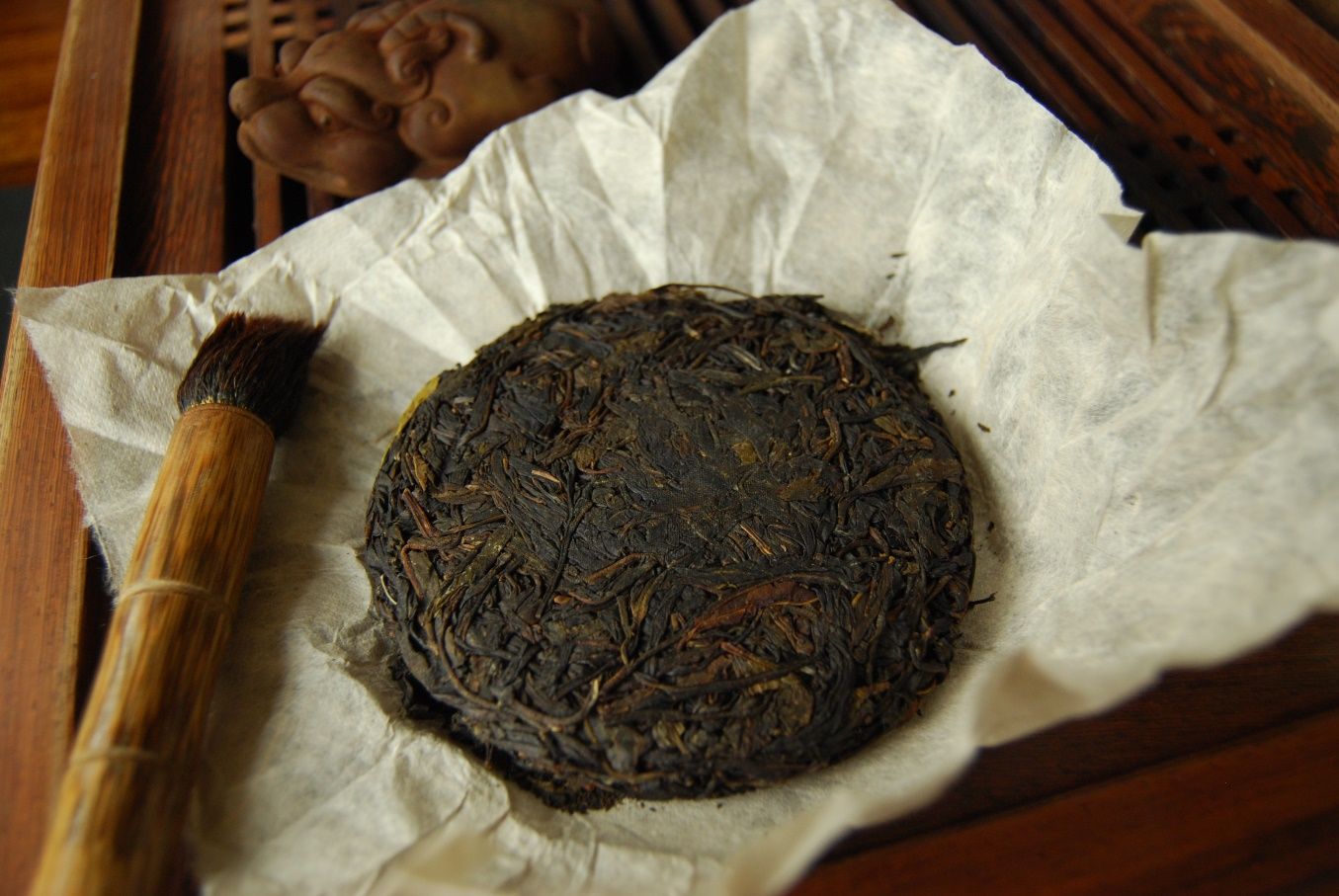
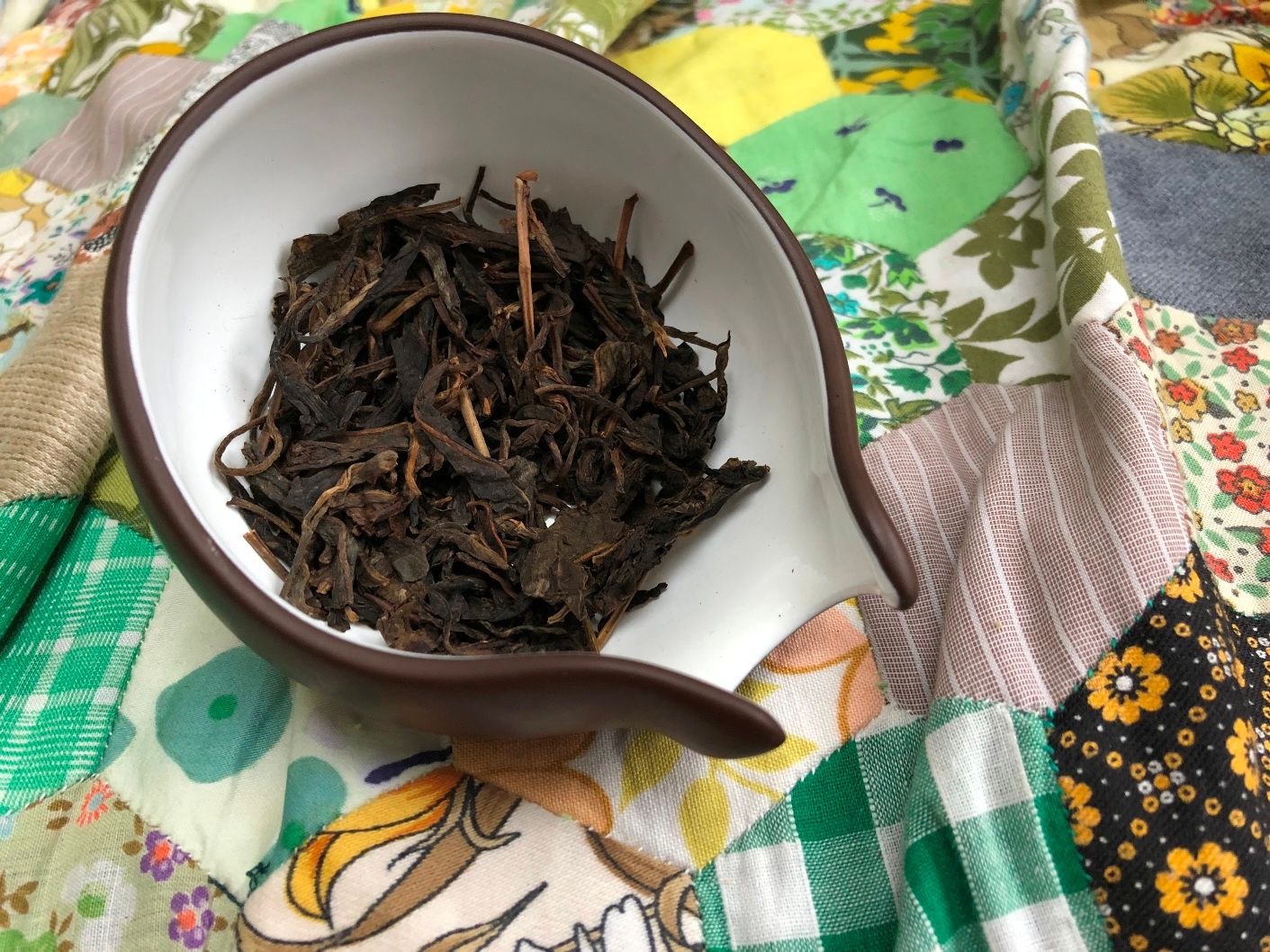
It is ab-so-lutely striking to read some of my old articles, in revisiting my teas, to learn what I considered to be quite a lot of money in those days.  For example, check out the two teas below, which I have updated with recent tasting notes:

2007 XZH Longfeng
2006 Douji "Dayeqingbing"


These are cakes that were super, super cheap back in the day, at £23 and £13, respectively, for the 2007 XZH and the 2006 Douji.  Taking the more expensive (!) of the two as an example, that £23 in 2007 is now approximately £28 in 2018, via inflation.  Back then, as I take great delight in reading, the price was a matter of huge concern.  These days, that gets me approximately 30 minutes of swimming class for one (not both) of my young children.

This is not to say that I have become entirely profligate, but merely: how our expectations have changed when it comes to tea-prices!  How great is the distance in price between a "solid" cake at £13-£23 pounds and the modern equivalents!

(Note also the important fact that these are proper 357g bingcha, rather than the cheeky xiaobing that are now commonplace, such that vendors can reduce somewhat the effects of the enormously high "sticker price" for a 357g cake.)

Now, I'm not here to punch vendors in the metaphorical ganglia.  As with all of us who've been around a little while, it might come as a surprise to learn that vendors are human beings, and that some of them are not (entirely) douchebags.  Most of the time.  Probably.  (Love you, vendorchums.)

I used to take it as a personal insult that someone might want to be remunerated for sweating into their grey knitted underwear up a mosquito-laden mountain in Yunnan, etc.  These days, I'm happy to see these folks turning a profit; after all, tea businesses need to be sustainable (i.e., making bank) otherwise there won't be any tea businesses.  Heaven forbid we return to the dark days of Houde being the only place to buy tea (love you longtime, Houde).

However, expectations have changed, that much is clear.


The irony is so very, very sweet!  When prices were at their most affordable, my budgets were at their least amenable to purchase.  Now that personal circumstances have changed, well... you know the price of modern bingcha as well as do I.  It's not bad, it just is what it is.

So, prices are higher than they were, such is the outcome of a developed China (always a good thing) and a maturing market for pu'ercha (likewise a good thing).  There's not much to be done on that front, except enjoy older tea when we have it.

Hence onto the second aspect of this article: the introspection of a tea writer, disappearing up his own proverbial collection.  This is dangerous.  I am thus writing about cakes that are quite probably not available any more and, if they are available, might be murderously expensive.  Of course, half the fun in the teasphere is the shared experience of trying out cakes together, picking up tips on which one might buy next, and so on.  That simply can't happen if some dude starts vanishing into his own shelves.

However, I hope it might be helpful.  It's certainly turning out to be extremely instructive for me.  The last time that I revisited cakes in any number was around half a decade ago, in 2013, typically much earlier even than that.  So, we have a good number of years now from which to make our observations, form hypotheses, and maybe even draw a tentative conclusion or two.

From the above two articles, we might conclude that even quite basic teas (as those above) can do nicely with age.  £23 and £13 are not objectively high prices, and the teas were almost certainly from plantations, in my opinion.  That plantation character exists within the aged versions, but, like rancid ol' 7542 (which I adore), it has come out well.  The raw strength of the early days has smoothed, mellowed, and become elongated into a very substantial sweetness that just continues on and on.  The texture is much improved, too: these teas are thick, viscous fluids and they are rewarding.  They are not dark teas, but they have the rounded character of sanded and varnished wood, in a good way.  I like 'em.
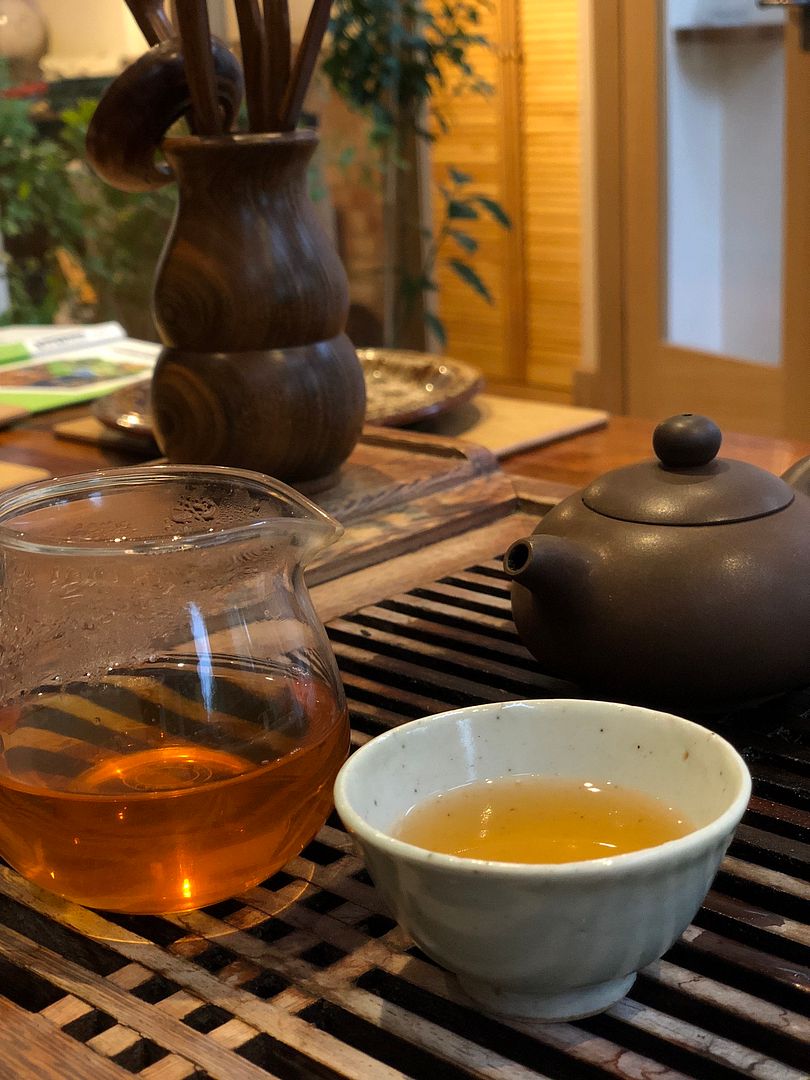


I am also able to draw some conclusions about English storage: as you might have read in the articles above, the sheer dampness of England, and Oxford in particular, is great for keeping these teas "fed" with moisture, such that they don't die.  I believe that a lack of humidity is the death knell for pu'ercha, which I understand is commonly-received wisdom.  However, British climates are not tropical: we don't have searing heat for much of the year (almost no houses have a.c., for example), and we get high(ish) temperatures for a short part of the year.

(Climate change might have something to say about that!  As with most of the world, we're experiencing an unusual heatwave at the moment.)

The cooler temperatures mean that the teas, while staying nicely alive in the humidity, are not accelerating towards redness.  Such is the price of not aging one's tea in the tropics.  This is something that you can also see from humid-yet-cooler regions of China.

Heresy incoming: I did not choose my place to live based on its capacity to age pu'ercha.  I know, what a newb!  Thus, I mus live with the consequences.  Happily, those consequences seem to be reasonable for tea, in that it's not dying and that it's getting somewhere - albeit slowly.  If we are being generous, we might wonder if this is a similar effect to compressing one's tea extensively: tuocha age much more slowly than loose bingcha, of course.  As with the prices, it is what it is.

A final conclusion concerns the "black" character beloved of some "house styles", which seems to originate, as far as I can tell, to the mid 2000s.  Think of, for example, the recognisable house style of Xiaguan, as typified most clearly in its "FT" range, or, in the extreme, its "Baoyan" products for Tibet (from which perhaps the style originates, given that Baoyan is very much older than the mid 2000s).  Douji cakes have a similar, but noticeably different, house style.  There is processing afoot such that these teas start a little darker than they might otherwise - and, in the case of Xiaguan, very much more dark.  This brings smokiness, richness, and, sometimes, a "tobacco" association.

When these cakes were being processed in this "black" manner, there was not a huge amount of evidence to say how they would age.  We have older Baoyan, of course, but most of the FTs, Doujis, and the like come only from the mid 2000s.  So, how do they do, after some 12 years?

I rather like the result.  The power of youth has smoothed into the sweetness noted before, and the blackness lends a fragrant afterscent that is most complementary, in my opinion.  The smokiness has gone, almost entirely, and we are left with dark fruits, old summerflowers, etc.  Grab one for yourself and see if you agree.

P.s. Holy smoke: more than 7,000 views for recent articles suggests that the teasphere is very much larger than once it was.  Hordes of drinkers, unite!
03 July, 2017

Wuliang Clan

Gentle Reader, before we get down to our mutual camellia sinensis addiction, it would probably be helpful to give you the background to how I approached today's tea.  The one informs the other, and it would be giving you a partial assessment were I to attempt to separate the two.

Imagine, if you will bear with me, that you have been born and raised in a cold country.  Imagine childhoods spent playing in snow, long winter months of darkness, being wrapped up in heavy clothes for most of the year, and having a runny nose for about 75% of that time.  This is what it is like to be English.

You think the darkness is your ally; you merely adopted the dark.  
I was born in it, molded by it.  
I didn't see the light until I was already a man; 
by then, it was nothing but blinding!

-- Your average Englishman

Your entire life is predicated on the fact that (i) winter is dark, rainy, and cold; and (ii) summer is, at best, "quite nice".  A good summer of memory will hit the low-to-mid 20s, in degrees Celsius (i.e., in the 70s, degrees Fahrenheit).  You spend most of your life dressing in "proper" clothes (inc. cardigan), and you might slip into short sleeves for one or two months in the height of summer, to try and cope with those temperatures in the 20s (70s Fahrenheit).  Your entire childhood was spent playing sports on frosty ground, acclimatising yourself to being constantly cold.

There is very nearly no air conditioning in the entire country, because it would be unused for most of the year.  This fact alone causes tremendous amusement to people from overseas, but there really is very little use for it here.

Now, if you're still with me on this imaginary train of thought, I would like you to imagine what it would be like for temperatures to jump from being 21 degrees C (70 degrees F) on a Tuesday to 32 degrees C (90 degrees F) on the following Wednesday.

Imagine your cold constitution suddenly exposed to this heat - the hottest that it has ever been (since records began 200 years ago) in England at this time of year.

Now imagine yourself wearing a black woollen suit ("subfusc").

Now imagine yourself wearing a white bow tie, tightening around the neck.

And, finally, imagine yourself wearing heavy, scarlet, woollen robes that weigh 10% of your body-weight*.
*At your correspondent's rather lardy 75 kg.

All without air conditioning.

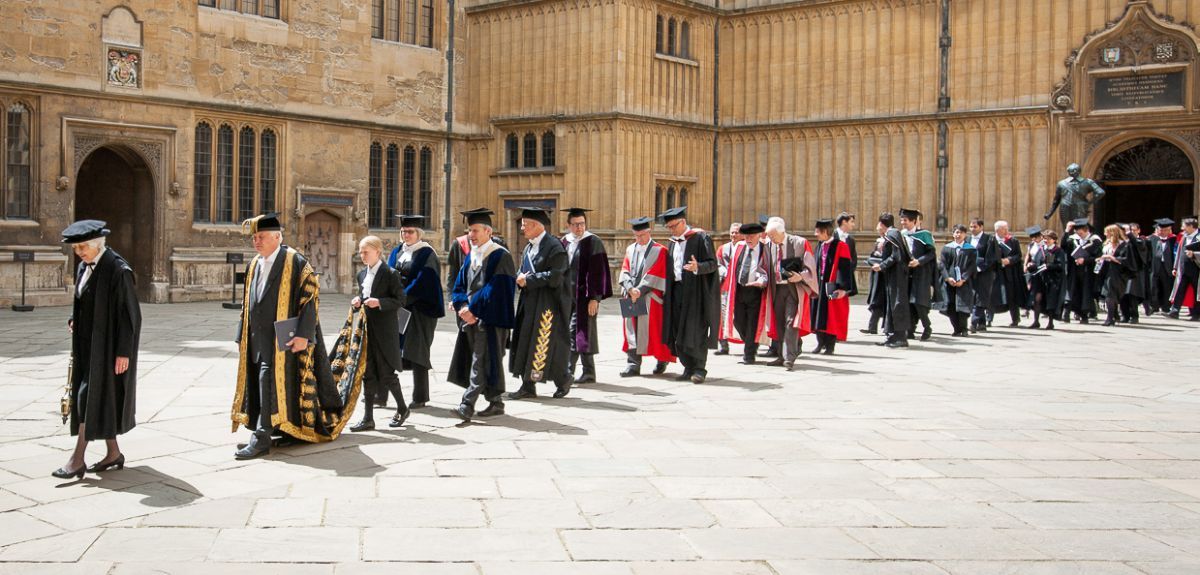
This is Encaenia 2017, and it is f***ing deadly for all concerned.


It is the university marking the end of the academic year, before we go our respective ways for the summer.  200 or so dons assemble in an old, pretty building designed by Sir Christopher Wren, and we sit there for an hour or so while awards are presented in classical Latin; the Professor of Poetry delivers a short homily; and the Public Orator does what seems to be 15 minutes or so of (academic-related) stand-up comedy.  Which typically corresponds to taking the p*** out of The Other Place.

Except this year, the temperature.  The temperature.


I'm amazed that there were no deaths.

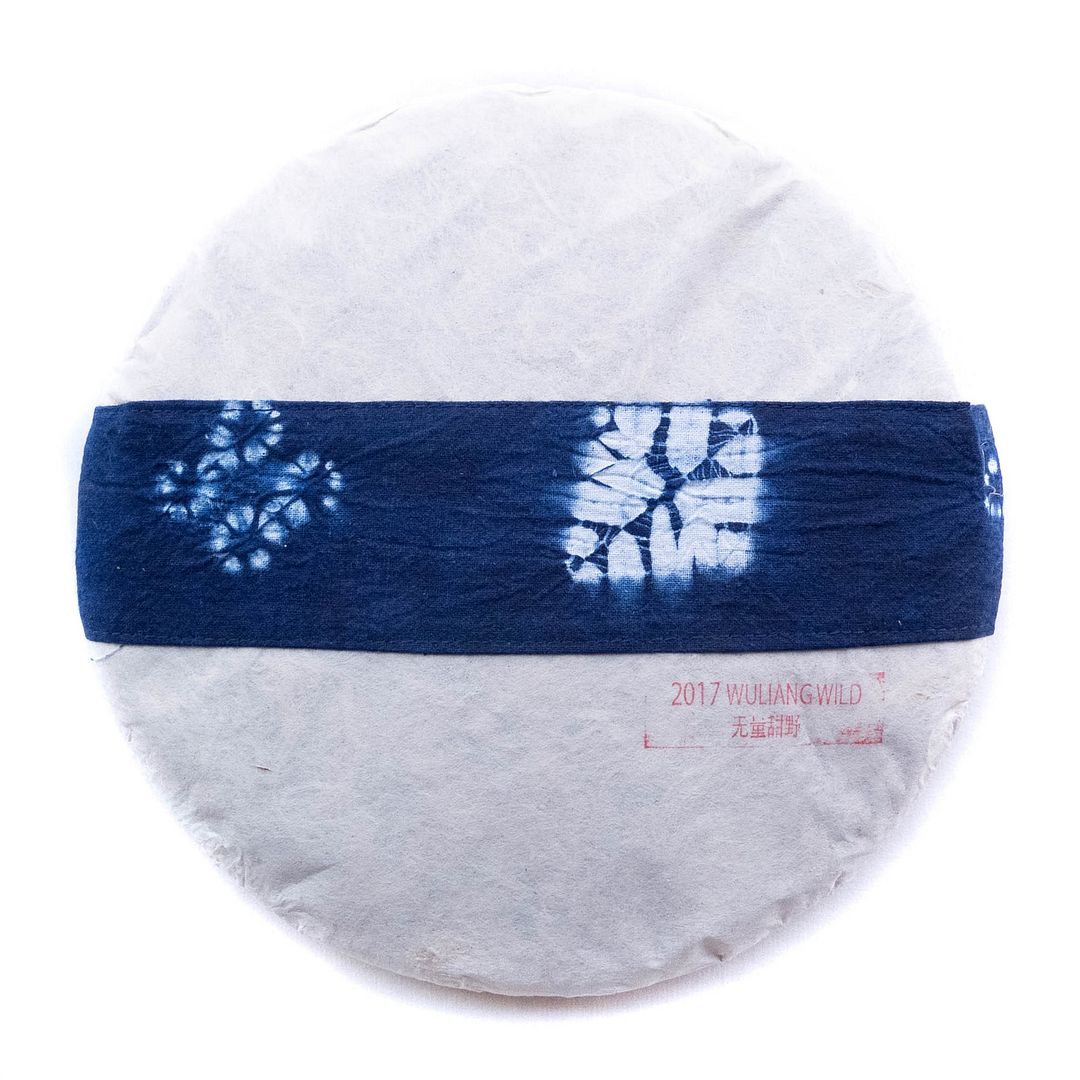
This was the background to cracking open the proverbial cold one with the proverbial boys: the 2017 "Wuliang Wild" from Essence of Tea.


I very nearly don't need the kettle to heat the water today.  It is hot, like your mother.

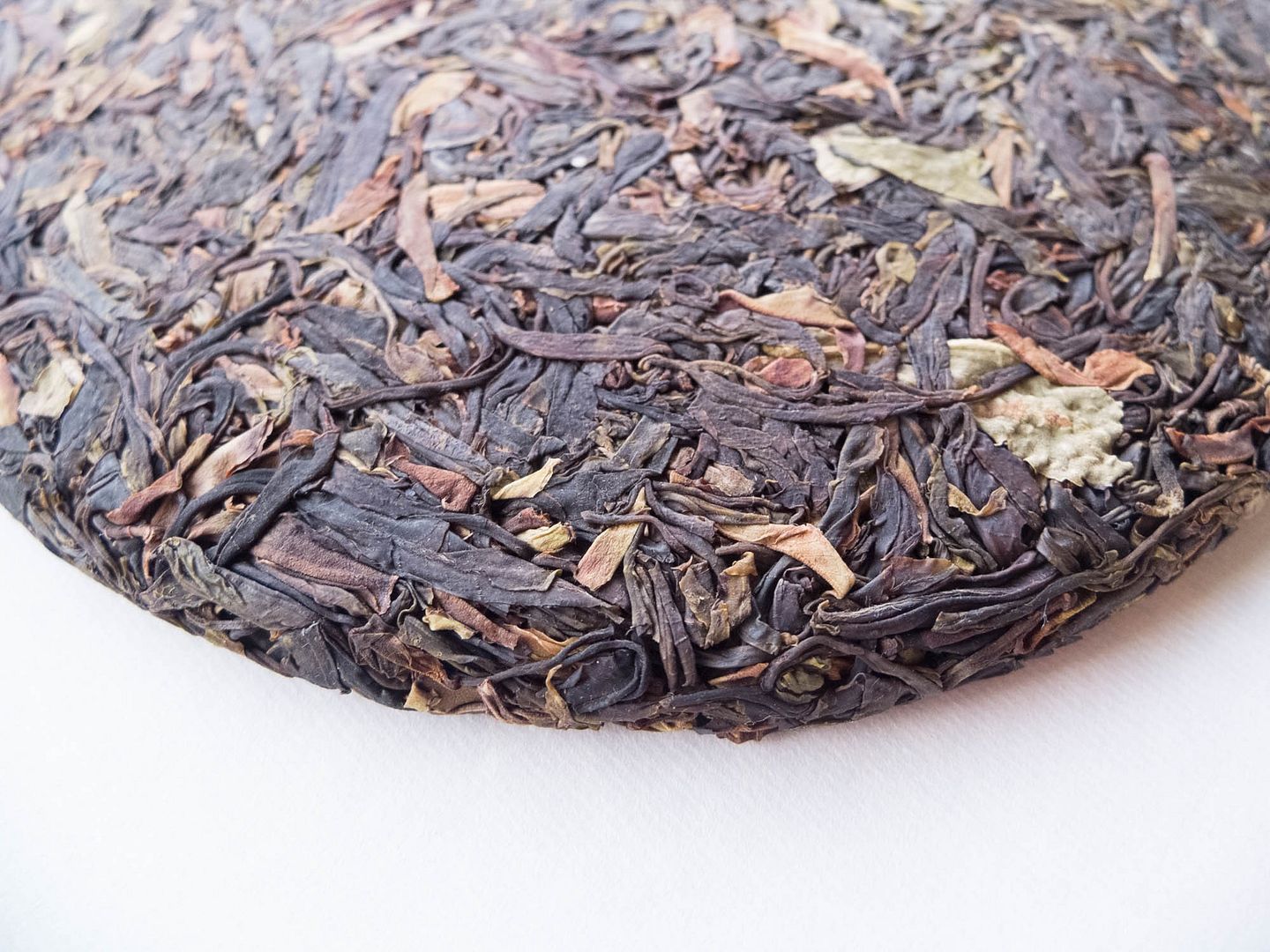
On disrobing my sample, I am struck by what are very red leaves.  I am instantly reminded of the recently-described 2017 "Secret Forest Wild Really Secret Wild It's Actually Very Secret".  Both cakes are "red".  The Super-Secret cake comes from an undisclosed location; today's cake comes from Wuliangshan.

I invite you to check out the cake below where, even under these photographic conditions, you can see redness.  Of course, the leaves have the delicious scent of purple fruits.


As ever, this is exceedingly clean and sweet - it is definitely "sweet wild", as Mr. Essence writes, rather than "bitter wild".  (I was unaware of the distinction in descriptions of wild trees, but it makes some sense.)

Is the fruitiness from the "sweet wild" nature of the tree itself, or of the manner in which the leaves are treated?  My suspicion is that it might be latter (the leaves are red, after all), but this is speculation.

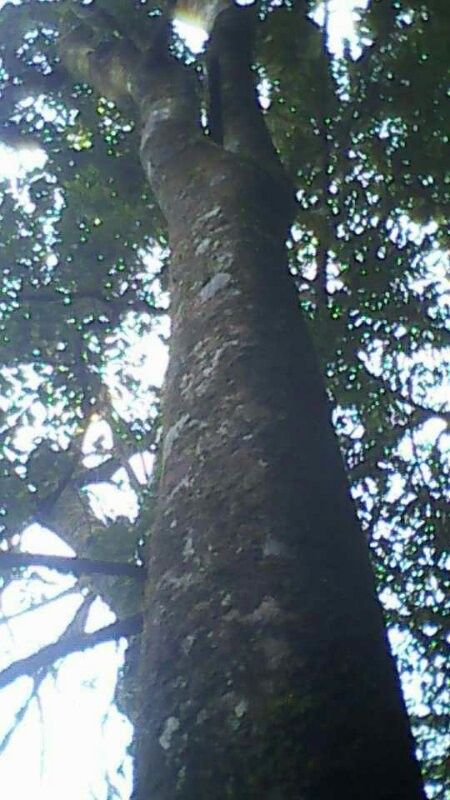
Mr. Essence shows a photograph of a huge tree, reproduced below, which the locals tend to avoid picking in favour of their tea-gardens.  We read that aforementioned locals were convinced to climb this extraordinary tree to obtain the leaves for this cake, making it a rather special production.


There is initial fruitiness in the soup, of course, which is not unlike the "Secret Forest Wild" (as linked earlier), but this is much more cooling - it is almost Bingdao in its chilliness.  At £76 / 400g, this Wuliang cake is also substantially less costly than the Secret Forest Wild.  £76 for a rare picking, with the usual clean panel of lab results, does seem like rather a bargain.

Given the roaring heat, it is charming (and greatly relieving) to drink this now.  This is precisely the tea that should be consumed after Encaenia in the heat.

Would it age?  It might not be strong enough to age in chilly, damp England, where we need sheer potency to see us through.  This is a "sensations" cake, and is almost entirely absent any bitterness.

This is not to say that it is not full - the colour is a solid orange, and the texture is quite chunky.  It's a perfect cake for summer, and really energises my tired, fatherly frame.  There is a very positive effect on the constitution.  Somehow, even though it is not big ol' pugilistic pu'ercha, it makes the mouth water with its payload of mature-tree contents.

I am attempting to avoid likening tea this to the quality of lactation of the more senior age of lady, and will surely spare you the comparison for the sake of decency.  You get the idea.

As with the Secret Forest Wild, I will defer in favour of a more orthodox pu'ercha, but will always remember the manner in which this 2017 Wuliang Wild saved me from admission to the Intensive Care Unit, through cooling my constitution and chilling me back to the temperatures that nature intended.

Addendum: for the past week, it has returned to 18 degrees C (65 degrees F), and I am back in my cardigan.  This is "summer" as I have been bred to understand it.

28 June, 2017

Fructis Ventris Tui

...the figurative Tea-Womb of Mr. Essence, that is.

Let us indulge in a little exercise in tea obstetrics.  Let us part the tea-labia of Essence of Tea, and deliver the fine pu'ercha from within.  Thence, quivering and perhaps still covered in (figurative) amniotic fluids from the birthing process, we examine this fine, new-born cake.

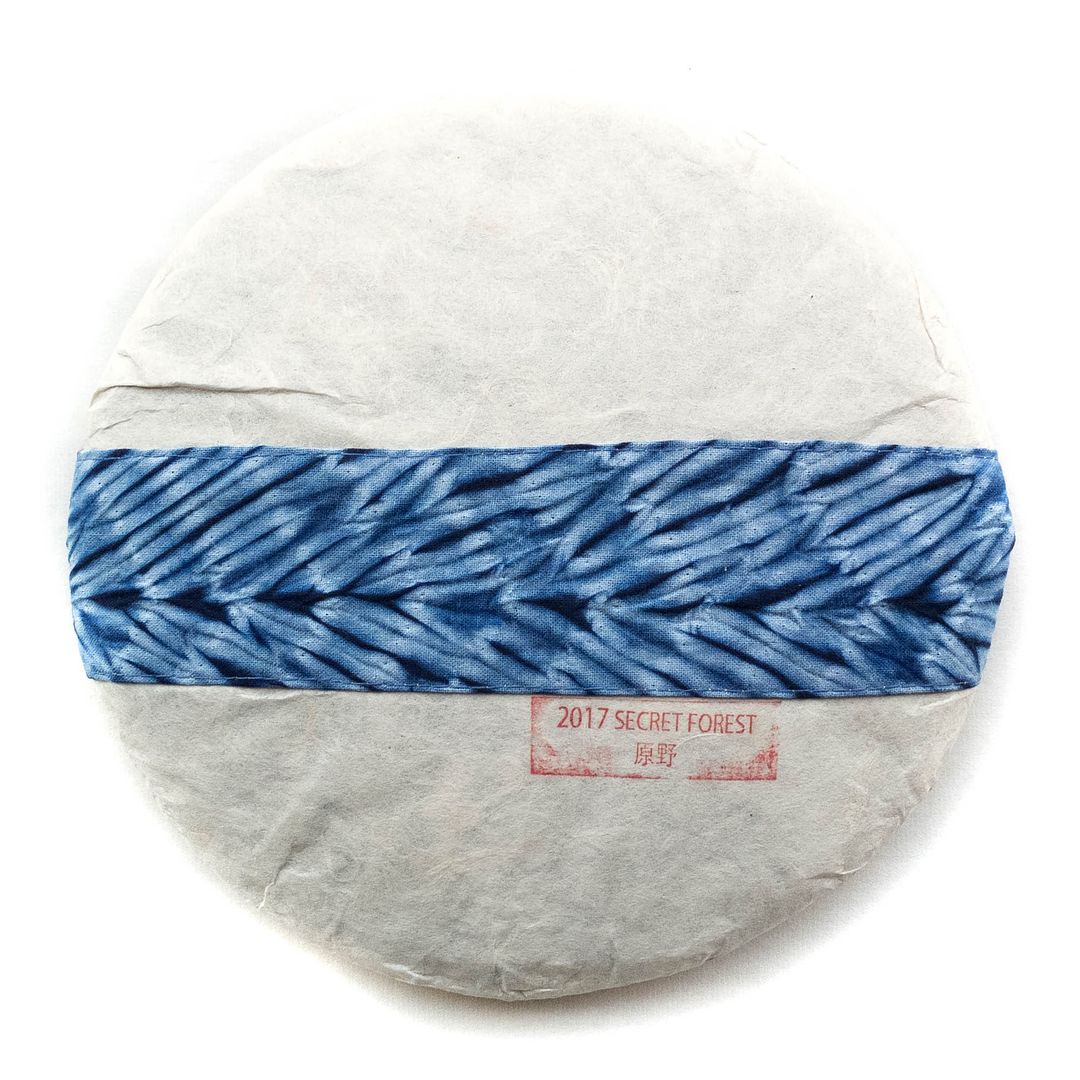
This is the 2017 "Secret Forest Wild".


There is substantial and obvious fruit here.  Mr. Essence's tea-womb is fruity to the max.  Merely exposing the leaves to air causes the (Dancong-style?) scent of purple oxidation to assail the nostrils.

Some of the leaves are red, as one might expect.  "Elegant" appears twice in two sentences, on the product's web-page, and it is.  Elegant, that is.

The charming flavours gently blow away the sweet exertions of the morning, after getting my boys to school and pre-school.  In the warmth of summer, the cooling nature of this tea is obvious: cooling on the breath and of the body.  It is internal air-conditioning.

Coffee can be like a shot of adrenaline injected directly into the myocardium.  Coffee wakes me up, but it does leave me feeling as if I've just been brought round from a particularly ungallant overdose of opiods.  By comparison, this tea does it right: it gets the juices flowing, and cleanses the doors of perception, and yet it does so without giving your cardiologist something to complain about.  It is, for want of a better word, a tonic.

Now, for some trees...


I could quite happily walk up to those trees and chew on the leaves.  In fact, merely looking at the photograph causes me to move my jaws like a ruminant.

Mr. Essence writes that these are the same trees as were picked for a 2016 cake, but that the 2017 version has used bigger leaves, rather than focusing on buds.  This suits me just fine, as I never find "white" teas especially exciting, and prefer a bit of oomph. as the larger leaf might deliver.

Does it do so on this occasion?  This is a fine, fine tea.  It really is "elegant".  Given the grim near-30 temperatures of summer, the fruity drink-it-now appeal is immediately satisfying.  The price (£110/400g) is good, I think, for something (i) as clean as this (in terms of soup, and in the lack of cadmium) and (ii) as "wild" as this - its provenance is excellent.  I trust Mr. Essence to deliver the goods in these two categories, these days.

All that said, there is perhaps not enough tea for me.  I am forever in search of a violent, aggressive tea, and this petite little lady is, to my tastes, not quite there.  I cannot deny its quality, but my tastes run to the more chunky end of the spectrum, perhaps.  This might well age properly in a humid-and-hot climate, but a humid-and-chilly climate such as England requires something a little more rancid, a little more deadly, a little more elegant, I fear.

19 June, 2017

Going Out with an Yibang (2017, EoT)

Greetings, Heroes. How's 2017 treating all y'all?

Trump (hnng), Brexit (hnnnrghn), Theresa May (hhrrrnnnngghh) - everything is proceeding as I have foreseen.

*Sith lightning*

After all of the (really) bad news, I was super-thrilled to be in correspondence with Mr. Essence, who offered me a ray of light. And a mighty package.  Never one to shy from a mighty package, I was delighted to read of Mr. Essence's recent forays into hitting the pu'er farms.


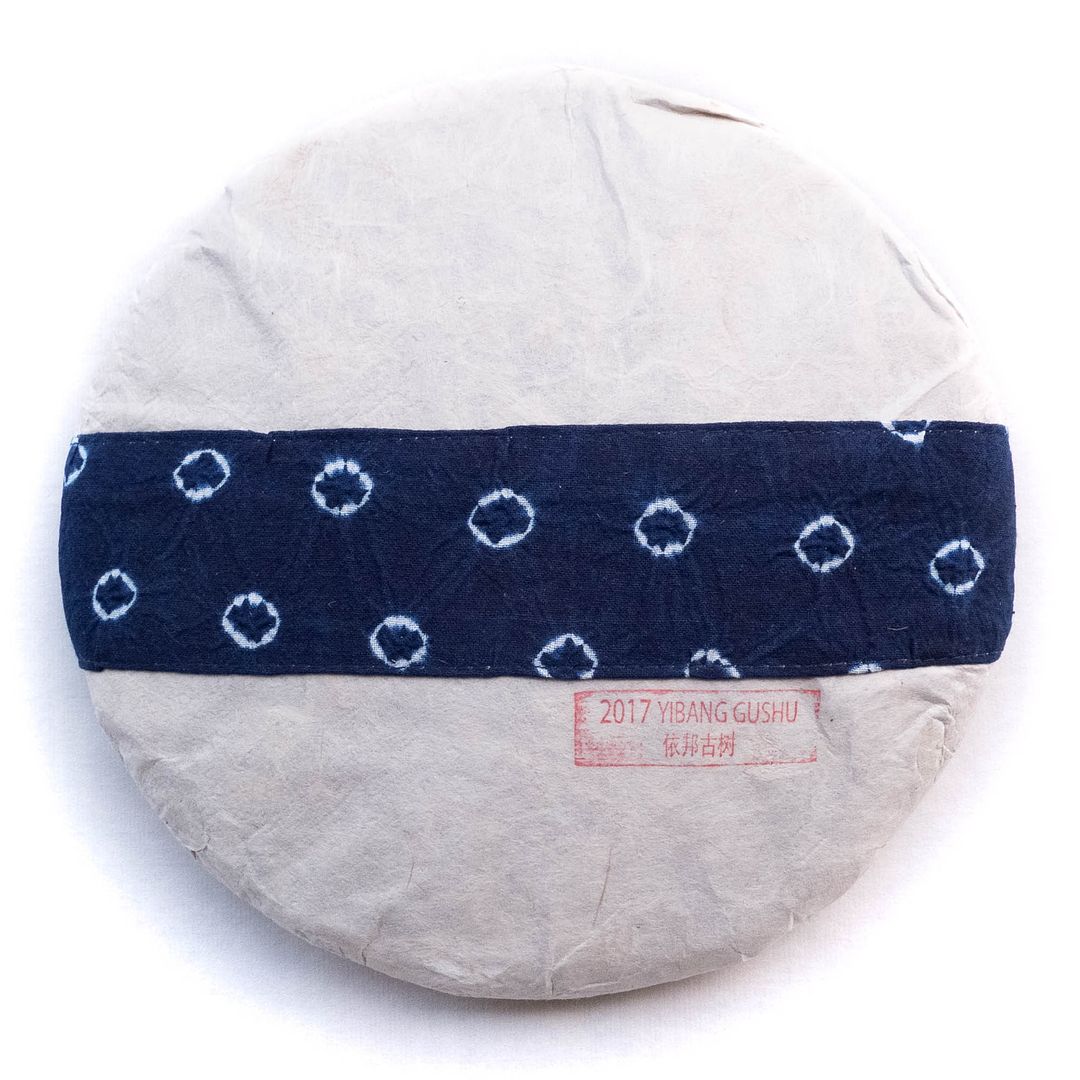
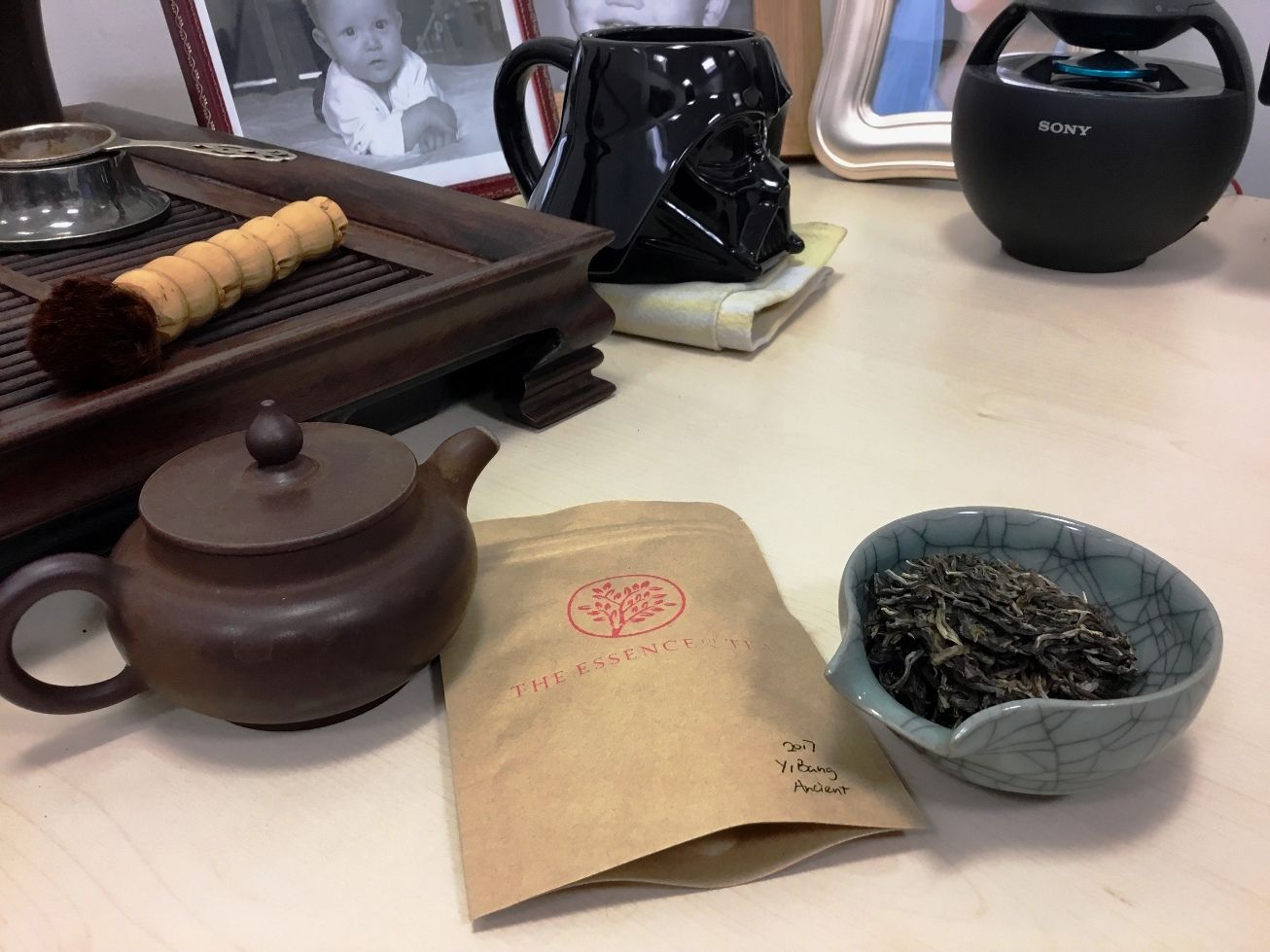
Naturally, on prising open the aforementioned package, I went straight for The Goods which are, in this case, the 2017 YIBANG GUSHU.

This is the first use of the "2017" tag!  I had to type it out explicitly.  Exciting times...


The deluxe editions in the 2017 line-up of cakes from the Ol' Essence seem to be wrapped in Japanese-style headbands.  They convey the feeling of human male perspiration as I check out the image, which is surely a positive association when one is about to drink a tea.  Tie-dyed, like your mother's hippy trousers from the 1970s.  I dig it, man.

On breaking open my sample, I am overwhelmed by the beauty of this cake.


It's been a long time since a sample aroused so much arousal in my arousal-prone zones.  It is, at the time of writing, pushing 30 degrees Celsius here in England, which is the hottest it has ever been for this day in June.  Like Trump, I believe that global warming is a Chinese conspiracy.  I also believe that Theresa May is a credible politician, with a commanding wit and impressive ability to handle complex situations.  I also believe that the Earth is flat, like a pu'erbing.


Even before this little number slams into the palate, the scent slams you upside the head, in a disrespectful gesture of defiance.  There are so many volatile organic compounds in this sample that I begin to wonder if it has not been engineered by an elite corps of scientists, who have been kept in virtual captivity in a research lab, on an inhospitable planet, led by a hard-nosed R&D type.  Its power is truly enormous.


I am supposed to be somewhere, crammed into a small walnut-clad room, dressed in Elizabethan academic dress, in 30-degree temperatures, along with 50 of my peers (Governing Body), perspiring heavily.  However, all that can wait.  Right now, I am having a hot and tempestuous love affair with a sample of pu'ercha, and her name is 2017 YIBANG GUSHU.  She is a demanding mistress.

This is the cleanest, most pristine cake I have had in quite some time.  Mr. Essence goes out of his way to ensure minimal cadmium deposits make it into his teas, and that the bare minimum of radioactive waste seeps into the leaves.  This is admirable, and is a sentiment that I can totally get behind.  I read the .pdf results of his lab tests the way that other men view pornography.  It's almost lustful.

There are so many false claims in the world of pu'ercha that a table of lab results reminds me of the misrepresentations that are so common in tea.


Grain - there is so much grain here.  Grain, like greed, is good.

Yibang always maxes out my grain-sensors, with its sweetness and, when done right, just that tempting lilt of the wok remaining in the background.  It stops time.  It chills the roof of the mouth.  It brews, and it brews, and it brews - the sheer density of VOCs just never gives up.  It far surpasses the hour of time that I have set aside for it, and begins to eat into the rest of my day.

It is almost impossible not to buy this cake.  I look at the price, which is 300 Big Ones.  Back in the day, as a student, I would have not been able to get over the pricetag.  Through the passing of time and fate, I am a little more inured to such things... but it still seems as if it wouldn't be quite right to take the plunge.  I came so very close...


A thing is beautiful because it is transitory.  Both the Buddha and Darth Sideous taught us this.  I look into the remainder of the box of samples, attempting to convince myself that there will be other pleasures within, and that I was doing The Right Thing not to buy a cake of the 2017 Yibang Gushu.

All the while, as I attempt this self-justification, my conscience pesters me...


Day Two

This is the second day running with the 2017 YIBANG GUSHU.  As I commence primary ignition, I am struck by the enormity of them there huigans, as they begin to emerge.


This is a very friendly cake.  It is not a beast, waiting to strip away the lining from the inside of the mouth, but, instead, a complex and enjoyable reminder of how potent a leaf can be if it's grown nicely.

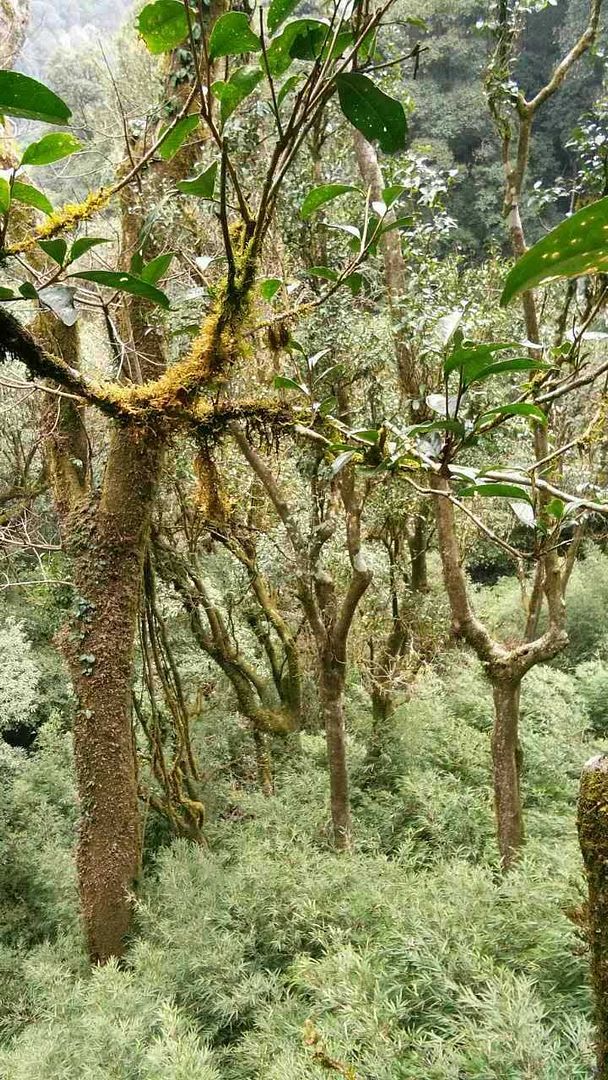
Monsignor Essence writes that this is from "ancient trees" (naturally) of "the small leaf varietal" from Mangong village in Yibang.  (I particularly enjoy browsing photographs of the trees!)

The leaves are small, 'tis true.  While the leaves in some cakes seem empty, easily-depleted, and over-farmed, this cake strikes me as being diametrically opposite.  They are crammed full of contents, and I like the result very much - it's friendliness is a great virtue, and it is an immediately drinkable treat.

Over the past few months, I've been drinking from my collection, and in a stochastic, scatter-gun manner.  I'll delve into a stack that looks untouched and see if I can find something that I don't recognise (which is getting easier as the years pass).  Not every cake in my collection is actual gushu (heh), and the contrast with the EoT Yibang Gushu is marked and obvious: the former can be quite aggressive, certainly in terms of caffeine, while the latter just seem to go down more easily.  It isn't at all aggressive - which is not to say that it is weak.  It's just friendly.

Sometimes, friendly is good.

16 January, 2017

Congregation of Vapours

I have of late, but wherefore I know not... lost all my mirth.  Foregone all custom of exercise.

And, indeed, it goes so heavily with my disposition that this goodly frame, the Earth, seems to me... a sterile promontory.


However, what better way to desterilise one's promontory than with some EoT?

This little baby has been sitting in a box, on a shelf, in my office, calling to me.  Every day, I come into the lab, and it starts its siren-song.  DRIIINK ME.  Every day, I bustle around pretending to be busy on something or other, and, before I know it, the end of the day is upon us, and it's nursery pick-up time.

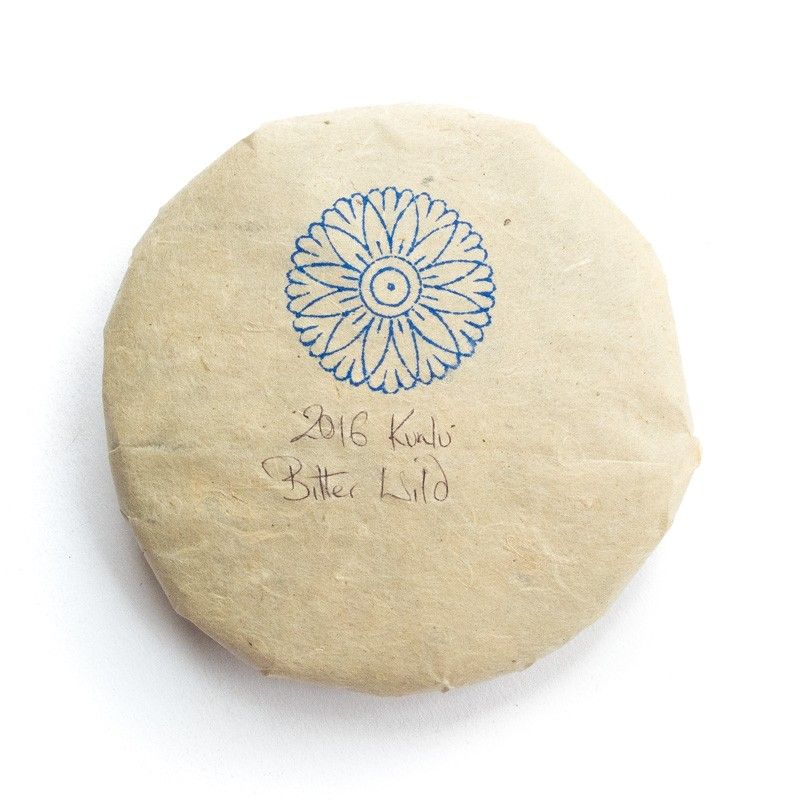
But not today!  Today, we stand and fight.  Today, we are all Kunlu!


OK, this isn't the Kunlu, but it's a nice recent (Darjeeling) tea all the same


It looks as if the old addage "You snooze, you lose" is true yet again; as I peruse the EoT web-site, I learn that many of the 2016 cakes have long since been vanquished by a ravenous public, starved for affection and good tea.  Thus it ever was, and rightly so - it's good to see the ol' Essence pimping its wares effectively.  Long may the pimping proceed.

If there is one (just one) thing that bothers me about the charming, dazzling white of the EoT website it's the fact that every cake seems to cost between £0.08 and £0.40, judging by the main page.  "What a great price!", thought no-one, ever.  Instead, we ceaselessly have to click through to each individual page to determine the actual price of each cake - presumably, this clicking is the point.  It rather feels like putting the milk at the far end of the supermarket, so that you have to walk past shampoo and haemorrhoid cream to reach it.  It feels like those shops that put chocolate bars next to cash tills, on the hope that some poor child will convince their tired parents to buy them a package of solidified diabetes while they queue to leave the shop.  It really sticks in my craw - and, Gentle Reader, if there's anything I don't like, it's a sticky craw.  I keep my craw glisteningly clear of all such nonsense.  It's a source of pride.

So, this cake doesn't cost "£0.20", which is the price shown to me by the product page, as it lies to me through its fetid teeth.  The cost is, in fact £32, which is a rather larger number than £0.20, but which is a more accurate number than £0.20.  Also, this cake is "Out of stock".  I believe I may have whispered "MOTHERF*CKER" to myself, at that stage of the proceedings.

The tea.  As the description on the EoT page reads ("Perhaps not for girls, or for people who are girlymen cowards"), this is rather a bitter tea, and tastes like KUDINGCHA - bitter tea, of the astringent kind that puckers not just one's lips, but every single last sphincter that is physiologically available at the time of consumption.  However, it's a nice bitter.  It's long, strong, and thoroughly absorbent.

In form and moving, how express and admirable: the sweetness is enduring and potent, like the irony of a reality-TV host being elected president of a third-world country somewhere out west.  It has the bittersweet tang that stays with you, like the economic consequences of half a country voting against its best interests to leave a large socioeconomic union of nations.

Which is to say, it's challenging.  If you like a challenge, then drink it today: let's make shengpu great again!
He quoth with irony, for the literal-reading folk amongst us.

03 August, 2016

Today's Agenda

Today's agenda: got the shengpu up in the Sentra.

Go to room 1-12, 
tell 'em Miss Lin sent ya.


Please make your brewings clean, rinse up in between.


Rule #1 about me: I am pathologically contrary. If you tell me that I have to like something, or, even worse, that it is cool to like something, then I will almost certainly dislike it, on principle.  This is not something over which I have conscious control.

So, when the (super-cute, "Mister Scruff") wrapper of "Poundcake" tells me that it says a lot about you if you not feeling us, then I am almost preternaturally indisposed to find the cake undrinkable.  Without intervention of any decision-making process, that's just how it is.

On the bright side, this cake ($50/200g) was green and fruity; Miss Lin described it as being "outlier Yiwu", which is accurate.  There is a hint of sourness at the back, which terrifies me, because it has a leafy green-brown flavour that tastes a lot like everything I try to avoid in shengpu.  The opening infusions were much better than the tannic later infusions.

"This is quite ordinary", notes my dear wife, as she offers an opinion in passing.  I silently rejoice, wondering if I might not be mad, after all.


Calm as possible, make the deal go through


$38/200g is, on the grand scale of modern tea, reasonably affordable.  I love the way that the wrapper says "Will this do?", as if Miss Lin ran out of time or ideas.  You couldn't say that about some of the 2016 cakes with their plush wrappers!

The leaves are rich, and dark, and spicy.  The pale yellow soup is thick, and comforting, and very sweet.  I appreciate the beefy, almost meaty, aftertaste.  The dry opening is so dry that I am half-expecting to find grapeskins mixed in there with the leaves.  It chugs on nicely, with the buttery scent of a clean wok'ing.

It is a solid little drinker, but the background has a hint of sourness that terrifies me; those of us in cooler climes ware the sourness like a werewolf fears silver.  "Nice, but not for me", I hurriedly conclude.


I got a hundred bricks, 14.5 a piece


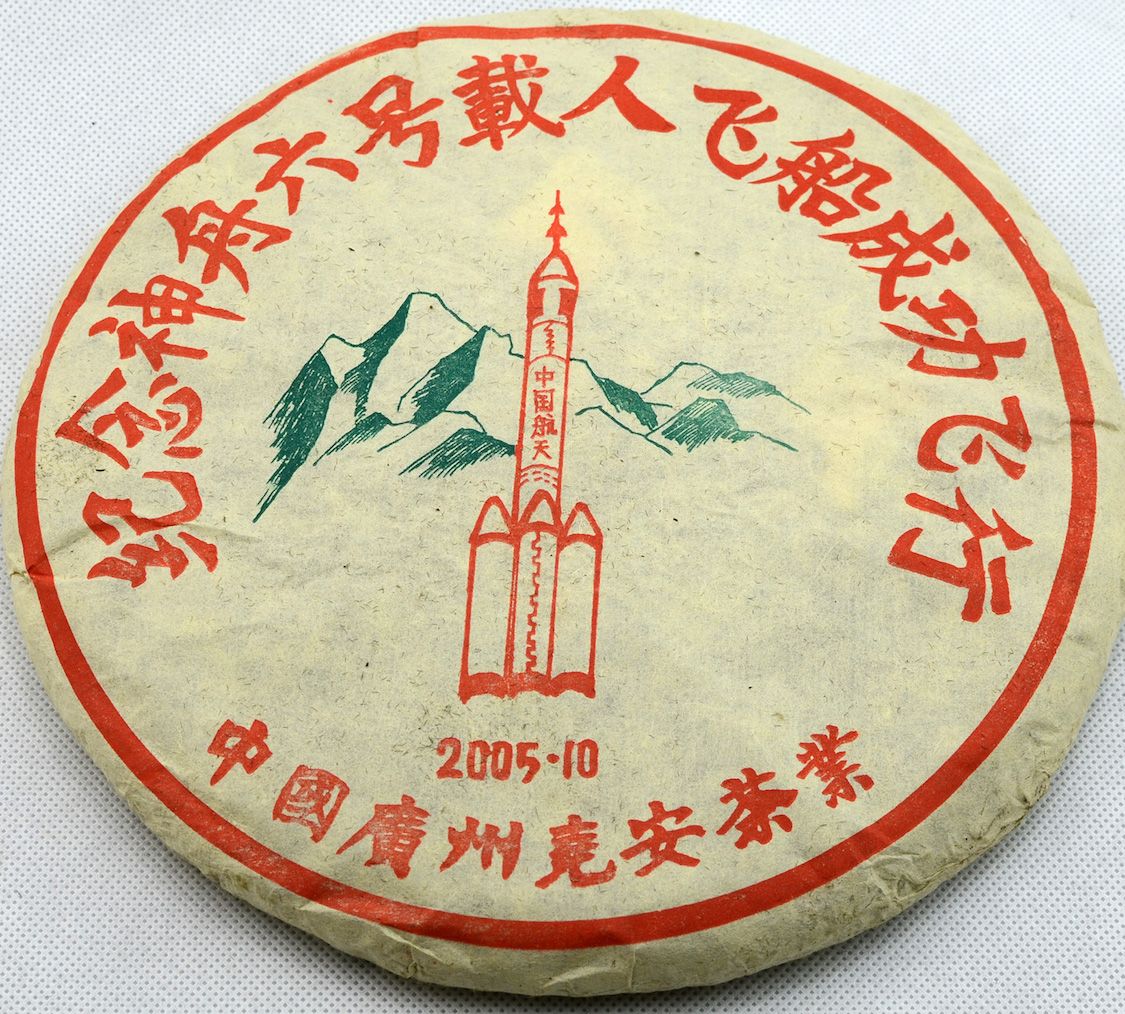
Now this one - this one is a bad boy.  You know I saved the best until last, and it's absolutely true in this case.  I totally dig 200% the cheesy old wrapper that looks like a leftover from the 1950s.  This is real Communist space-race tea.  Admittedly it's from 2005, but the ambience is very "planned economy".

This is another White Whale, and old Captain Ahab knows total embargaination when he sees it.

Like the Whale, this is clean orange in its brew.  Like my purple-wrapper Dingxing (inexplicably prized from the hands of the dodgiest Taobao seller imaginable), it is sweet in its rustic Yiwu stylings.  Unlike either of those two, it has a complexity in its scent, with floral summer-flowers.  Hell, it even leaves an explicit cooling sensation in the nose.  The nose!

So good is this tea, that it even managed to see off the cold that I had incurred recently, after hitting some deadlines.  It cured the common cold, you read it here first.

The first half-dozen infusions are the best for this tea; while remaining clean, sweet and robust, it fades a little after that.  For $88/400g, I think it has earned to right to do so.  Complaining about this later infusions of this tea would be like complaining about the colour of the leather interior of a classic Jag that someone sold you for 10% market value.

The tongs, they are a-purchasin'.

29 July, 2016

2015 Green Shroom (w2t)

Nothing helps a situation like a serious cup of tea.

Looming deadlines? Cup of tea.

Student trying to convince you to let them submit an unready doctoral thesis, while their primary supervisor has disappeared to South America? Cup of tea.

Electricity and water not working while the builders try their hardest to destroy what little remains of your sanity? Cup of tea.


No, you're right: functioning electricity was an aspiration, not a requirement.


Much of this last year, I've enjoyed tea in one of two places: (i) feet up back at Chez Moi, huddled over my teatable, while children bounce off the walls; (ii) sitting in my lab, huddled over my computer keyboard, while researchers bounce off the walls.  Both of these seem to work well to a surprising degree.

I've noticed that I've developed an unexpected ability to enjoy tea at the unlikeliest of times - by setting up my secondary teatable in my office, it's genuinely surprising how much enjoyment I can get out of even the most mediocre tea when it's brewed right.  And by "right", I mean "strong".

Mediocre tea is no short supply: much of the intake has been "gift tea", provided by generous colleagues as they come back from China and India.  Gift tea looks nice, and is characterised by being, let's say, "accessible".  It needs to be inoffensive, by definition.  Good tea is rarely inoffensive, however.

Wimpy wulong?  Just double the amount and perform a "flash brew".  Humdrum hongcha?  Crank up the amount of leaf in the pot, and enjoy the tippy first infusions.  Dodgy Darjeeling?  There's little that maximum amounts can't overcome.

"If in doubt, just overwhelm them with violence."  It's a family motto that I like to like by.


Rarely, I get to drink outside, but that's another great way to improve even the laziest leaf (pictured above, in that "sweet spot" between the students leaving at the end of the academic year, and before the tourists arrive in their bazillions).

Thankfully, w2t has made a tea that (i) I love so much that it seems too big to fail, no matter how it's brewed; and (ii) is unavailable, naturally.  Perhaps the latter is part of its appeal - the one that got away.


When you're making tea that looks like something from Super Mario, then "you had me at hello".  If this were available, my entire life would be filled with such cuties.  Perhaps it is good, then, that (as ever) I got to the party too late, and this had sold out before I got around to drinking the sample from "MISS LIN" (chortle).

As the kettle fires up, I find myself humming the theme-tune to Super Mario Bros.  At one point, I'm sure that I even said, "OBEY WARIO - DESTROY MARIO" to my youngest son.


Dubs (i.e., w2t) has morphed from being super-cheap-and-cheerful into a more premium outfit, and that's entirely fair.  Miss Lin (chortle) makes great tea, and if she wants to charge a living wage on top of it, then I'm not going to whine.

I realise that this makes me a massive hypocrite: the Hobbes from nearly ten years ago, back when the ol' Half Dipper started off, would have been vociferous in condemning a vendor for charging for their tea.  Now, I'm more laissez-faire.  If the tea's right (and w2t's tea is right), then I'm fine with Miss Lin making her margin.

As a thought experiment, I asked myself if I would be equally content with another vendor doubling their prices.  I concluded that I would not be content.  Why, then, am I content for w2t to charge thus?  Perhaps it's personality: personality goes a long way.  The cakes are great, and they have personality.  Additionally, and I think this is the crux for me, there is always a bargain available for sale.  You can grab a huge stack of Elephant Cakes, or Rocket Yiwu, or whatever it might be, for a good and fair price.  That helps a great deal, and discriminates between "ripping off customers wholesale" and "offering something for everyone".

This is, by far, the best tea that I've had for some time.  It is Menghai to the max, but it has a hint of complex darkness.  It  has the heavy scent that matches its dark leaves.  It is green, and especially violent, because I used the whole sample.

This is my kind of town: strong, dark, and unexpectedly fragrant.  The fragrance won't last as it ages, I suspect, but it is a consequence of the complexity of the leaves.  If I wrote "it tastes like a bizarrely-delicious broccoli" you'd be forgiven for thinking it was dreadful, but, really, it is a complex mixture of fruits and vegetal tones that thrills me.

On checking my notes, I was amused to see that this was the last tea that I drank before the builders pulled one side of our house off, in a process that has only just completed, some 11 months later.  The memory of this tea stays with me, and I sorely wish that I'd bought at least one tuocha while it was still available.

Drink 'em while you've got 'em!

04 July, 2016

Strange Days

Warriors, poets, and warrior-poets: I bid you welcome.  I trust that all is well, with you and yours.  These are strange days indeed, but first, let's fire up the trusty ol' tetsubin before we get down to business.


I'm up before the dawn chorus, this morning, which gives me the opportunity and the means: we have a 2010 Mansai cake from Essence of Tea (nee Nadacha) on the table.  The sweet thrills of this cake rather take me by surprise; I wasn't expecting to be thrilled, at 4 a.m., and yet thrilled I appear to be.  Apricots, dried fruits, humidity, sweetness - I am enthused.

It is my ambition, in the coming months, to write up some of the (copious) notes that have accumulated, as accretion is wont to do, in my journals.  I beg your patience, with respect to their arrival, and your tolerance, with respect to their quality; there is a certain rustiness in my ability to write, but rust can be worn away with sufficient elbow-grease.  Let us grease together.

To say that these days are "strange" is not quite to do justice to the batsh*t craziness that seems to typify life at the moment.

We have come a long way together, you and I, on our respective warrior-poet journeys, have we not?  When the Half-Dipper was started, I was a humble graduate student; I was subsequently a humble post-doc; then, father to two mighty warriors (one of whom has just finished his first year at school!).  I remain humble.  As of ten days ago, I am "tenured", which is to say "sufficiently knackered so as to be put out to pasture".  My colleagues refer to me as "professor", which is both extremely unnerving and simultaneously alienating.  Even my old boss uses the title, although, it must be said, not without irony.

A few days later, my countrymen voted themselves out of the European Union.  Much ink has already been committed to this subject, and I will not bore you with my own opinion, suffice to say that literally every single person in my life (personal, professional, adversorial) is of the same mind on this subject, which appears to be on the other side of the argument from the majority of people in the country.

Imagine the Republican Party and the Democratic Party suddenly having no leaders, nor firm idea of what should happen next, and you have some insight into the substance of these recent times.

Balliol lunch
after the referendum -
sauerkraut noodles

Friends, let us shoulder our lances and our quills. It is time to drink some tea - surely, this is the only cogent response to these Strange Days.

10 August, 2015

Pairing Tea

We have known one another for so long, Gentle Reader, that I feel as if I can confide in you.  Among the veritable plethora of "things that yank my chain", up there near the top is "pairing tea".

Don't get me wrong.  Everyone should be free to do as they wish in the comfort of one's own home.  However, if you are pairing TEA and FOOD, and you choose to write about it, then I am probably quietly hating you.  Is that too strong?

>_<  HATRED  >_<  

It feels good, so it must be right.


Pairing wine and food is fraught with danger, too.  It's good when you get it right (thx, Wine Steward), but it gives rise to all manner of silly rules that folk try to remember.  "White with white meat, red with red meat", for example.  I'm probably going to cry the next time I hear that: big, fat tears are just going to tumble down my face.

So, with pairing such a dangerous game, I thought I'd give it a go (!), by matching a tea to a wine.


OK, I happened to be drinking a tea and a wine from approximately the same year.  However, the similarities between the two were absolutely striking.


The tea is a 1990 "Qizi Bingcha", which is a bit like saying "red wine".  The paper, pictured above, is written in the handwriting deluxe of my old teachum, RJ.  I appreciate a bit o' the ol' calligraphy. 

 "From wild trees at the border between Yunnan and Vietnam, processed on pine wood.  A private creation from the tea merchant Wang from Taiwan - I was told."


The boys leave for the park with their auntie.  The tea consequently takes on a new significance, as I pay attention in the unexpected silence.  An old aircraft drones overhead.  A gentle breeze gives the impression of an indolent summer Sunday.  The qizi bingcha is tannic, and magnificently eroded - just like the Pauillac.  There is rounded, unobtrusive, structural sweetness.  Most importantly, it is comforting.


"Very good - this is old tea", notes my dear wife as she takes a cup in passing.  I could drink this tea all day.  Sadly, I have to go to town to buy swimming trunks, to take my dudes swimming, after my previous pair spontaneously disintegrated while I was swimming with them last time.  There's nothing funnier than seeing a bony white man suddenly become naked, against his will, in the children's learning pool.


UCL, I-IV

I

and just when they stop
f'ing you - then the f'ing
really begins


II

thanks for the question
there's a whole community
working on that


III

more seminars
more hamiltonian
markov chains


IV

I double-dare you
to give your talk and not say
big data

03 August, 2015

The Circle is Overcomplete

The Peacock of Bulang went well, last week, and thus emboldened, I dug through some of my old samples to find a bit more Dayi: the 8582-805.

First of all, this is a sample kindly provided (many years ago, in fact) by Terje; the tea-leaves have been relaxing in the splendour of their polythene bag for a number of years. I have written previously about a cake that I own in some quantity, the 8582-801 (which is doing quite well).


Comparing the fifth batch of cakes to the first batch of cakes in a year (i.e., 805 to 801) is fraught with difficulties under normal circumstances, but any comparison is surely futile if one has been aging nicely in a tong, while another has been "aging" in a baggie.


Perhaps expectedly, the result for this 805 is not great: it is orange, sour, and seems to be desperately in need of humidity.  It is not a comfortable tea to drink.  It is fishy, like Dayi, but ultimately so, so sour and dry.

Thus, for the avoidance of doubt, I would not recommend aging your young Dayi cakes by sealing them in plastic bags.  Ahem.


Westminster, I-IV

I

on a moving train
before opening the bottle
of fizzy water


II

a summer day
at our lower Thames campus -
Westminster palace


III

oh piss off, sir mark
another friendly meeting
in the ministry


IV

the sound of the bell
that ends he meeting
is Big Ben

27 July, 2015

The Circle is Complete

Peacocks.  Sure, they look pretty - until they open their mouths.  GRAAAARKKK!  They sound like the eternal damned.

There is a very pretty pub in this city, by the river.  Everything nice, everything routine.  Bridge, running water, old buildings.  Also, it has a bunch of peacocks strutting around.  GRRAAAKKEEK!  It's not a peaceful place.


Old-school Gs among you might recall some similarly pretty-but-obnoxious cakes in the "peacock" range from Dayi, in 2008.  We had the Peacock of Badashan, and the Peacock of Menghai, and even the Peacock of Mengsong.  While perusing the darker zones of our tea-toom, I discovered a cake that I've not written about before: the 2008 PEACOCK OF BULANG.  Just when you thought it couldn't get any more bitter, we find a Bulangshan cake.


This cake has spent its entire life in storage at our place - we bought our house at almost exactly the same time as we bought these cakes.  Therefore, I am tense!  It has only known British storage.  Will it be any good?


It has a dense scent of sweet darkness, which is, at least, mildly suggestive of improvement.  The scent in the wenxiangbei is "breadlike" and sweet, which is, again, not bad news.

It is strong (strong!) plantation tea, as expected.  The soup, pictured below, demonstrates that - lo and behold - it does appear to have aged somewhat.  The chunky yellow Dayi youth has gone, at least. 


It is clean, bitter, and has a soft and settled flavour.  Also, it is bitter.  I am primarily thrilled by the fact that it doesn't suck, and secondly quite surprised that it tastes reasonably humid.  British storage is a funny thing: it is (very) wet, which you can taste in the air when you come home from abroad; this avoid the "dry" storage aspect.  However, it isn't very warm here, and so cakes do not rocket off into the aging that you'd expect from humid Asian regions close to the equator.  The result is interesting - it is a little like aging a super-tight tuocha in Asia, in the sense that its aging is slow (deliberately so, in the case of a supertight tea).

For $10, I am surprised that it is so drinkable.  I wonder if I have the mystery fifth variety of Peacock around here somewhere...


ICML, V-VIII

V

sunday monday
tuesday - shops, restaurants
museums closed


VI

mother and child
emerge from the cathedral
their pushchair stolen


VII

I cannot tell
French peaches from nectarines
- that's an apple


VIII

you taught him to beg
I wonder when you will
teach him to read

18 July, 2015

Purple Haze

Gentle Reader, I hope that you are easing pleasantly into the summer, in whichever way you ease best.  The end of the academic year  here feels like the climax to a bad movie: more, and more, and more pressure / examinations / socials... and then pop!  Sudden silence.  

All that remains is the high-pressured whine of the accumulated guilt of that huge pile of papers that needs to be written, and those grant proposals that need to be sent off for review.  As a consequence, it sometimes feels that this job is as much about talking about what you want to do in future (via grant proposals), as much as doing actual research.  Sadly, "I want to drink tons of tea" doesn't seem to cut the mustard, as far as talking about what I want to do in future.


The sun is shining (just about), and so let's make some hay.  I seem to have been added to Jalam's "tea club" mailing list: this is the second xiaobing that has made its way to me in as many months. I am not complaining!


The 2014 Nannuoshan "Ziye" [purple leaf] is packed with summertime sweetness, atop a base of true and surprising bitterness.  BOLD is the man that sends real tea to his tea-club, rather than nondescript crowd-pleasers!  I approve wholeheartedly. 

The "purple" flavour of ripe fruits is always welcome, and very well-suited to the character of Nannuoshan, which is likewise fruity. So good, in fact, is this tea that I have a second session with the same cake in the afternoon, using a new set of leaves in the pot.  This tea is ab-so-lutely perfect for low-intensity summertime quaffing.  Perhaps I'm just in a good mood, from the season.


There is vibrancy abound in this little number, and that satisfying sweetness is made interesting by the unsociably bitter base.  I can imagine tea-club members being terrified by this bitterness, and that makes me love it twice over.

The remainder lasts me several days in my lab, and I drink it as a priority, due to its haute deliciousness. It seems to last forever, and it stays unbroken in its sweetness as the infusions come and go.  Purple tea is so very good for the summer, and this cake is a friendly example of the genre.


Trinity Term, I - III


I

FORTISSIMO
is when everyone
sneezes at last


II

little fireworks
reflected in the eyes of
little boys


III

saying goodbye
to the old professor
at his funeral