Showing posts with label 2003. Show all posts

30 March, 2015

Chiptunes + Shoops

The Easter Vac.  It is a sacred time.  Not least because my college has, it being the end of term, wound down.  This means two things: (i) all the academics get to focus on sweet, delicious research; and (ii) I have the time to combat a Dark Breakfast every day, followed by a remedial diet of chiptunes + shoops (i.e., shupu) upon hitting my lab shortly thereafter.  

Bacon followed by shoops is the only way to fly, I have concluded.


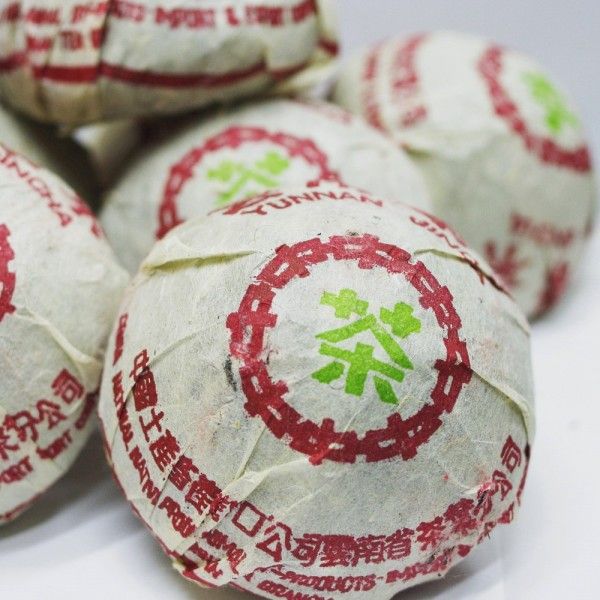
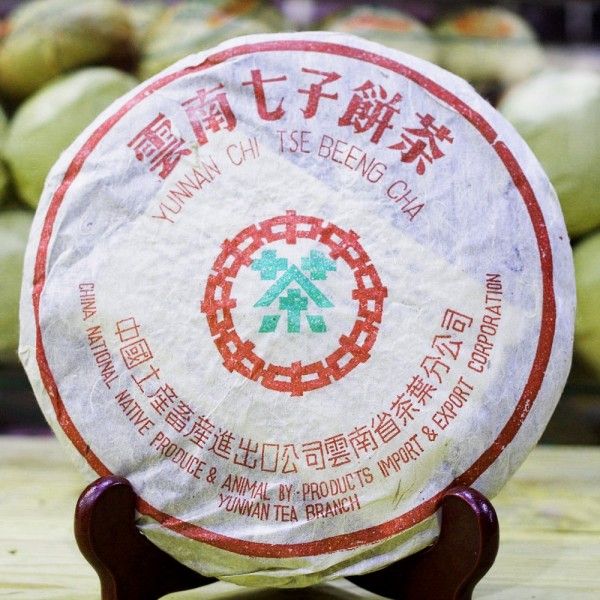
Knackered 2003 Fenqing wrappers


As if picking up the psychic vibrations of the times, my homes from back home, Mr. TG, sent an e-mail to tempt me with some large doses of the aforementioned shoops + some shengpu.

As Oscar Wilde once said, "I can resist anything except temptation."


This is, in fact, a 2003 cake made by an outfit called Xiangzhuqing Tea Co.

TG (pronounced "TEEDJ") noted that this used to be available via the mighty bushido-laden Bannacha, but that it is now out of stock, and that I suck.  It seems that TEEDJ himself purchased his cake from Chawangshop, but, again, I cannot seem to find it listed there, and, again, I suck.


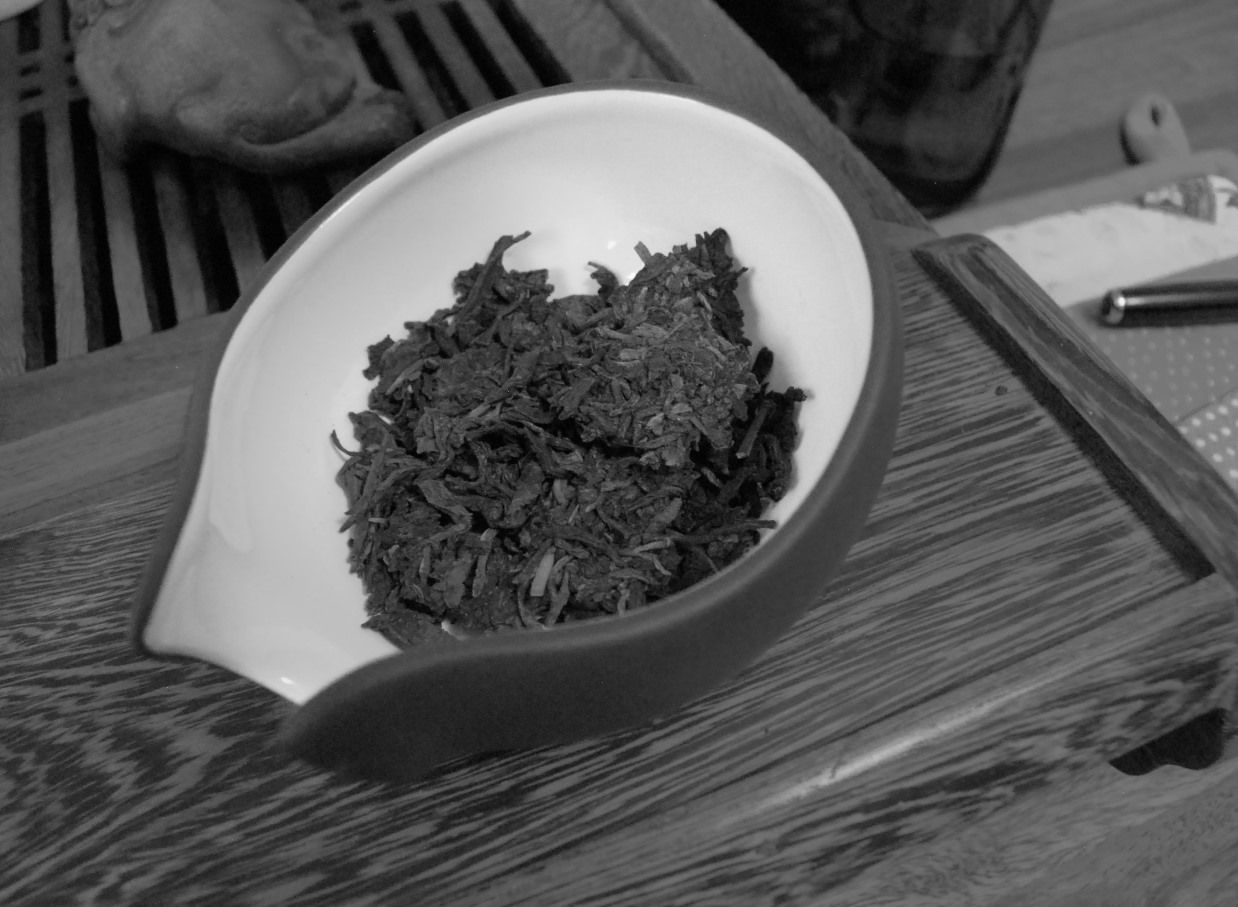
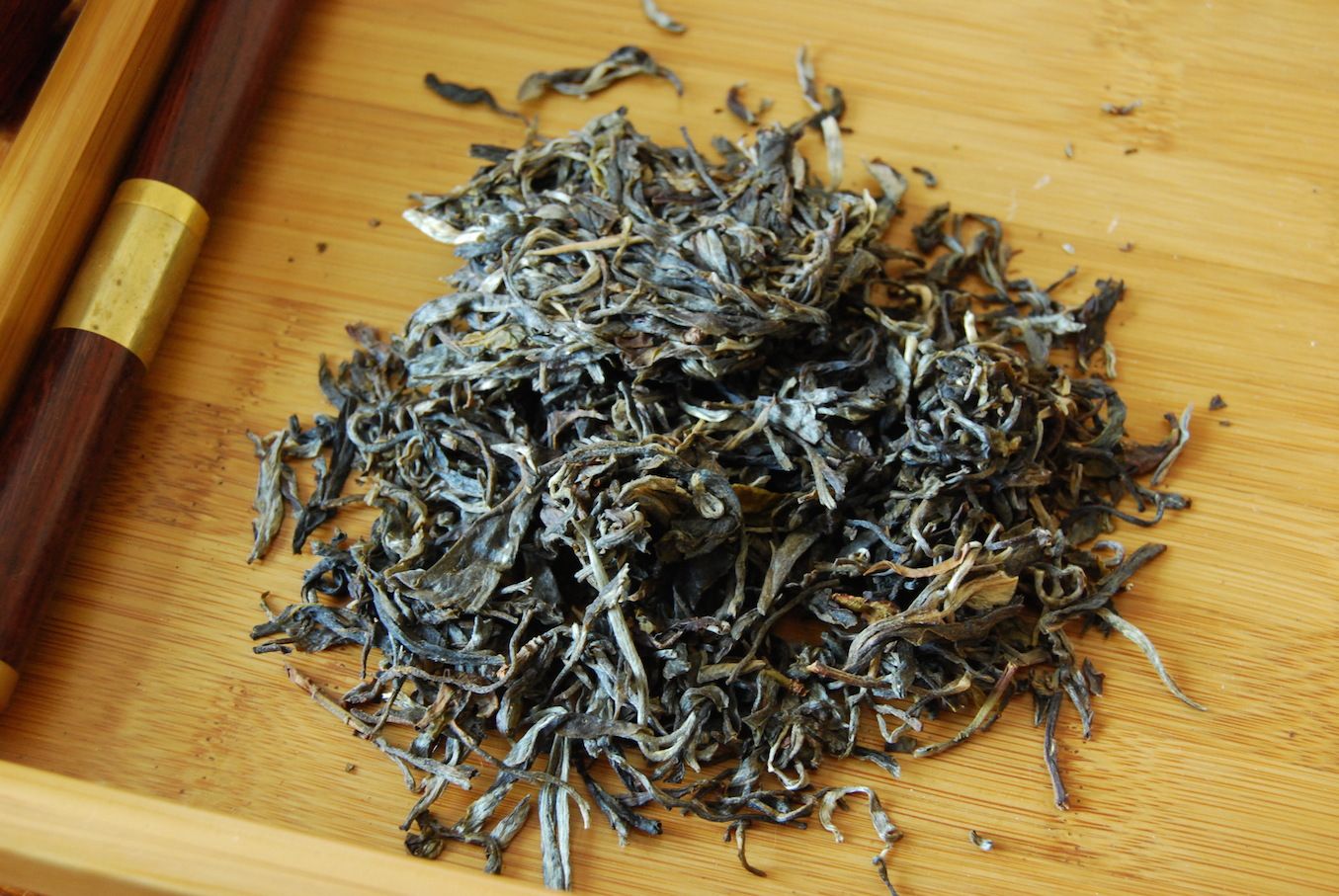
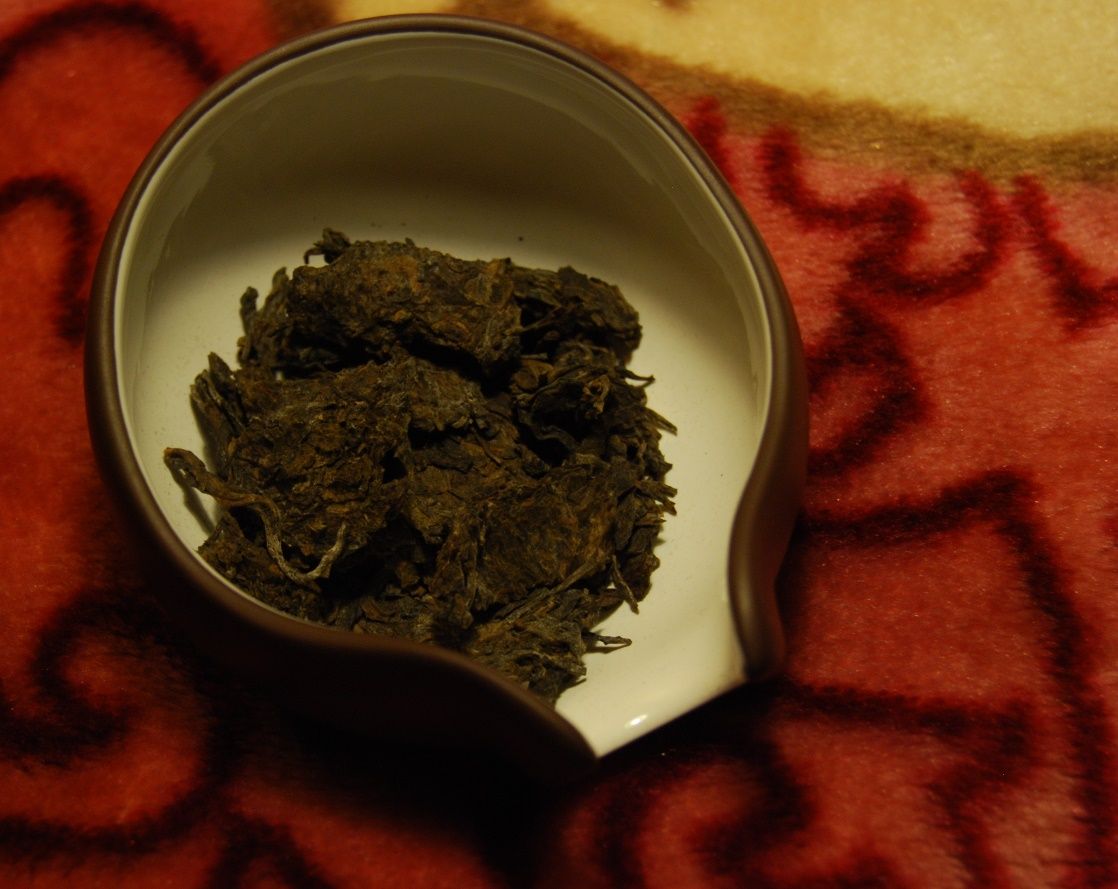
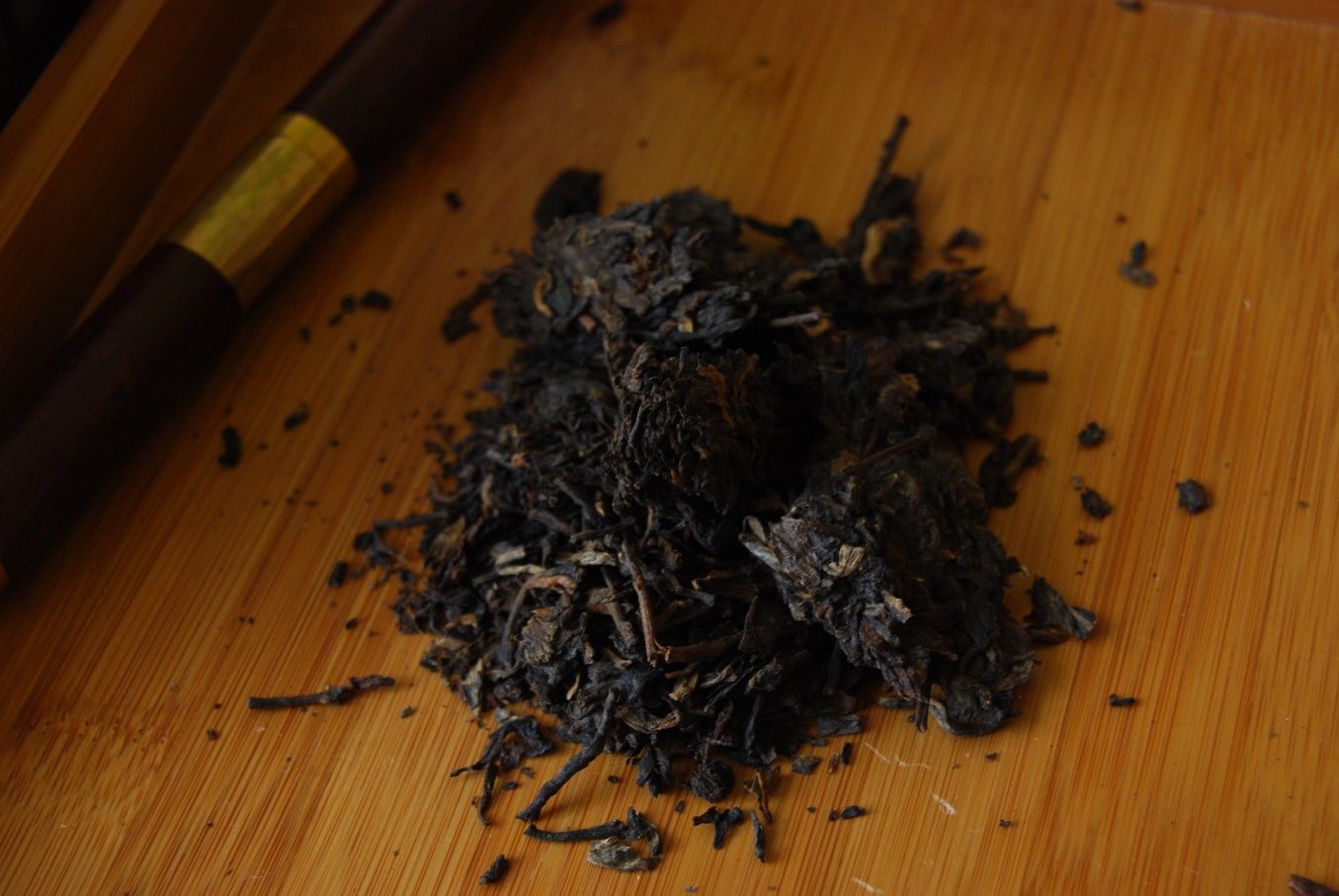
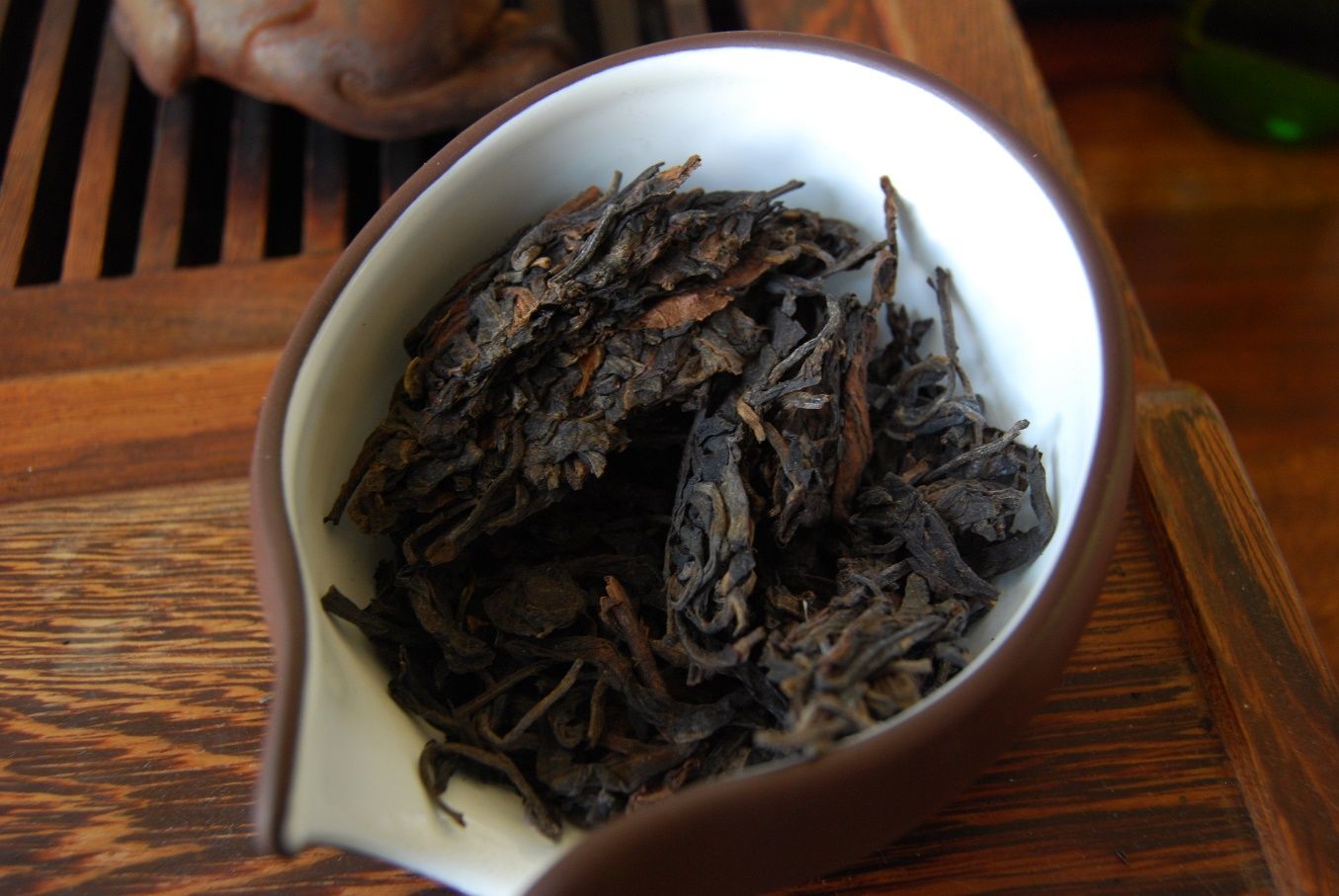
"Like, whatever", I thought to myself, in my native Valleygirl accent.  I busted out the sample from TEEDJ, which, pictured above, rather reminds me of my day job, in which we sometimes have to extract samples of tuberculosis DNA from the most antisocial of patient byproducts.  Say no more.  I count my blessings that I'm only exposed to the data, rather than the... original material.

Apart from looking like pestilent faecal matter, then, the 2003 Fengqing cake is allegedly "old tree".  Again, this causes my inner Valleygirl to start with the "whatevers", because why in the sweet bowels of Hades would you make shoops out of good laoshu leaves?  You wouldn't, of course.  If you think you're drinking "old tree" shoops, then the chances are quite reasonable that you're not, and that you're gullible, and that, like me, you suck just a little bit.

Edit: this isn't shupu, my notes are incorrect - it is shengpu, and the suction is all mine.


I've never brewed human excrement laden with infectious disease-carrying bacteria, but I suspect that this huangpian-infested, red-tinged leaf is not a million miles away from the charms that we might anticipate from such an experiment.

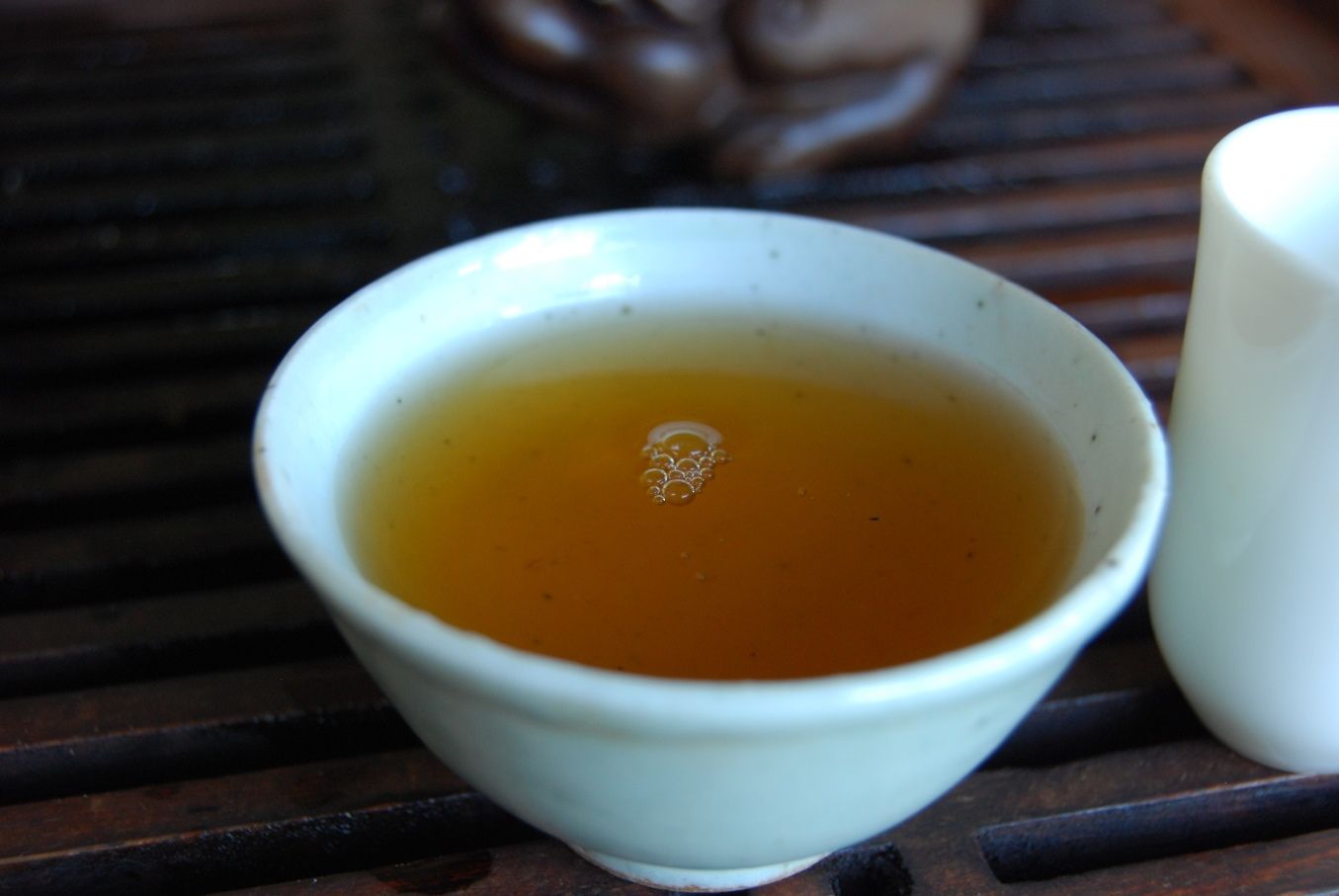
That is not to say that it's bad, far from it: what we have here is merely rather "rustic", let's say.  It is a Lincang cake, and it is smooth, and rather cooling.  I dig mightily on its sweet and mouth-watering satisfaction.  If it started out "red", which I suspect, then it has nonetheless managed to retain some its oomph, 12 years later.  The background is malted redness, and there is some Lincang grainlike sweetness in it - the impression is one of "decent minor-label artisan cake".  It is not the world's most complex tea, but it has much to recommend it, in its well-balanced way.  If inexpensive, it might be worth a look, although I cannot find its price due to the aforementioned negative pressure gradient that surrounds me.


Enough of the pussyfooting around: it's time drink dirty shoops.


The tiny wee picture above tells us that this is really rather dirty, in that sub-CNNP manner.  Thrills indeed!  This 200g brick will set you back a staggering twenty American bucks via Awazon.  It's cheap, it's nasty, it's just what I needed.

Let's do this.


Did you ever have a tea so rancid that all of the thick, greasy Chinese hair that was embedded in the leaves voluntarily got up and left, because it was too nasty even for thick, greasy Chinese hair to tolerate?  This brick is exactly like that.

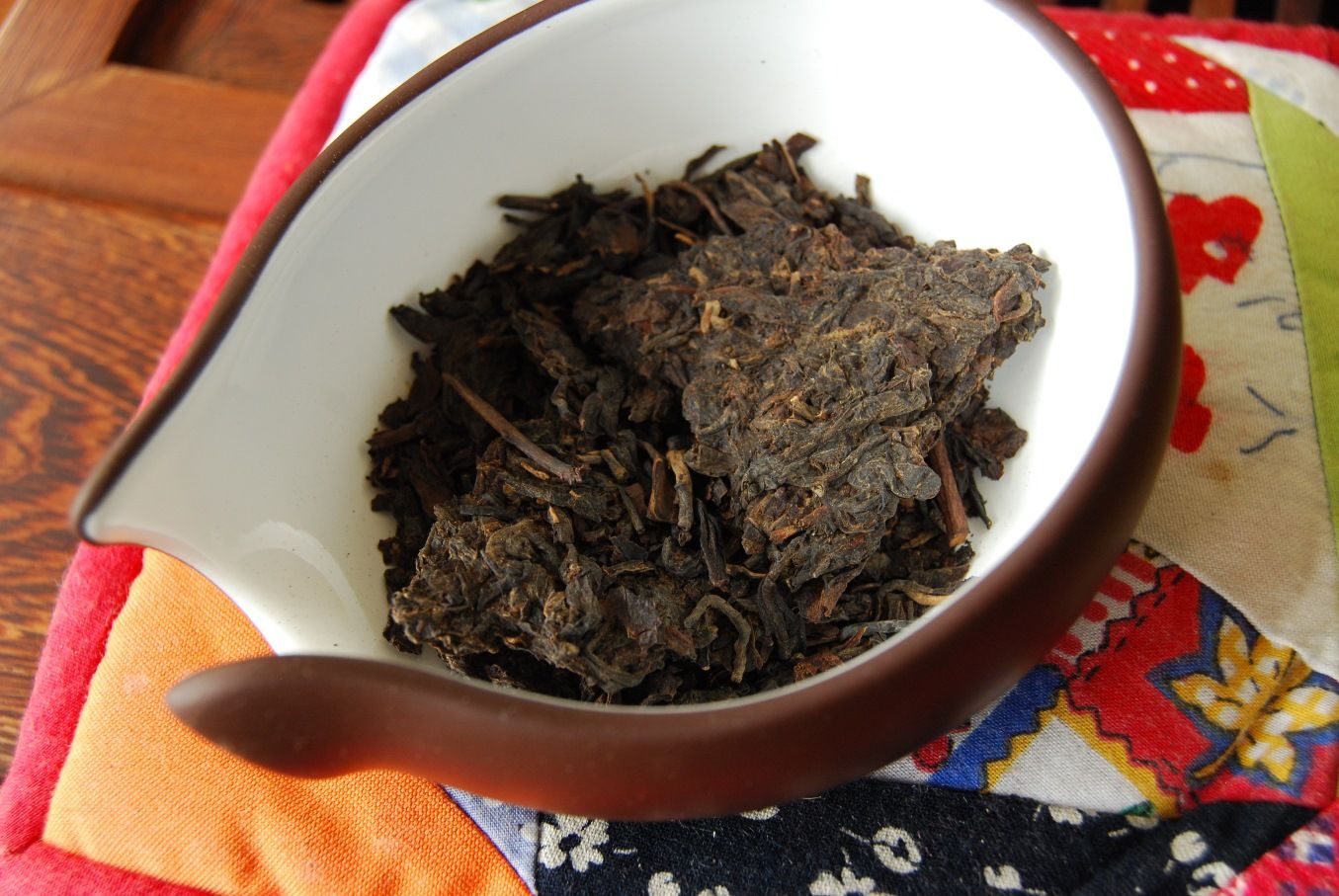
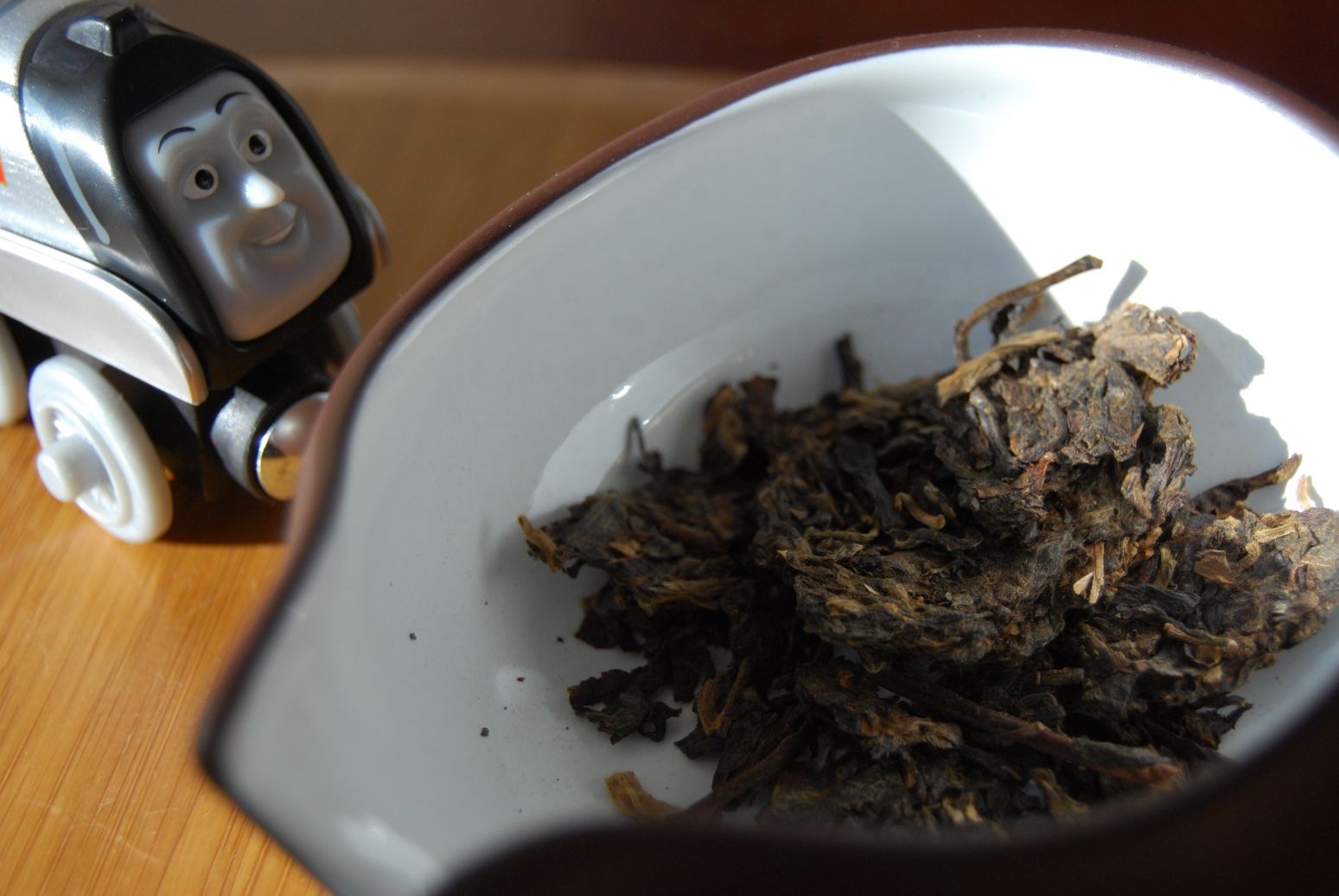
Pictured below, we have some sort of... I'm going to say "webbing" embedded in the mixture.  Would you believe that it smells like rank heicha from Hunan?  You would?  Well, it does.  It has the scent of nasty tobacco, just like Hunan bricks of deadliness.  I'm just going to point out the epidemiological fact that this area of China has some pretty serious throat diseases - moreso than any other region.  I can hit you up with some project publications on that if you wish to see the data.


Now, I'm not suggesting that there is a causal link between drinking TEA THAT COMES FROM THE COLON OF SATAN and illness, but I'm going to leave the idea in the back of your mind.

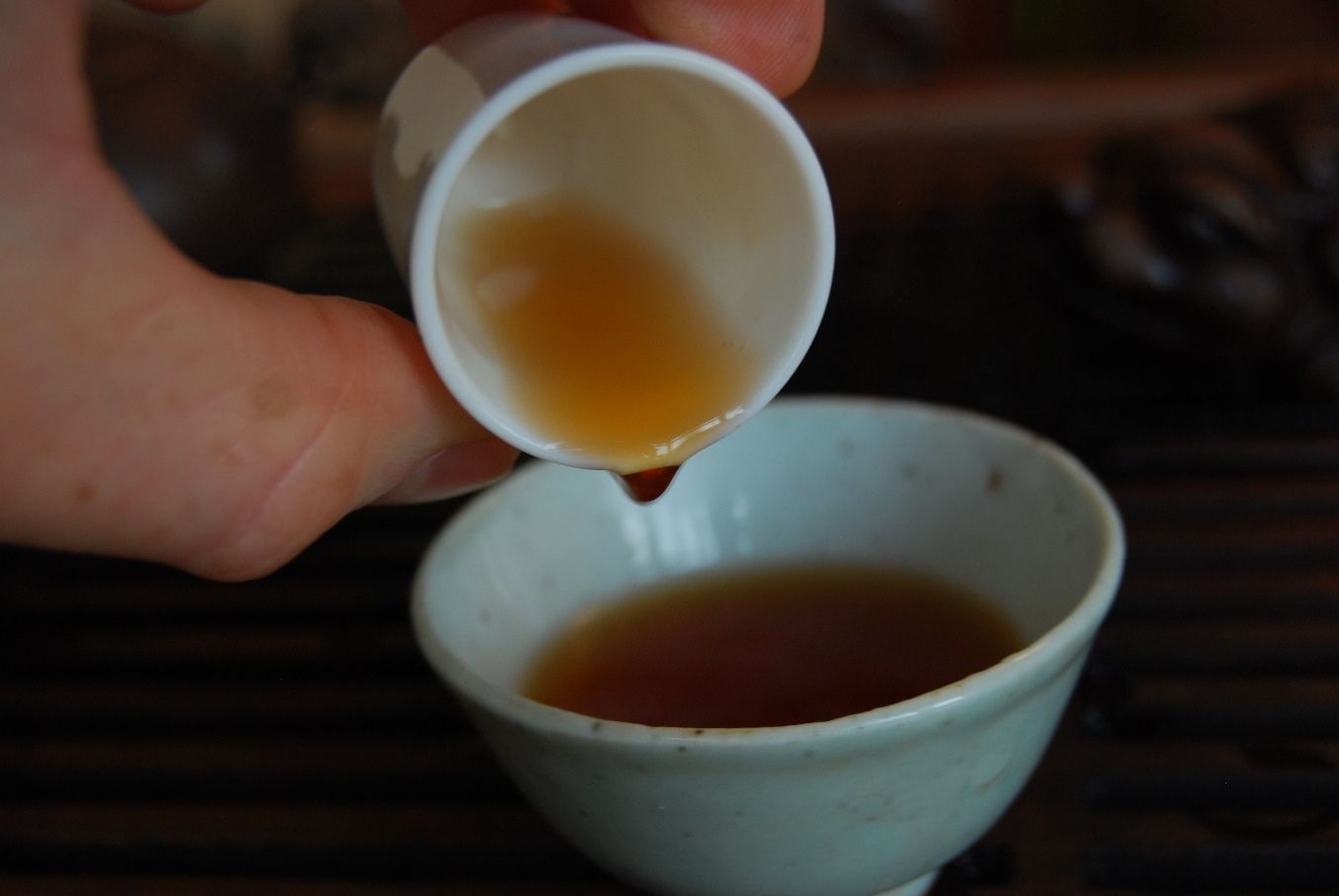
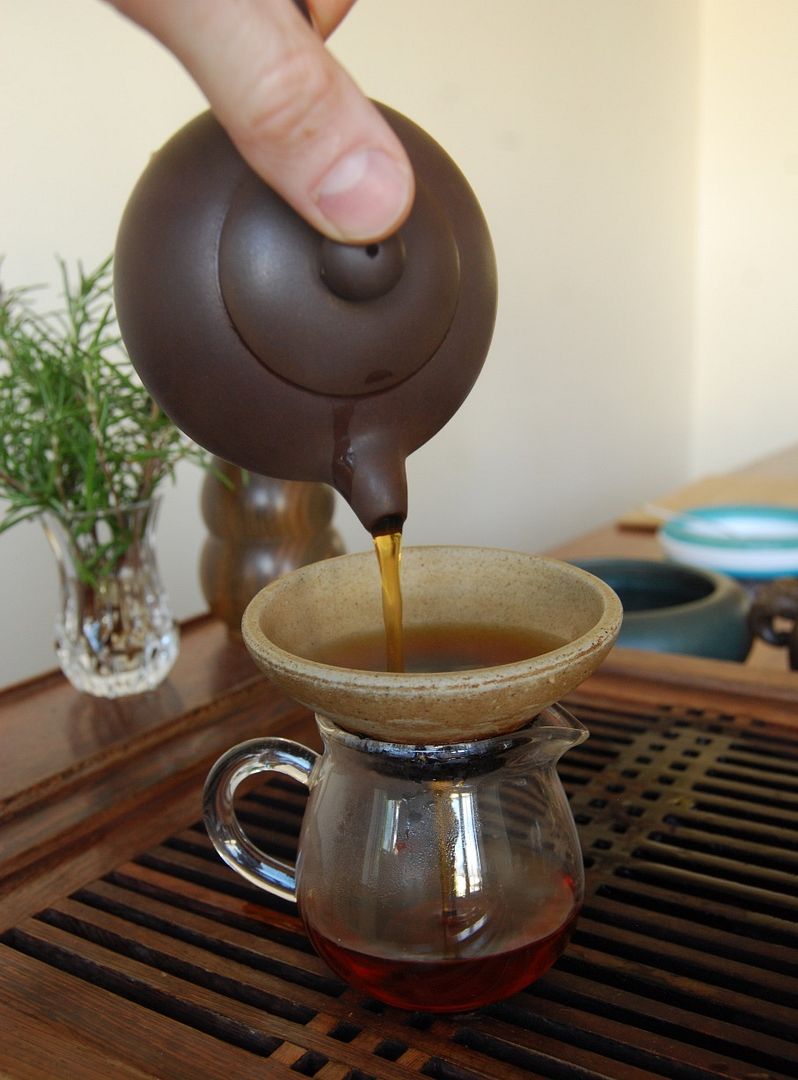
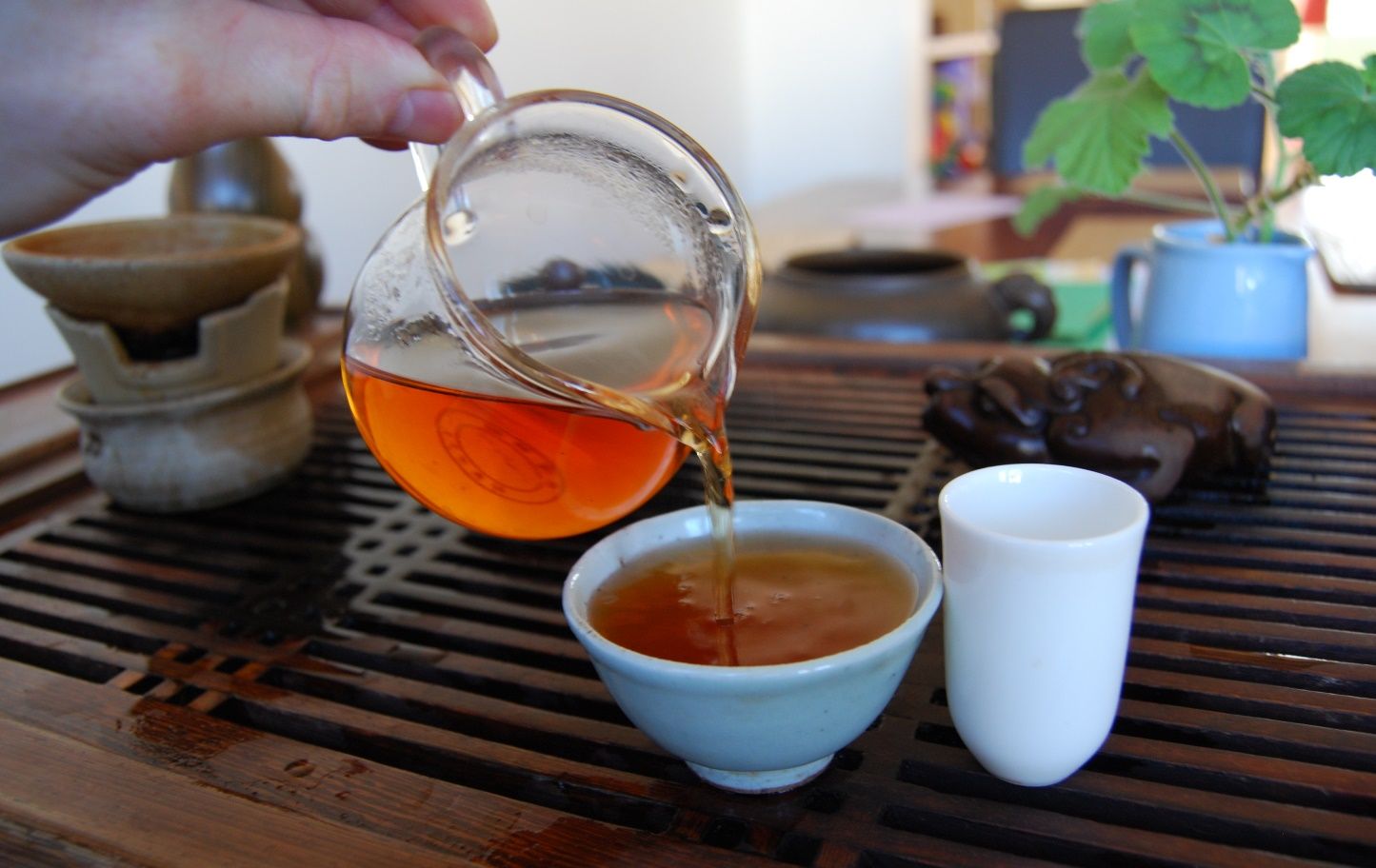
The photograph below rather summarises my opinion of this tea.


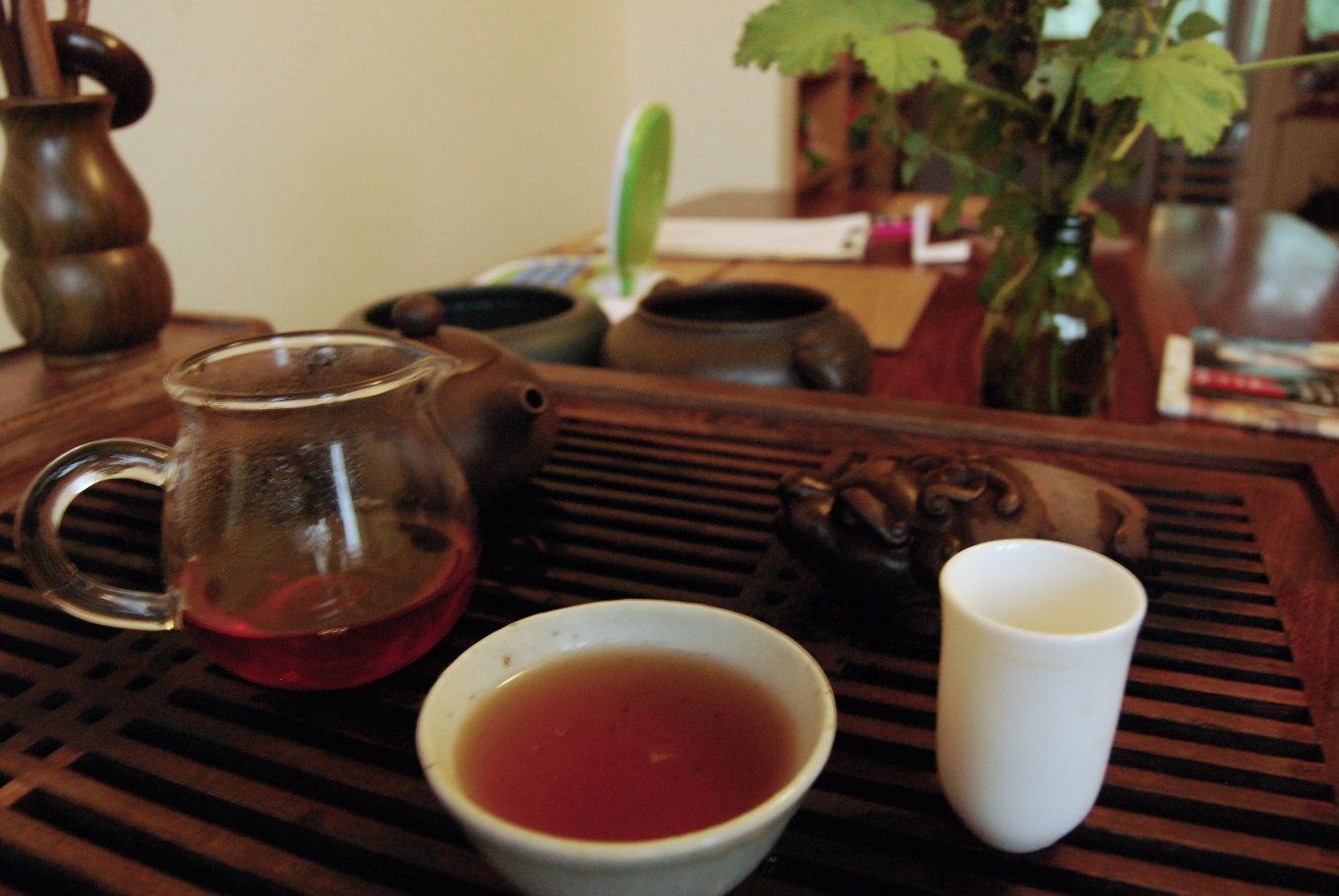
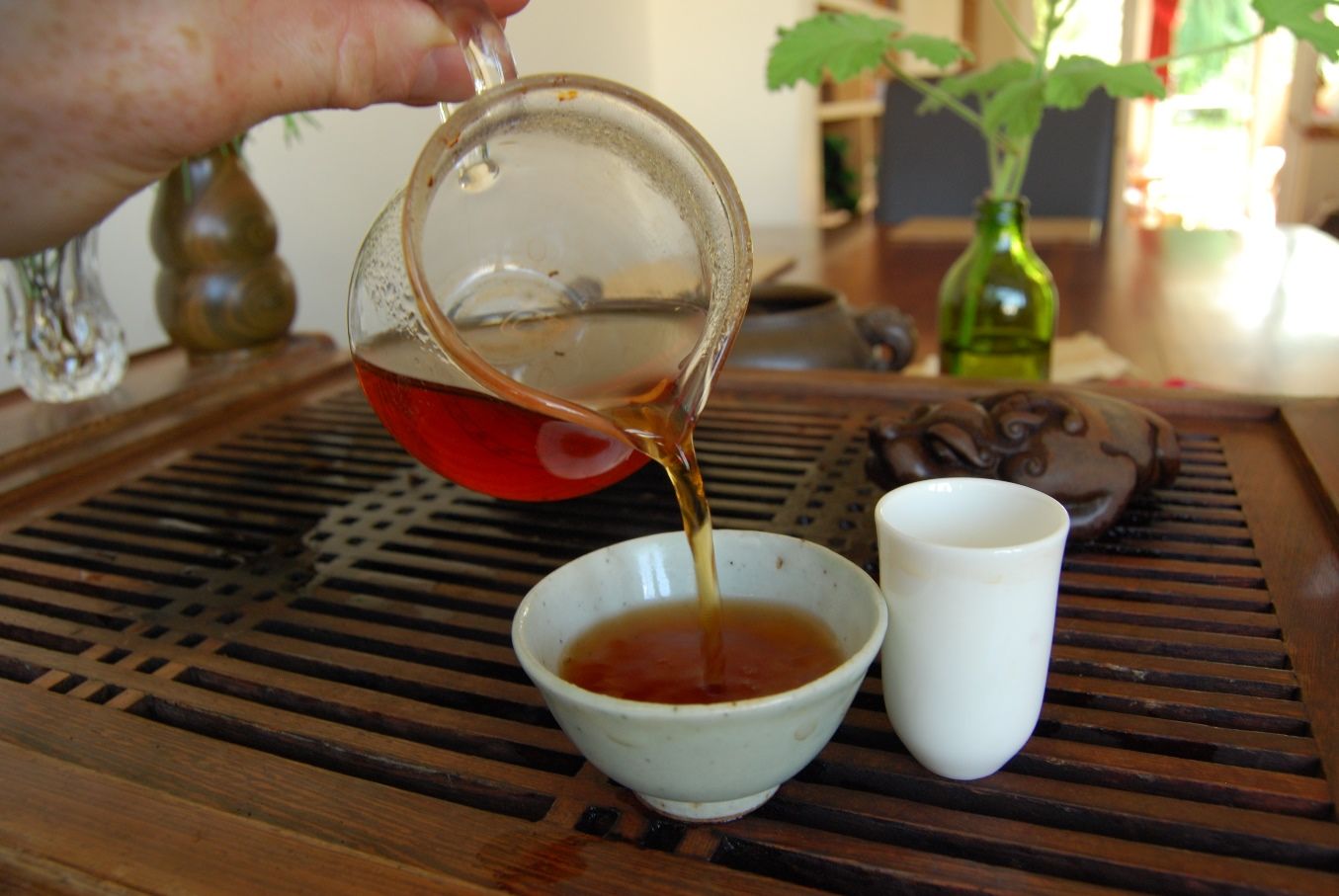
It is dark, it is thick, and it is very (very) dirty.  TEEDJ notes that it "responds well to filling the gaiwan with leaf", and so I went heavy with the quantity.  I was rewarded with a very strong, knock-out dose of surprisingly sharp shoops.  It is so very smooth and so very powderlike that I fall instantly in love.

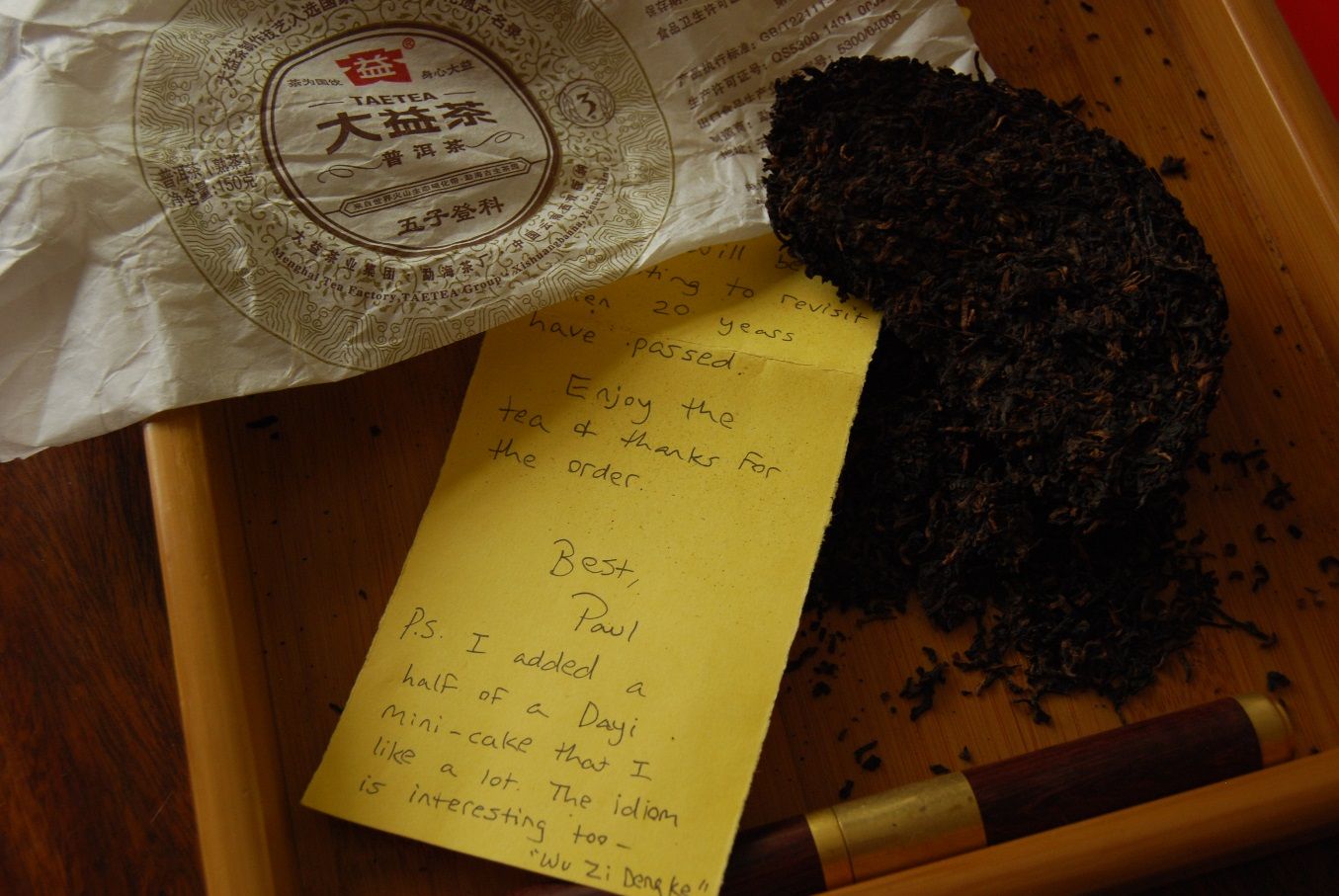
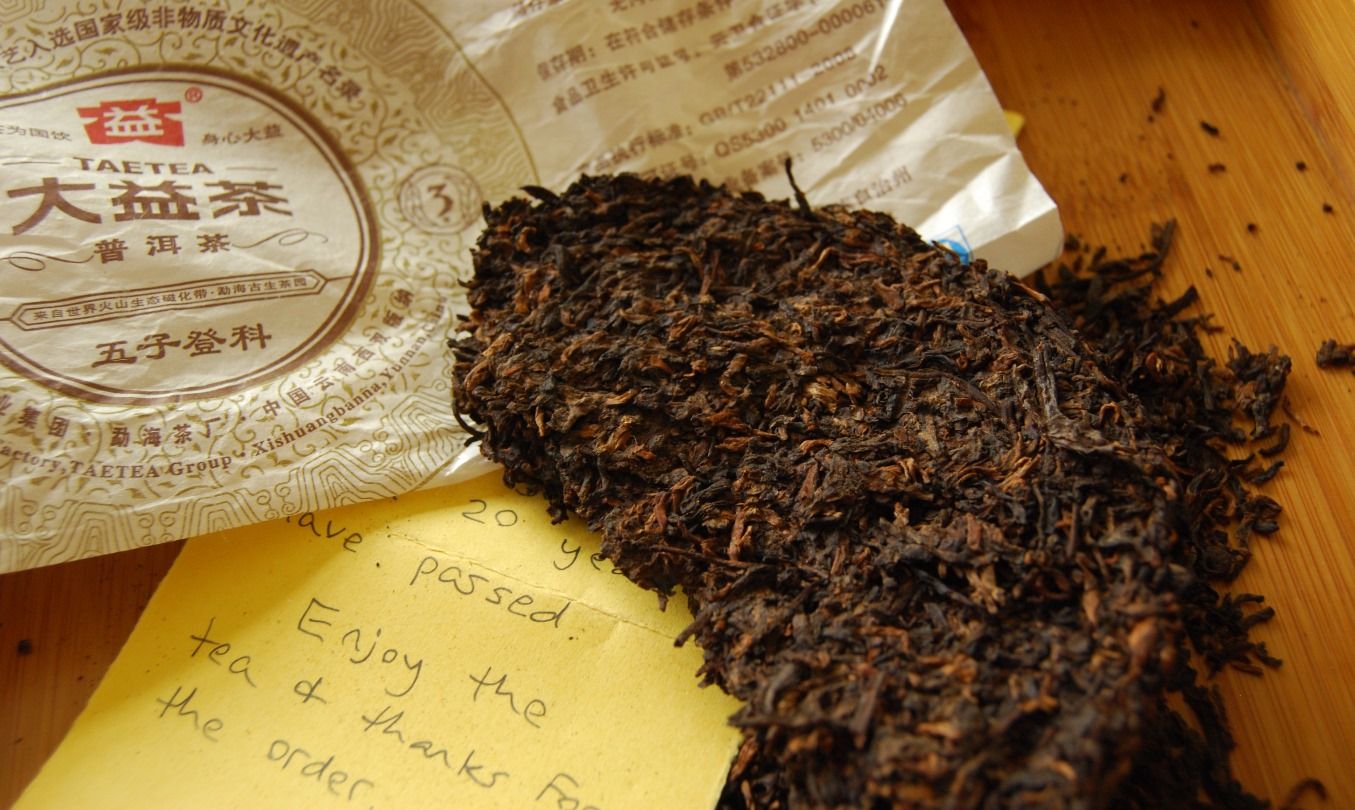
My current lab tipple is WUZIDENGKE from Menghai, which is amazing.  I have tins and tins and tins of this stuff sitting in my lab, thanks to Dubs.  Given that its name means (approx.) "five sons pass Imperial exams", this makes it a fantastic gift for academic colleagues, all of whom seem to get muchos chortles out of the name.  However, so thick and nasty is the CNNP brick from Awazon, that I am considering changing gear from time to time.  

I'm just not sure my white blood cells are up to the job.


SK LFG


SK LFG
WTB DL TP
1G PST
24 October, 2014

Teenager Tea

Teenage pu'ercha is a great deal easier to handle than real teenagers, I think.  Although my boys are just 2 and 4 years old, at the time of writing, I look forward to their teenage years.  In tea years, it is approximately years 2-10 where the changes happen, depending on storage - after a decade, you're into much more gradual territory, and the character of the tea has, to some degree, been determined.

The teenage teas in today's article, then, are all "settled down", to a varying extent.


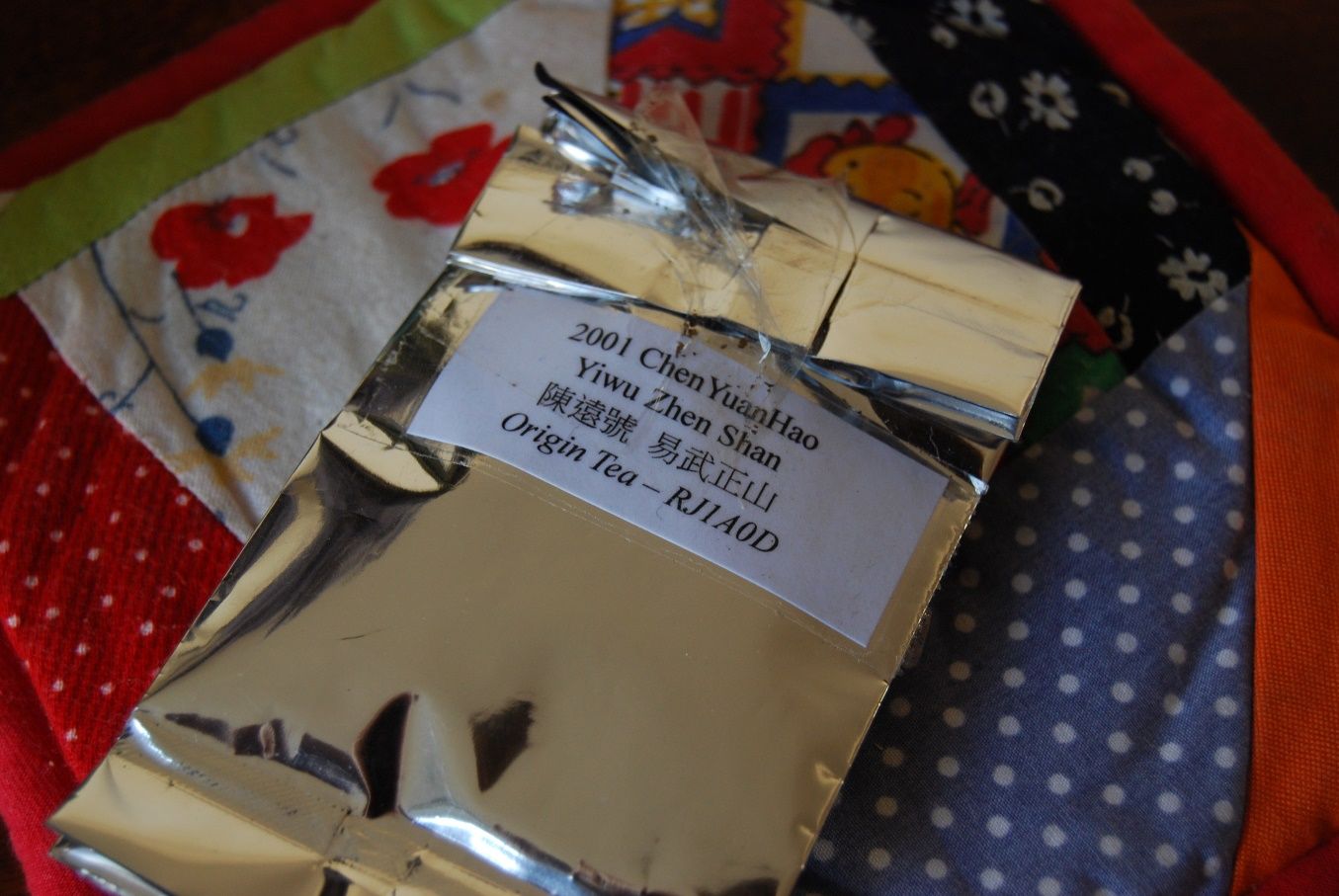
The first is the 2001 Chenyuanhao, a Taiwanese producer with a reputation for scrupulous control of processing.


While seemingly stored in Taiwan (this tea came from Origin Tea, after all), the black-with-rusty-orange leaves have the dense sweetness of more humid climes.  I seem to drinking nothing but HK-Taiwanese tea lately.  That is not a complaint.


It turns out to be a heavy orange, aided by the quantity of leaves that I have rammed into Zidu, my pot.  It is tangy and a little "fishy", in the manner of some straw-like Yiwushan tea.  There are few other regions from which a tea of this character could be derived.  Again indicative of the region, to my mind, there are those wildflower overtones that I associate with the better teas from the area.

Dense, tangy, and sweet, with a reasonably smooth body, it actually seems a touch unready.  The floral Yiwushan nature is very familiar, and very welcome.


A second tea from Origin (and again kindly provided by JT), we have...


...some sort of "special order" Haiwan.  I don't usually touch Haiwan with a big stick, because it is the single guaranteed producer that you'll find in almost every single bad pu'ercha shop in China.  Laotongzi is, almost literally, everywhere.

Brushing off those negative associations is not easy!  The fact that this used to cost around $150 when it was available raises the eyebrows, too; presumably it is better than I think it will be.


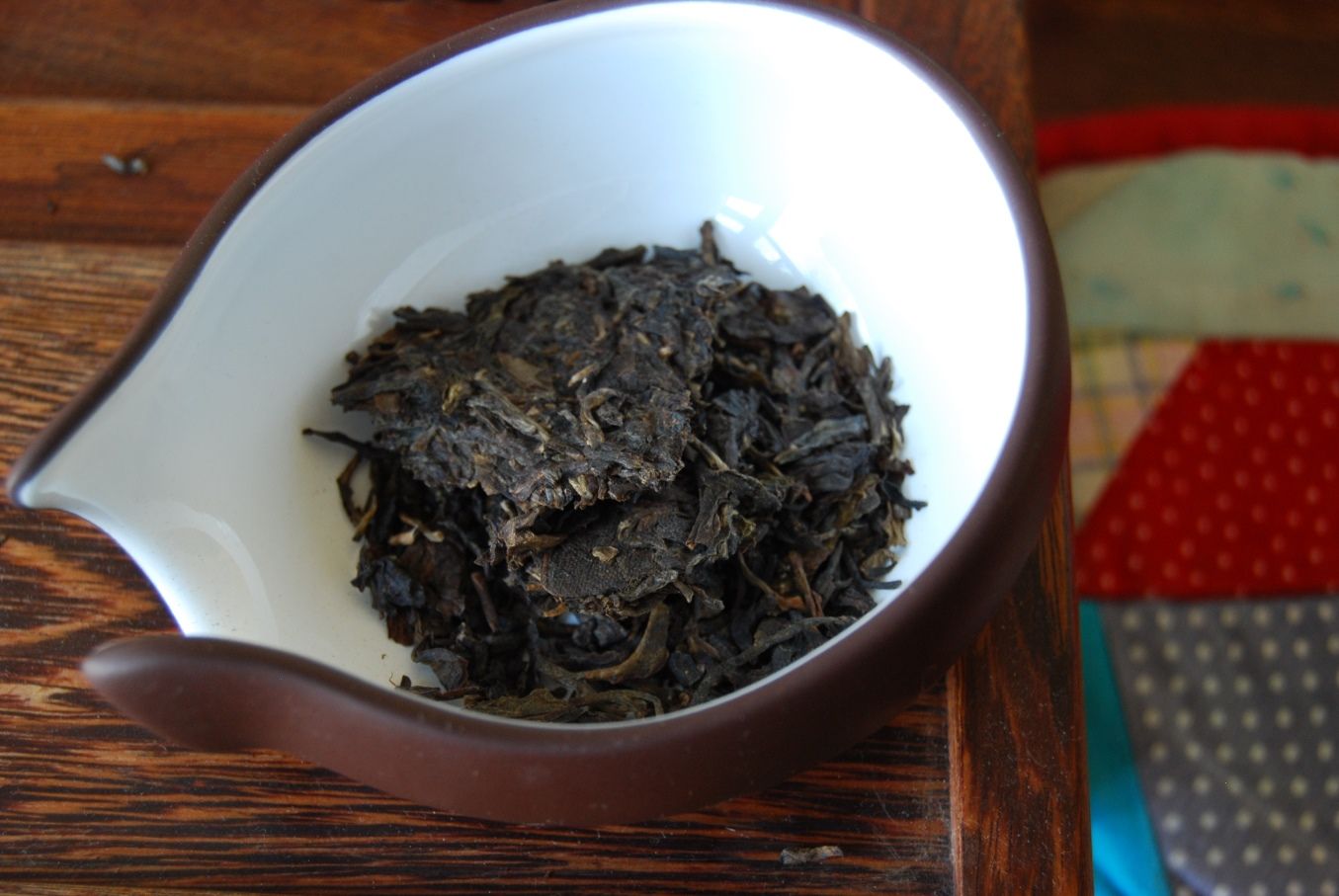
The little leaves, pictured above, are filled with heavy and humid scents.  When I opened the sample bag, I was assaulted by obvious smokiness; this continues in the aroma cup, but, thankfully, not so in the tasting cup.  It is also immediately sweet, which I was not expecting at all.


Its standard "black" woodiness is not too underpowered, despite the high compression that would otherwise suggest it needs time to open.  It is easy enough to drink, and surprisingly rewarding: the "black" sweetness, although presumably down to Dayi-style cunning in the processing of this tea, is long-lasting and perhaps even cooling.  It tastes rather like Dayi, and has the low plantation ceiling of same.


Speaking of which...


I like Dayi, but I don't like Dayi.  There is a difference.  If you're of the mind for some low-ceiling plantation tea, with a probably blackness added by virtue of the old factory's dark pantheon of tricks, then it is always good fun.  When aged, even when aged in Taiwan (as is this), the result is often woody, sharp, and enjoyable.

This particular cake weds the Dayi blackness to a charming Nannuoshan sweetness that works very well together, and of which you'd think there would be more, given how many zillions of cakes Dayi churns out every year.

The problem with Dayi begins when the mainland tea market gets its brand-fixation problem going, and the price disappears through that same ceiling that is otherwise containing the character of the tea.  Dayi tea is simply not worth the often-huge asking price.  More than any other mainstream brand, Dayi seems to have some sort of terrible grip on the wallets of mainland consumers and I know not why.  I can guess (!), but I'm sure the true reasons are manifold.

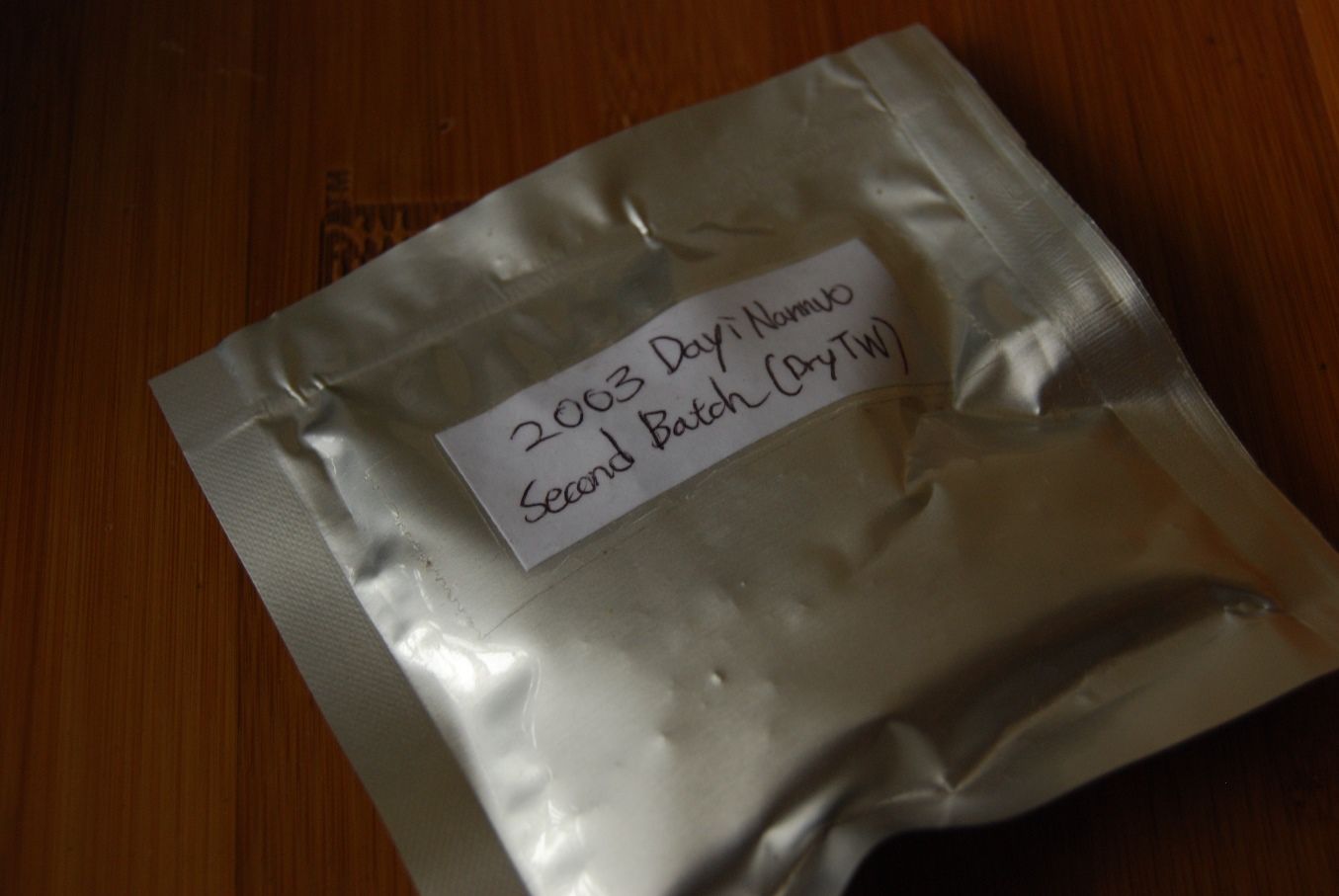
This 2003 Dayi is, would you believe it, orange, woody, husky, and tastes like solid 11-year-old taidicha.  I refuse to look up its price, because it would make me chuckle.  Thanks to PM for this sample, which reaffirms all of my preconceived notions with respect to the Great Benefit.

19 September, 2014

A Postcard from the Fragrant Port

If all goes well, Gentle Reader, then you are reading this while I am on the way to the Fragrant Port.  I'm not entirely sure which fragrance modernday Hong Kong sports at this time of year, but I suspect that "fragrance" might be a little generous.

As it happens, this article is all about The Dayi, and one of my Hong Kongese chums, Apache, is about as into Dayi as I am.  We're not fanboys, I should point out, but we do get together from time to time to drink up the "Great Virtue".  There are people like us, who enjoy a bit o' Dayi, and there are the other kind of Dayi fans - those folk who can tell you all about the way certain flecks of ink on certain characters indicate special batches, and so on.


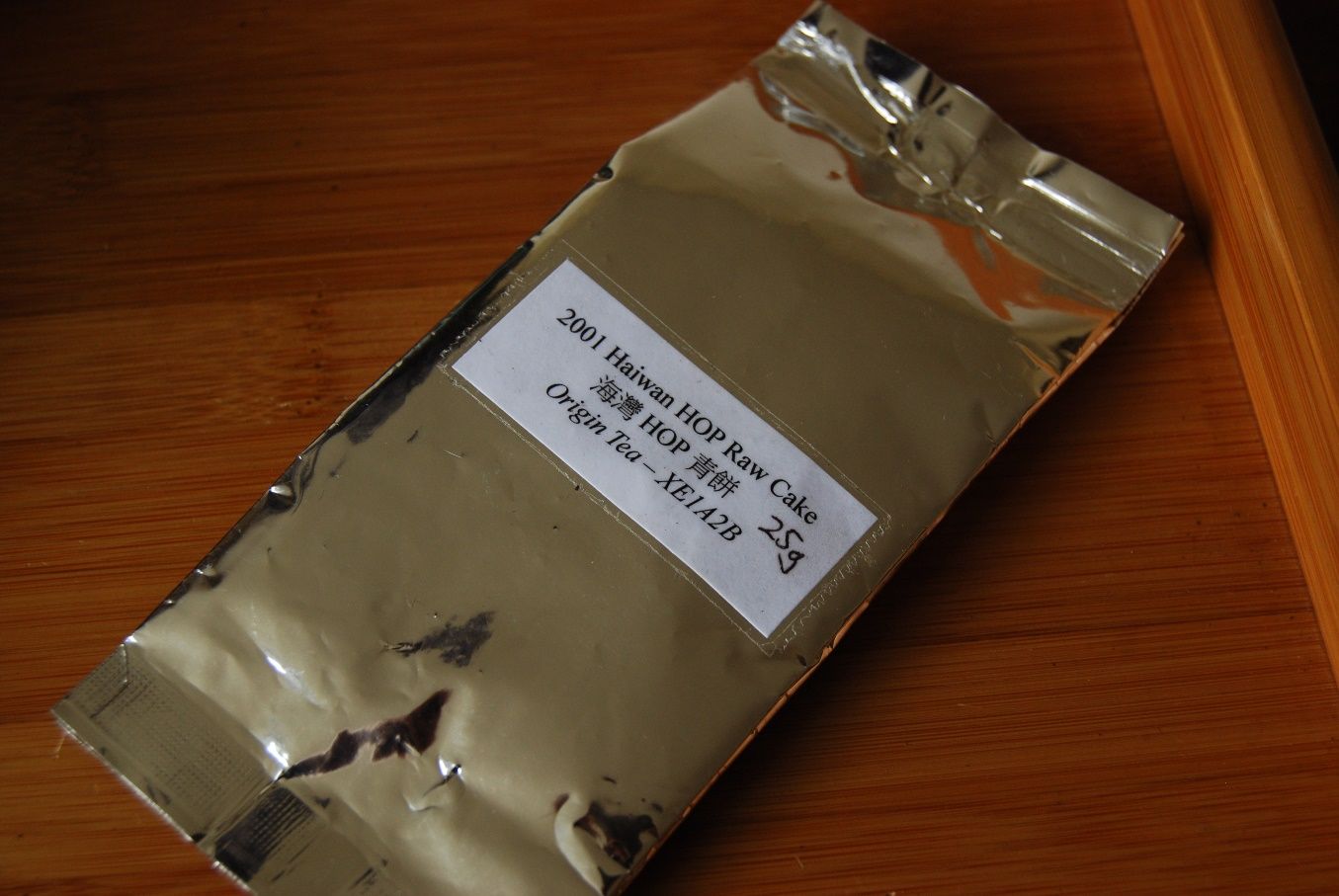
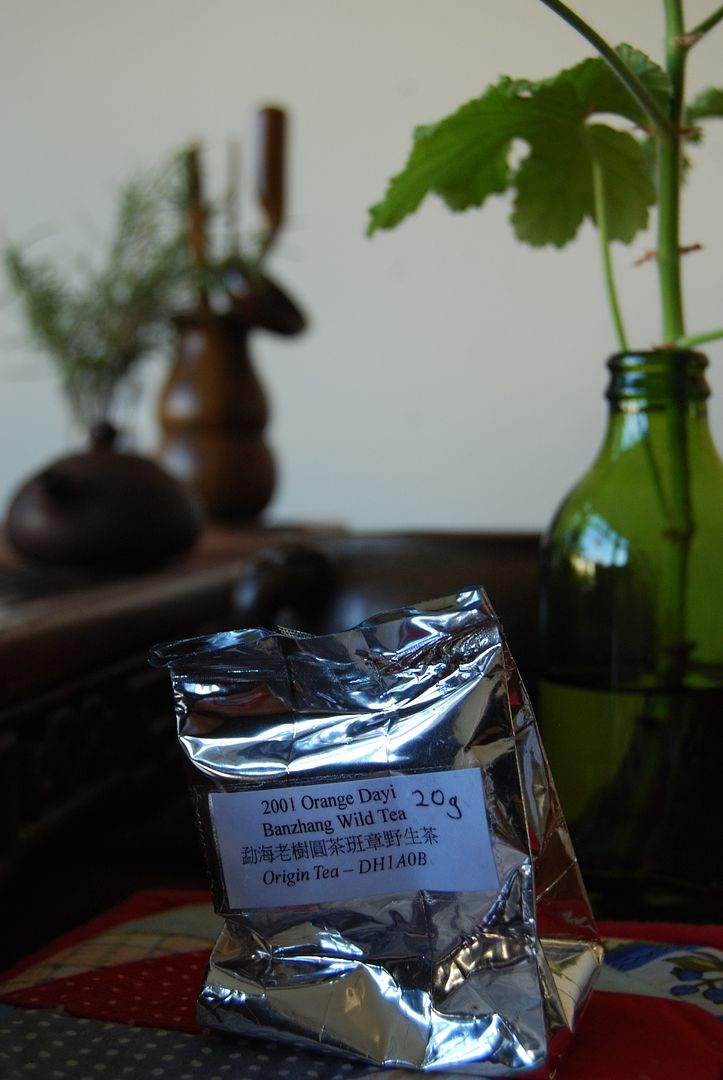
This tea came from the now-defunct Origin Tea, by way of JT (many thanks).  2001 Banzhang "Wild"?  Of course it is.


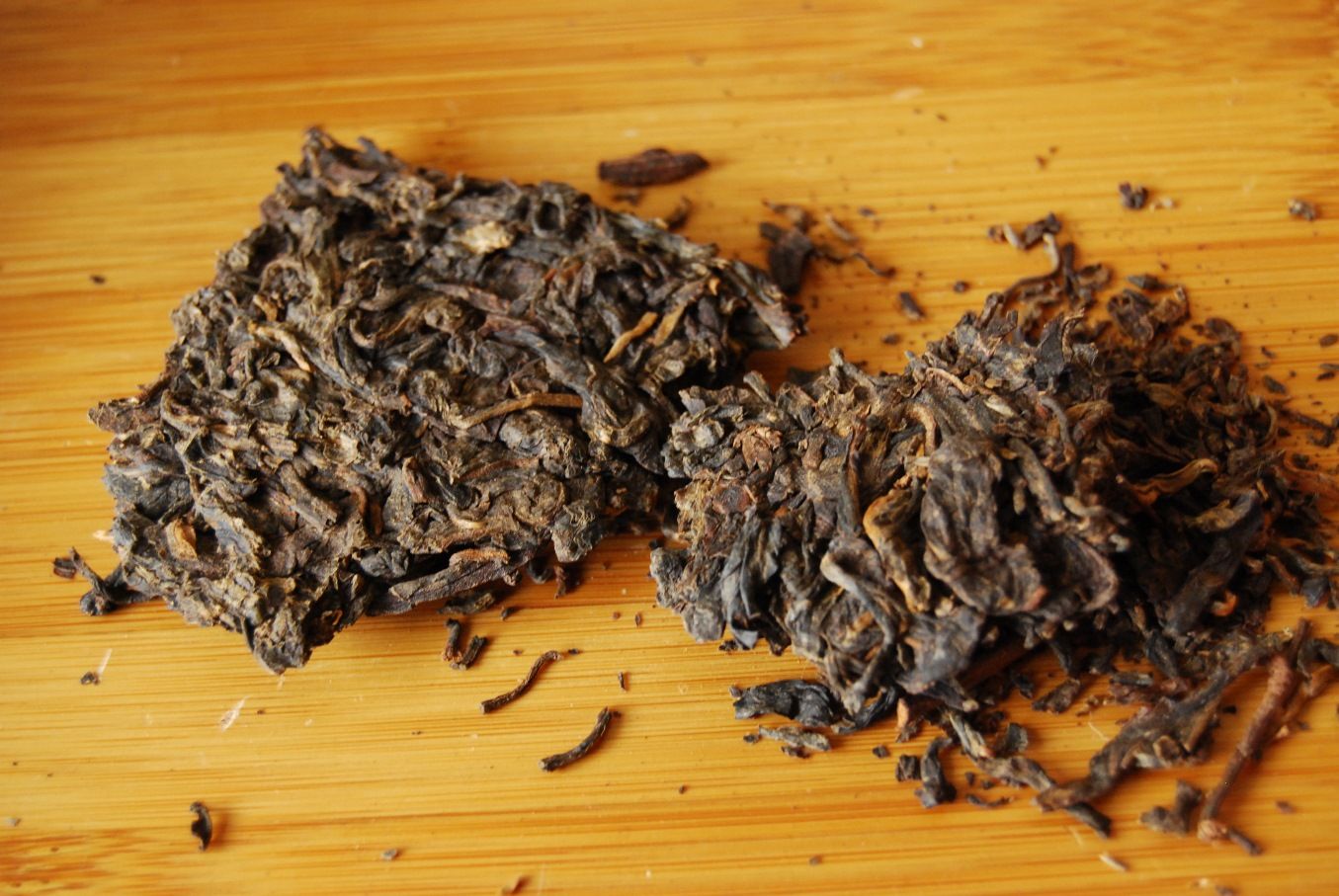
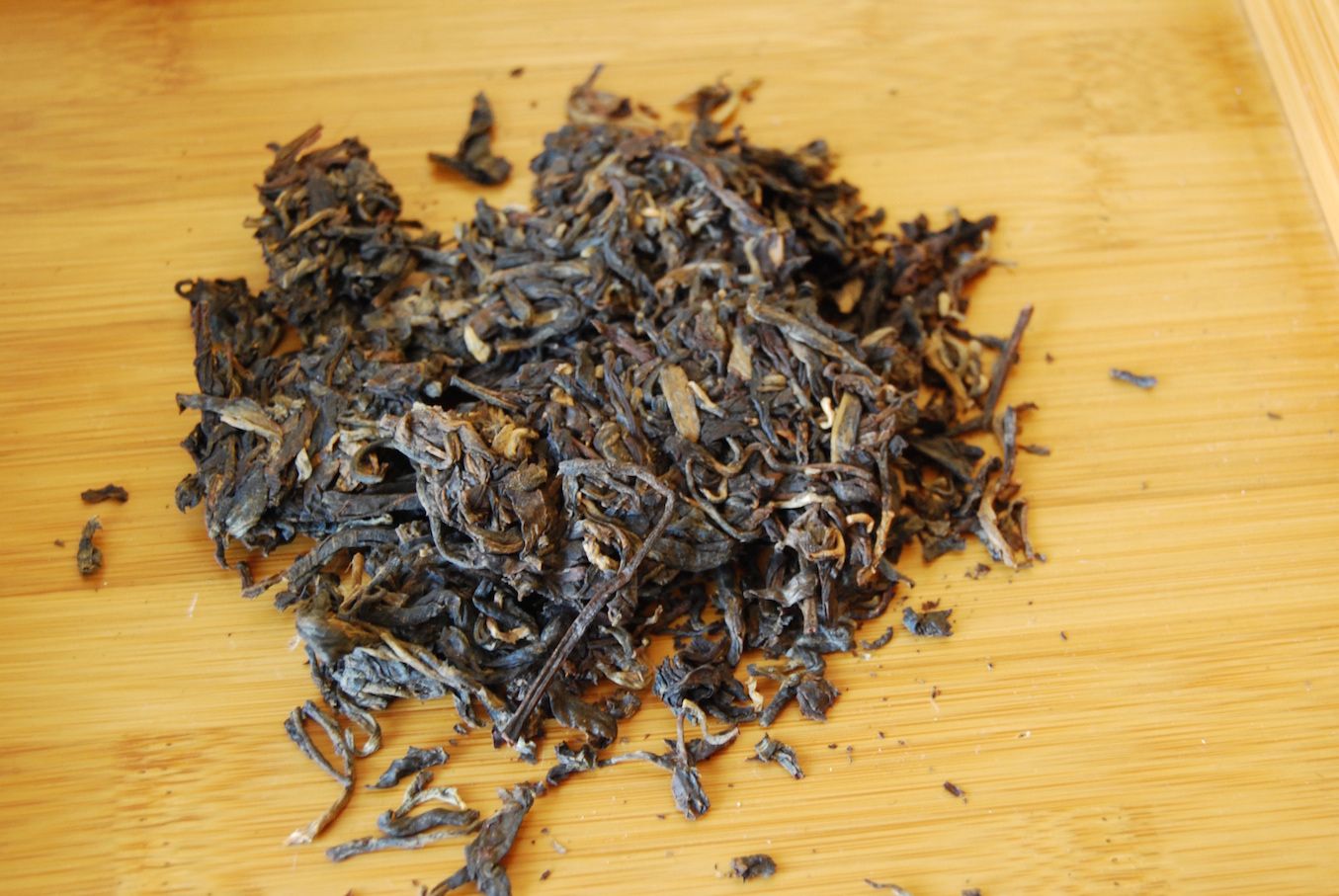
Looking at the photograph above, this tea is as expected.  You can almost smell the tell-tale blackened plantation aroma just from the bitmap.  It is exactly that which you would anticipate for Dayi.  I am fascinated to see that the stereotypical "Dayi" house style existed even in 2001.


It is orange and husky, but you knew that.  This is a sharp cake, with some (ready the lifeboats, stand by your bunks) dry storage.

Queue pictures of Luke Skywalker holding onto a weathervane.

Luke didn't have it so bad.  He lost a hand and the Sith Lord that was doing the Emperor's dark bidding turned out to be his father, sure, but he didn't have to cope with excessively dry tea.  I'm not a fussy drinker, and I can drink everything from a cake that's so humid even your average Hong Kong resident wouldn't touch, all the way down to something that's as dry as a Jawa's gusset.

In this particular case, it has a solid body, but absolutely no huigans at all.  There is simple, plantation strength, but not too much else.  Yes, it's Dayi, but (and don't hate me here) it's really not the best example of Dayi that you might hope to find.


This next cake is the 2003 Dayi "Purple".


Foiled!  The colour balance of my pre-dawn photography was so unalterably nasty that I simply had to desaturate the entire image.  At least you can see the shape of the leaves. 


This second plantation recipe, like the 2003 Jin Dayi, has become very expensive.  As with the 2001 Orange Banzhang, above, this is blackened and sweet in the usual Dayi way.  This cake is also a victim of basic economics: the demand is so high that the price has risen way beyond that which I would consider to be "good value", and has passed even beyond "almost reasonable".  It is, merely, a husky Dayi plantation tea, without much huigan [returning sweetness].  It is good plantation tea, certainly, but you couldn't buy this with a straight face.  This is internet forum madness, and not worth contemplating.


The 2001 "Commissioned Purple", however, is really worth thinking about, in my opinion.


That picture is enticing.  I am enticed!

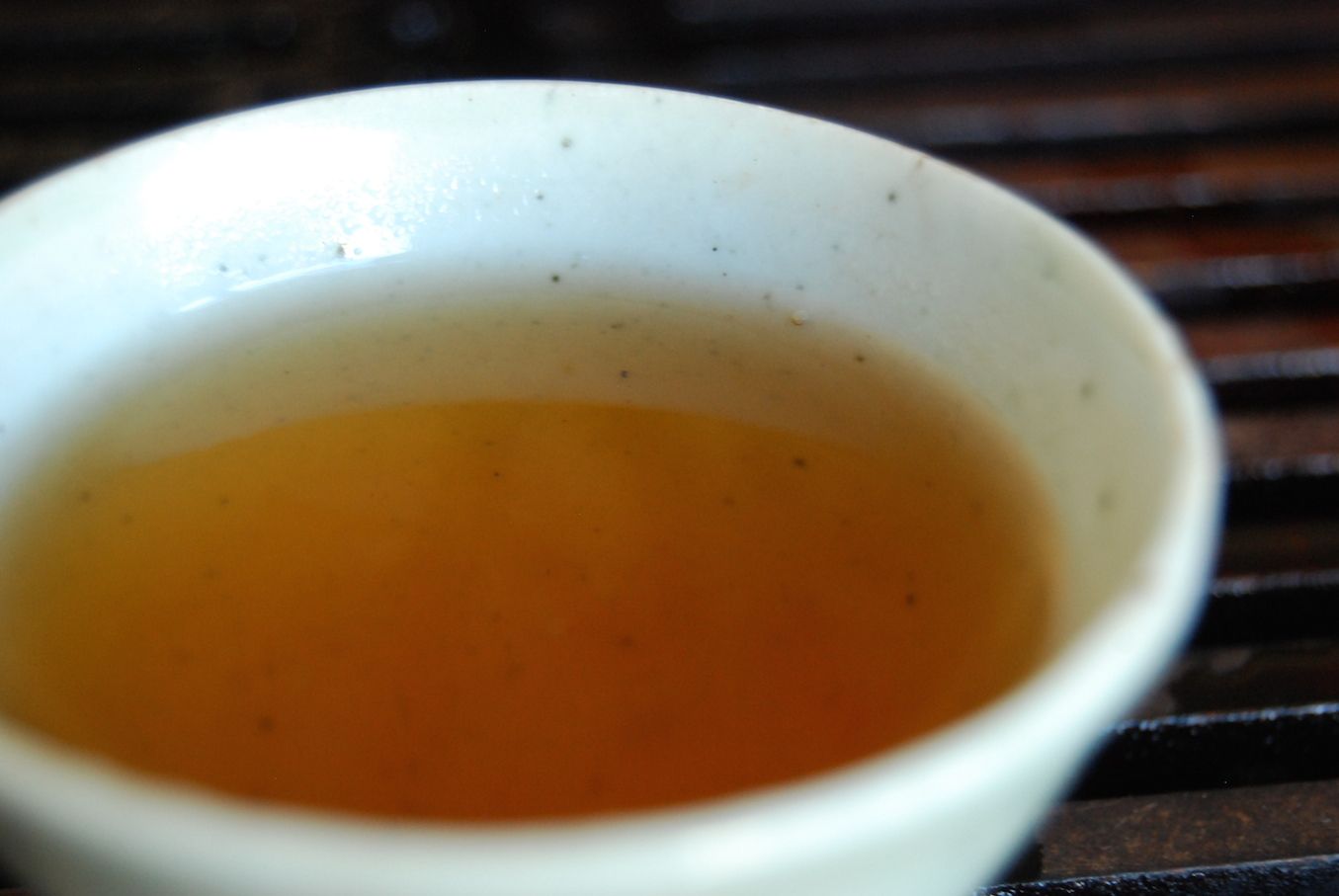
Dark and humid, these leaves are calling out for a good session.  The "commissioned" status lifts it above the norm, quite obviously.  Gone is the husky blackness of standard Dayi; in comes the very real scent of grapes and raisins.  This smells much more natural.


This is red-brown, and very smooth.  Compare this 2001 Commissioned Purple to the 2001 Orange Banzhang, at the top.  It's like chalk and cheese; heaven and earth; Optimus Prime and Megatron.

I used all of the leaves in my sample, safe in the knowledge that it would be almost impossible to overbrew, which turned out to be correct.  It is dark and oaken like dodgy Norweigan metal.  Devoid of roughness (unlike the aforementioned Norweigan metal), this is made from quality leaves.

This is surely about as Dayi is ever going to get.  Its pure strength is its primary advantage, but it is the punch of an Ent: woody, solid, and completely unstoppable.


Finally, shupu.

Please, contain yourself, Gentle Reader, for such wailing is most unbecoming.  You sound like a schoolgirl.


I will have you know that I actually like shupu.  I often drink it in my lab, and I sometimes even drink it at home at the teatable.  Shupu is fine by me, when done right.

Doing shupu right is exactly what Dayi knows.  When you want shupu, you go to the people who invented shupu.


"Wuzidengke" [woo-zer dung-ker] refers, approximately, to five sons passing the examinations for the Imperial civil service.  It's a great name.  It's also a great pu'ercha pun, because a tong is called qizi, as you know (seven sons), referring to the seven cakes in a tong.  Guess how many little cakes you get in the (metallic) tong casing here?

PM of white2tea sent me a sample of this, as you can see in the photographs above, and I promptly swooped like the vulture I am and acquired a groovy metal tin.  It weighs in a about $70 for the lot, which is really good value considering how awesomely stable this shupu can be.

Heavy, black, clean, fresh, husky, and sweet: Dayi are the unbeaten masters of shupu, and here they are on fine form.  It has the soft, eroded edges of shupu, but retains good strength - a marvellous piece of composting.  There is complexity the likes of which one would never expect: honey, and much in the way of vanilla softness.

If you're doing shupu, then do please try a sample of Wuzidengke.  The name is hard to forget, and it is a personal favourite.

15 August, 2014

White Tea

Be calmed, Gentle Reader.  Despite the title of this article, the Half-Dipper has not started a baicha regime; instead, we focus on a trio of pu'ercha (hoorah) from white2tea.  We're not quite so desperate as to start drinking baicha.  Yet.


2003 Keyixing


Regular readers will know that I have enjoyed plenty of the teas on offer from white2tea, up to and including some of the Taochaju cakes made by a mutual tea friend in Maliandao.  I like the focus on good tea, at a good price; I get the feeling that we are in safe hands with white2tea.


It's strong, it's orange, and it's better than a lot of others - and it's $70


Keyixing is, apparently, a proper old brand from the 1920s.  That means about as much as you might expect in China, and so some modernday outfit has been making tea under that label, perhaps, if we are feeling charitable, as an "homage".  Ahem.

Mr. White2Tea notes that this tea was dry-stored in Guangzhou.  2003 seems about right, as you might conclude from the photograph above.  It is an interesting little fellow: caramelised, in a way, with a cooked, raisin-like edge that reminds me of heicha.  Unlike Hunan's rancid nega-tea, this Keyixing is vivid and crisp, with a decent aftertaste.  It is by no means "grand", and perhaps a little suspicious in its cooked-style constitution, but it is, at least, aged and quite strong.  At $70, it's a tight little tea for the money, and reminds me of white2tea's good selection criteria.  (Note to self: is it this 2003 Keyixing?)

It reminds me of old (possibly poisonous) Chinese cigarettes.  In a nice way.


Somehow, I missed the "New Amerykah" cake from 2013.  I get the opportunity to redress this karmic injustice by trying the "New Amerykah 2" from 2014...


2014 white2tea "New Amerykah 2"


Like the Keyixing, this is $70 at the time of writing.  I like Paul's naming conventions for his cakes, and look forwards to the day when his tea starts quoting, for example, Monolith Deathcult lyrics, rather than classics from jazz and world music.  I fear that I may be waiting a long time.


It's good

It seems, from the blurb, that this cake is "old arbor Menghai" (aren't they all?) with some Bulangshan leaves.  Unlike almost every other vendor under the sun, I do tend to trust Paul's assessment of his maocha's origin.  This is a big, fresh tea that reminds me of years past, spent discovering similar-tasting leaves from maestro cakemeisters such as Essence of Tea.  Just like some of the best EoT, this is bold, sweet, and grape-like.  It packs a fantastically clean finish that delivers a precision, laser-guided strike to the deliciousness receptors in the mouth.

It isn't strong in kuwei, but then Paul notes that the emphasis is on "fullness" in this 2014 version, rather than on "bitterness" in the 2013 version.

"Quite mild", notes my mother, who is visiting.

Take note: when your mother calls a pu'ercha mild, then it is probably as soft as faerie urine.  There's mild and then there's "my mother just called that mild".  This is the latter.

Later infusions build on the faerie urine to make a dry, husky, sweet cake with a long aftertaste and decently citric, fruity finish.  It rather reminds me of a dry white wine.  By the third infusion, it has swollen into a mouth-dominating bigness that confirms Paul met his target of "fullness".  It isn't too expensive, and is a fun trip around the tea-table.  As ever, white2tea delivers on its ability to select decent cakes.  I am tipped over into the "do not buy" state by virtue of the fact that I have quite a lot of tea that tastes like this (many kg of which were bought from Nadacha, back in the day when they were £20).


Closing the show, we have the 2014 Laoman'e.  The blurb quite reasonably states that this "is by no means a bargain", which is testament to its $180 price.


2014 white2tea Laoman'e


A modern tea has to be darned fine to justify $180.  I'm just going to buy something aged for the same price.  I do understand that maocha costs money these days, but the result remains unchanged.


Nature always finds a way


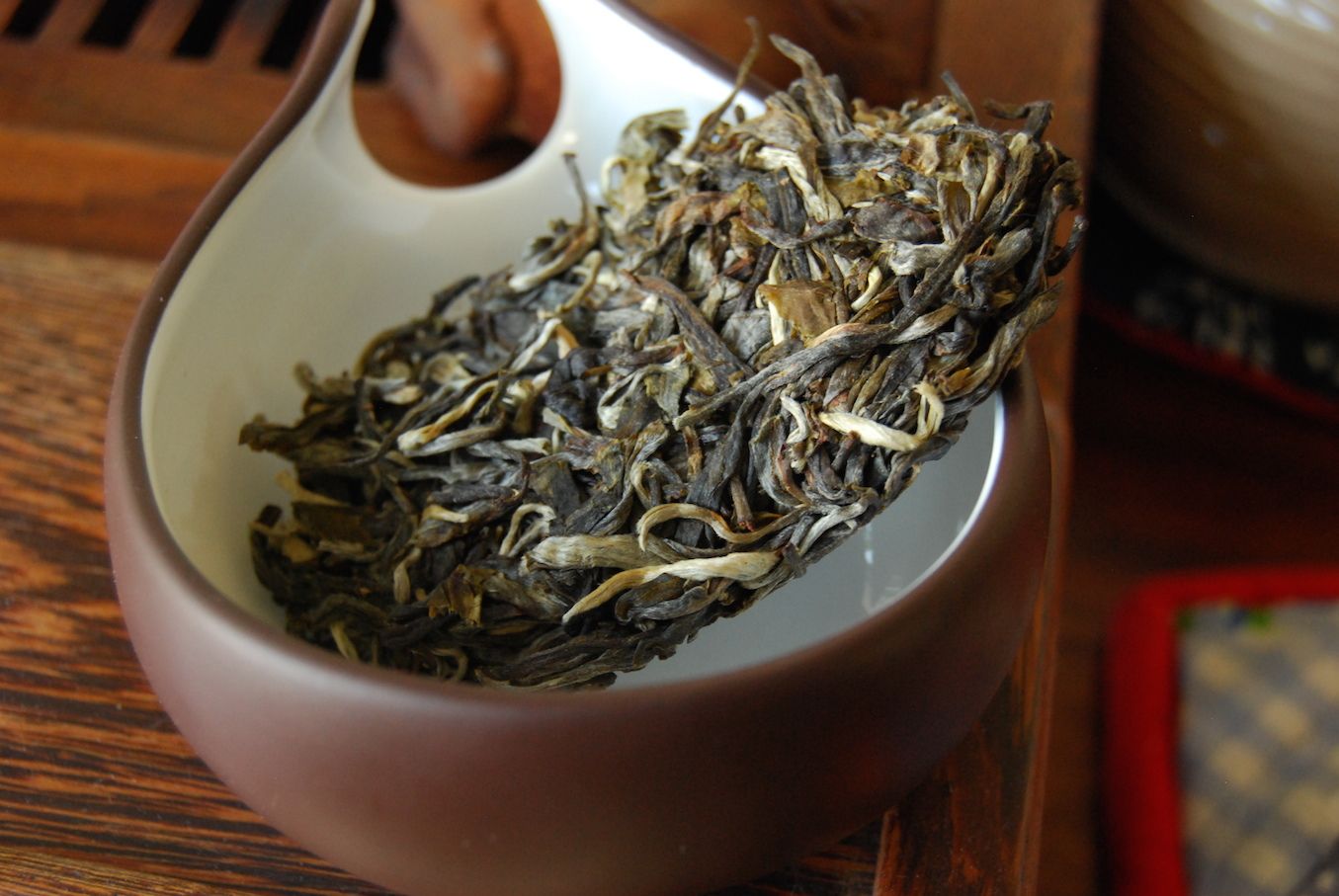
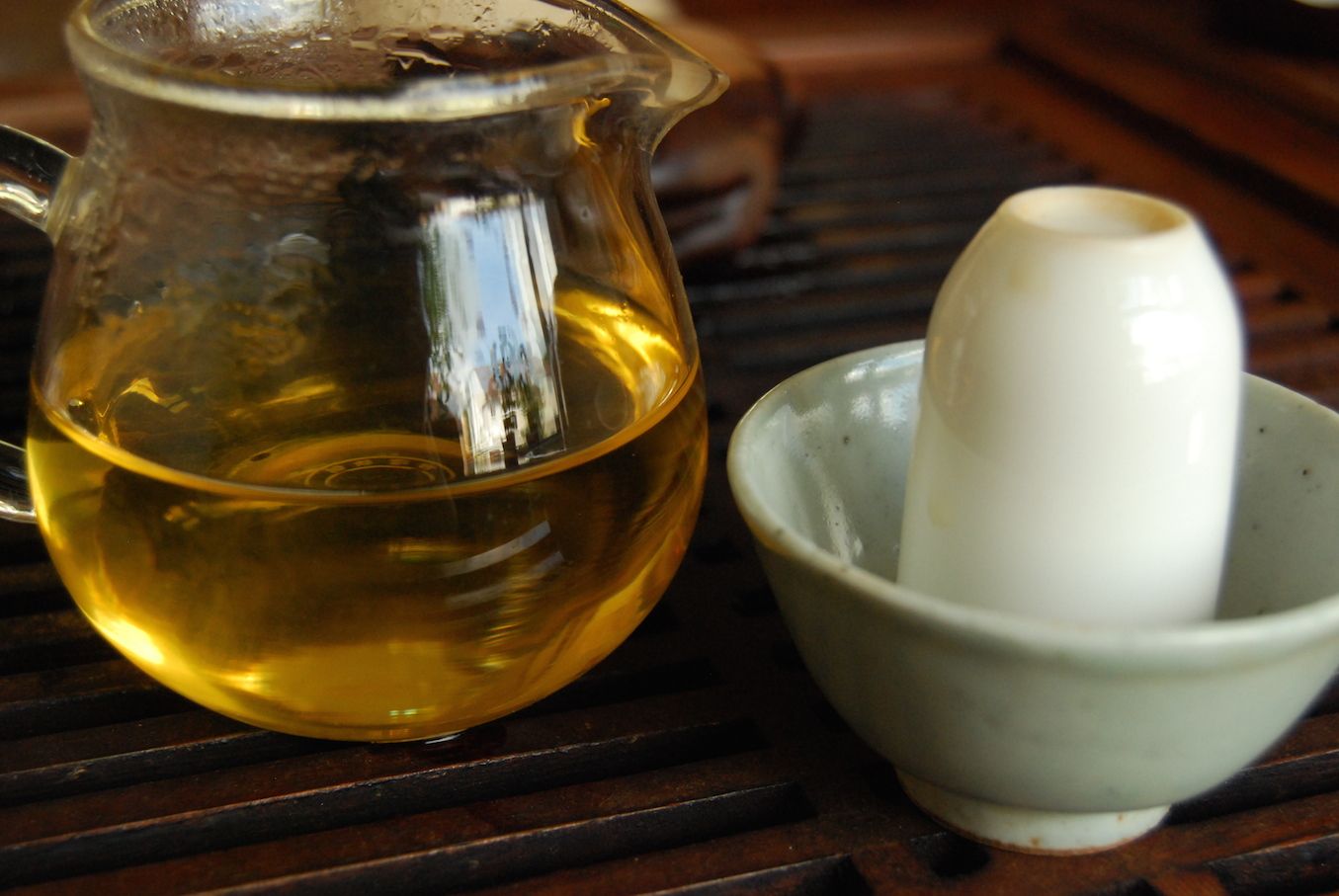
The leaves are tippy and a little broken, but look good.  The soup, as you'll already have cleaned from the above, is very clear.  It reminds me of the amber from Jurassic Park, in fact, which is surely every chaos mathematician's playbook.  You would be genuinely surprised how many chaos theorists I meet who are still doing the Jeff Goldblum look.


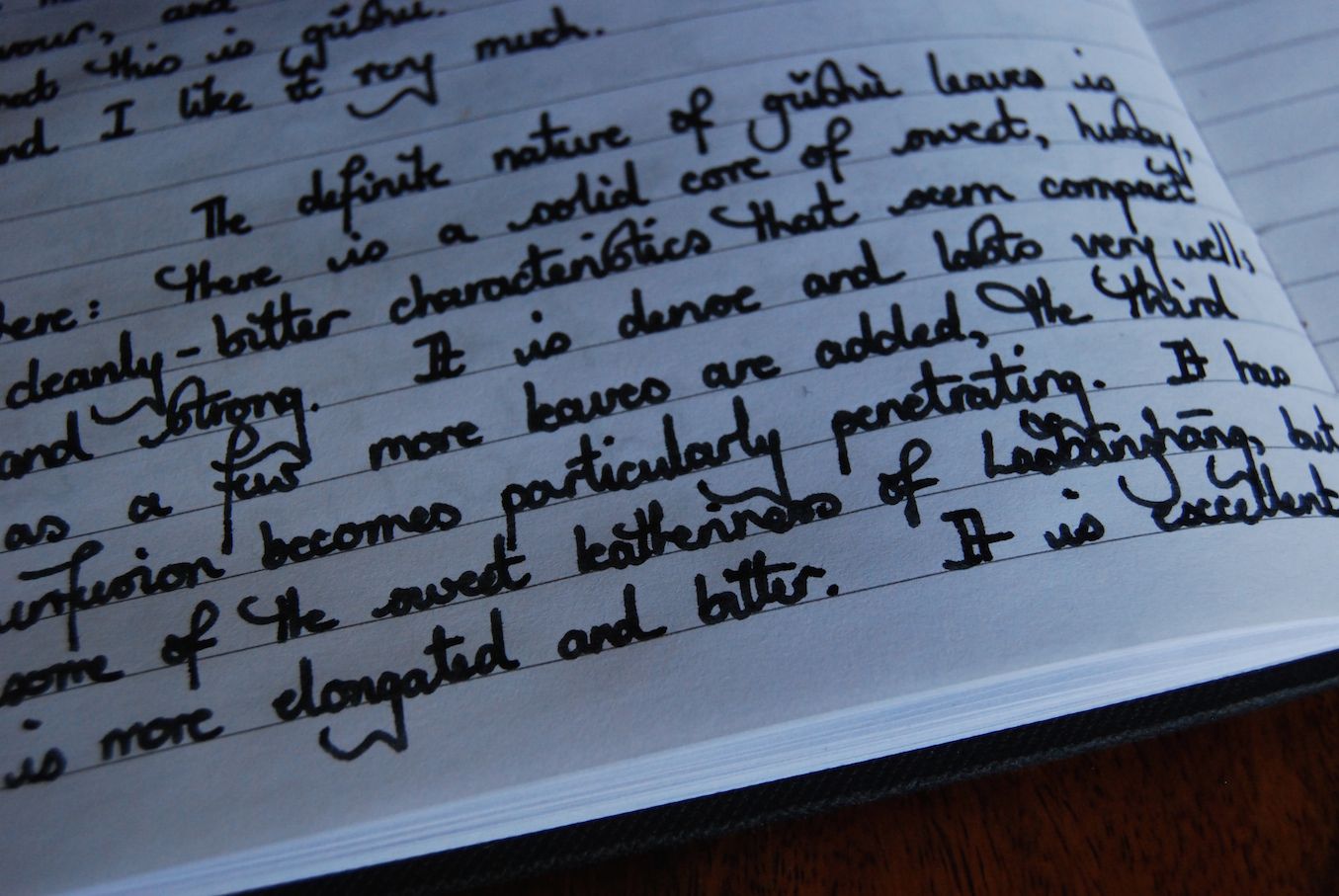
The definite nature of gushu character is here.  There is a solid core of sweet, husky bitterness that seems compact and strong.  That density carries it on well, and is surely something that we're looking for in a candidate for aging: you want something heavy and irreducible, that will not fade with age.

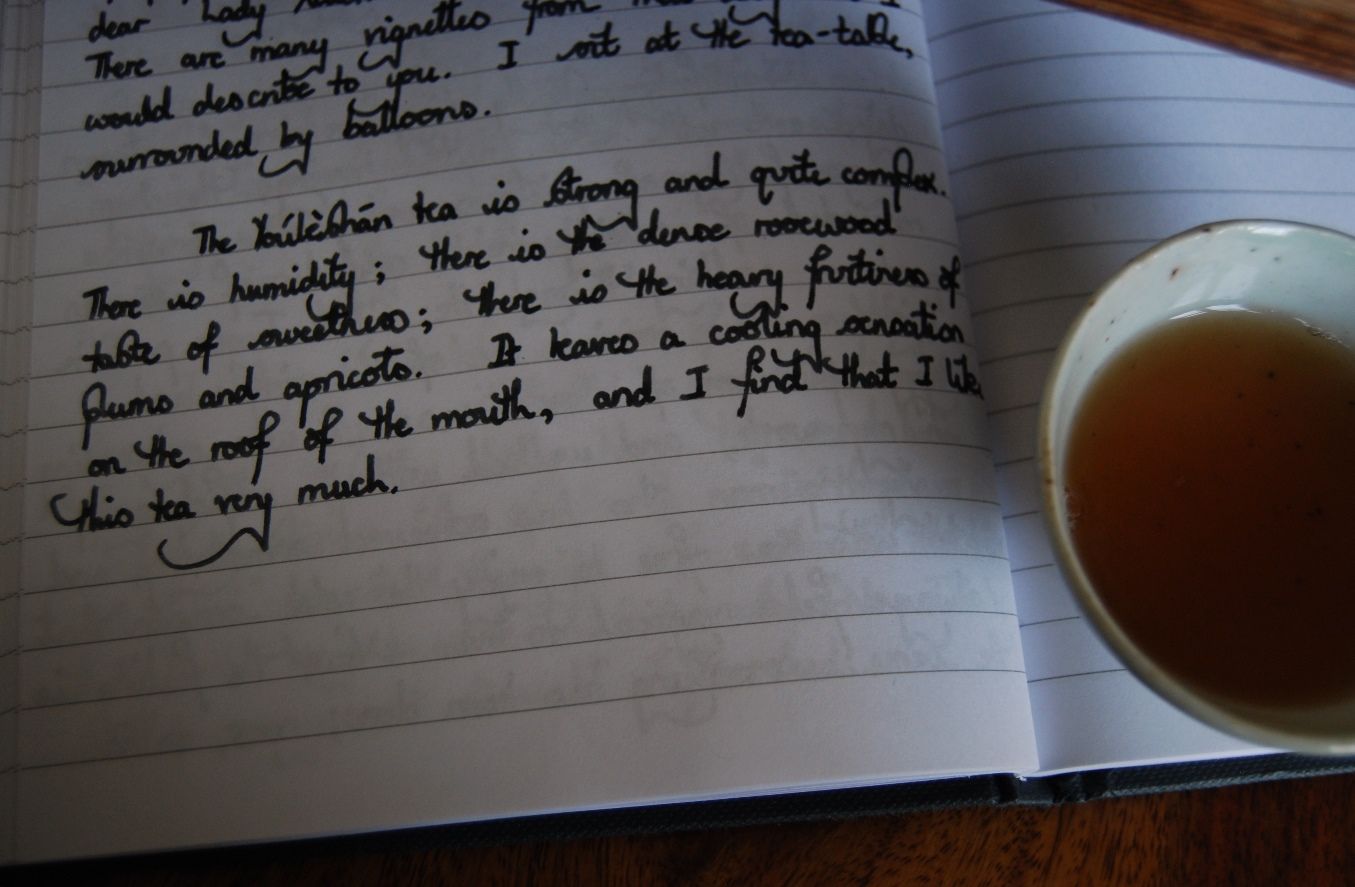
As with much Laoman'e, it tastes like the bitter, citric, evil twin of Laobanzhang.  "It is excellent", I wrote in my journal.

As for me: $180?  I'll take the already-aged cake, even if it is of leaf from a lesser provenance, but that's just me.

Overall: white2tea continues to deliver the goods, to fit a range of wallet-tightnesses.

08 August, 2014

The New Old Half-Dipper

The ol' Half-Dipper is coping with some changes, which you may or may not have noticed - it is the common story of a tea-site.  I thought that I might offer you an explanation, Gentle Reader, which is much-deserved given your infinite patience.

Back in the day, I somehow managed to write an article on this web-site almost every day, which was perhaps a  testament to exactly how much spare time doctoral students have on their hands.  I started as a graduate student in 2004, and met my wife-to-be in the same year.  Happy days indeed!  I drank a lot of tea.


Since graduating, in more recent years, I've written articles for publication on Mondays and Fridays, which fitted with the timescales of my post-doc status of the time, in which I was effectively working for a senior professor.  If you've ever served your time as a post-doc, you know that it can be busy, but there is a certain rhythm that allows you to, for example, drink and write about tea on a moderately regular basis.

The big change to my life happened in October of last year when, in a moment of uncharacteristic and substantial foolishness, my university decided to appoint me as a member of the faculty.  It subsequently handed me the steering wheel for a research lab.  Bear in mind that I cannot drive, and that I get asked to prove my age when I try to buy alcohol (heh).

Since that time, life has consequently become more and more rapidly accelerating.  It is a hugely enjoyable time, and it gives me the genuine privilege of working with some massively talented students and researchers - but it does mean that, as our lab grows (approximately doubling in size every six months), the opportunities to drink and write about tea decrease proportionally.

The new ol' Half-Dipper will, therefore, be a little less regular in its publication, and we will make permanent that arrangement that I have been trialling recently, with a summary article every week or so.

Let's kick off this new old Half-Dipper with an investigation of a recent week of annual leave, some of which I managed to spend at the tea-table.


The 1998 CNNP "Apple-Green" tuocha


I basically spent the mornings of the entire week with some mind-wreckingly good tea from an outfit called teaclassico.com.  Full disclosure: the proprietor, Neil, sent me a big box o ' treats without charge.

This actually caused me to reevaluate completely how I go about buying tea, such was the magnitude of the fabulosity of the tea.


Decent CNNP tuocha leaves in the old style


The tea market is a strange affair: modern pricing has inflated the cost of modern tea to tear-inducing quantities; even a few years ago, the same tea could be bought for a fraction of its current price.  These price increases have been passed onto consumers, and there are now very few outfits that provide good, modern tea at a reasonable price.

I would count white2tea, Chawangshop, and Yunnan Sourcing as my current "go-to" tea vendors, who have managed to keep a cap on prices, and I spend almost no money outside these three (excepting direct purchases via Maliandao or Taobao).  Other vendors are in no way bad, but their offerings are now frequently double or triple (or more!) the price of equivalent cakes from previous years, and I simply could not bring myself to pay that much.  In many cases, this is not the fault of the vendor, due to the cost of maocha - but, whatever the cause, the result is the same.

Price increases could be argued as being a good thing, if the farmer is seeing more of the profits.  We see signs of this throughout Yunnan, particularly in places such as Laobanzhang.  To estimate the proportion of the price increases that reaches the farmer is rather futile, given the lack of data.


Gloopy, strong, clean - what else do you need?


We have older teas, however, that have already reached a price ceiling, of sorts.  The only way that modern tea can comfortably be priced at sky-high prices is if all vendors simultaneously increase the prices of their older teas, but this they have not done - perhaps due to that intangible (and soft) price ceiling on older teas.  There is, after all, a limit to how much an old tea is worth, without demand for it increasing hugely.  With demand often confined to modern teas, hence the price rises, we have the strange effect that price pressures are tightly focussed on modern teas, but less on older teas.

Yes, the prices of the super-classics have gone crazy, but I maintain that there is a class of good, aged teas that has not seen the price increases of either the very modern or the very old teas.

Therefore, drinkers such as me, and perhaps even you, Gentle Reader, are being driven away from spending their money on modern teas (excepting obvious "white whale" bargains!) and instead spend their money on older teas.  This was previously something that I did not do, at scale, but where now I would much rather spend X units of currency on something of proven vintage and aging, than spend the same X units of currency on something modern, with all of the risks that arise from uncertainty over processing, storage, etc. Why take the risk, when older tea costs the same?

In that spirit, outlets such as Teaclassico are well-placed to capitalise on this new category of consumer, which comprises drinkers who are looking for reasonably-priced older teas, of similar price to modern cakes.  We are searching for those cleverly-prices teas from the mid-range, between modern and aged, and places like Teaclassico are meeting that need.  Such vendors are unhindered by trying to sell you modern cakes, and so can afford to price their aged tea at reasonable (Taiwan-esque) prices.

The first tea that meets my quality:price threshold is the 1998 CNNP "Apple Green" tuocha, shown here: this is $83/250g ($119/357g equivalent), which makes it much less expensive than many modern cakes.  Admittedly, this tuocha is not a grand tea, but it is (i) strong, (ii) aged, and (iii) priced nicely, which is a fine place for a tea to occupy, whereas modern tea can claim only (i) at best.

It is a heavy red-orange, as befits tuocha from 1998, and it very smooth, very heavy, and very enjoyable in the mouth.  It has a smooth, "beefy" sweetness that is clean and soft; it cools and tickles the tongue, and has the liveliness of good tuocha.  Purchase of this tea seems straightforward.


One step up the food-chain from the tasty 1998 Apple-Green tuocha is this 2003 Menghai 7542.  This could very well be the last 7542 before Menghai Tea Factory flipped over into Dayi.


2003 Menghai 7542


We're one step up the price ladder here, at $129/357g.  The cake started out in Hong Kong, and ended up being stored in Taiwan for some years.  This is a common story for the cakes from Teaclassico, which leads me to conclude that Neil has spent some time with sellers in Taiwan - this is no bad thing, as I never get to Taiwan, and I like the storage there.  In some ways, an initial period in HK followed by a cleaning-out in Taiwan is an optimum, as far as my tastebuds go.


Even the leaves look "Menghai"


It is a heavy orange-red, as you might see below, and has a sweet and tarry body that reminds me of other 7542s from this era that I have enjoyed with Apache.  It is clean, and cooling, and quickly fills the mouth.  There is a good quantity of Menghai house character, and this surely must be the best protection against fakery that one could hope to achieve: a recognisable house character.


Chunk-y

As with many strong, good teas, this one takes a good two or three infusions before it reaches full speed: it needs a good run-up, which usually always corresponds to good-quality tea in my experience: it has tons of contents, and does not throw them all away in the first infusion.  Perhaps it is this "locked in" character, taking several infusions to rouse, that made it such a good candidate for storage.  Warmth, depth, mahogany: this is solid tea, with a penetrating, woody sweetness that leaves me feeling strangely calm.

Again, it is actually cheaper than many modern cakes, and is guaranteed to be good for aging - because it is already aged.


The prize for this week of teas is shown below.


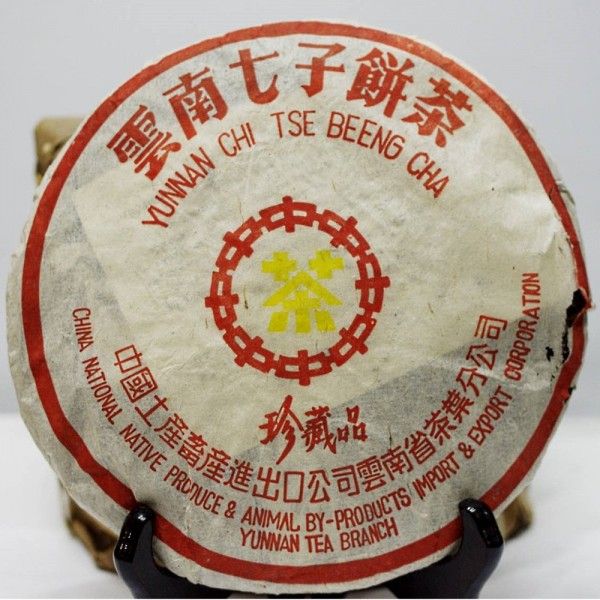
2000 CNNP Zhencangpin


The "Zhencangpin" [lit. treasure-store product; e.g. "collector's item product"] designation is shown in the calligraphic text under the yellow zhongcha character - otherwise, it looks like standard yellow-label.  However, that calligraphy makes all the difference: this is a big, bad cake.  Big!  And bad!


Delicious


The photograph of the leaves shown above makes the mouth water just from the image alone.  That's when you know it's good tea: when the photograph of the dry leaves makes you thirsty.

This is the only tea in the collection from Teaclassico that I actually drank twice, taking two precious days to enjoy it.  This means that, as far as I'm concerned, it is really rather fine.  It is a not insubstantial $220/357g, but compare that to modern cakes and you will be immediately convinced that this is, if not a bargain per se, then at least a very properly-priced cake (given recent pricing).

It is heavy, full, and continuous in its woodiness.  Again, there is a HK background of humid, mineral characteristics, but this has been sharpened and cleaned by the Taiwanese storage to magnificent effect.  In price, storage, and character it is almost precisely what defines "good tea" for me.  This is a personal decision, but it hits every single note that I need a fine tea to hit.

"OAK-PANELLED STRENGTH", I have in my diary.  Elongated,velvety, and strong.  If you have the opportunity to sample this tea, you may well be as enamoured as I was, during that week of annual leave.  Purchasement, as with the other two cakes shown here, is straightforward.


Everything that is good in tea


I hope that Teaclassico builds on its start, and that it continues to keep the pricing right - I will certainly be keeping an eye on their inventory from here on, as my buying habits have been forcibly changed.

Thanks again to Neil for a great week of teas that made for some excellent summer mornings.  The "Zhencangpin" was so good that I actually invented a new non-parametric Bayesian stochastic process during the session, and documented it over 17 pages in my log-book.  Not many teas manage to be both a great beverage and a muse...

19 May, 2014

Revision Classes

Trinity term has a pleasant feeling: it is sunny, there are few lectures, and my undergrad students are either heads-down in revision or heads-down in their glasses of Pimms. It is a time of revision classes and the like, which led me to some revision of my own...

I have received a goodly quantity of positive feedback for my previous foray into the nether-regions of my shelves and I am, Gentle Reader, always configured for maximal response to positive feedback.  If that makes me an unstable system, then may my poles will always reside in the positive half of the s-plane.

I have been revisiting some of my old teas, with an emphasis on the more trustworthy, reliable cakes that I know will deliver the goods.  This makes my sample biased, and I am fine with that: the goal, after all, is for good sessions these days.

Perhaps the most pleasantly educational encounter in the list below was that of the 2005 Xiaguan: this was a cake that was as black as an investment banker's soul when it was young, but which has matured so pleasantly that I am now wondering how my other "black" Xiaguan cakes have turned out.

To the victor, the spoils:

2007 Changyai - Yichanghao "Yiwu": sweet, heavy, solid, and aging despite being sealed in plastic.

2003 Changtai - Qianjiafeng "Jinzhushan": excellent tea.  Orange, heavy, and long-lasting.

2005 Xiaguan "8653": modern "black" Xiaguans can age well, it seems.

2008 Shuangjiang Mengku - Muyechun "Laoshu Qingbing": basic pu'ercha dressed up with purple tones, this is aging slowly.

2008 Menghai - Dayi "8582": in preparation for the arrival of a large purchase of 2008 8582, I try some of my own cakes.  They are coming on nicely, and provide basic Menghai richness.

2004 Changtai - Yichanghao "Yiwu Zhengpin": red, malty, and smooth, this is "old fashioned" tea of a reliable kind.

As ever, the new notes have been appended to the original articles, linked above, and so I invite you to scroll down when opening these pages.

17 March, 2014

The End of Winter

My friends, I hope that this post finds you well.  Wherever you are in the world, it is probably warmer than here, but that gives me hope.  Today is the first day after the end of term, and with it comes a feeling that something significant has come to a close.

The start of the "vac" is always a special feeling, but this year seems moreso.  The winter, here, was long: it rained almost non-stop for two months (which is unusual even for England), the sky seemed constantly dark and low as a result, and our two youngs boys were almost perpetually suffering from minor colds.  Today, with the end of term, the sun has come out.  The flood waters are receding.  Where once was deep water, now there are blossoms - actual flowers - of all shapes and colours.  First, the daffodils, in the vanguard of spring, and now finally the cherry and apricot blossom.  It is as if Mother Nature has finally said, "OK, let's do this."

On days like today, you will, I hope, forgive me for defaulting to a low-risk, high-reward tea.  This is the 2003 Dayi "Badashan tuocha".  I like Badashan, I like tuocha, I like teas from 2003, and I like Dayi ("so sue me", as our colonial cousins might say).  The game is afoot.


This tea was kindly given to me at the end of a lecture, believe it or not.  Hilary term is always a bit pressed for time, but this particular Hilary term was perhaps moreso: a close colleague just left for the USA, to be with his wife and child, and so my commitments have immediately changed as a result.  It has been a fun term, filled with opportunity and bright new people, but it has also been quite demanding.  Perhaps that makes this 2003 Dayi tuocha even more well-timed.

You can imagine the scent of the dry leaves, I bet.  Each one of us, to a greater or lesser extent, has "Dayi memories" that we can recall on demand.  They may be pleasant memories, or not so pleasant, but such is the ubiquity of Yunnan's oldest brand (approximately) that the Menghai Tea Factory has its own little place in each of our repertoires.  Suffice to say that these leaves are precisely as you might expect.  For me, that is A Good Thing.


Again reassurringly, the blend contains very few tips and is almost entirely made from dark Dayi mulch.  I have, this morning, just finished cooking my family a week-end breakfast, and the scent of fried eggs mixes surprisingly well with the rambunctious potency of Dayi.  My hot-plate, during the warm-up for this session, broke down, but not even a broken hot-plate can stop me today.  I grab a spare from the kitchen, and continue.

This is red and spicy, in exactly the right way.  As with many Dayi products of a certain age, as I remember noting before, it has a certain "fishy" character, for want of a better adjective.  This isn't at all bad - it is merely a description.  There is also, as ever, plenty of sharp sweetness.  It is not especially complex, but we do not turn to Dayi for complexity.  Instead, we require stability, a super-strong base of concrete kuwei [good bitterness], and that welcoming, cooling warmth that aged Dayi can sometimes achieve.  It is not noticeably "Badashan", but I am not one to quibble.

This is a fine and timely session, and I am grateful for JT for the sample.

I look forward to a warm spring, and look to sharing some tea with each of you, Gentle Readers, in our own distant, but connected, manner.

30 December, 2013

Aging Tea: A Mixed Bag

I have been sampling my own shelves widely, of late, and have come to some conclusions on the relative merits of my cakes ability to age.  (In each case, I have added notes to the original articles, which you are invited to inspect by following the corresponding links.)

The Good

The 7542-801 is quite good, although a little akin to a "dry storage" cake. The 7532-801 is better - it tastes more humid and more developed, and does not have the "dry storage" straw of the 7542-801.  Oddly, the 7542-901 is absolutely first-class.  Made just one year later, it is dark and heavy in that classical Dayi manner, and tastes very nicely aged indeed.  I suspect that most people would enjoy it - they would certainly enjoy it for the sub-$10 price in 2009.

Another success story is our aging experiment in central China, where Chinese Mama and Baba have recently brought us a few tong from our stores there.  The 1997 Laojunshan (pictured below), being one such cake brought to England, even though it is shupu, is heavy, round, and excessively sweet with old vanilla.  I look forward to trying the shengpu that we have.


My post-viva Hongjie cakes, bought in 2009 in Maliandao, when my dear wife was unknowingly carrying Xiaohu, our eldest son, has come on very well (much like dear Xiaohu himself!).  The change in the tea-leaves from their original green to a husky red-orange is very encouraging.

Finally, the 1996 Xiaguan bricks from Maliandao (pictured below) are coming on a treat - somehow, they are superdense carriers of vanilla and smooth huigan.


The Not-So-Good

Oddly, the 2003 Zitenglu Zipinhao [Wysteria Teahouse purple-label], pictured below, fits in this category. The original sample that I tried, stored in Singapore, stopped the clocks and was unfathomably excellent.  The actual cake, stored in Taiwan, was less amazing.  I managed to overcome some of this simply by using many more leaves of the Taiwanese-stored cake, which got it a little closer to the Singaporean version.


Perhaps most concerning of all, the 2011 Yunzhiyuan "Autumnal Xikong" (pictured below) has collapsed into tasting like purple tea.  I am deeply concerned for its future, and will take this as a warning concerning the purchase of super-sweet, unaged autumnal cakes in future.


Tea is such an education, and an experiment in itself.

23 December, 2013

The Joy of Six

Six Famous Tea Mountains, or "6FTM" to its friends: I have a big store of cakes from this factory, many from 2003, and most provided thanks to the generous auspices of Keng, teachum from Singapore.  6FTM are not makers of fancy cakes, but, back in the early 2000s, they were making cakes of such simple potency that they have aged rather well.


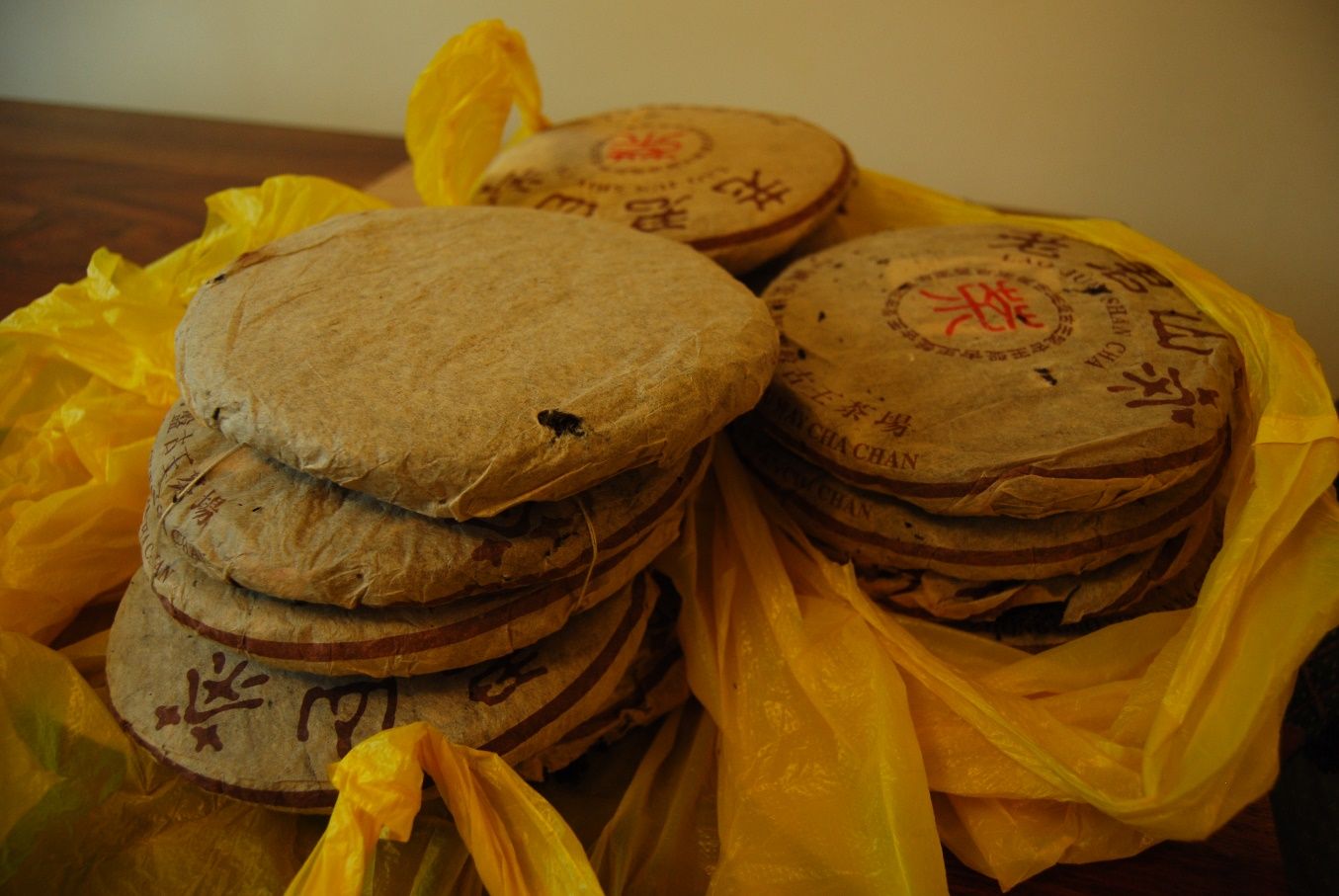
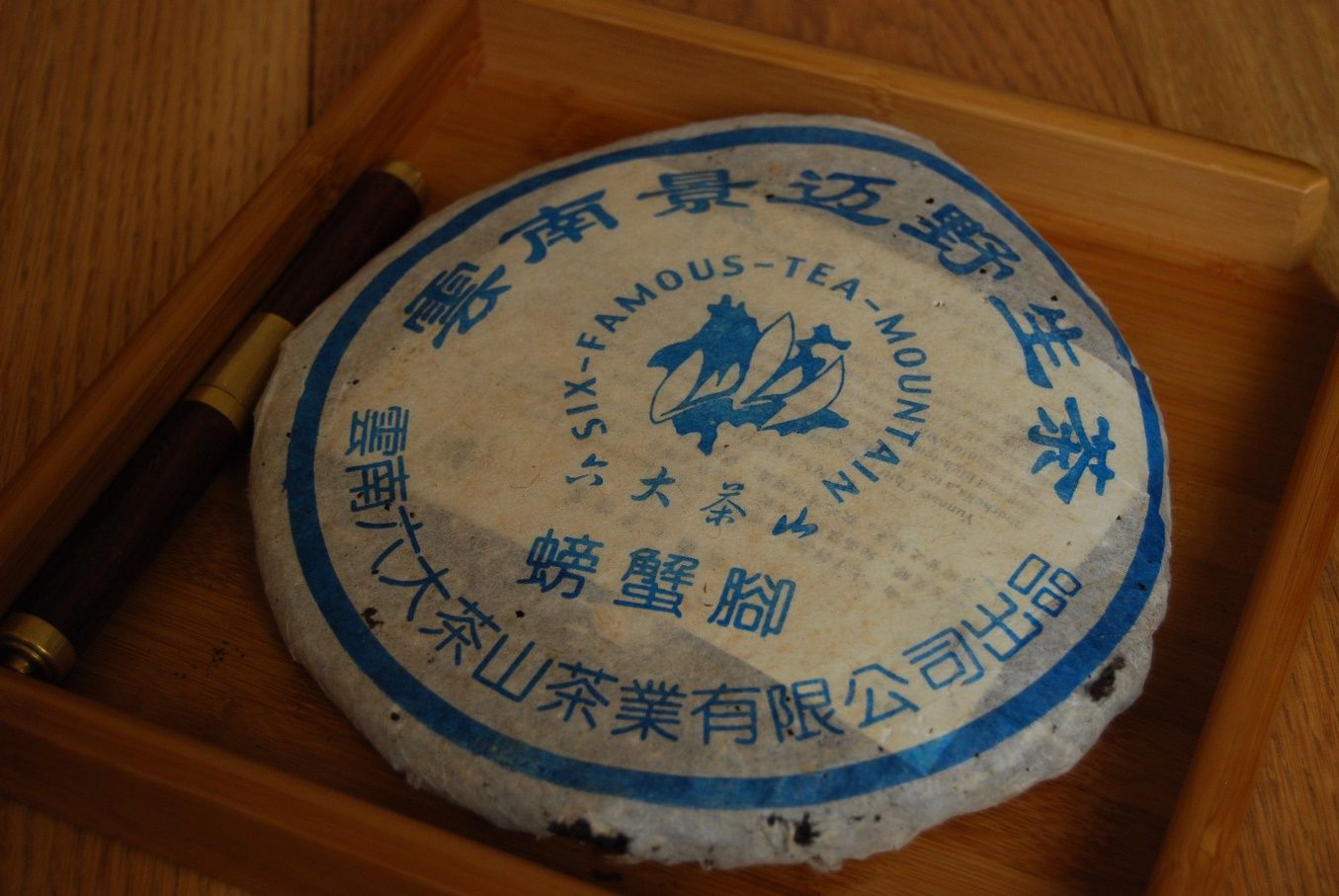
The 2003 6FTM Jingmai Pangxiejiao looks like a novelty cake (it is called "crab's feet"), but tastes really rather good.  A recent session revealed that the crab's feet (a vine) impart a sharp and noticeable bitterness that is both complementary to the otherwise fuzzy-warmth of Jingmaishan, and which I somehow missed the first time around.  (Notes have been added to the original article.)


Then, we have the...


2003 6FTM "Youle Gucha" which is much more canonical.  That is, it's strong and warm, and has aged in Singapore's heat quite nicely.  (More notes added to the original article.)


We also have the 6FTM known only as "Yunnan Qizi Bingcha" which is a little like seeing wine labelled as simply "red wine".


This is a fun cake, and one with which I wished to spend a little more time, after the whistle-stop introduction some years back.  The aroma, revealed on opening the wrapper, is strong sweetness of the dark 'Banna variety.


This is not a "grand" tea, even by 6FTM standards, in that it has not been attributed to any particular region.  This is confirmed by the fragmented, small leaves, which have been mixed with stems, huangpian [yellow flakes], and all sorts of grades.  I like to call this kind of mix "rugged" or "robust", in the sense that it is something akin to a shaggy dog.  Messy, but endearing.


The scent in the wenxiangbei starts quietly, and I wonder if it is a tired, old cake.  The soup promptly slaps me "upside the heed" [sic], and we are rapidly disabused of all notions that this tea will come quietly.  It is potent, sharp, heavy, sweet, and extremely violent.  Naturally, this makes it rather appealing.


The fact that this tea still seems to be spoiling for a fight, even after a decade of aging, testifies to the raw power that early 6FTM cakes can contain.  This cake has since gained some "blackness", in the general way of aged, generic 'Banna leaves, and which is rather satisfying.  While it cannot be said to have a huigan per se, it has something of a proto-huigan.  That is, there is a long, dense sweetness that sits in the throat - it just doesn't turn into the classical huigan.

I found this tea to be strong, and was (surprisingly) possible to overbrew, which is unusual for decade-old tea from Singapore, where the heat rapidly takes the edge off a tea.  Later infusions developed the floral characteristics of "black" 'Banna tea, which was, again, a pleasant surprise for what I assume to be very mainstream pu'ercha.  

Back then, even the "humble" leaves packed a serious punch.  I like it a lot, and am pleased to observe that aging will probably only improve it further, given its innate violence and comprehensive density.

What fun!


Finally...


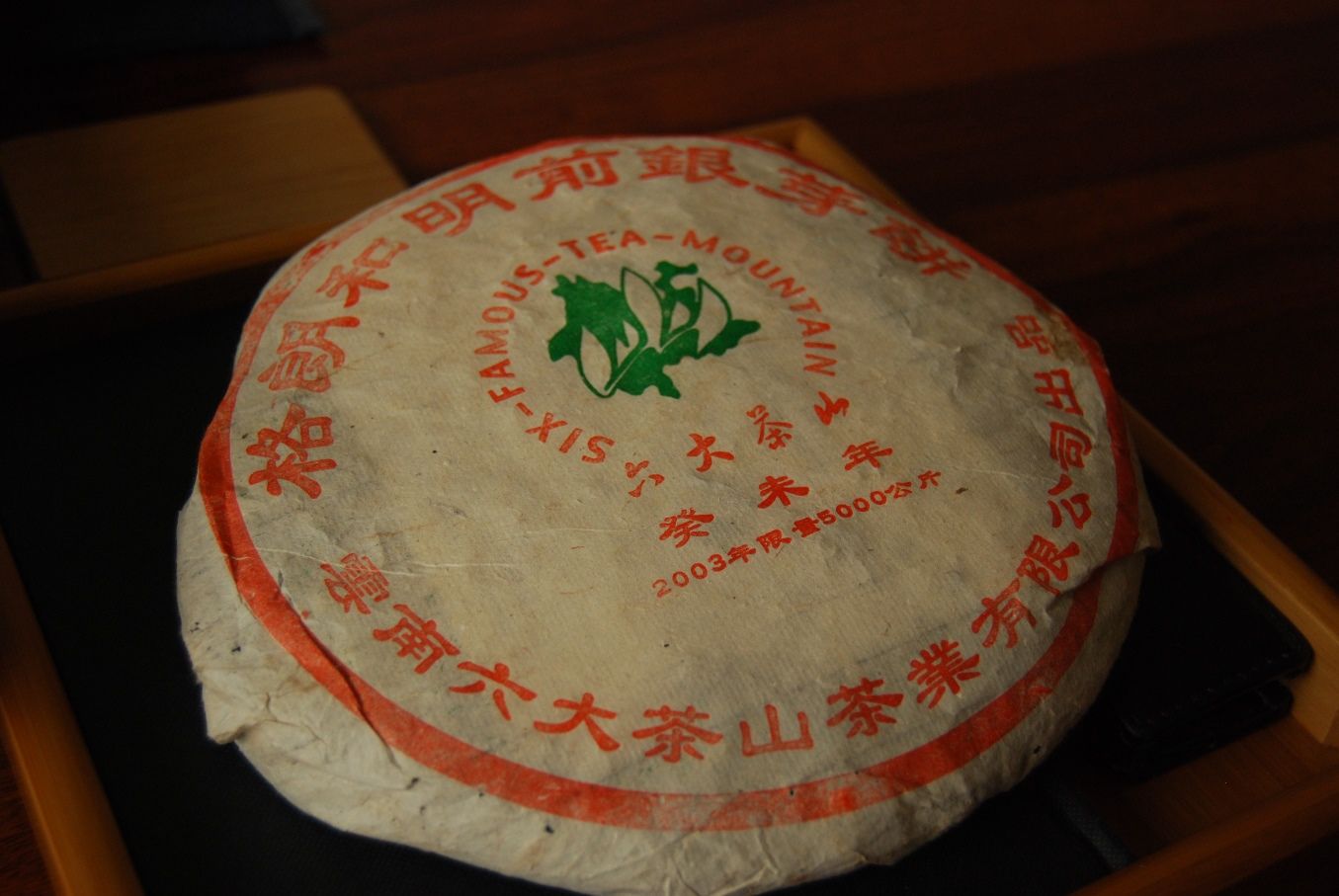
The 2003 6FTM Gelanghe (with detailed notes added to the article) is probably the best of the lot, to my mind. It has the qualities of a bigger tea, and yet is priced at sociable 6FTM levels. While I cannot say that I really understand "Gelanghe" [approx. ger-laang-her] as a regional characteristic, this cake is certainly doing well after its first decade, with the strength to go on to better things.