Shengpu by factory/brand
12 Gentlemen
...see Shi'er Xiansheng
6 Famous Tea Mountains
...see Liu Da Chashan
Baoyan
...see Xiaguan
Boyou
2007 Boyou "Caifu Guangchang" (Royal Puer)
2007 Boyou "Manlushan" (Royal Puer)
Changtai
2003 Changtai - Yichanghao "Yibang" (Houde, DL)
2004 Changtai - Yichanghao "Yiwu Zhengpin" (KC)
2004 Changtai Yiwu (Houde, MA)
2005 Changtai "1st Pu'er Trade Fair" (PS)2006 Changtai "2nd Pu'er Trade Fair" (Houde)
2006 Changtai "Jinzhu" (DTH)
2006 Changtai "Taipei Tea Expo" (Houde, DL)
2007 Changtai "Houde" (Houde)
2007 Changtai - Yichanghao "Yiwu" (Nada)
Chen Guanghe Tang
2000 Chen Guanghe Tang "Yiwu Yesheng" Brick (Houde, TA)
2001 Chen Guanghe Tang "Mengsa" (Houde)
2006 Chen Guanghe Tang "Yiwu Chawang" (Houde)
2006 Chen Guanghe Tang "Yiwu Yecha" (Houde)
2007 Chen Guanghe Tang "Hongyin" (Houde, KCJ)
Chunguang
2006 Mingyuanhao "Yiwu 858 Puer Museum" (Houde, TA)
Chunming
2005 Chunming "Chunya" (Royal Pu'er, VL)
CNNP
1960s CNNP Huangyin (Houde, GV)
1980s CNNP Zhongchapai (ST)
1986 CNNP (ST)
1990 CNNP "Jiang Cheng" Brick (SE, Nada)
2000 CNNP "Green Mark" (Skip4tea)
2000 CNNP "Yellow Mark" (Skip4tea)
2002 CNNP (LZ)
2003 CNNP "Yunnan Qiaomu Bing" (Puerh Shop, GV)
2004 CNNP "Yiwu Zhengshan" (VL)
2004 CNNP "Yiwu Zhengshan" (Royal Pu'er)
2005 CNNP "Big Blue Mark" (TeaCuppa)
Dadugang Longyuan
2006 Longyuan "Yiwu Xiangbing" (YS, TA)
Dayi
...see Menghai
Douji
...see Yiwuzhengshan
Fuchaju
2002 Fuchaju "Ailaoshan" (YS)
Guangnan Fenghui
2005 Guangnan Fenghui "Yiyi" (Suiping)
Guangyungong
1958 Guangyungong (Nada)
1960s Guangyungong (Houde)
Gujun
2008 Gujun "Korea Export Bulang" (Puerh Shop)
Hailanghao
...see Mingxiangyayuan
Haiwan
2000 Haiwan "Guhua" (Jing, MA)
2006 Haiwan "Mengpasha Organic" (YS)
2006 Haiwan "Yushoushan" (YS)
2008 Haiwan - Laotongzhi "8808" (YS)
Hengfu
2004 Hengfu "Laohei" (Xiaoxu)
2006 Hengkang (Hengfu) "Chawang" (Xiaoxu)
He Shihua
2004 He Shihua "Jingmai" (Nada)
Jiangcheng
2005 Jiangcheng "Yesheng" (TeaCuppa)
Jingyehao
2000 Jingyehao "Yiwu" (YS, CB)
Keyixing
2003 Keyixing "Yiwu Zhengshan" (Puer Shop)
Kunming
1998 Kunming Tiebing (Jing Teashop, KCJ)
Kunming Tailian
2003 Kunming Tailian "Jingmai Yuancha" (YS)
Liming
2006 Liming "Tuowang" (Royal Puer)
Lincang Gucha
2005 Lincang "Gushu Zhenpin" (Kunming, Nada)
2005 Lincang "Gushu Chawang" (YS)
Liu Da Chashan (6FTM)
2004 Six Famous Tea Mountains (VL)
2004 Six Famous Tea Mountains "55th Anniversary" (Awazon, Nada)
2005 Six Famous Tea Mountains "Yiwu Zhengshan" (YS, VL)
2006 Six Famous Tea Mountains "Yesheng Banzhang" (Royal Pu'er)
Longyuanhao
...see Dadugang Longyuan
Meiguohao
2008 Meiguohao "801" (Puerh Shop)
2009 Meiguohao "901" (Puerh Shop)
2009 Meiguohao "902" (Puerh Shop)
2009 Meiguohao "903" (Puerh Shop)
2009 Meiguohao "904" (Puerh Shop)
Menghai
1989 Menghai 7542 "89 Qingbing" (KC)
Late 1990s Menghai 8582 (KC)
1990 Menghai 9062 (Nada)
1996 Menghai - Dayi "Red Neifei" (Skip4Tea)
1996 Menghai 7532 "Green in Orange" (Nada)
1998 Menghai 8582 (Houde)
1998 Menghai - Dayi Tuocha (5000friend)
1998 Menghai "Peacock" Tuocha (YS)
1998 Menghai "Peacock" Shicang (AL)
1998 Menghai "Shuilanyin" 7542 (Houde)
1999 Menghai 7542 (CB)
1999 Menghai "Big Green Tree" - Blue/Black Label (Houde)
1999 Menghai "Big Green Tree" - Red Label (CB)
2001 Menghai "Yiwu Zhengshan" (Houde)
2003 Menghai "Big Green Tree" (CB)
2003 Menghai "Big Green Tree" Fake (RTG)
2003 Menghai "Yiya Yuancha" (ST)
2003 Menghai - Dayi "Qiaomu Laoshu" (Puerh Shop)
2003 Menghai "Hong Kong Henry" 7542 (Houde)
2004 Menghai - Dayi "Qiaomu Laoshu" Fake (DJC)
2005 Menghai - Dayi "Zaochun" 501 Tuocha (YS)
2006 Menghai - Dayi 7742-601 (Tan)
2008 Menghai - Dayi 0622-801 (YS)
2008 Menghai - Dayi "08" Tuocha (YS)2008 Menghai - Dayi 7532-801 (YS)
2008 Menghai - Dayi 7542-801 (YS)
2008 Menghai - Dayi 8582-801 (YS)
2008 Menghai - Dayi "Dajingdian" (YS)
2008 Menghai "Peacock of Menghai" (YS)
2008 Menghai "Peacock of Mengsong" (YS)
2009 Menghai - Dayi 7542-901 (YS)
Menghai Pengcheng
2005 Menghai Pengcheng "Yuanyexiang" (PS, GV)
Mengku
...see Shuangjiang Mengku
Mengku Banmu
2008 Mengku Banmu "Bingdao Qiaomu" Zhuancha (Puerh Shop)
Mengku Chengguan
2005 Mengku Chengguan "Qingchengfeng" (Puerh Shop)
Mengnuo Gucha
2008 Mengnuo Gucha "Bulang" (Tan)
Mengyang Guoyan
2005 Mengyang Guoyan "Banzhangwang" (DTH, TA)
2005 Mengyang Guoyan "Laobanzhang" (Nada)
2006 Mengyang Guoyan "98 Special" (YS, CB)
2007 Mengyang Guoyan "Phoenix of Yiwu" (DTH)
2008 Mengyang Guoyan "Yiwu Chahuang" (YS)
Mingxiangyayuan
2002 Mingxiangyayuan - Hailanghao "Mengku Qiaomu" (YS)
2005 Mingxiangyayuan - Hailanghao "Dabaicha" (Kunming, Nada)
2005 Mingxiangyayuan - Hailanghao "Lincang Impression" (YS)
2005 Mingxiangyayuan - Hailanghao "Motian Yinhao" (Kunming, Nada)
2006 Mingxiangyayuan - Hailanghao "Laobanzhang" (YS, AL)
2007 Mingxiangyayuan - Hailanghao "Bulang" (YS, Nada)
2007 Mingxiangyayuan - Hailanghao "Jingmai Wild Arbor" (YS)
2008 Mingxiangyayuan - Hailanghao "Ban'E Laoshu" (YS)
2008 Mingxiangyayuan - Hailanghao / Shuangyi "Bulang zhi Xing" (YS)
2008 Mingxiangyayuan - "Jingmai" (YS)
2009 Mingxiangyayuan - Hailanghao "Zhang Jia Wan" (YS, ST)
Mingyuanhao
...see Chunguang
Nada Chayuan
2008 Nadachayuan - Chachanyiwei "Nannuo" (Nada)
2008 Nadachayuan "Yiwu Laoshu" (Nada)
2009 Nadachayuan "Bulang" (Nada)
2009 Nadachayuan "Naka" (Nada)
2009 Nadachayuan "Nannuo Qiaomu" (Nada)
2009 Nadachayuan "Yiwu Mahei" (Nada)
Nanjian
1980s Nanjian Tuocha (ST)
1993 Nanjian "Fenghuang" Tuocha (Houde, TA)
2005 Nanjian "Fenghuang Xiangbing" (Royal Puer, VL)
2006 Nanjian "Wuliangshan" (YS)
Puerh Shop
...see Meiguohao
Quanji
2003 Quanji "Bulang" (LZ)
Ruironghao
2003 Ruironghao "Daxueshan" (CB)
Sanhetang
1997 Sanhetang - Xizihao "Yiwu" (Houde, TA)
2005 Sanhetang - Xizihao "Laobanzhang" (Houde)
2006 Sanhetang - Xizihao "Banzhang" (Houde)
2006 Sanhetang - Xizihao "Chahuang" (Houde)
2007 Sanhetang - Xizihao 7542 (YS)
2007 Sanhetang - Xizihao 8582 (YS)
2007 Sanhetang - Xizihao "Daxueshan" Maocha (Houde, TA)
2007 Sanhetang - Xizihao "Dingji Gushu" (Houde)
2007 Sanhetang - Xizihao "Dingji Nu'ercha" (Houde)
2007 Sanhetang - Xizihao "Huangshanlin" (YS)
2007 Sanhetang - Xizihao "Jinggu Nu'ercha" (Houde)
2007 Sanhetang - Xizihao "Kuzhushan" (Houde)
2007 Sanhetang - Xizihao "Longfeng" (YS)
2007 Sanhetang - Xizihao "Nannuo" (Houde, TA)
2007 Sanhetang - Xizihao "Pu Zhen" (Houde)
2007 Sanhetang - Xizihao "Xishangmeishao" (Houde)
2007 Sanhetang - Xizihao "Yiwu Chahuang" (Houde)
2007 Sanhetang - Xizihao "Yuanshilin" (YS)
Shi'er Xiansheng
2006 Shi'er Xiansheng "Yiwu" (Nada)
2007 Shi'er Xiansheng "Weizhongwei Menghai" (Kunming, Nada)
2007 Shi'er Xiansheng "Weizhongwei Yiwu" (Kunming, Nada)
Shuangjiang Mengku
2001 Shuangjiang Mengku "Yuanyexiang" Gancang (Houde, DL)
2001 Shuangjiang Mengku "Yuanyexiang" Shicang (Houde, MA)
2004 Shuangjiang Mengku "Bainian" (ST)
2004 Shuangjiang Mengku "Daxueshan" (ST)
2005 Shuangjiang Mengku - Mengku Rongshi "Green Label" Xiaobing (YS, CB)
2007 Shuangjiang Mengku (DTH)
2007 Shuangjiang Mengku - Muyechun "001" (YS, TA)
2007 Shuangjiang Mengku - Muyechun "002" (YS)
2007 Shuangjiang Mengku "Qiaomuwang" (YS)
2008 Shuangjiang Mengku "Bingdao" (YS)
2008 Shuangjiang Mengku - Muyechun "Laoshu Qingbing" (YS)
Six Famous Tea Mountains
...see Liu Da Chashan
Taihe
2004 Taihe bingcha (Wysteria, GV)
2004 Taihe maocha (Wysteria, GV)
Tongxinghao
1970s Tongxinghao (Warwickb)
Twelve Gentlemen
...see Shi'er Xiansheng
Wenlong
2006 Wenlong "1000 Year" (Pure Puer)
2006 Wenlong "1 Sprout, 2 Leaves" (Pure Puer)
Xizihao
...see Sanhetang
Xiaguan
1980s Xiaguan "Black-Labelled CIB" Boxed Tuocha (Houde)
1980s Xiaguan "Zhubao" Tuocha (Houde)
2001 Xiaguan - Baoyan (Skip4tea)
2003 Xiaguan Bingcha (RTG, CB)
2003 Xiaguan "Teji" Bingcha (YS, TA)
2003 Xiaguan "Teji" Bingcha (YS) - revisited
2003 Xiaguan Tuocha (Woogie)
2007 Xiaguan - FT #4 (YS)
2008 Xiaguan "Dali" Tuocha (YS)
2008 Xiaguan - FT #6 (YS, KC)
2008 Xiaguan - FT "Baoyan Jincha" (YS)
2008 Xiaguan - FT "Duling Fengsao" (YS)
2008 Xiaguan - FT "Xizi" Tuocha (DTH,YS)
2008 Xiaguan - FT Nanzhao "Yiming Jingren" (YS)
2008 Xiaguan - FT "Yun Mei" (YS)
2008 Xiaguan "Hongloumeng" Tuocha (DTH)
2008 Xiaguan "Jinse 8100" (YS, RJoC, Jamus)
2008 Xiaguan - Nanzhao Bingcha (YS)
2008 Xiaguan - Nanzhao Tuocha (YS)
2008 Xiaguan - XY "8853" (YS)
2008 Xiaguan - XY "Yiwu Zhengshan Laoshu" (YS)
Xingshunxiang
2006 Xingshunxiang "Yiwu Zhengshan" (LZ)
Yangqinghao
2004 Yangqinghao "Chawang" (Houde, KCJ)
2004 Yangqinghao "Special Reserve" (Houde, TA)
2006 Yangqinghao "Gushu Chawang" (Houde)
Yibang Chamasi
2006 Yibang Chamasi - Gedebaohao (Royal Puer)
2006 Yibang Chamasi "Menghai" (Royal Puer, VL)
Yichanghao
...see Changtai
Yisheng
2005 Yisheng "Yiwu Zhengshan" (Xiaomei in Maliandao)
Yiwu Manluo
2003 Yiwu Manluo "Yiwu Zhengshan" (Xiaomei in Maliandao)
Yiwu Yongpinhao
2003 Yiwu Yongpinhao "Manzhuan" (YS)
2005 Yiwu Yongpinhao "Yiwu" (YS)
2007 Yiwu Yongpinhao "Qiaomu" Maocha (Puerh Shop)
2008 Yiwu Yongpinhao "Lanxiang Guyun" (YS)
2008 Yiwu Yongpinhao "Lingbo Qingdai" (YS)
Yiwuzhengshan
2006 Yiwuzhengshan - Douji "Dayeqingbing" (Maliandao)
2006 Yiwuzhengshan - Douji "Yiwushan Qiaomu" (Puerh Shop)
2007 Yiwuzhengshan - Douji "Yiwushan" (YS, MN)
2008 Yiwuzhengshan - Douji "Bulangshanyun" (Puerh Shop)
2008 Yiwuzhengshan - Douji "Dadou" Zhuancha (Puerh Shop)
2008 Yiwuzhengshan - Douji "Shengdou" Zhuancha (Puerh Shop)
Yongde Ziyu
2006 Yongde Ziyu "Shengtai Gushu" (YS)
2007 Yongde Ziyu "Qingbing" (Norbu, Jamus)
Yongpinhao
...see Yiwu Yongpinhao
Yunnan Sourcing
...see Yunzhiyuan
Yunzhiyuan
2009 Yunzhiyuan / Ruicaoxiang - "Banzhang Chunqing"
2009 Yunzhiyuan / Ruicaoxiang - "Bulangshanyun"
2009 Yunzhiyuan / Ruicaoxiang - "Wuliang Lanxiang"
2009 Yunzhiyuan / Ruicaoxiang - "Yiwuzhidao Guanfengzhai"
2009 Yunzhiyuan / Ruicaoxiang - "Youle Zhi Chun"
Zitenglu
2004 Zitenglu "Taihe" (TP)
Miscellaneous Shengpu
1960s Gaolingongshan Maocha (Royal Puer, CB)
1970s Maocha (Iw)
1985 Yiwu Tuocha (SE, MA)
1986 Yiwu Chunya Maocha (Sunsing, GV)
1990s Song Pin (DTH, CB)
1990s Tuocha (Nada)
1993 "Wild" Maocha (Red Blossom, DL)
1999 Maocha (Puerh Shop)
1999 Sunsing (Sunsing, GV)
2000 Jingmai Ruyi (Xiaoxu)
2002 Mystery Shengpu (KCJ)
2002 Yiwu Bamboo-Wrapped Zhuancha (ST)
2002 Yiwu "Wild" (SE)
2003 Lincang Special Order (Prague, TA)
2005 Awashan Maocha (Awazon, VL)
2005 Banzhang Maocha (TeaCuppa)
2005 Dehong "Purple-Leaf" Brick (YS, Nada)
2005 Jingmai Maocha (VL)
2005 Simao Yesheng (TeaCuppa)
2005 Yinzhen Zhuancha (Maliandao)
2006 Dehong Yesheng (VL)
2006 Lincang (SE)
2006 Lincang (SE) - revisited
2006 Agu Laoshu (YS)
2006 Yiwu Zhuancha (TeaCuppa)
2007 Banzhang Maocha (Puerh Shop)
2007 Maison des Trois Thes "Mengkuxue" (Nada)
2007 Mengku Bingdao Maocha (Puerh Shop)
2007 Mengku Mangbo Maocha (Puerh Shop)
2007 Simao Maocha (Maliandao)
2007 "Yesheng" Maocha (TA)
2008 Youle Bamboo-Wrapped Maocha (Nada)
2008 Bangwei Laoshu Maocha (Nada)
2008 Laobanzhang "Chan" (YS)
2008 Laobanzhang Maocha (Nada)
2008 Xinbanzhang Maocha (Nada)
2009 "1000-Year" Yinhao Maocha (KC)
2009 Guafengzhai Xiaobing (KC)
Shupu
1994 Shupu (Suiping)
1995 Yunnan Import/Export (JMcM)
1997 Maguan Panguwang "Laojunshan" (Suiping)
1999 CNNP "Simao" (Nada)
2000 Fuhai Factory (SE)
2003 Tiandiren (GA)
2005 Chunming "Nuomixiang" (YS, CB)
2005 CNNP (TeaCuppa)
2005 Haiwan - Laotongzhi "Gongbing" (VL)
2005 Haiwan "Yushan" (VL)
2005 Luxi "Organic" 8821 (TeaCuppa)
2005 Menghai - Dayi "Jinzhen Bailian" (Houde, DV)
2005 Menghai Tiandiren (TeaCuppa)
2005 Menghai V93 (DL)
2006 Kunming Guyi Chatou (Tuocha, DL)
2006 Xiaguan Tuocha (Turin)
2007 Jiuwan - Tongqinghao (YS, RJ)
Other Heicha
1930s Liu'an (Nada)
1990s Tibetan Heicha (YS)
2001 Liu'an (Jing, CB)
Hongcha
2000 Fujian Bailin Gongfu (Maliandao)
2006 Premium Yunnan "Gold Tips" Dianhong (YS, CB)
2006 Yunnan Black "Pure Buds" Dianhong (YS, CB)
2007 Fujian Bailin Gongfu (Maliandao)
2007 "Hongyawang" Dianhong (Maliandao)
2007 "Yongji Hongya" Dianhong (Maliandao)
2008 Kho-cha SFTGFOP Nilgiri (SS)
Wulong
1980s Baozhong (Houde)
1980s Dongding (Iw)
1992 Wuyi Shuixian (SE)
1997 Wuyi Shuixian (SE)
2004 Baijiguan "Zhengyan" (Houde)
2004 Tieluohan "Zhengyan" (Houde)
2004 Wuyi Shuixian (SE)
2005 Dahongpao "Zhengyan" (Houde)
2005 Laocong Shuixian "Zhengyan" (Houde)
2005 Maoho Wenshan Oriental Beauty (SE)
2005 Rougui (TeaCuppa)
2005 Wenshan Oriental Beauty (SE)
2005 Xinzhu Oriental Beauty (SE)
2006 Alishan Jinxuan (SE)
2006 Baxian Dancong (RTG, CB)
2006 Fenghuang Huangzhixiang Dancong (TeaCuppa)
2006 Huangzhixiang Dancong (RTG, CB)
2006 Milanxiang Dancong (TeaCuppa)
2006 Oriental Beauty (TeaCuppa)
2006 Shuixian Dancong (RTG, CB)
2006 Songzhong Dancong (RTG, CB)
2006 Wudong Baiye Dancong (RTG, CB)
2007 Baxian Dancong (Jing, IMcC)
2007 Dayuling (SE)
2007 Milanxiang Dancong (Jing, IMcC)
2007 Milanxiang Dancong "Gold Medal" (Imen)
2007 Taiwan "Fushou" Nongxiang (Houde, DL)
2007 Tieguanyin (Suiping)
2007 Tieguanyin "Dahongdai" (JMcM)
2007 Tieguanyin "Dajindai" (JMcM)
2007 Tieguanyin "Xiaozidai" (JMcM)
2007 Wuyi Yancha Bing (AL)
2008 Daoist Baozhong (Nada)
Lucha
2006 Hachijuhachiya Sencha (Kaori, CB)
2007 Biluochun Organic (TeaCuppa)
2007 Molilongzhu (Suiping)
2007 Tenbu Fuka Sencha (T-Ching)
2007 Tenbu Sencha (T-Ching)
2007 Xinyang Maojian (Suiping)
2007 Yongxi Finetip (Whole Leaf, CB)
Baicha
2006 "Sun-Dried" Baimudan (YS, CB)
2006 "Traditional" Baimudan (YS, CB)
Mocha / Matcha
2009 O-Cha "Kiku Mukashi" (O-Cha)
Showing posts sorted by relevance for query sanhetang. Sort by date Show all posts
Showing posts sorted by relevance for query sanhetang. Sort by date Show all posts
04 April, 2007
07 April, 2014
Cigarette Box
Zhangjiawan is an area from which I have only good (taste) memories: the only other cake I have had that called itself "Zhangjiawan" was a fantastic little 2012 xiaobing from Chawangpu, that cost < $40.
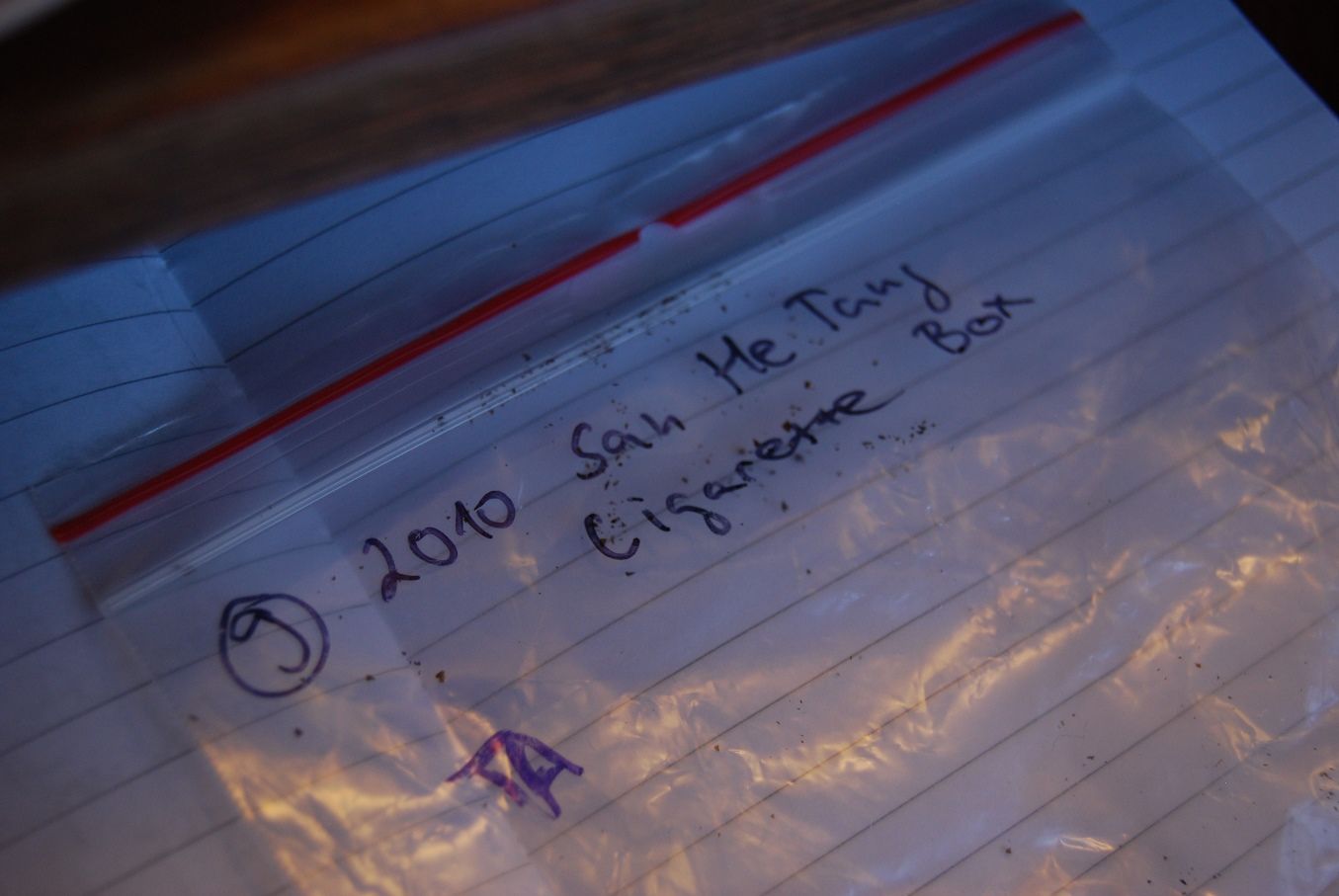
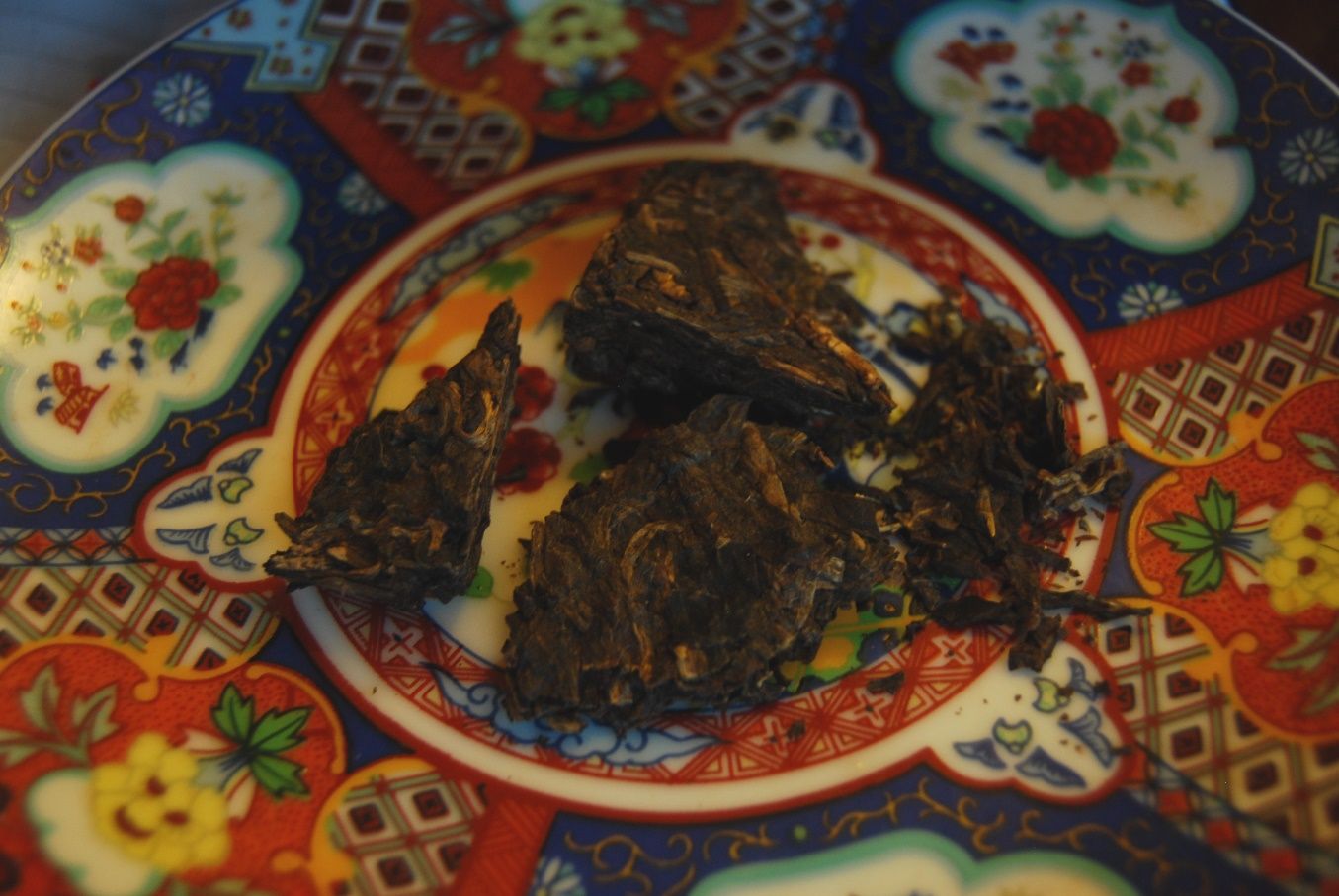
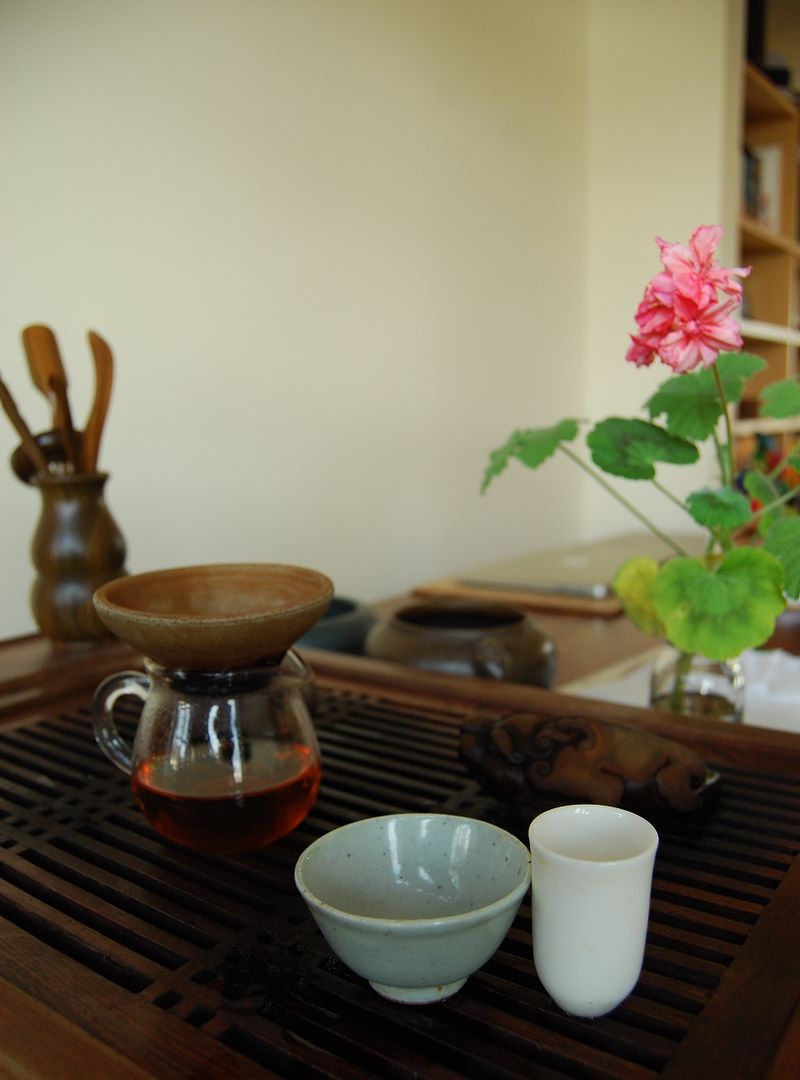
This particular Sanhetang cake is from they of the Xizihao fame. This sample was kindly provided (about a hundred years ago) by TA - I do not know the link between this cake and the eponymous "cigarette box", but I suspect that it must be the format of the tea. Either than or it tastes like Marlboro.
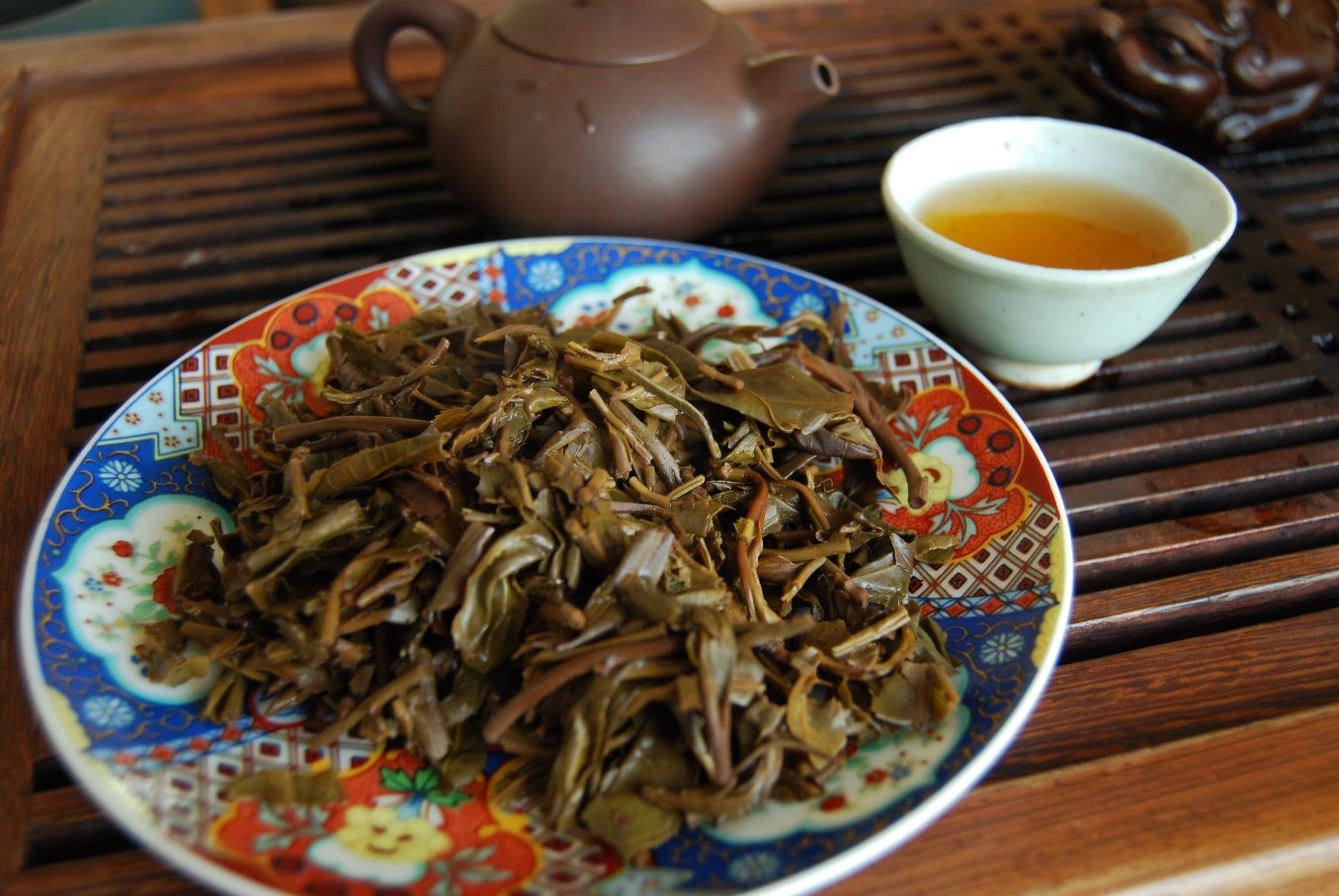
The suspicions of little-brickiness begin to become more firm as we examine the small chunks of leaf, pictured above, which have the sharp edges of brick tea. As is typical for zhuancha, the leaves are small and broken. I begin to wonder why Sanhetang have stooped to creating brick tea. Then I remember the 2010 Xiaozhutong [little bamboo-tong] from Sanhetang, which was dreadful and which Houde sold to me without me trying a sample (silly, silly me). Clearly Sanhetang is not above making the odd wacky, terrible pu'ercha.
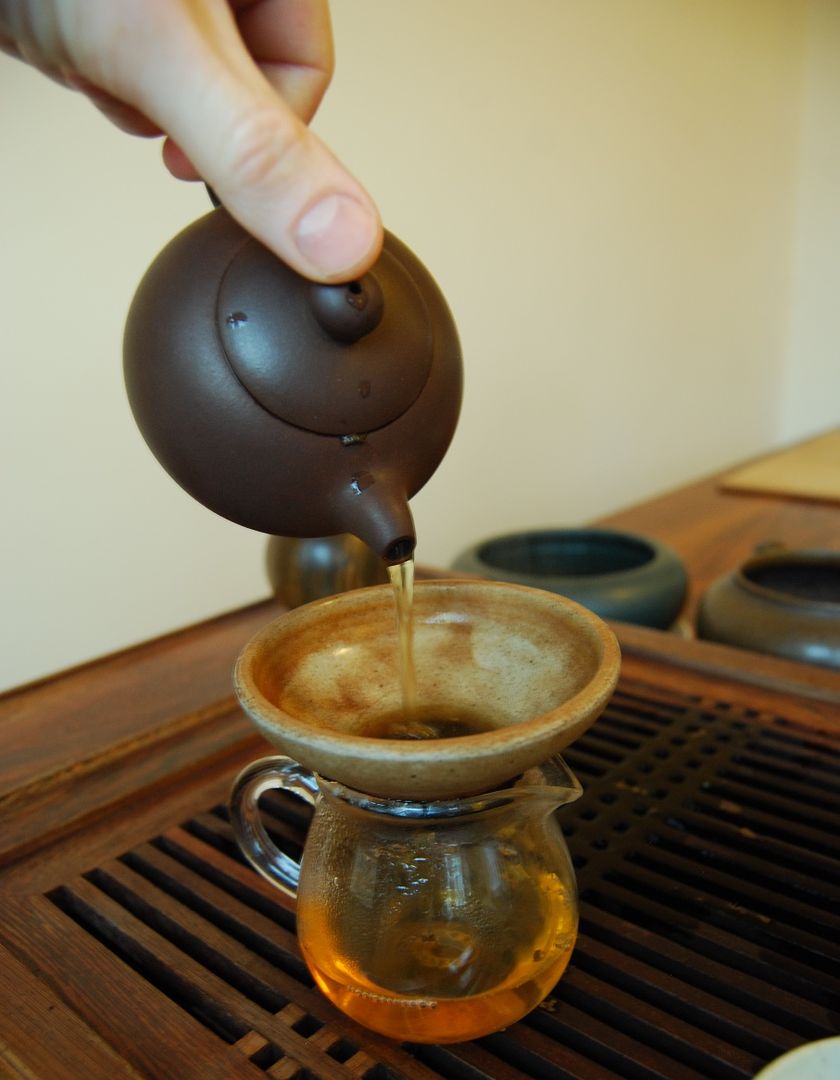
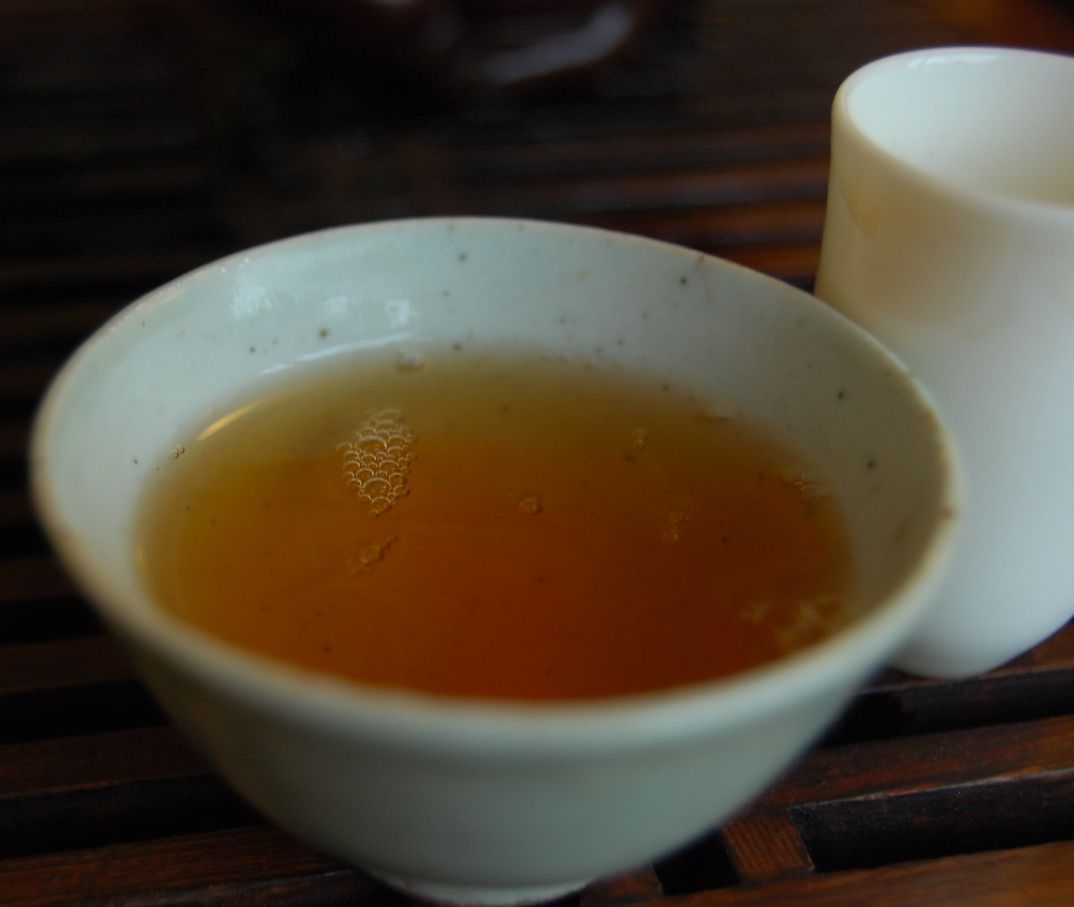
However, my considerable faith in the skills of Sanhetang are restored on brewing it up: despite the fact that the public frontman for Sanhetang has committed the ultimate crime of wearing a pony-tail, he does know his pu'ercha. This particular example is a solid yellow-orange, as pictured above, and as clean as ever they were from this brand.
Sanhetang even seems to be able to make brick tea into something enjoyable: it has a lively base of dried fruits, and a decent kuwei [good bitterness]. It is also rather energetic, and seems to have something to say. This is at odds with the simply univariate bitterness of many zhuancha.
As the leaves begin to open, and the nuggets separate yet further in the belly of Zidu, my pot, they reveal some more Yiwushan complexity: alongside that thick, clean sharpness comes plenty of regional character that suggests Sanhetang has used decent leaves, even if they appear as mulch within the maocha.
The leaves show no sign of weakening from their state of thick sweetness, even after a dozen infusions. They must have been leaves from a good, healthy set of trees: even fragmented, they seem to last forever. I am impressed that the "cigarette box" turned out to be much better than its dreadful name suggested. Thanks again to TA for the sample.
09 April, 2008
2007 Xizihao "Puzhen"
One of a trio of autumn Xizihao teas, this is one I found to be particularly enjoyable. These leaves are allegedly grown near a Daoist temple in Jinggu. Strap on your Daodejing, and let's find out.

Sanhetang always provide attractive leaves (below): large, unbroken, and well-handled, many are still covered in the fine silver fur of youth. Sweet tobacco scents bode well.

The soup is a deep yellow, filling me with hope that this is going to taste substantial. The body is oily and full; the flavour is a light mushroom with some sweeter straw overtones. There is green youth, and a quiet huigan draws water into the mouth.

Later infusions show a cooling sensation in the mouth. "Light and pleasant" is the order of the day.

The leaves are good quality, being thick and beefy. I find myself constantly looking for sincere, honest, chunky teas in preference to the more ethereal pu'er.
I bought some of this tea, finding it to be the best of the recent Xizihao bunch, with an eye to seeing how it turns out further down the line. Not too great value-for-money (currently $96 at Houde), but a solid performer.

Addendum
March, 2011
This cake means quite a lot to me. I bought it back when Lei and I were living in the university's accommodation for married couples - a flat [apartment] on the top floor of a "functional" building that they only refurbished when we moved out. I remember many days sat in my pokey little office in that flat, writing my DPhil thesis with the scents of the pu'ercha with which I shared the room.

On opening it today, three years later, the big, pretty cake (it really is a rather big disc) appears to have turned brown. As pictured below, it has long, unbroken leaves, with some tips. That familiar old aroma that haunted me in my pokey old office remains - sweet and dark, these days, rather than green and fresh.

Pu'ercha is a fantastic method to combat a hangover. It's so legendary, in fact, that it appears as such in Hongloumeng [Dream of the Red Chamber / Dream of Red Mansions / The Story of the Stone], the Chinese romantic classic.
I keep meaning to re-read my copy of Hongloumeng (Beijing Foreign Language Press is the best translation), but if ever there were an example of the density of Chinese text, this is it: the original is a fairly normal-sized novel, when written in Chinese. My translated copy fills four volumes. (My Penguin Classics translation, which is my second-favourite version, occupies a mighty five volumes.)

"Puzhen" means "innocent, like a child", according to my dear wife, as she passes by, munching on some toast. The chaps at Sanhetang do have an eye for the romantic, with some of the most baroque names for cakes that I've come across. I have a soft spot for them, however, as I get the impression that the head chap there knows his stuff rather well, and has an air of gentle intelligence about him (excepting his ponytail).

The soup turns out to be rather orange these days, rather than fat yellowness of its youth, and I take this as a positive sign. It has a decent, clean body, with hints of tobacco sloshing around in the finish that linger pleasantly in the nose and throat.
Already, it is showing indications of woodiness.

Clean and energetic, I am reminded that Sanhetang goes tea very well indeed. It has a citric note, and a plantation residue in the finish, but the overall impression is very positive. It's gratifying to see that it has aged a little, too.
On checking Houde, I notice two things:
i. This cake is no longer available, and
ii. STOPTHEPRESS Houde has corrected the spelling of "Xizhihao" to "Xizihao". My heart skips a beat, as I observe that the man who started all of the crazy mis-spelling madness across so many other vendors has (finally) dropped that extra 'h'. Kudos, Dr. Lee! It may have taken half a decade, but better late than never!
27 August, 2012
2006 Sanhetang - Xizihao "Taiji"
Lei is heavily pregnant at the moment. She is 6.5 months through, and so has 2.5 months to go (all being well), and yet is absolutely enormous. I think our second child is going to be a big'un. I think I've mentioned before that he's a boy, which will be great fun for Xiaohu and a blessing for us both. As an amusing consequence of working in biomedical research, Lei gets plenty of ultrasonic equipment tested on her by our overexcited doctoral students. The upside of this is that we get 3-dimensional baby scans in utero; the new baby looks almost exactly the same as Xiaohu did at the same gestational age, even down to the structure of the nose.
The good doctor and I are off to the USA today*. If you're going to IEEE EMBC 2012 in San Diego, then send us a message! This time, I get to be the "partner" - Lei has been invited to give a lecture and chair a session, and so I will be humbly presenting a separate paper (which is also hers!) in a parallel session as a second author. It's good to be put in one's place.
I leave you in the capable hands of Sanhetang.
*The only other time we have been to the United States was for a conference in Montana. It was cold, but entirely excellent. We saw bison.
---
Following my recent communications with myEastern European chums, it is with great thanks to long-time teachum TA from Slovakia that I sat down to try this "taiji" cake from Xizihao.
I leave you in the capable hands of Sanhetang.
*The only other time we have been to the United States was for a conference in Montana. It was cold, but entirely excellent. We saw bison.
---
Following my recent communications with my
I recall that when these cakes came out, I was travelling to another city to see my new wife - we lived apart for the first year of our marriage, while she finished her PhD. However, after three hours on the train, I got to spend every week-end with her. These days, I have the luxury of seeing her every day, and thinking back to that time when we were apart reminds me of how lucky I am. It's quite something to look back and see how dramatically life has changed.
Set against that background, the Taiji cakes from Xizihao were teas that I always wanted to taste, but never got around to it, and the price of which would have then been far beyond my means (as a humble DPhil student myself, at the time).

You know the drill with Xizihao. They typically look amazing, and this cake is no different: the long leaves (pictured above) have gathered some redness / darkness through age, and they give out a very decent sweet scent.
I didn't take any photographs of the soup, and so you will have to imagine the heavy orange colour looking cheerful in my small little white cup. This is a Laobanzhang cake, and the heavy slug of sweetness that it delivers to the throat is very decent. As you might expect (and hope), it has the complexity of good honey, which persists throughout the mouth. It is a penetrating tea, and we are reminded once again that Mr. Sanhetang makes reliable cakes. His record may be somewhat variable, but he certainly made solid cakes back in 2006.

It's probably for the best that I cannot remember how much this tea costs. Currently, it hangs in the balance between the green nature of its youth, and the darkness of age. The storage, presumably at Houde headquarters in the southern United States of America, has been good to the cake. It remains substantial.
Given that this cake is the black-wrapper version, I imagine that it is the "yin", whereas the white-wrapper version would presumably be the "yang", if the usual symbology for the "taiji" is used (i.e., the famous yin-yang circle). I've no idea of the differences between the two, but this black version is fine by me. If you own a cake or two of this, I assume that you are very happy with your purchase!
It reminds me of a very special time in my life, and it is a great pleasure to revisit. Thanks again to TA for the trip back to those student years.
06 May, 2007
2006 Xizihao Banzhang
 Given the following mutually incompatible axioms, what do you do?
Axiom 1: It's beautiful outside, and it's the week-end.
Axiom 2: Your supervisor is expecting an article from you.
The solution? As you've probably ascertained from the photograph to the right, you dust down your Mobile Gongfucha Platform (MGP) and head out into the garden. You're outside, but you're close enough to your desk to feel guilty enough to (eventually) get back to work.
It's high time that a few long-standing inaccuracies were straightened out regarding Xizihao, the first of which is its name. It's "xizihao" [Double-happiness character brand], and most definitely not "xizhihao". Absolutely, this is a Taiwanese product, but by adopting the "x" and "zh" nomenclature, we are already crossing the Taiwanese Strait onto the Mainland and attempting a Pinyin spelling, so we may as well make it correct.
On a slightly less defensible note, the Pinyin spelling of the manufacturer is "Sanhetang" [three-together hall], and not "San Ho Tang". I'm not certain if the latter is Wade-Giles, so do forgive me if it is - in which case it's entirely appropriate, given that the company is Taiwanese. Obviously, the mountain is "banzhang", and not "banzhan" (as appears on my packet), but that's probably a good old-fashioned typo, rather than a conscious error.
Pedantry aside, what else do we know about this cake? I've not seen any reviews for this 2006 Banzhang, and would gladly be corrected. It claims to be a "shengtai" [ecology/natural-habitat] tea, which brings to mind all sorts of camphor-trees-instead-of-pesticide ideas. Of course, these are unquantifiable and uncontrolled terms, but we can dream.
Caledonian Springs @ 100C; 20cl shengpu pot; "normal" quantity; 1 rinse.
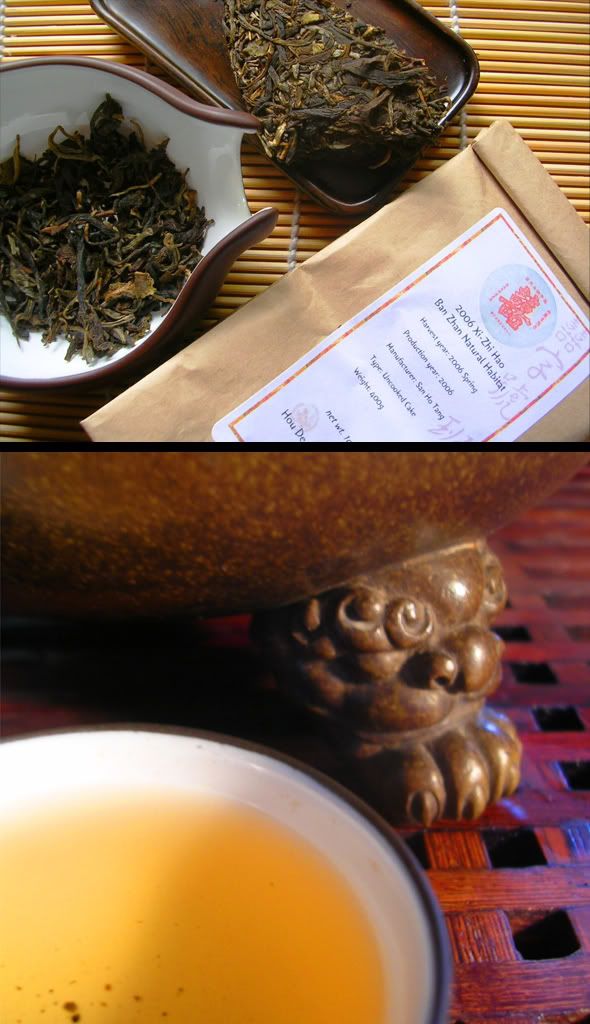 Dry leaves:
Truly desirable. Exquisite, long, full-bodied leaves with many silver tips. A lovely sheen over all. The cake is a fine mixture of dark browns, rich reds, and fresh greens. Classical, crisp aroma, with a healthy basis of smooth mushroom. Say what you like about Sanhetang (!), but they can definitely select fine leaves.
10s, 15s, 20s, 25s, 25s:
Light, golden soup, filled with tip-fur. The aroma is long and rich, unusually for a young shengpu, with plenty happening: the base of mushroom is present, with a fresh sweetness overlain.
The flavour is initially camphor, and astringent - but not unpleasantly so. "Very strong and uncompromising." The feeling is smooth, the chaqi is very positive.
The aftertaste is sweet, and light. The leaves in the pot are surprisingly gentle in scent - I was expecting much more brutality from a banzhang.
The pure astringency in this tea makes it hard to enjoy in a long sitting. I took a break and came back to it, and was refreshed again. It is particularly green in the throat.
Used leaves:
Beautiful, big, and green throughout. Some fairly chopped; is this what Guang means by "a more affordable Xizihao"?
Overall:
Powerful, and very green. It certainly feels as if it has the legs to reach a good age, and there is plenty of mushroom-and-camphor complexity occurring underneath that bodes well. As one of the least expensive Xizihao products, this could be worth a flutter. It is bountifully energetic, and not really a "drink it now" experience.

Addendum:
(4 July, 2007)
Keeping the infusions very short (~3-5s) and using more leaves (~6-7g) reveals a finery in this tea that I missed before. It is not overpowering, brewed this way, and the sweet-but-simple character marches on for many infusions. There is a lovely oiliness that I missed the first time around, which is surely a good sign, clinging to the tongue and moistening the lips with sweetness.
The caffeine content is high - it sits in my mind quite recognisably - making this not suitable for my usual evening sessions (yet).
(4 July, 2007)
Keeping the infusions very short (~3-5s) and using more leaves (~6-7g) reveals a finery in this tea that I missed before. It is not overpowering, brewed this way, and the sweet-but-simple character marches on for many infusions. There is a lovely oiliness that I missed the first time around, which is surely a good sign, clinging to the tongue and moistening the lips with sweetness.
The caffeine content is high - it sits in my mind quite recognisably - making this not suitable for my usual evening sessions (yet).
Addendum
(29 March, 2008)
We are revisiting this cake about about a year later, using very similar brewing parameters to the previous sessions - my brewing configuration has not changed in a long time.
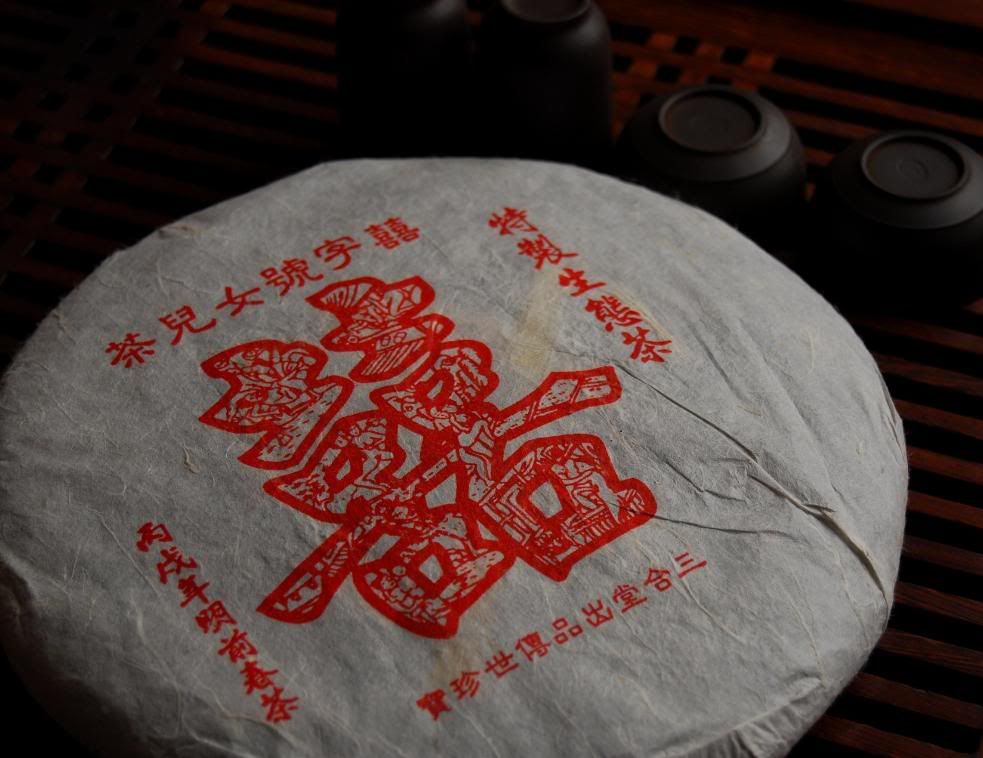
Previous encounters with this tea showed green astringency, sharp character, and the recommendation for storage.

The cake is becoming much darker, even in its two years. The English humidity has been kind to it: what was once green has been "caught in the act" of turning into rich tobacco. The green can be noticed, but it is blending more and more into a base of rich tobacco. The complexity of flavour has dramatically increased, causing Lei to say, "There is so much flavour in here - like a proper cheese."
The body remains thick; the huigan remains pronounced. It is very palatable, and we drink 11 infusions without hesitation.
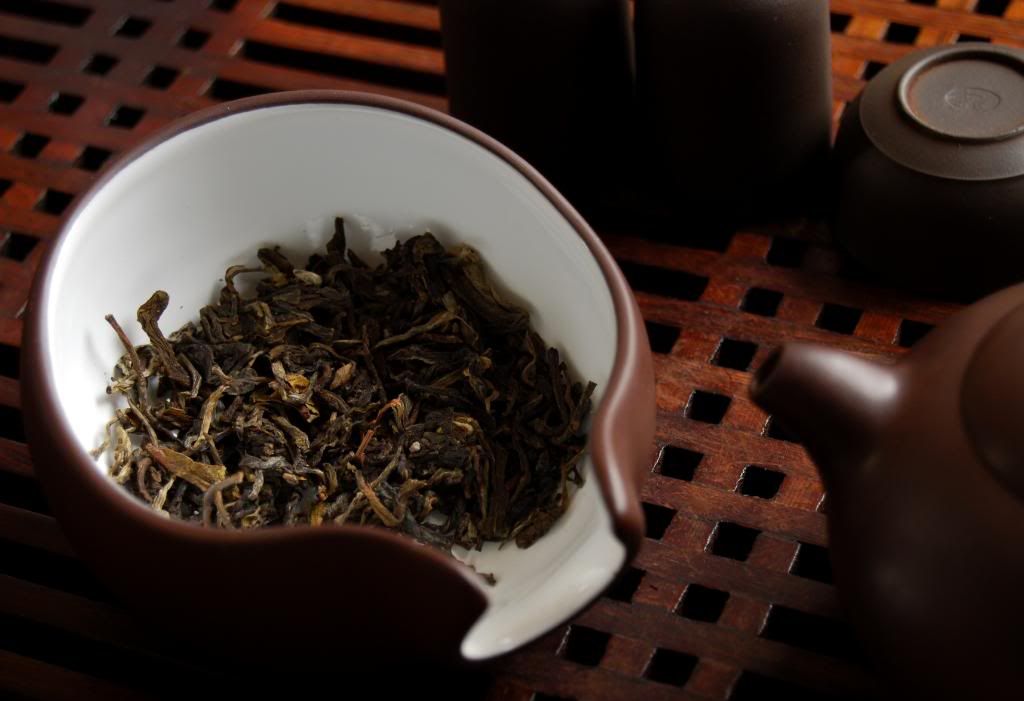
Coming back to this tea, I did not previous note the very small size of the leaves: there are many tips, but a distinct absence of the chunky "glamour" leaves that adorn more recent Xizihao cakes. I don't consider this a disadvantage. This tea has a rich variety of deep colours and textures in the leaves, and the aroma has become a deep tobacco in correspondence with its flavour.
A fascinating glimpse into the maturing process.
Addendum
October, 2011
It seems that I don't get many lazy Sunday mornings, lately. That's fine - it's for a good reason. However, when those rare times do occur, it's time to celebrate. Reaching for an old favourite, at the behest of Shah, let's revisit this 2006 cake after five years of English storage.

I forgot how naughty are the wrappers of Xizihao cakes from this era. Perhaps you might get a glimpse from the photograph below...

It has been so long since I tackled a Xizihao cake, that I also forgot the pomp and circumstance that accompanies them - here, a Menghai-style golden ribbon...

My first impression is that the leaves have continued their descent into darkness, which is A Good Thing. I am also reminded of the small and fragmented nature of the leaves, presumably the cause of the low price, and "accessible" moniker.

Checking my records, I cannot quite believe how inexpensive this cake was when I bought it: $35. That seemed a lot of money at the time. I would probably have bought much more at that price, these days. Such is the passage of time...

The soup has darkened from yellow (shown in the old photographs far above) to the orange pictured immediately above. This is in keeping with its progress: it has deepened, and filled out into a dense and sweet pu'ercha, but it still retains its kuwei [good bitterness] from youth.

I'm beginning to think that English storage could be very good for people with my taste in pu'ercha: it is a different kind of storage to the humid, dark charms of Singapore and coastal south China. It has the sharp potency of a north-China cake, but the constant humidity of England (compared with, for example, dry Beijing or Kunming) seem to be most favourable to the tea, keeping it alive, and nurturing it gently.
While this won't prevent me indulging my love of humid Asia-Pacific pu'ercha, I remain hopeful. The evidence is beginning to look rather good.
10 February, 2014
Pudi
Sampletea were very kind last Christmas, in sending me a little square parcel, rather like that sent one year ago. "This can mean only one thing!" I concluded, and was delighted to find out that the Malaysia-stamped parcel in fact contained...
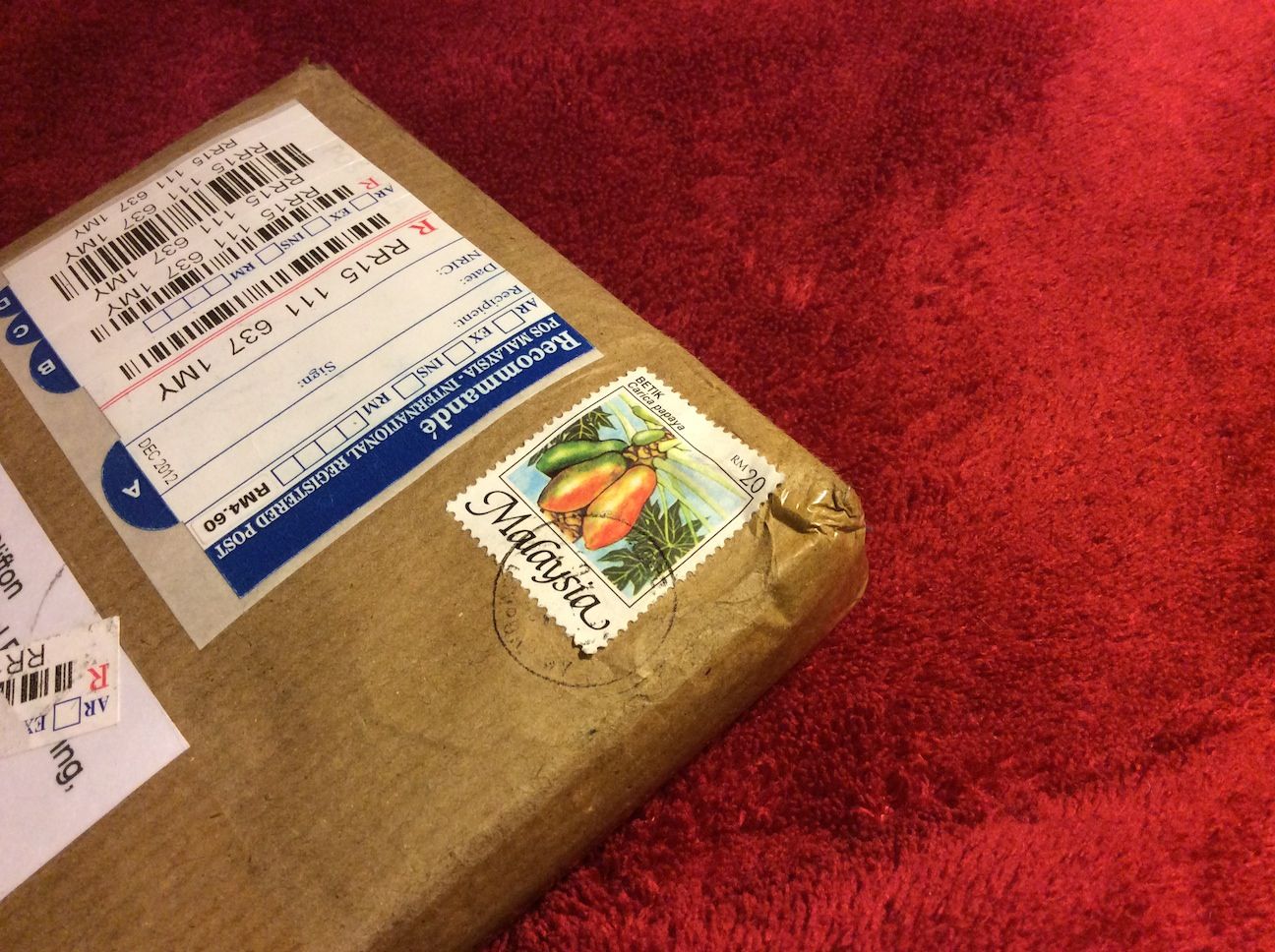
...a fangcha [square-tea] in a similar manner to that from 2012.
As you might decide for yourself from the images, this tea is already appealing, even from the wrapper. "The first bite is taken with the eye", it is said, and in this case, I am already nourished. I am a sucker for cherry blossom, it must be noted, and so I am hardly unbiased.
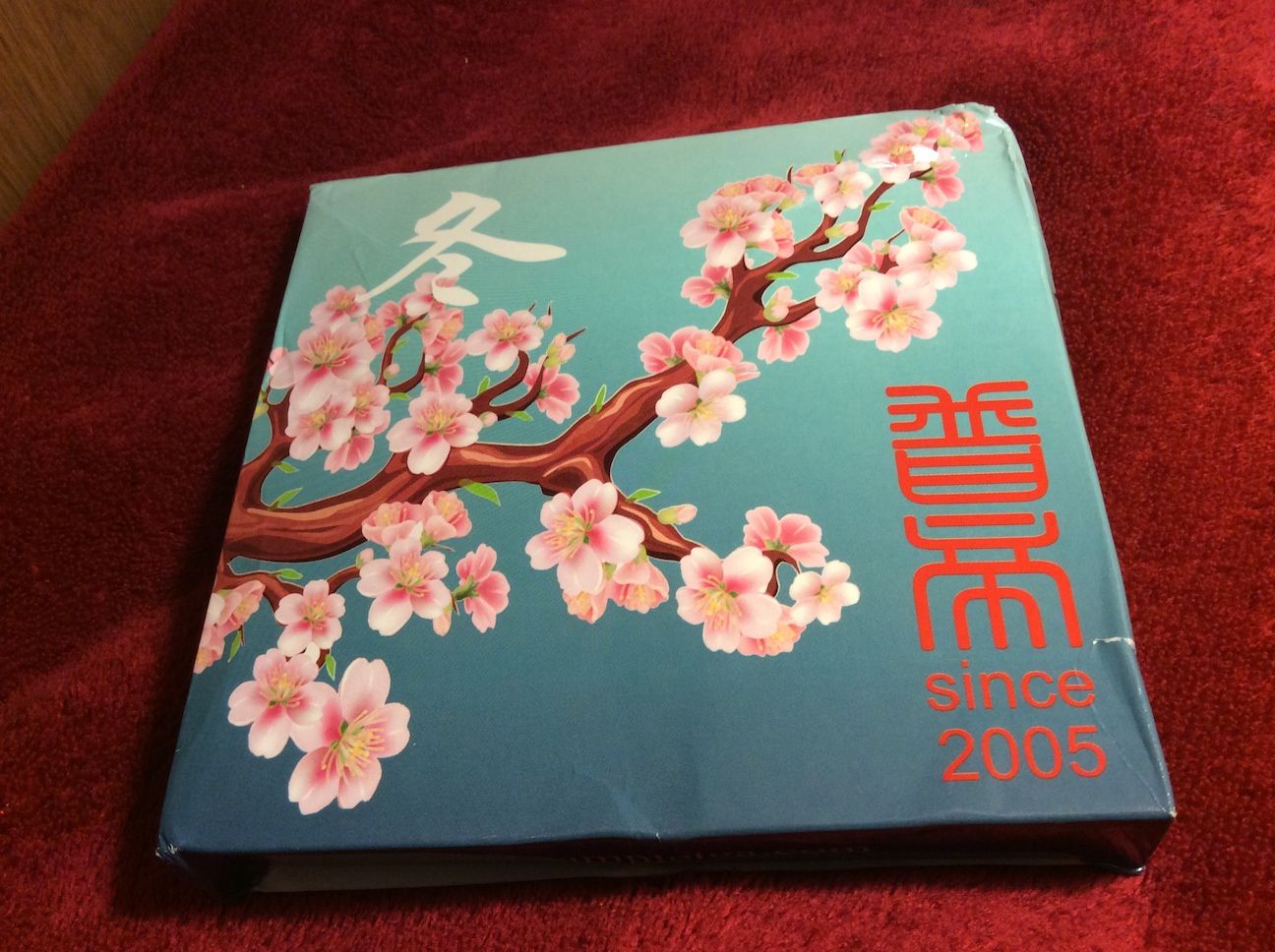
Perhaps more importantly than judging this book by its cover, the tea is a "winter" concoction of leaves from... Luoshuidong. I cannot recall ever consciously enjoying a tea, knowing that it was from Luoshuidong, but there is a first time for everything. This particular region of Yiwushan is not closely correlated to amazing pu'ercha, in my limited experience.
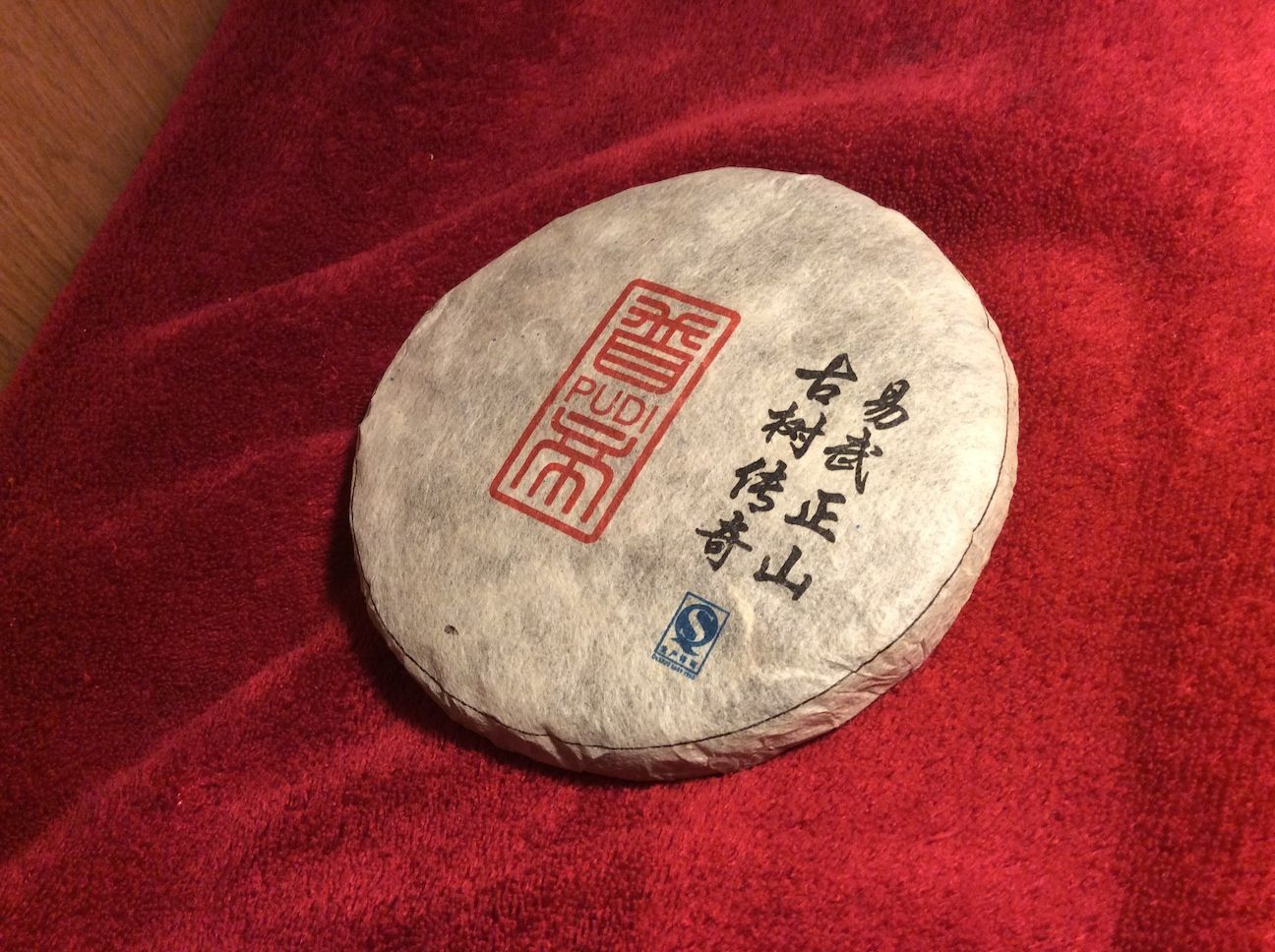
The characters that I could not read last year, and which are the name of the brand that SampleTea uses to mark its own tea, correspond to "Pudi". I think, if I'm not wrong, that the "pu" character is, of course, that of pu'ercha, while the "di" corresponds to the character used for "emperor", in the sense of "Qinshihuangdi". I therefore tentatively surmise that the name of the brand is "Tea Emperor", which rather reminds me of the humble, down-to-Earth (!) naming conventions employed by, among others, Sanhetang.
The name aside, this "2013 Yiwuzhengshan" cake is allegedly made from old-tree material, and the SampleTea web-site lists a 10g sample as costing $2.90, meaning that a full cake (at that price) would go for around $120, more or less. I imagine that the SampleTea model permits a customer to buy an actual cake at a lower price.
The name aside, this "2013 Yiwuzhengshan" cake is allegedly made from old-tree material, and the SampleTea web-site lists a 10g sample as costing $2.90, meaning that a full cake (at that price) would go for around $120, more or less. I imagine that the SampleTea model permits a customer to buy an actual cake at a lower price.
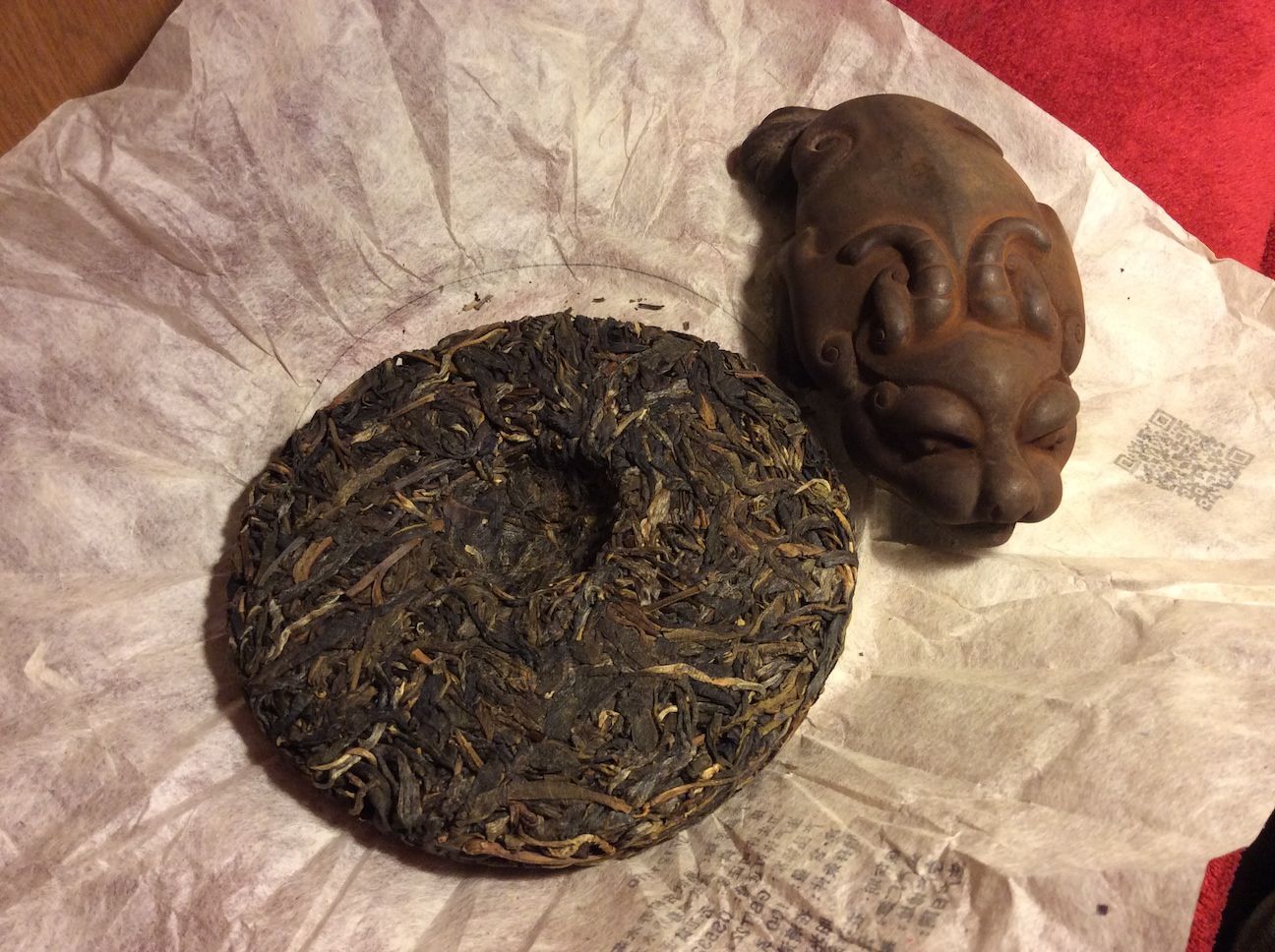
Fluff aside, what say you about the tea? Well, it is pretty, to start with. The leaves look mostly whole, and the traditional stone compression is obvious. SampleTea notes that the leaves were sun-dried, which is something to be admired, given the modern trend towards using electrical driers. The tea itself has the expected yellow colour and consequent buttery-sweet scent. So far, so Yiwushan.

However, this tea really shines when it comes to its character in the mouth, and the effect that it has on the body. The long body of sweetness in the mouth is classical Yiwushan, and there is a surfeit of complexity in its base that constantly engages my attention. "There is much to impress in the first infusion", I noted during the session.
Everything that one might look for in Yiwushan tea is here, down to the chunky base of tobacco. The endurance is excellent; the feeling of comfort on the body is pronounced. Throughout the mouth is a solid, non-chemical sensation of proper cooling. It is a big tea that burrows under the tongue and refuses to budge.
It may be, perhaps, that it is better in the first infusions than in the last, making it therefore better at the beginning than at the end - but that is true of us all, is it not?
Thanks go to SampleTea for this delicious treat. The irony that I return to Oxford from Malaysia only to drink a tea that has recently been posted to me from Malaysia is not wasted on me.
Everything that one might look for in Yiwushan tea is here, down to the chunky base of tobacco. The endurance is excellent; the feeling of comfort on the body is pronounced. Throughout the mouth is a solid, non-chemical sensation of proper cooling. It is a big tea that burrows under the tongue and refuses to budge.
It may be, perhaps, that it is better in the first infusions than in the last, making it therefore better at the beginning than at the end - but that is true of us all, is it not?
Thanks go to SampleTea for this delicious treat. The irony that I return to Oxford from Malaysia only to drink a tea that has recently been posted to me from Malaysia is not wasted on me.
06 August, 2007
2007 Xizihao "Yuanshilin"
We've moved house - let's drink some tea.
This is the first of the five Xizihao samples from Sanhetang, produced by Guoyan Factory. For previous purple-faced, vein-throbbing vitriol regarding the correct pinyin spelling of this tea, see here.
Market diversification is working its course with this premium range of teas, which is now being sold by Yunnan Sourcing (and also, though not yet on sale, presumably to arrive soon at Houde).
Five cakes are on offer: two premium expensive varieties, and three cheaper offerings - presumably capitalising on the "strength of the brand" while selling to the lower end of the market (the cynic in me thinks of "Calvin Klein" t-shirts).
The two expensive cakes are named "Yuanshilin" [virgin, untouched forest] and "Huangshanlin" [abandoned, desolate forest]. Again, the cynic in me wonders if these are merely poetic ways of saying "yesheng" [wild], the usual claim for upper-end pu'er. As with claims to being yesheng, the sensibily wary consumer treats virgin/desolate forest claims with an equal measure of caution.
This introduction serves, no doubt, to underline that in pu'er, much as in other largely unregulated ventures, the consumer has to be exceptionally careful. "A fool and his money are soon parted", runs the phrase, and modern brand-based approaches to marketing tea seem no different.
Caveat emptor...
The origin of today's cake (the aforementioned Yuanshilin) is, according to Yunnan Sourcing, Pasalaozhai. This could be Mengpashashan, which is used to make organic Haiwan Factory cakes, as they have similar-charactered names, and are both "South Menghai County". More information, as ever, is always welcomed.
Enough providence - is this expensive tea any good?
Brita-filtered water @ 100C in 12cl shengpu pot; ~6-8g leaf; 1 rinse
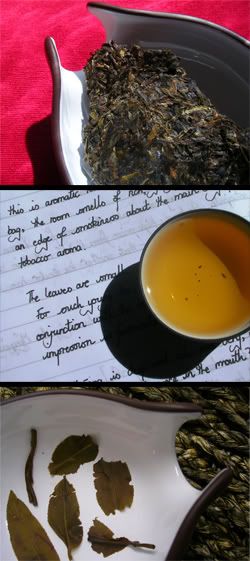 Dry leaf:
This is aromatic tea. Even though sealed in a plastic bag, the room somehow smells of rich, young pu'er leaf. It has an edge of smokiness around the main, tobacco body though it is often noted that this smokiness lessens with age.
The leaves are small, suggesting a spring picking. For such young tea, it is surprisingly dark. Alarm bells commence their ringing, and I wonder if this has been processed (read: partly oxidised) in order to capture the attention of the immediate market.
3s, 3s, 4s, 7s, 15s, 25s, 40s, 60s:
Right from the very first infusion, this is a thick, dark-orange tea. Concerns about the processing abound.
The beidixiang is immense in its duration, truly. It is deep, and rich, and lasts several minutes, before eventually fading into a somehow even longer lengxiang of sweet-sugar. Will this endurance continue in the pinmingbei?
This tea has two characters.
The first is seen in the initial three infusions: it is thick, orange, and a "dark fruits" pu'er, indicative of the old favourite processing techniques for making a tea immediately appealing. See the central illustration (taken from the second infusion) for an illustration of its unusually dense orange colours at this initial stage. There is an up-front tartness felt right at the lips, which then gives way to a rich set of tobacco flavours, especially present in the yunxiang [lingering aroma after the swallow]. It has a decent, potent ku.
The second stage appears around the third or fourth infusion, where the tea abruptly changes character: the orange colour changes to pure, solid yellow; the "dark fruit" character changes to a mushroom sweetness.
By the sixth infusion, it is becoming simpler, though the ku continues onwards admirably.
Lei came in from her laboratory while I silently poured the eighth infusion, and sat down to a cup, saying, "Is this the eighth infusion?" I'm impressed!
Wet leaves:
Tiny and pretty, though mostly fragmented and inclusive of many leaf-free stems. It's quite messy - something I have heard attributed to the current trend in Taiwanese pu'er manufacturers.
Some leaves are darkened, and partially oxidised, as if they have had a nudge away from their (I would argue, preferable) green state by some interesting processing choices. Hence, the initial solid orange soup, and "dark fruit" character.
Overall:
It's clearly a good leaf: it has tons of power, and lasts a very long time. I have objections with the leaf fragmentation (I don't like the mulch-based approach to some modern pu'er manufacture), and I have objections with the processing (just give me a pure, unoxidised pu'er leaf for mercy's sake! It's not dancong!).
It is tasty, it is a quality tea, and, obviously, it is overpriced. Each of us weighs these points in conjunction with what we're prepared to spend in our tea. It does deliver a pleasant experience, but it does not deliver value for money. I would be happy to own perhaps 1 or 2 of these cakes for amusement's sake, but buying a tong is absolutely out of the question for me - it's simply unjustifiable, to my mind.
This is the first of the five Xizihao samples from Sanhetang, produced by Guoyan Factory. For previous purple-faced, vein-throbbing vitriol regarding the correct pinyin spelling of this tea, see here.
Market diversification is working its course with this premium range of teas, which is now being sold by Yunnan Sourcing (and also, though not yet on sale, presumably to arrive soon at Houde).
Five cakes are on offer: two premium expensive varieties, and three cheaper offerings - presumably capitalising on the "strength of the brand" while selling to the lower end of the market (the cynic in me thinks of "Calvin Klein" t-shirts).
The two expensive cakes are named "Yuanshilin" [virgin, untouched forest] and "Huangshanlin" [abandoned, desolate forest]. Again, the cynic in me wonders if these are merely poetic ways of saying "yesheng" [wild], the usual claim for upper-end pu'er. As with claims to being yesheng, the sensibily wary consumer treats virgin/desolate forest claims with an equal measure of caution.
This introduction serves, no doubt, to underline that in pu'er, much as in other largely unregulated ventures, the consumer has to be exceptionally careful. "A fool and his money are soon parted", runs the phrase, and modern brand-based approaches to marketing tea seem no different.
Caveat emptor...
The origin of today's cake (the aforementioned Yuanshilin) is, according to Yunnan Sourcing, Pasalaozhai. This could be Mengpashashan, which is used to make organic Haiwan Factory cakes, as they have similar-charactered names, and are both "South Menghai County". More information, as ever, is always welcomed.
Enough providence - is this expensive tea any good?
Brita-filtered water @ 100C in 12cl shengpu pot; ~6-8g leaf; 1 rinse
 Dry leaf:
This is aromatic tea. Even though sealed in a plastic bag, the room somehow smells of rich, young pu'er leaf. It has an edge of smokiness around the main, tobacco body though it is often noted that this smokiness lessens with age.
The leaves are small, suggesting a spring picking. For such young tea, it is surprisingly dark. Alarm bells commence their ringing, and I wonder if this has been processed (read: partly oxidised) in order to capture the attention of the immediate market.
3s, 3s, 4s, 7s, 15s, 25s, 40s, 60s:
Right from the very first infusion, this is a thick, dark-orange tea. Concerns about the processing abound.
The beidixiang is immense in its duration, truly. It is deep, and rich, and lasts several minutes, before eventually fading into a somehow even longer lengxiang of sweet-sugar. Will this endurance continue in the pinmingbei?
This tea has two characters.
The first is seen in the initial three infusions: it is thick, orange, and a "dark fruits" pu'er, indicative of the old favourite processing techniques for making a tea immediately appealing. See the central illustration (taken from the second infusion) for an illustration of its unusually dense orange colours at this initial stage. There is an up-front tartness felt right at the lips, which then gives way to a rich set of tobacco flavours, especially present in the yunxiang [lingering aroma after the swallow]. It has a decent, potent ku.
The second stage appears around the third or fourth infusion, where the tea abruptly changes character: the orange colour changes to pure, solid yellow; the "dark fruit" character changes to a mushroom sweetness.
By the sixth infusion, it is becoming simpler, though the ku continues onwards admirably.
Lei came in from her laboratory while I silently poured the eighth infusion, and sat down to a cup, saying, "Is this the eighth infusion?" I'm impressed!
Wet leaves:
Tiny and pretty, though mostly fragmented and inclusive of many leaf-free stems. It's quite messy - something I have heard attributed to the current trend in Taiwanese pu'er manufacturers.
Some leaves are darkened, and partially oxidised, as if they have had a nudge away from their (I would argue, preferable) green state by some interesting processing choices. Hence, the initial solid orange soup, and "dark fruit" character.
Overall:
It's clearly a good leaf: it has tons of power, and lasts a very long time. I have objections with the leaf fragmentation (I don't like the mulch-based approach to some modern pu'er manufacture), and I have objections with the processing (just give me a pure, unoxidised pu'er leaf for mercy's sake! It's not dancong!).
It is tasty, it is a quality tea, and, obviously, it is overpriced. Each of us weighs these points in conjunction with what we're prepared to spend in our tea. It does deliver a pleasant experience, but it does not deliver value for money. I would be happy to own perhaps 1 or 2 of these cakes for amusement's sake, but buying a tong is absolutely out of the question for me - it's simply unjustifiable, to my mind.
20 November, 2007
2006 Xizihao "Chahuang"
Chawang [Tea King] is clearly out-of-fashion. Just as "wild" was upgraded to "desolate forest", so Sanhetang have promoted their mere provincial Tea King to a suitably more stately Tea Emperor.
Addendum
15 October, 2008
Addendum
March, 2014
When does the use of superlative begin to seem like parody?
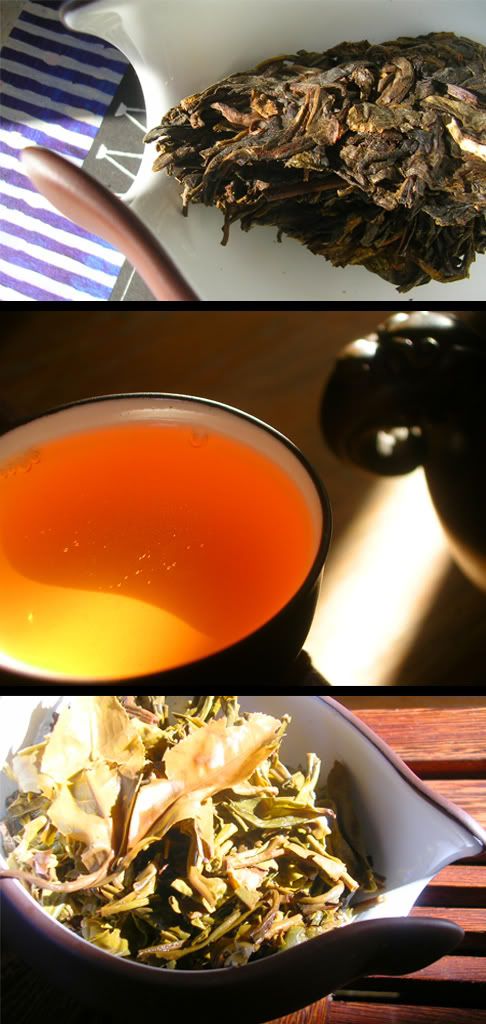
Dark, tippy, and showing evidence of good handling, these leaves exhibit a remarkable sweetness, against a rich background of pleasant licorice. The wenxiangbei continues the pronounced sweetness, but the magic happens in the pinmingbei: the soup is excellently thick, and has a fine active quality where it touches the lips and tongue.
There is much to experience in this tea, and it proved a pleasant foil to recent samples that I have been drinking. There is a complexity of sensation about this tea that I miss when I drink less esteemed cakes.
All the way out to the dark sugars from the yunxiang [after-aroma], contrasting well against green notes in the body, and always that buzzing, vibrating, effervescing quality of the soup's activity.
The huigan is fair in duration. I would be happy if there were more low, rich notes to accompany the panoply of high, sweet, sugary experiences on offer - but perhaps this is having one's cake and eating it.
The overall character is sweet, high, grassy, and active. A fine tea, and, apparently, an unavailable tea.
Dark, tippy, and showing evidence of good handling, these leaves exhibit a remarkable sweetness, against a rich background of pleasant licorice. The wenxiangbei continues the pronounced sweetness, but the magic happens in the pinmingbei: the soup is excellently thick, and has a fine active quality where it touches the lips and tongue.
There is much to experience in this tea, and it proved a pleasant foil to recent samples that I have been drinking. There is a complexity of sensation about this tea that I miss when I drink less esteemed cakes.
All the way out to the dark sugars from the yunxiang [after-aroma], contrasting well against green notes in the body, and always that buzzing, vibrating, effervescing quality of the soup's activity.
The huigan is fair in duration. I would be happy if there were more low, rich notes to accompany the panoply of high, sweet, sugary experiences on offer - but perhaps this is having one's cake and eating it.
The overall character is sweet, high, grassy, and active. A fine tea, and, apparently, an unavailable tea.
Addendum
15 October, 2008
One year on, and this tea has become empty and flat. Despite using lots of leaves, it is surprisingly quiet and seems to have run out of steam. What little flavour is to be had is high and sweet, as before.
The leaves are clearly of good quality, because the texture is very thick and it is a fizzy, active tea. Some fruity notes are evident in the background, testament to a cheeky blending in of fruity, oxidised leaves which can be seen to form part of the mix in the pot. The proportion is kept low, however, so as not to dominate the tea.
Too weak, sadly. Definitely not a Tea Emperor.
The leaves are clearly of good quality, because the texture is very thick and it is a fizzy, active tea. Some fruity notes are evident in the background, testament to a cheeky blending in of fruity, oxidised leaves which can be seen to form part of the mix in the pot. The proportion is kept low, however, so as not to dominate the tea.
Too weak, sadly. Definitely not a Tea Emperor.
Addendum
March, 2014
The year after I first tried this, six years ago, the tea had "gone quiet". Six years later, it is much improved. The body is thick and, best of all, there is a long aftertaste of sweetness. It has settled into a dense, sweet little thing, with the clean feeling of storage that is not immensely wet. It lasts well, and has returned from quietness - perhaps fed by the Oxford humidity.
10 March, 2011
2009 Xizihao "Pasha Laozhai Dianhuang"
I may have previously given the impression that I think Xizihao tea is for ladyboys.
Now don't get me wrong, while some of their productions are no doubt very popular with the transgender hospitality industry of Bangkok, there are a goodly number of "raw" Xizihao cakes out there.
They don't come much more raw than this cake from Pashashan (a.k.a. Mengpashashan).

Firstly, we need to unpack the typically mighty Xizihao name.
Pasha / Mengpasha is a mountain infrequently identified by pu'er producers. There was a 2006 Haiwan version of this mountain's leaves, which was one of the first teas that I bought in quantity. Funnily enough, I can remember the latter cake very clearly, even though I've not tried it since 2007. Taste memory is a strange thing. Everything I've ever had that's been associated with Mengpashashan has been Hardcore with a capital "H".
The "Laozhai" [laow-djai] part of the name simply means "old village". Xizihao are far too cool for the usual "zhengshan" [proper mountain].
Similarly, Xizihao are far too cool for the usual "chawang" [tea king], and so the final phrase of this cake's unwieldy name is "Dianhuang" [dee'an hwang], meaning "Yunnan Emperor". Brilliantly humble.

It's a pretty cake, which makes me concerned that we might need to file this under "ladyboy", but such worries are assuaged the minute that the pungent, rancorous, acrid stench of the leaves assaults my nostrils. In a good way.
This tea does not go quietly into the night.

Like the older Haiwan cake, this has a fat, uncompromised, savoury character. Also like the Haiwan cake, it is entirely powerful, and sits in the teacup shouting obscenities at me. I rather like it. This tea puts up a good fight.
But there can be only one.

I take a few hours off in the morning to teach this cake who's boss. It's a close-run battle, but it gives up before I do, after some 15 infusions.
Throughout, I am impressed by the fatness of its body, the chunkiness with which it dominates the mouth, and that acrid, tart, "Who's the daddy" kuwei that squats in the throat like an illegal tenant, and just won't leave.
Kudos to Sanhetang for making a sincere, unmonkeyed cake. Initial (intense) smokiness soon subsides, leaving a long, challenging tea.
This isn't one for the casual pu'ercha drinker - if you're a part-time sailor on the pu'ercha seas, then I'd recommend stable blends, or the sweet, gentle charms of the usual Yiwu / Laobanzhang / Nannuo / etc. ranges.
If, on the other hand, you're a grizzled old swine that fancies a bit of tea-table pugilism, then this is the tea for you.
N.B. this cake is no longer available at Houde, and so I have no idea of its cost. I wouldn't pay more than about $60-$75 for this, given its decent, but not entirely captivating, quality.
Addendum
March, 2014
I miss Old Houde. Back in the days of yore, Houde and Yunnan Sourcing were, more-or-less, the holders of most of the market-share for Western drinkers of pu'ercha. YS took the "low road", offering cheap-and-cheerful cakes, while Houde took the "high road", offering more rarified goods at higher prices. Looking back at my articles from that time, perhaps 2007 or so, the prices that I considered "high" are, ironically enough, actually lower than most prices today. If only my time machine were still working.

Due to the dominance of YS and Houde on the Western market, the latter's gratuitous mangling of pinyin (which only the English or Taiwanese peoples can really achieve to any degree of significance) led to Xizihao cakes being called "Xizhihao". This looks innocuous enough, but it completely changes the pronunciation from the elegant Mandarin of "shee-zzer-how" to the rather clunky and inelegant "shee-djur-hao". Hence, whenever I dig up these cakes, a mischievous part of my mind (i.e., the dominant fraction thereof) tells me that this is XIZHIHAO, in accordance with Houde's pinyin-mangling machine.

The fact that I have a sample from Houde that I have not yet finished this sample is quite a surprise: presumably, I paid for this sample, as I don't recall ever receiving samples gratis from Houde. This one must have snuck under my RADAR, and slipped into the depths of my tea-shelves unnoticed. Until today!

This tea from Mengpashashan is as robust in its scent as it was in 2011 - there is a good base of molasses to the lengxiang [cooling-scent]. Its thick body is adopting the spicy warmth of a strong cake that is descending into a somewhat aged state. Not all cakes go this particular way, but I am pleased when it happens.
This is strong tea in the Menghai (region) style, and very welcome. There is considerable activity on the tongue and a substantially cooling sensation that even affects the airway through the nose, such is its strength. This is a "big and bitter" tea; it has strength, but it could not be described as being tremendously entertaining, as the infusions wear on.
This is strong tea in the Menghai (region) style, and very welcome. There is considerable activity on the tongue and a substantially cooling sensation that even affects the airway through the nose, such is its strength. This is a "big and bitter" tea; it has strength, but it could not be described as being tremendously entertaining, as the infusions wear on.
Subscribe to:
Posts (Atom)